Hyaena Hall’s Last Passage31087 BCE
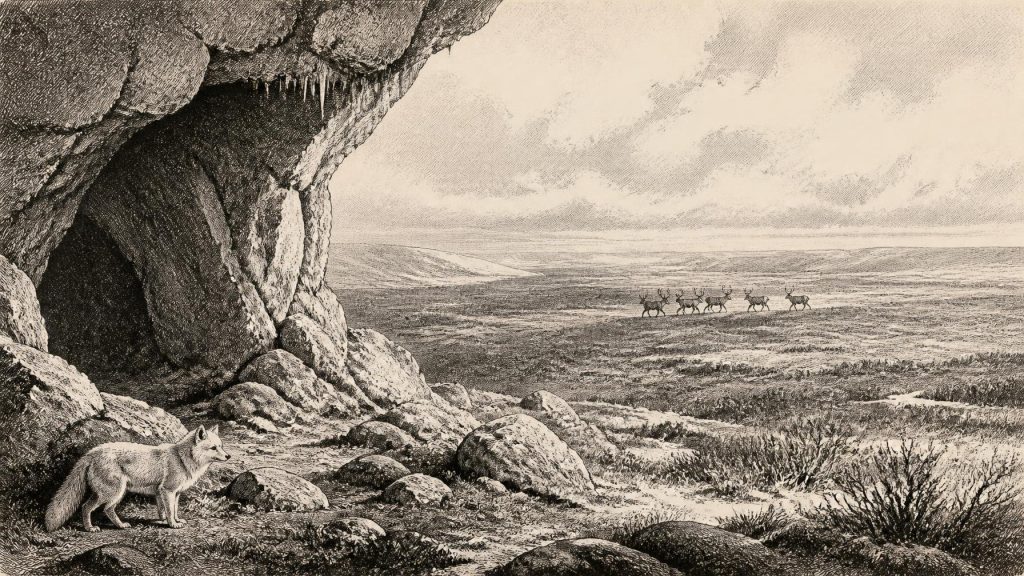
31,087 BCE is an imprecise label for a period near the onset of Ireland’s Last Glacial Maximum. Evidence, centred on Castlepook Cave in County Cork, depicts a cold, open tundra-steppe environment inhabited intermittently by mammoth, reindeer, giant deer, wolves, Arctic foxes and spotted hyaenas. Cave bones, coprolites and feeding damage demonstrate carnivore activity within a wider Eurasian-connected fauna. A marked reindeer femur may indicate human stone-tool use around 33,000 years ago, but disturbed deposits and uncertain taphonomy prevent conclusions. No settlements or cultural evidence are securely known. Subsequent ice expansion transformed Ireland, leaving Castlepook as evidence of early human passage.
Dateline
“31,087 BCE” is a modern calendar label, not a date that can be recovered from Ireland’s deep past with year-by-year accuracy. No written record, settlement sequence or archaeological layer can be assigned responsibly to that single year. The most useful comparison is with the later part of Marine Isotope Stage 3, roughly 33,000 calendar years before present, when Ireland stood on the threshold of the Last Glacial Maximum. Even that comparison must be treated broadly: radiocarbon ages require calibration, cave deposits can be disturbed, and calibrated ranges commonly cover centuries or millennia rather than a particular season, let alone a named year.
For Ireland at this point, the central evidence comes not from houses, graves or tools, but from bones, cave sediments, glacial geology and environmental records. They describe a cold north-western European landscape occupied at intervals by large mammals and predators, with a still-unresolved possibility of very early human activity. County Cork’s Castlepook Cave, near Doneraile, is especially important. Its chambers, including the evocatively named Hyaena Hall and Elephant Hall, preserve the most substantial Irish faunal archive for this period.
Approaching the Ice Maximum
The date falls during the Midlandian, Ireland’s last major glacial stage. This was not a uniformly frozen era. Ice sheets advanced and retreated over long intervals, while local conditions changed with temperature, snowfall, sea level and the behaviour of glaciers. Research synthesising Irish evidence suggests that the island was still largely ice-free until about 32,000 calibrated years before present, before the ice sheet expanded towards its maximum extent. Thus 31,087 BCE should be imagined as close to a major environmental turning point, not as a time when the whole island can automatically be pictured beneath a single unbroken mass of ice.
Low global sea levels altered the map of north-west Europe. The coast lay far beyond many modern shorelines, and the geography between Ireland, Britain and the continental landmass was unlike that of today. Precisely when terrestrial or glacial corridors were available remains debated and varied through time. Recent sedimentary ancient-DNA work at Castlepook supports the broader conclusion that Irish Pleistocene animals belonged to populations connected with Eurasia before the Last Glacial Maximum. That is evidence of ecological connectivity, however, not a map of a safe route on a particular day, nor proof that people used the same routes.
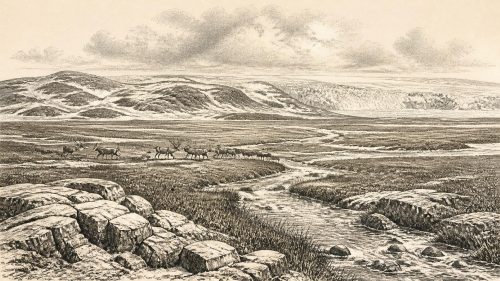
The land itself was open, cold and exposed. It was not the green, wooded Ireland familiar from later prehistory. Plant and animal evidence from Irish deposits points instead towards tundra-steppe or park-tundra mosaics: grasses, sedges, herbs, mosses and low shrubs, with scattered wetter places and little tree cover. The exact vegetation around Doneraile cannot be reconstructed for 31,087 BCE alone, but it would have supported grazing and browsing animals rather than the dense Atlantic woodland that developed much later. Winters were severe; seasonal contrasts and wind exposure would have mattered greatly to every animal moving through the landscape.
Castlepook’s Mixed Fauna
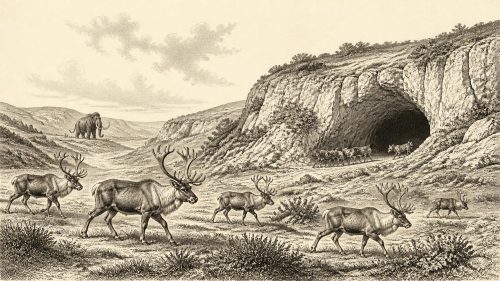
Castlepook Cave supplies the clearest direct window. Excavations and later reassessment have identified remains attributed to woolly mammoth, reindeer, giant deer, brown bear, wolf, fox, Arctic fox, mountain hare, stoat, collared and Norwegian lemmings, and spotted hyaena. No single list should be treated as a photograph of one moment. Material was recovered from a complex cave system, much of it excavated in the late nineteenth and early twentieth centuries, and some deposits were disturbed or mixed. The presence of later intrusive material is one reason why modern dating and re-examination are indispensable.
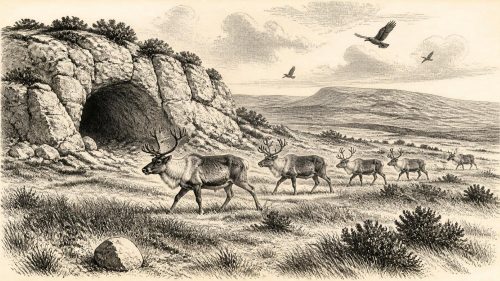
Nevertheless, the combination is powerful. Reindeer and lemmings are consistent with cold, open country; Arctic fox strengthens that impression. Mammoth and giant deer indicate that large herbivores could reach and live in the region during favourable phases. Wolves and spotted hyaenas reveal a predator and scavenger guild far removed from the fauna of historic Ireland. Hyaenas were not merely exotic visitors in an antiquarian collection: bones, teeth and coprolites from Castlepook show that carnivores used caves and had access to carcasses. A mammoth bone from the site also bears damage attributed to hyaena feeding.
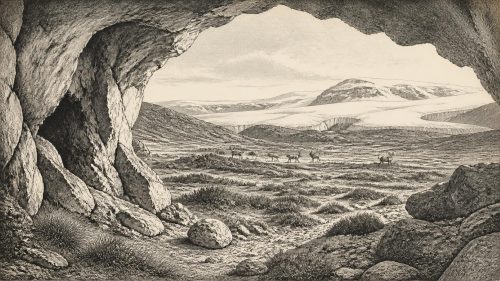
The cave’s name “Hyaena Hall” is therefore more than picturesque. It points to a landscape in which caves could be dens, scavenging stations, traps for bones carried in by animals, or shelters periodically occupied by people. The fossils cannot tell us which of those uses occurred in every chamber. What they can establish is that southern Ireland formed part of a mobile, cold-stage ecosystem. Animals did not recognise modern county boundaries, and their presence indicates repeated movement through a changing Atlantic-edge environment.
The Reindeer Bone and Human Question
The most arresting object for this period is a reindeer femur from Castlepook. It has been reported as bearing a mark interpreted as a cut or chop made with a stone tool, and the bone has been publicised as evidence for human activity in Ireland around 33,000 years ago. If that interpretation survives continued specialist scrutiny, it would be extraordinary: a rare trace of Upper Palaeolithic people at Europe’s north-western margin, far earlier than Ireland’s well-established post-glacial settlement record.
But the responsible conclusion is narrower. A radiocarbon measurement dates the death of an animal within a statistical range; calibration translates that measurement into calendar probabilities. It does not by itself date a mark, identify the person who made it, or demonstrate a camp, a hunt or a resident population. Equally, a sharp surface modification requires taphonomic assessment to distinguish a stone-tool action from damage caused by carnivores, sediment movement, excavation or later handling. Castlepook’s complicated depositional history makes this caution essential.
There are no securely dated hearths, knapping floors, dwellings, burials, formal tools or art from Ireland that can be assigned to 31,087 BCE. It is therefore impossible to name a community, language, identity or territory. Nor can historians responsibly describe a political system, chiefs, warfare, diplomacy or religious practice. These are not omissions caused by lack of imagination; they are limits imposed by the evidence. The possible worked reindeer bone allows the prospect of a brief human encounter with a carcass. It does not yet permit a narrative of an Irish Palaeolithic society.
Life at the Edge of Evidence
If people did reach Ireland during this broad interval, comparison with Upper Palaeolithic groups elsewhere in north-west Europe suggests small, highly mobile parties capable of exploiting large animals and moving through seasonal landscapes. That is an interpretation from analogous regions, not a demonstrated description of Castlepook’s visitors. They may have hunted reindeer, scavenged an animal killed by predators, removed meat, hide, sinew or marrow, or simply passed through. The single bone cannot decide between these possibilities.
There is similarly no evidence for farming, herding, pottery, metalworking, permanent villages, long-distance commercial exchange or monuments. “Economy” in the strict sense cannot be recovered. At most, the fauna shows the resources potentially available in the environment: mammal carcasses, hides, bone, antler, fat and perhaps seasonal opportunities along animal routes. Any exchange between human groups is unknown. The greater regional connection that can be observed is biological: the arrival and circulation of animals related to wider European populations.
Religion, learning and culture are also beyond direct reach. Ireland has no cave art or portable art securely attributable to this date. Caves certainly had practical significance for carnivores and possibly for people, but symbolic meaning cannot be inferred from their later names or dramatic interiors. The intellectually honest history of this period is therefore a history of landscapes and evidence: palaeontologists identifying species, geologists tracing ice, archaeologists testing marks on bone, and laboratories refining chronologies.
A Landscape About to Change
What gives 31,087 BCE its historical importance is what followed. During the Last Glacial Maximum, conventionally placed about 27,000–23,000 calibrated years before present for the British-Irish Ice Sheet at its greatest extent, ice covered Ireland and much of its continental shelf. Glacial erosion and deposition reshaped valleys, basins and lowlands, while advancing ice destroyed, buried or displaced many earlier deposits. That process helps explain why the evidence for any early human presence is so sparse and fragmentary.
Castlepook’s fauna records an Ireland before that maximum expansion: an intermittently habitable, open country where mammoths, reindeer and hyaenas could occur, and where a reindeer bone may preserve a human action. It is not a foundation story for later Irish peoples. Tens of thousands of years separate this uncertain episode from the island’s secure Mesolithic settlement, and the intervening ice transformed the physical world. Yet the cave matters precisely because it refuses the old image of an empty Ireland before the end of the Ice Age. It reveals instead a changing ecological frontier, and perhaps a fleeting human passage, just before the corridor narrowed beneath ice.
Primary Sources
- The Exploration of Castlepook Cave, County Cork
- The Irish Quaternary Fauna Project
- Occurrence of mammalia relicts at site Castlepook Cave
- Pleistocene Vertebrates in the British Isles
- Sedimentary Ancient DNA Reveals Late Pleistocene Faunal Connectivity Between Ireland and Eurasia
- Ireland: Submerged Prehistoric Sites and Landscapes
- Pattern and Timing of Retreat of the Last British-Irish Ice Sheet
- Dimensions and Chronology of the Last Ice Sheet in Western Ireland
- Response of the Irish Ice Sheet to Abrupt Climate Change During the Last Deglaciation
- Character of Advance and Retreat of the Southwest Sector of the British-Irish Ice Sheet
- New Data for the Last Glacial Maximum in Great Britain and Ireland
- Geology of Ireland
- Ireland Through Geological Time
- Quaternary Geomorphology
- The Colonization of Ireland: A Human Ecology Perspective
- First Evidence of a Late Upper Palaeolithic Human Presence in Ireland
- New Insights on the Fauna of Ireland's Younger Dryas and Early Holocene from Alice & Gwendoline Cave
- The Mesolithic in Ireland: When Was It?
- Heritage Artefacts of County Cork
- Anthropogenic Changes to the Holocene Nitrogen Cycle in Ireland