Maguirebridge’s Sedge Clock31085 BCE
About 31,085 BCE, Ireland lay within the unstable Marine Isotope Stage 3, not a precisely datable historical year. At Derryvree, County Fermanagh, freshwater silts between glacial tills record an ice-free interval of wet, treeless tundra, supporting sedges, mosses, herbs and cold-adapted plants. Ice conditions elsewhere remain uncertain. Castlepook Cave, County Cork, preserves mixed faunal remains, including mammoth, reindeer, giant deer and predators, from several episodes. A marked reindeer femur may indicate stone-tool butchery, suggesting brief human visits, but this remains unproven. No settlements, polities, beliefs or exchange networks can be identified. Ireland was an environmentally dynamic, intermittently habitable cold-stage landscape.

Dateline
Modern calendar precision cannot responsibly be projected onto Ireland in 31,085 BCE. Nobody in this landscape recorded years, and the archaeological and geological evidence cannot isolate a single season, let alone a particular day. The date is best treated as a point within a much broader Late Pleistocene interval: approximately 33,034 years before AD 1950, the conventional reference point for radiocarbon years. The strongest relevant Irish sequence, at Derryvree near Maguiresbridge in County Fermanagh, has a calibrated age range of roughly 36,900–31,700 years before present, or about 34,950–29,750 BCE. Thus 31,085 BCE falls inside the range, but is not an independently dated moment within it.
A Date Inside a Range
This was part of Marine Isotope Stage 3, a long and unstable phase of the last Ice Age. The Irish landscape was not simply an island buried beneath permanent ice. Climate repeatedly swung between severe cold and comparatively milder interludes, while glaciers grew, shrank and altered their routes. Terms such as “Derryvree Cold Phase” are useful archaeological shorthand, but they should not suggest a neatly bounded historical era. They describe a set of deposits and environmental conditions whose beginnings and endings remain uncertain.
The evidence closest to this nominal year comes from a road cutting made through a drumlin at Derryvree in 1969. Beneath a later sheet of glacial till, and above an older one, investigators found freshwater silts and fine sands containing organic matter. The position of this bed is crucial. A glacier had deposited the lower till; afterwards, water, sediment and plant remains accumulated in an ice-free setting; then a later ice advance sealed the deposit under fresh till. Its radiocarbon determination, BIRM-166, was 30,500 radiocarbon years before present, with a substantial statistical uncertainty. Calibration transforms that measurement into a broad calendar range, not a precise BCE year.
Wet Ground Between Glaciers
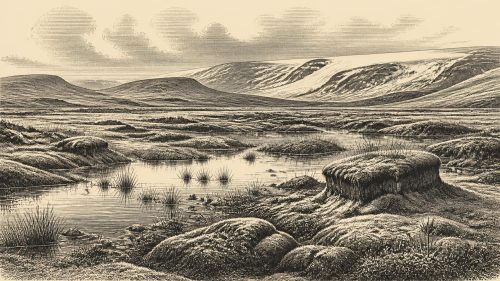
Derryvree offers an unusually vivid environmental record. Pollen, plant macrofossils, mosses, insect remains and small animal evidence point to open, treeless tundra or muskeg: a waterlogged mosaic of sedges, grasses, herbs, mossy ground and shallow pools. Plants identified from the sequence include cold-tolerant types such as mountain avens, dwarf willow, bogbean and clubmoss. Juniper pollen was also recorded. These remains do not recreate a postcard view of all Ireland, but they establish what could grow at this north Fermanagh locality during part of the interval.
The landscape was harsh but not lifeless. Standing water and wet ground supported aquatic and marsh plants; exposed ground carried low vegetation rather than woodland. Seasonal contrast was probably pronounced. The original investigators described a periglacial climate, meaning one shaped by intense frost and freeze-thaw processes close to, but not necessarily under, glacier ice. Later syntheses have inferred very cold winters from the fossil assemblage. They do not, however, allow modern readers to assign an exact temperature or snowfall total to 31,085 BCE.
At the scale of the island, ice cover remains a matter for careful qualification. Derryvree shows that north-central Ireland was ice-free when its organic bed formed. It does not prove that every coast, mountain and lowland was simultaneously free of ice. Recent reconstructions of the British–Irish Ice Sheet use extensive landform, marine-core and dating evidence, yet emphasise that the geometry and timing of ice-sheet growth around 31,000 years ago are still less securely known than the later maximum and retreat. The most defensible picture is of a rapidly changing region: ice-free ground and wet tundra existed in at least some Irish areas before the great expansion that eventually covered much of the island.
Caves and Cold-Stage Animals
County Cork supplies a different kind of evidence. Castlepook Cave, near Doneraile and sometimes called Mammoth Cave, produced an important collection of Pleistocene bones during excavations led by Richard J. Ussher in the early twentieth century. Later studies and renewed radiocarbon dating have shown that its fauna represents more than one episode. The cave should therefore not be treated as a single, undisturbed deposit or as a snapshot of one year.
Its assemblage nevertheless demonstrates that a striking range of mammals reached southern Ireland during the broader pre-Last Glacial Maximum period. Identified remains include woolly mammoth, reindeer, giant deer, brown bear, wolf, fox, Arctic fox, mountain hare, lemmings and spotted hyaena. Some animals were likely carried into cave passages by carnivores or washed and reworked by natural processes. Cave bones can reveal that species were present in a region, but they do not automatically show which animals shared one hillside at the same time, or whether people saw them.
Re-dating has materially changed the story. Improved pretreatment of bone collagen, particularly ultrafiltration, returned Castlepook dates thousands of radiocarbon years older than determinations made in the 1990s. This matters because older dates had once encouraged overly simple reconstructions of late-glacial animal arrivals. The revised evidence places some Castlepook fauna within Marine Isotope Stage 3 and indicates that species including giant deer and spotted hyaena may have disappeared locally before the Last Glacial Maximum. Scientific progress here has not supplied certainty; it has instead made the chronology more accurate and the cave’s mixed history more apparent.
The Reindeer Femur Question
A reindeer femur from Castlepook is especially relevant to a date around 31,000 BCE. County Cork heritage material describes it as a Palaeolithic bone of about 31,000 BCE and reports a deep fresh-bone mark interpreted by zooarchaeologist Ruth Carden as having been made during butchery with a sharp stone tool. If that interpretation is sustained, it would be extraordinarily important: potential evidence that a person processed a reindeer in Ireland far earlier than the previously accepted record of human presence.
Yet the distinction between evidence and interpretation is essential. The bone is direct evidence for a reindeer and for a mark on its surface. The claim that the mark was made by a stone implement is a specialist taphonomic judgement. Even an accepted cut mark would demonstrate an episode of carcass processing, not a permanent settlement, named hunting band or continuous Irish population. No securely associated Upper Palaeolithic hearth, house floor, stone-tool assemblage, burial, food store or occupation surface has been recovered at Castlepook for this period. Nor does the old excavation context permit the femur to be tied securely to a particular layer, season or calendar year.
The cautious historical conclusion is therefore limited but significant. Around the broader period represented by 31,085 BCE, people may have reached Ireland, perhaps briefly, within a wider north-west European world of highly mobile hunter-gatherers. Reindeer were a valuable potential source of meat, fat, hide, sinew, bone and antler. That statement describes known practices among Upper Palaeolithic groups elsewhere; it is not proof that a documented Irish community had an economy based on reindeer hunting. The Castlepook femur makes such an expedition plausible, rather than demonstrated.
No Polities, No Recorded Beliefs
There is no responsible basis for describing political affairs, warfare, diplomacy, leaders, tribes or territories in Ireland at this date. No language, personal name, symbolic system, grave, dwelling or monument can be assigned to 31,085 BCE. The same restraint applies to religion and learning. The wetland deposits reveal ecology, not ritual; animal bones reveal faunal presence and depositional histories, not myths or ceremonies. It would be misleading to fill those silences with later Irish traditions or with general ideas about Ice Age spirituality.
If people did visit, their social world would have been organised at a scale invisible in the present Irish record: small and mobile groups, rather than states or villages. Any crossings to or from Ireland depended on changing coastlines, sea levels, ice margins and navigable water routes. The evidence does not show whether a human party arrived over exposed terrain, crossed water, followed animals, or visited once rather than repeatedly. “Trade” and “diplomacy” are likewise unsupported; no imported artefacts or exchange networks have been identified for Ireland at this time.
An Island in Formation
The most important development was environmental rather than political. Derryvree records an interval when freshwater wetland and tundra life persisted between glacial episodes. Castlepook shows that Ireland, at least intermittently, lay within the range of large herbivores and formidable carnivores usually associated with Ice Age Europe. Crag Cave in County Kerry adds a further, independent climate archive: episodes of speleothem growth indicate times when liquid water could circulate underground, linked broadly to abrupt climatic shifts recorded across the North Atlantic region.
For 31,085 BCE, then, Ireland should not be imagined as either a settled prehistoric homeland or a featureless frozen blank. It was a changing cold-stage landscape with pools, sedges and mosses in Fermanagh; cave-dwelling carnivores and roaming large mammals in the south; and ice sheets not yet at their eventual greatest extent. Its human story remains a question rather than a settled fact. That uncertainty is not a weakness in the record. It is the central historical reality of Ireland at this immense depth of time.
Primary Sources
- A Middle Midlandian Freshwater Series at Derryvree, Maguiresbridge, County Fermanagh, Northern Ireland
- A reconsideration of the radiocarbon dating of the Marine Isotope Stage 3 fauna from southern Ireland
- Growth and retreat of the last British–Irish Ice Sheet, 31,000 to 15,000 years ago: the BRITICE-CHRONO reconstruction
- Exploring controls of the early and stepped deglaciation on the western margin of the British–Irish Ice Sheet
- Trimlines, blockfields and the vertical extent of the last ice sheet in southern Ireland
- The timing and magnitude of the British–Irish Ice Sheet between Marine Isotope Stages 5d and 2: implications for glacio-isostatic adjustment, high relative sea levels and ‘giant erratic’ emplacement
- Episodic speleothem deposition tracks the terrestrial impact of millennial-scale last glacial climate variability in SW Ireland
- New insights on the fauna of Ireland's Younger Dryas and Early Holocene from Alice & Gwendoline Cave
- The Irish Quaternary Fauna Project
- Irish Pleistocene biostratigraphy
- Landscapes and environments of the last glacial-interglacial transition: a time of amazingly rapid change in Ireland
- Cenozoic: Tertiary and Quaternary
- Introduction to the Late Quaternary and Holocene of Northern Ireland
- Heritage Artefacts of County Cork
- Quaternary Sediments 1:50,000 Ireland (ROI) ITM
- Outreach and Education Resources
- Publications
- Spatio-temporal dynamics of speleothem growth and glaciation in the British Isles
- Exposure-age constraints on the extent, timing and rate of retreat of the last Irish Sea ice stream
- The Last Irish Ice Sheet: Extent and Chronology