Maguirebridge Beneath Advancing Ice31012 BCE
31,012 BCE is a modern label, not a recorded Irish year, lying within a broad Late Pleistocene radiocarbon range. At Derryvree, County Fermanagh, organic sediments between glacial tills preserve evidence of temporary freshwater tundra: grasses, sedges, herbs, juniper, mosses, insects and shallow pools. The sequence shows that ice advanced, retreated and returned unevenly across Ireland. Castlepook Cave, County Cork, indicates an Ice Age fauna including reindeer and mammoth, though old assemblages require caution. A marked reindeer bone may suggest brief human butchery, but proves neither settlement nor permanent occupation. Evidence reveals changing environments and visitation, not polities or uniform climate.

Dateline
31,012 BCE is not a date that can be treated as a recorded Irish year. No people on the island left writing, calendars, named polities or dated monuments from this depth of time. The number is a modern chronological label. Measured against the archaeological convention in which “present” is AD 1950, it falls roughly 32,960 calendar years before present, in the later part of the Last Glacial Period and within Marine Isotope Stage 3. Scientific evidence can illuminate broad intervals, sometimes several millennia long; it cannot identify a particular winter, journey, hunt or political event in Ireland in this nominal year.
A Date Within Wide Ranges
The closest important Irish chronological anchor is the Derryvree deposit near Maguiresbridge, County Fermanagh. Organic freshwater sediments there produced a radiocarbon determination of about 30,500 radiocarbon years before present, with a large uncertainty. When calibrated against changing past concentrations of atmospheric carbon-14, this has been placed broadly at about 36,900–31,700 calibrated years before present. The modern label 31,012 BCE lies within that broad range. It does not follow that every plant, insect or pool represented in the deposit existed in that exact year, nor that conditions at Derryvree applied unchanged across all of Ireland.
This distinction is fundamental. Radiocarbon dating measures the age of once-living material, not a calendar entry; calibration converts that measurement into a probability range rather than a pinpoint. At more than 30,000 years’ distance, the interval is necessarily wide. The responsible subject is therefore Ireland during a cold, unstable Late Pleistocene phase, not an invented episode of national history.
The Derryvree Sequence
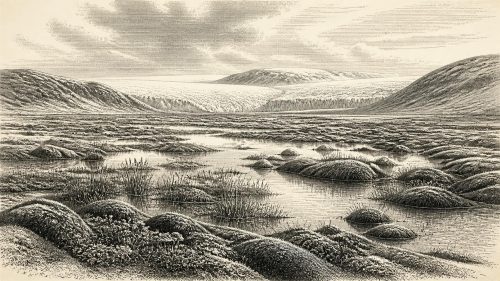
Derryvree is valuable because later glaciers buried its evidence rather than completely destroying it. Roadworks exposed fine sands and organic silts enclosed between two tills: unsorted material deposited by glacier ice. The lower till shows that ice had previously occupied the locality. Above it, water accumulated and plants, insects and other organic remains entered a wetland or shallow freshwater environment. The upper till demonstrates that ice later returned across the site. This sequence records a local interval between glacial episodes, preserved beneath the drumlin landscape of Fermanagh.
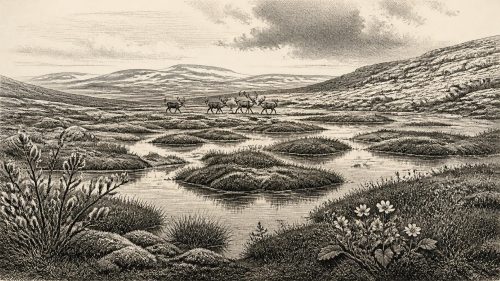
Its fossil content indicates an open, treeless and periglacial environment. Grasses, sedges, herbs, juniper and mosses point to tundra-like vegetation rather than forest. Finds associated with the deposit include evidence for plants now familiar from cold or wet ground, such as dwarf willow, lesser clubmoss and bogbean. Insect evidence has been interpreted as consistent with wet ground, open pools and abundant plant matter. The picture is not of a featureless frozen desert: it is of a biologically active but austere mosaic of marshy ground, shallow water and low vegetation, subject to severe winters and repeated freezing and thawing.
That is evidence for a particular north-western Irish locality over an extended phase. It supports an inference that at least some land in the region could sustain freshwater habitats and plant communities despite harsh climate. It does not demonstrate a single uniform “Irish climate”, much less permit a weather report for 31,012 BCE. Upland, coastal and ice-marginal settings may have differed markedly, while the later passage of ice removed or disturbed much of the evidence that might have refined the picture.
Ice Was Growing, Not Static
Ireland’s Last Glacial Period was not a simple story in which the whole island was either wholly iced or wholly open. Research on the British–Irish Ice Sheet shows mobile and regionally asynchronous growth, advance and retreat. At around 31,000 years before present, modelling and geological reconstructions suggest a landscape in transition: substantial ice lay over some high ground and sectors, while other areas could remain ice-free or become temporarily free of local ice. The full maximum volume of the last British–Irish Ice Sheet came much later, around 23,000 years ago in the BRITICE-CHRONO reconstruction.
For people living far later, glaciers would leave the obvious legacy: drumlins, scoured rock, erratic boulders, tills and altered drainage. At this earlier point those landforms were still being made, reworked or waiting to be overrun. Derryvree’s paired tills are a direct reminder that the freshwater interval was temporary. A wetland capable of supporting mosses, sedges and aquatic plants was ultimately sealed by renewed ice. Environmental change, rather than stability, is the central historical fact.
Animals at the Western Edge
Evidence from Castlepook Cave near Doneraile, County Cork, provides the clearest Irish indication that large mammals entered the island during portions of the period before the Last Glacial Maximum. The cave’s old collections include remains attributed to reindeer, woolly mammoth, spotted hyaena, brown bear and other animals. The Irish Quaternary Fauna Project concluded that a comparatively broad mammal fauna colonised Ireland between at least about 45,000 and 20,000 years ago. Later re-dating and reassessment have also shown why individual old dates and cave assemblages require careful handling.
A cave bone collection is not a photograph of a living herd. Carnivores can drag carcass parts into caves; water can move bones; deposits can mix over long periods; and early excavations did not always record context to modern standards. Castlepook is especially important for demonstrating that Ireland formed part of an Ice Age animal world, but it cannot establish that every listed species lived together near Doneraile in 31,012 BCE. Nor can it safely supply exact population numbers, migration routes or seasons.
Nevertheless, the fauna makes the Derryvree landscape easier to understand. Open vegetation, wet hollows and broad exposed ground could support grazing animals in suitable phases, while predators and scavengers exploited them. Such relationships were ecological, not political: no territory, chiefdom, alliance or war can be recovered from these bones. The evidence supports a changing food web, not a prehistoric state.
A Possible Human Trace
Castlepook also raises the most consequential question for Irish human history at this date. A reindeer femur from the cave has been published by Cork County Council as dating to about 31,000 BC and bearing a deep mark interpreted by palaeozoologist Ruth Carden as damage made by a stone tool during butchery. If that interpretation and association withstand further scrutiny, it may be evidence that Upper Palaeolithic people handled a reindeer in Ireland at roughly this horizon. It would push possible human activity on the island far earlier than the better-established post-glacial record.
But the claim must remain proportionate to its evidence. One modified bone is not a settlement. No securely associated hearth, stone-tool assemblage, dwelling surface, burial, store, artwork or repeated butchery area has yet demonstrated a resident community in Ireland at this age. The cave’s deposits and collections have complicated histories, and the animal bone’s date is not a timestamp for the precise moment when the mark was made. Recent excavation and survey at Castlepook aim to recover better-contexted material, including sediments capable of environmental, dating and microscopic analysis.
The most cautious interpretation is therefore one of possible, perhaps very brief, human presence or visitation rather than proven permanent occupation. If people did reach Ireland, hunting or scavenging large animals is a reasonable inference from the marked femur; the size, composition, technology, language and origin of any group are unknown. Continental European Upper Palaeolithic cultures, cave art and ritual practices cannot simply be imported into Ireland as facts.
No Recoverable Polities
There is no evidence from Ireland around this point for government, diplomacy, organised conflict, religion, trade networks or formal learning in the later historical sense. There are no named leaders, communities, settlements or institutions. Neither farms nor domestic animals nor cultivated crops belong to the known Irish record of this period. If humans visited, their economy would have depended upon mobile foraging in a severe landscape; that remains an interpretation, not a documented local social system.
Religion and culture are similarly beyond direct recovery. A single cave bone or a buried wetland cannot reveal beliefs, stories, kinship rules, music or language. Silence in the record does not prove that people possessed none of these things. It means only that archaeology has not recovered evidence capable of describing them responsibly. The remarkable achievement of the surviving record is different: it preserves the environmental setting in which any human encounter, if it occurred, would have taken place.
What This Year Can Mean
For Ireland, 31,012 BCE represents neither a national beginning nor a calendar-worthy event. It is a point within a long interval of climatic fluctuation, advancing ice and intermittent ecological opportunity. Derryvree preserves an open freshwater tundra environment caught between glacier advances. Castlepook preserves animal remains and a provocative possible trace of human butchery. Together they show an Ireland connected to wider Ice Age processes while retaining a fragmentary and locally uneven archive.
The appropriate history is consequently one of evidence and limits. Beneath later drumlins, a Fermanagh wetland retained seeds, spores, insects and silts. In a Cork cave, bones retained clues to vanished animals and perhaps to a human hand. Those traces do not yield an annual chronicle, but they do make this remote Irish past more tangible: a cold land of open pools and low vegetation, increasingly vulnerable to returning ice, at the edge of the known Upper Palaeolithic world.
Primary Sources
- The IntCal20 Northern Hemisphere Radiocarbon Age Calibration Curve (0–55 cal kBP)
- Growth and Retreat of the Last British–Irish Ice Sheet, 31,000 to 15,000 Years Ago: The BRITICE-CHRONO Reconstruction
- Growth and Retreat of the Last British–Irish Ice Sheet, 31,000 to 15,000 Years Ago: The BRITICE-CHRONO Reconstruction
- New Data for the Last Glacial Maximum in Great Britain and Ireland
- Radiocarbon Constraints on the Age of the Maximum Advance of the British–Irish Ice Sheet in the Celtic Sea
- Pattern and Timing of Retreat of the Last British-Irish Ice Sheet
- The Timing and Magnitude of the British–Irish Ice Sheet Between Marine Isotope Stages 5d and 2
- Behavioural Tendencies of the Last British–Irish Ice Sheet Revealed by Data–Model Comparison
- The Irish Quaternary Fauna Project
- A Reconsideration of the Radiocarbon Dating of the Marine Isotope Stage 3 Fauna From Southern Ireland
- New Insights on the Fauna of Ireland’s Younger Dryas and Early Holocene From Alice & Gwendoline Cave
- New Insights on the Fauna of Ireland’s Younger Dryas and Early Holocene From Alice & Gwendoline Cave
- Figure 6.— The Subdivision of the Quaternary Period in Ireland
- Quaternary Site Descriptions
- Publications
- Introduction to the Late Quaternary and Holocene of Northern Ireland
- Selaginella selaginoides
- Salix herbacea
- Menyanthes trifoliata
- Heritage Artefacts of County Cork
- Archaeology Research Excavation Grant 2022: Castlepook Cave Project Final Report
- 2022:564 — Castlepook Cave, Castlepook South, Cork
- Quaternary
- Archaeological Excavations at Killuragh Cave, Co. Limerick: A Persistent Place in the Landscape from the Early Mesolithic to the Late Bronze Age
- Reindeer Bone Found in Cork Cave Shows Human Activity in Ireland 33,000 Years Ago