Derryvree’s Periglacial Poolscape31013 BCE
Around 31,013 BCE, Ireland’s condition cannot be reconstructed year by year, but evidence indicates a cold, unstable Late Pleistocene landscape. Derryvree, County Fermanagh, preserves freshwater sediments beneath till, showing ice-free wetlands with sedges, grasses, mosses and sparse tundra vegetation during a broad interval. Castlepook Cave, County Cork, yielded varied fauna, including reindeer, mammoth and hyaena, though its deposits are time-averaged and disturbed. A marked reindeer femur may indicate butchery by humans, but proves neither settlement nor continuous occupation. Later ice expansion reshaped and erased evidence. Thus environmental change, rather than political or cultural history, dominates this currently available fragmentary record.
Dateline
The label 31,013 BCE is a modern way of locating a point in very deep time, not a year that can be recovered from an Irish record. There were no written calendars, named rulers or datable events on the island. In archaeological terms, it lies roughly 33,000 calendar years before AD 1950, within the Late Pleistocene, the Midlandian cold stage in Ireland and the climatically erratic Marine Isotope Stage 3 (MIS 3). Evidence can illuminate broad spans of centuries or millennia around it; it cannot responsibly distinguish what happened in this particular calendar year.
The most useful Irish evidence comes not from a settlement but from sediments, caves, animal remains and the landforms made or later reshaped by ice. Around this notional date, Ireland was part of a changing north-west European cold-world. It was moving towards the major expansion of the last British–Irish Ice Sheet, but it should not automatically be pictured as a single, uniformly ice-covered island. Local ice margins shifted, and the surviving evidence is too discontinuous to map the island’s exact condition in 31,013 BCE. What can be said is that parts of Ireland had supported freshwater, tundra-like vegetation and Pleistocene animals during the relevant broad interval, before later glaciation buried, reworked or destroyed much of that record.
A Date Without an Annal
Scientific dating is essential but has limits. Radiocarbon ages are conventionally measured before AD 1950 and must be calibrated to account for past variations in atmospheric carbon. At ages of around 30,000 radiocarbon years and beyond, calibrated results commonly cover substantial ranges rather than a single year. Sediments may also build up over time, while bones date the death of an animal rather than every later process affecting the specimen. Consequently, a modern BCE number is useful for filing this article, but it is not a chronological pin driven into an ancient Irish event.
The closest important environmental anchor is Derryvree, near Maguiresbridge in County Fermanagh. Road works in 1969 exposed a drumlin section in which organic silts and fine sands lay between deposits of glacial till. The freshwater sediments produced a radiocarbon determination of 30,500 +1,170/−1,030 BP. Published calibrations place the broad age of this evidence at approximately 36,900–31,700 calibrated years BP. That wide range encompasses the chronological neighbourhood of 31,013 BCE, but does not prove that the entire deposit formed then. Its value lies in showing that, during an ice-free interval later sealed beneath renewed glacial deposits, freshwater habitats and cold-adapted vegetation existed in south Fermanagh.
Derryvree’s Open Wetlands
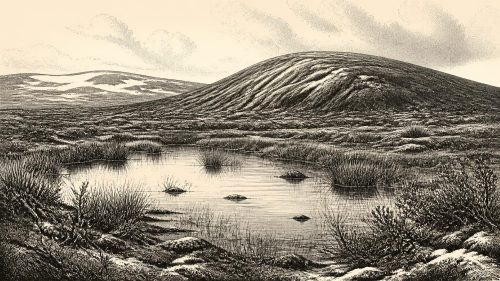
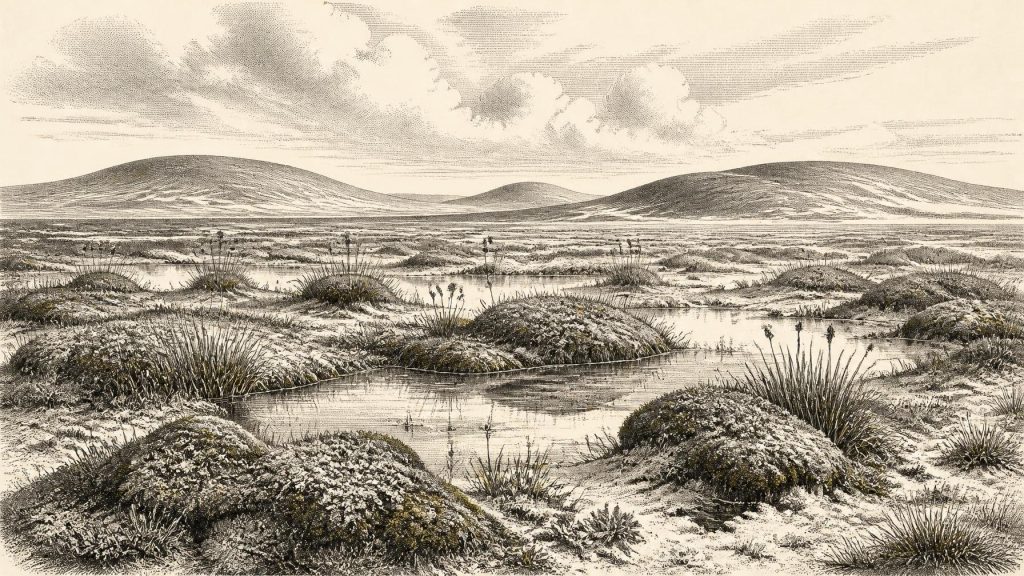
The Derryvree fossils offer the clearest local picture of the landscape. Pollen, plant macrofossils, mosses and insects indicate an open, largely treeless environment, often described as tundra or muskeg-like ground. Sedges and grasses were important; mosses flourished in wet places; herbs and low shrubs occurred in the wider vegetation. Shallow pools and waterlogged ground lay amid exposed mineral surfaces shaped by frost. The evidence does not support forest, farmland or a settled countryside. It instead suggests a sparse, seasonal landscape in which cold winters and periglacial processes were major ecological forces.
That scene should not be treated as an unchanging national landscape. Derryvree is one locality, and pollen can travel beyond its immediate source. Some grains may have been reworked from older deposits. Nevertheless, its combined plant and insect evidence is unusually valuable because independent forms of evidence point in the same direction: cold conditions, little tree cover, wet ground in places and open country elsewhere. It establishes that Ireland’s Late Pleistocene environments could be more varied than the shorthand image of an island wholly entombed beneath ice.
Across the North Atlantic region, MIS 3 was marked by abrupt climatic oscillations. Greenland ice cores document repeated swings between relatively milder interstadials and severe stadials. Irish deposits preserve local results of those changes but are rarely dated precisely enough to assign them confidently to a named Greenland event. The responsible conclusion is therefore modest: the surroundings of 31,013 BCE were cold, unstable and increasingly vulnerable to glaciation, rather than permanently uniform.
Animals in a Changing Island
Caves in the limestone country of north County Cork provide another fragmentary archive. Castlepook Cave, near Doneraile, has yielded a remarkable Late Pleistocene faunal collection, including remains attributed to reindeer, giant deer, brown bear, wolf or fox, hare, Norwegian lemming, woolly mammoth and spotted hyaena. The list is striking because it links Ireland with wider cold-stage faunas of Britain and continental Europe. It demonstrates that large herbivores and predators reached the island during favourable parts of the Late Pleistocene.
Yet the cave must not be made to tell more than it can. Its deposits were affected by carnivores, water movement, older excavations and later disturbance. Bones of different ages may have been mixed, and a species list does not prove that every animal lived together in the same valley, season or decade. The remains are best understood as a time-averaged record of changing animal communities rather than a snapshot of a single hunt or a complete food web in 31,013 BCE.
For people, these animals would have represented potential food, hides, bone and danger. But that sentence is an inference from hunter-gatherer lifeways elsewhere, not direct evidence of an Irish community. No securely dated camp, hearth, stone-tool assemblage, dwelling floor, burial or repeated occupation surface of this age has been published from Ireland. In consequence, there is no basis for describing families, social ranks, language, territories or a permanent Palaeolithic population on the island.
The Castlepook Reindeer Question
The principal possible human trace is a reindeer femur from Castlepook reported as approximately 33,000 years old and bearing a deep linear mark interpreted by palaeozoologist Ruth Carden as a stone-tool cut or chop made during butchery. If the modification is confirmed as human-made and contemporary with the animal’s death, it would be significant evidence that a person or small group handled a reindeer in Ireland during MIS 3. It would push possible human activity far earlier than Ireland’s better-established post-glacial settlement record.
The conditional wording matters. One modified bone does not demonstrate a settlement, a population, a migration route or a continuous occupation. A radiocarbon age for the bone dates the animal’s death, not necessarily the marking episode; the cave context is complex; and no associated tools or hearth have yet converted this intriguing object into a documented habitation site. The evidence may record a brief hunting or scavenging visit, but it cannot identify who came, from where, how often or whether they remained.
Nor can lower sea level alone settle the question of access. With much global water held in ice, coastlines and continental shelves differed greatly from those of today. Ireland’s separation from Britain may have been narrower or its routes different at various times, but lowered seas do not automatically prove a continuous dry crossing. Animals and any humans could have moved by changing combinations of exposed terrain, short crossings or seasonal routes. The precise geography remains an active research question.
No Polities, No Proven Ritual
Political affairs, diplomacy and organised warfare are beyond the reach of the evidence. There are no named groups, fortifications, weapons caches or territorial monuments from Ireland at this horizon. It would be misleading to project later Gaelic kingdoms, Celtic identities or even the well-attested Mesolithic societies of millennia afterwards into this Ice Age landscape. If humans did visit, they belonged to mobile Upper Palaeolithic worlds known elsewhere in Europe; Ireland itself has not yielded enough securely contextual material to assign a local tool tradition or social identity.
The same restraint applies to religion, art and learning. Caves can invite speculation about ritual, but Castlepook’s known Pleistocene remains are chiefly faunal and geological evidence. No Irish cave art, figurine, grave, shrine, musical instrument or symbolic object can be securely placed around this date. The absence may partly reflect later ice erosion, acidic soils, sea-level change and the limited survival of excavation contexts. It is still an absence in the present record, not permission to invent an unseen tradition.
Economy, if a human presence is ultimately established, can only be discussed at the smallest scale: possible processing of a reindeer carcass. There is no evidence for agriculture, herding, craft specialisation, long-distance exchange or regular trade on the island. The dominant economic processes visible archaeologically were ecological: plants colonising exposed ground, herbivores exploiting open vegetation, predators following prey, and ice repeatedly remaking the terrain.
Ice, Loss and Historical Perspective
Within several millennia, the last British–Irish Ice Sheet expanded dramatically towards its later maximum. Glacial erosion and deposition moulded drumlins, stripped surfaces, diverted drainage and concealed older deposits beneath till. This helps explain why Ireland’s record for the time is so sparse. The scarcity of early sites is not proof that no person ever arrived; equally, it cannot be used as proof of a substantial vanished population. Archaeology must preserve both possibilities while treating the evidence in proportion to its strength.
The chief development around 31,013 BCE was therefore environmental, not political: an unstable cold-stage Ireland of open wetlands, sparse tundra vegetation, mobile Pleistocene fauna and growing ice. Derryvree’s buried freshwater deposits show that life persisted in ice-free pockets; Castlepook’s bones show connections with the wider Ice Age fauna of north-west Europe; the marked reindeer femur poses, but does not yet settle, the question of human activity. That is a thin record, but it is a real one—and its uncertainty is part of the history.
Primary Sources
- Growth and retreat of the last British–Irish Ice Sheet, 31 000 to 15 000 years ago: the BRITICE-CHRONO reconstruction
- The colonization of Ireland: A human ecology perspective
- Palaeoecology
- Castlepook Cave
- 32564: Castlepook Cave, Ballyhooly, Cork
- The Archaeological Heritage of County Cork
- The Mesolithic in Ireland: when was it?
- Ireland: Submerged Prehistoric Sites and Landscapes
- Trimlines, blockfields and the vertical extent of the last ice sheet in southern Ireland
- European vegetation during Marine Oxygen Isotope Stage-3
- Changes in the Thermal Climate in Northwestern Europe during Marine Oxygen Isotope Stage 3, Estimated from Fossil Insect Assemblages
- The Irish Quaternary Fauna Project
- Irish Pleistocene biostratigraphy
- Cenozoic: Tertiary and Quaternary
- Heinrich Events and the British-Irish Ice Sheet
- Evidence for major British-Irish Ice Sheet expansion during Marine Isotope Stages 4 and 3 and implications for glacial-isostatic adjustment and high relative sea-levels
- New insights on the fauna of Ireland's Younger Dryas and Early Holocene from Alice & Gwendoline Cave
- Ireland's Palaeolithic Archaeology – Fleeting Footprints in a Frozen Land
- Investigating Heritage and Climate Change in the Coastal and Maritime Environments of Wales and Ireland: A Guide to the CHERISH Toolkit
- Archaeological excavations at Killuragh Cave, Co. Limerick