Derryvree Tundra31074 BCE
Although 31,074 BCE is a modern notional date, evidence from Derryvree near Maguiresbridge illuminates a Late Pleistocene interval when Fermanagh was temporarily ice-free. Freshwater sediments between tills, dated broadly to 36,900–31,700 calibrated years ago, record treeless, cold wetlands supporting local vegetation and insects. Lower sea levels linked Ireland to Britain and continental Europe, enabling animal movement across an unstable tundra-steppe landscape. Cave remains show reindeer, mammoths, giant deer and predators, though their coexistence is uncertain. A cut-marked reindeer bone from Castlepook may indicate human butchery, but cannot prove settlement. Later glaciation reshaped Ireland and erased much evidence of this period.
Dateline
Modern calendar-year precision is not available for Ireland in 31,074 BCE. The label is a convenient point on a modern timescale, roughly 33,000 calendar years before AD 1950, rather than a year that anyone then living could have named, recorded or experienced as a discrete historical unit. Ireland had no writing, states, rulers or dated events. The responsible subject is therefore a broad Late Pleistocene interval: part of Marine Isotope Stage 3, a climatically variable phase of the last Ice Age. Its evidence comes chiefly from stratified sediments, fossil plants and animals, glacial landforms, and one much-debated possible trace of human activity.
A Point Within a Long Interval
The closest especially informative Irish sequence is at Derryvree, near Maguiresbridge in County Fermanagh. Roadworks exposed a drumlin cut through by two layers of till, the unsorted sediment laid down by glacier ice. Between them lay freshwater silts, sands and organic deposits. This arrangement is more revealing than it may first appear. It shows that ice had crossed the locality, that an interval followed in which water and vegetation could accumulate sediment, and that renewed glacial activity later buried the record beneath another till.
Organic material from Derryvree produced a conventional radiocarbon determination of about 30,500 ± 1,200 radiocarbon years before present. Radiocarbon ages are not calendar dates: past atmospheric carbon-14 levels varied, and measurements must be calibrated against internationally maintained curves. Published discussion places the Derryvree material broadly at about 36,900–31,700 calibrated years before present, or approximately 34,950–29,750 BCE. Thus 31,074 BCE falls within the wide chronological horizon illuminated by this deposit, but it cannot be assigned to a particular layer, season, pool or living creature within it.
This distinction is essential. Derryvree is not a photograph of all Ireland in one year. It is a local archive, surviving by unusual good fortune beneath a later glacial deposit. Yet its sequence gives rare evidence that at least part of Fermanagh was ice-free for a time during the later Pleistocene, and that cold-climate wetlands existed between episodes of more extensive glaciation.
Treeless Wetlands and Open Ground
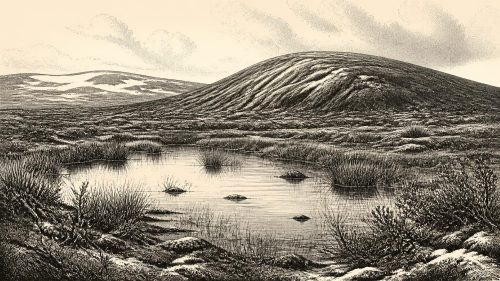
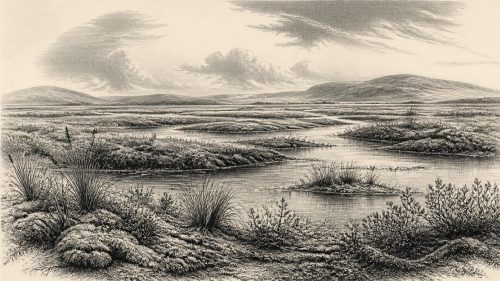
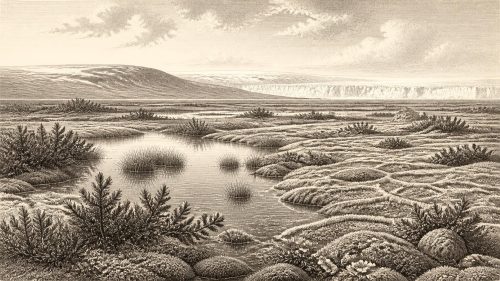
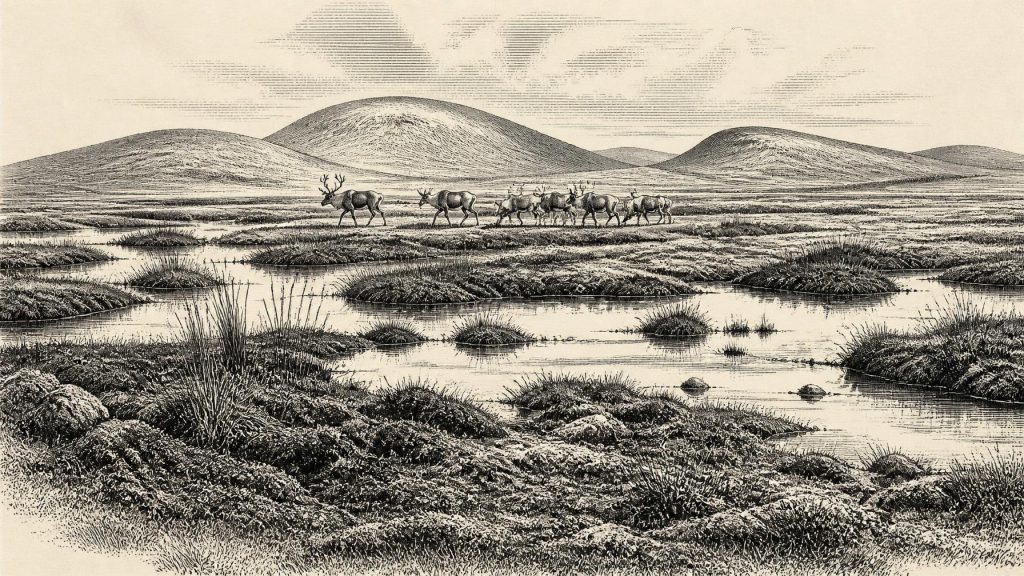
The environmental picture suggested by Derryvree is of a treeless, cold landscape with wet ground, standing or slow-moving freshwater, and low vegetation rather than forest. Irish Quaternary researchers have characterised the setting as a muskeg-like environment: a waterlogged mosaic of mossy, sedgy and shrub-rich ground. Plant and insect evidence from such deposits is valuable because it records conditions close to the place where it was buried. It indicates that summer thaw, moisture and sheltered terrain could sustain local biological communities even in an overall severe climate.
That does not mean a uniformly frozen or uniformly habitable island. Conditions varied sharply with season, altitude, exposure and proximity to ice. A lowland basin could hold shallow water and wetland plants while uplands, or regions nearer an advancing ice margin, were far harsher. In this period Ireland was also not separated from Britain and continental north-west Europe by the modern coastline. Lower global sea levels exposed extensive areas now below the Irish Sea and Atlantic shelves, changing travel corridors, drainage systems and the effective size of the land available to animals and, perhaps, people.
The landscape was nevertheless heading towards greater instability. The British–Irish Ice Sheet was not yet at its later maximum extent, but ice was growing and reorganising across the region. The fullest Late Glacial Maximum expansion occurred thousands of years after the Derryvree interval, broadly around 26,000–23,000 calibrated years before present. Later ice movement destroyed or concealed much earlier evidence. This is one reason why Ireland’s record for this age is so fragmentary: absence of a site may reflect erosion and burial rather than proof that no animals or people ever reached the island.
The Animal World
Irish cave collections provide another, less tightly contextualised window onto this world. Late Pleistocene remains from southern Irish caves include reindeer, woolly mammoth, giant deer, brown bear, wolf, Arctic fox, lemmings and spotted hyaena. Not every species need have lived together, or at the same moment, and cave deposits commonly represent accumulations over long spans. Carnivores can drag carcass parts into caves; water, frost, collapse and older excavation methods can disturb their original position. The secure conclusion is that Ireland was connected to, or repeatedly reached by, a richer cold-stage fauna than survives today.
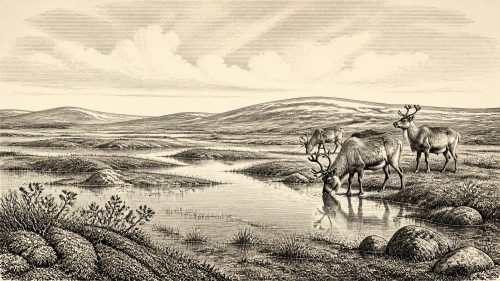
Reindeer are particularly evocative because their presence implies open country able to support grazing herds. Mammoths and giant deer likewise belong to a substantially different ecological world from modern Ireland. Predators and scavengers followed their own opportunities: wolves hunted, while spotted hyaenas could accumulate bones in dens. Such animals were not exotic visitors in a familiar green Ireland. They belonged to a fluctuating tundra-steppe and wetland landscape, shaped by cold, seasonal scarcity and the approach of renewed glaciation.
The Castlepook Question
The most consequential possible human evidence is a reindeer femur from Castlepook Cave near Doneraile, County Cork. Examined in the National Museum of Ireland’s historic collections, it bears a deep mark interpreted by zooarchaeologist Ruth Carden as a fresh-bone incision made with a sharp stone tool during butchery. Public heritage material places the bone broadly around 31,000 BCE. If that interpretation and association are upheld, it would indicate that people handled a reindeer carcass in Ireland during the Upper Palaeolithic, far earlier than the long-recognised evidence for post-glacial settlement.
Its importance should not be exaggerated. The original cave excavations pre-dated modern standards of stratigraphic recording, and the object was not recovered with an unquestionable occupation floor, hearth, stone-tool assemblage or human remains. A bone’s date establishes when the animal died, not automatically when a surface mark was made. Nor can one modified specimen demonstrate whether a small party visited once, hunted repeatedly, crossed by a now-submerged route, or left descendants. It is best treated as significant but limited evidence for possible human activity, not as proof of a permanent Irish population.
Life Without a Chronicle
If people did reach Ireland around this broad period, their way of life would have been highly mobile and dependent upon knowledge of animals, terrain, weather and routes. The Castlepook evidence, if human-made, would support only the modest inference that someone possessed and used a sharp stone edge while processing a large animal. It does not reveal the group’s language, numbers, kinship, shelter, clothing, hunting methods or origin. Comparable Upper Palaeolithic groups elsewhere in north-west Europe made sophisticated tools and maintained social networks, but importing those details wholesale into Ireland would go beyond the evidence.
There is no archaeological basis for political affairs, diplomacy, organised warfare, named communities or territorial boundaries in Ireland at this date. Nor is there evidence for trade in the usual sense, agriculture, herding, permanent villages or managed fields. No securely contemporary Irish object can demonstrate ritual practice, formal religion, art, burial custom or teaching. These absences are not claims that Ice Age people lacked beliefs, relationships or learning; they are limits on what the surviving Irish record can responsibly show.
Economy, where the evidence permits the term, was ecological rather than market-based. Large herbivores represented potential food, hides, sinew, bone and other useful materials for any people present, while wetland and open-ground resources structured the lives of animals. Butchery marks would testify to carcass processing, not necessarily to the killing of an animal, and a cave may have been a carnivore den rather than a human camp. The difference matters: interpretation must remain proportional to the object and its context.
An Ireland Repeatedly Remade
The deeper historical importance of this period lies in regional change. Ireland was neither permanently ice-covered nor a settled, forested island. It was a northern landscape repeatedly altered by ice advance, thaw, water, vegetation change and animal movement. Derryvree’s organic silts preserve an interval of freshwater life between glacial episodes; Castlepook’s bones preserve traces of an animal community that later vanished from the island; the later ice sheet remodelled the terrain and removed much of the record that might have answered further questions.
For 31,074 BCE, then, the clearest history is environmental. Around this notional date, parts of Ireland could include cold, open and wetland habitats capable of supporting a varied Pleistocene fauna. The island’s connection to the wider north-west European landmass made animal movement possible, and may have made short-lived human visits possible as well. Yet neither a specific journey nor a specific hunt can be dated to this calendar year. The evidence offers a compelling landscape, not an annual chronicle: a vanished Fermanagh fen, cave bones in Cork, and the gathering force of ice that would soon transform Ireland again.
Primary Sources
- A Middle Midlandian Freshwater Series at Derryvree, Maguiresbridge, County Fermanagh, Northern Ireland
- Figure 6—The Subdivision of the Quaternary Period in Ireland
- South Fermanagh: Irish Association for Quaternary Research Field Guide 16
- A Reconsideration of the Radiocarbon Dating of the Marine Isotope Stage 3 Fauna from Southern Ireland
- Trimlines, Blockfields and the Vertical Extent of the Last Ice Sheet in Southern Ireland
- Growth and Retreat of the Last British–Irish Ice Sheet, 31,000 to 15,000 Years Ago: the BRITICE-CHRONO Reconstruction
- New Data for the Last Glacial Maximum in Great Britain and Ireland
- Early Deglaciation of the British-Irish Ice Sheet on the Atlantic Shelf Northwest of Ireland Driven by Glacioisostatic Depression and High Relative Sea Level
- The IntCal20 Northern Hemisphere Radiocarbon Age Calibration Curve (0–55 cal kBP)
- IntCal Publications
- New Insights on the Fauna of Ireland's Younger Dryas and Early Holocene from Alice & Gwendoline Cave
- Heritage Artefacts of County Cork
- Reindeer Bone Found in Cork Cave Shows Human Activity in Ireland 33,000 Years Ago
- UCD School of Archaeology Research Day 2022
- Could Brown Bears (Ursus arctos) Have Survived in Ireland During the Last Glacial Maximum?
- The Irish Quaternary Fauna Project
- Ireland: Submerged Prehistoric Sites and Landscapes
- Outreach and Education Resources
- Field Guides
- Irish Quaternary Association
- The Quaternary of the Irish Midlands
- The Late Quaternary History of East-Central Ireland