Castlepook’s Cold-World Fauna30178 BCE
Labelled 30,178 BCE only approximately, this period belongs to later Marine Isotope Stage 3, before the Last Glacial Maximum, when Ireland experienced unstable cold climates and advancing ice. Castlepook Cave in County Cork preserves evidence of varied fauna, including reindeer, bears, deer, hyaenas, lemmings and mammoth, indicating open, changing habitats. Derryvree deposits suggest sedgy, tundra-like wetlands. Lower sea levels altered coastlines, but migration routes remain uncertain. A possibly cut-marked reindeer bone raises, without proving, early human visitation. No secure settlements or artefacts establish occupation. Subsequent ice expansion reshaped terrain and destroyed evidence, leaving fragmented records of a dynamic ecological frontier.

Dateline
The label 30,178 BCE is a modern calendrical convenience, not a year that any community in Ireland recorded or could have recognised. At this depth of time, archaeology cannot responsibly identify an event on a particular day, season or year. In the conventional archaeological system it falls roughly 32,000 years before AD 1950, but the evidence is dated in broad calibrated ranges, not single calendar years. The most useful setting is therefore later Marine Isotope Stage 3, before the Last Glacial Maximum: a time of severe climatic instability, changing ice margins and intermittent animal populations on the western edge of Europe.
Ireland at this notional point was not the settled island familiar from later prehistory. There are no securely excavated houses, hearths, stone-tool floors, graves, fields or monuments that can be assigned to this precise time. There were no states, chiefs, diplomatic alliances or documented wars. Nor is there evidence from which to reconstruct language, religious belief, ritual or a social hierarchy. The historical task is more modest, but still compelling: to assemble what animal bones, cave sediments, glacial landforms and palaeoenvironmental deposits say about the landscapes in which people might have moved.
A Date at the Edge of Resolution
The distinction between radiocarbon years and calendar years is crucial. Radiocarbon measurements must be calibrated because atmospheric carbon-14 has varied through time; beyond the securely tree-ring-dated part of the curve, calibration relies on several natural archives and necessarily carries wider uncertainty. A date expressed as 30,178 BCE therefore should not be treated as a pin fixed in a sequence. It is better understood as an approximate waypoint within a span of centuries or millennia.
For Ireland, the relevant evidence is particularly difficult. Later ice repeatedly eroded landscapes, moved sediments and destroyed or buried potential sites. Cave collections were often excavated in the nineteenth and early twentieth centuries, before modern stratigraphic recording, and some finds have uncertain original positions. That does not make them useless: direct accelerator dating of individual bones has transformed knowledge of the island’s Ice Age fauna. It does mean that a bone date establishes when an animal lived, not automatically the date of a deposit, the moment a surface mark was made, or the presence of people.
The current broad reconstruction places the growth and maximum of the last British–Irish Ice Sheet after this horizon. Large-scale chronological syntheses investigate the ice sheet from about 31,000 to 15,000 years ago, while evidence from different Irish sectors shows that growth, maximum extent and retreat were not simultaneous everywhere. Around the early thirties of millennia before present, Ireland was entering a period in which ice expansion would become increasingly decisive. It would later cover much, probably nearly all, of the island during the Last Glacial Maximum, conventionally placed about 28,200–20,400 calibrated years before present.
Castlepook and the Animal World
The principal Irish window onto this earlier cold-world fauna is Castlepook Cave near Doneraile in north County Cork, in the Awbeg valley below the Ballyhoura Hills. Its historic excavations recovered a remarkably rich collection of bones, while renewed research has sought undisturbed deposits in parts of the cave system left unexplored by earlier diggers. Castlepook is important not because it supplies a neat snapshot of one year, but because it demonstrates that Ireland supported a more varied Pleistocene fauna before the last ice sheet’s fullest expansion.
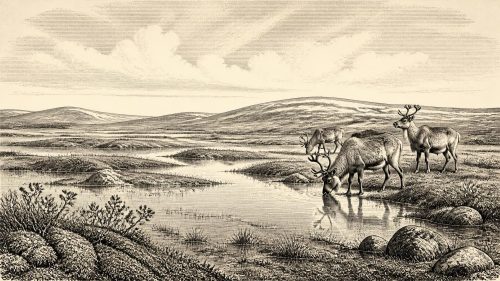
Directly dated material and reassessment of the cave archive indicate the presence, at different points in Marine Isotope Stage 3, of animals including reindeer, brown bear, red deer, giant deer, spotted hyaena, fox, hare and small mammals such as lemmings. Woolly mammoth is also represented in the wider Castlepook assemblage. These species do not all prove that they stood together in one valley in 30,178 BCE. Cave deposits accumulate across long periods; carnivores may bring prey or carrion inside; water and later disturbance can mix material. The defensible conclusion is that the island, during intervals before the Last Glacial Maximum, could sustain cold-adapted and open-country animal communities far richer than its later historic fauna.
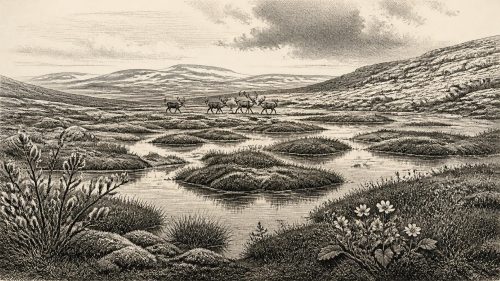
Reindeer provide the clearest image of a mobile grazing landscape. Their presence implies access to open vegetation and seasonal forage, rather than a closed forest. Hares, lemmings and arctic or subarctic associates reinforce the picture of cold conditions. Yet there is no warrant for imagining a uniform, snowbound wilderness. Marine Isotope Stage 3 contained rapid climatic swings. The habitats available in southern Ireland could have altered markedly as temperature, moisture, snow cover and the proximity of ice changed. A cave bone is testimony to an animal’s existence, not a complete ecological census.
Open Ground, Water and Ice
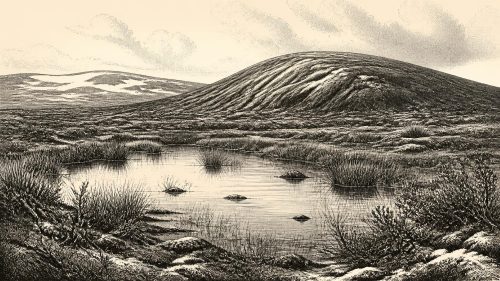
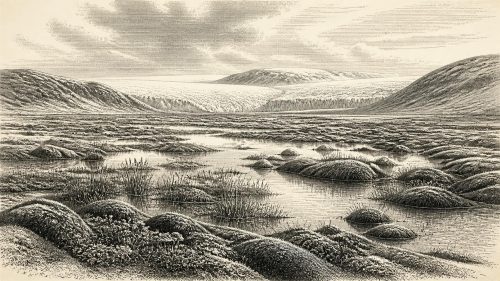
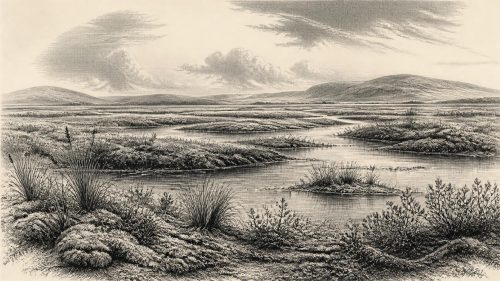
Other Irish deposits help to fill out that ecological setting. At Derryvree in County Fermanagh, organic silts sealed between tills have yielded evidence interpreted as a treeless, cold-stage muskeg or wetland environment. Plant remains from such contexts point to sedges, mosses and hardy tundra or wet-ground vegetation, with pools and waterlogged ground interrupting more open terrain. Their chronology is debated and their dates are broad, but they demonstrate that, before later ice overrode the area, parts of Ireland contained freshwater habitats capable of preserving fragile environmental evidence.
The contrast between Derryvree’s wetland record and Castlepook’s cave fauna is revealing. Ireland was not a single environmental zone. Lowlands, limestone valleys, uplands and coastal margins would have offered different shelter, drainage and forage. Periglacial processes—frost shattering, seasonal thaw, solifluction and the action of meltwater—continually reworked the ground. Trees were probably scarce or absent over wide areas in colder phases, though regional and chronological variation matters. It is safer to describe a mosaic of open grass-herb communities, sedgy wetlands, exposed mineral ground and locally sheltered niches than to impose a single modern habitat label.
Sea level was substantially lower than today because so much water was held in ice sheets. Ireland’s coastlines and the surrounding shelves were consequently very different, and its physical connection or separation from Britain changed through the wider glacial cycle. Low sea level did not automatically create an easy, permanent land route at every moment: glaciers, sea channels, estuaries and hostile terrain mattered. The later evidence shows that Ireland became an island by roughly 20,600–18,100 calibrated years before present. At the earlier horizon considered here, palaeogeography remains a subject of reconstruction rather than a basis for claiming a particular migration route.
The Human Question
The possibility of human presence is the most arresting and the most uncertain aspect of this period. Castlepook has produced a reindeer femur reported as carrying an incision that may have been made by a sharp stone tool while fresh bone was being processed. If that interpretation is confirmed and securely associated with the animal’s death, it could point to an exceptionally early human visit to Ireland, well before the better-established final Palaeolithic evidence. But the standard of proof must remain high. No associated stone-tool assemblage, hearth, occupation floor, dwelling, burial, human bone or artwork securely establishes a community in Ireland around this date.
Thus it is not responsible to write of a Castlepook hunting band, a seasonal camp, a ritual cave or a settled population in 30,178 BCE. At most, the faunal record and the reported modification raise the possibility of brief pioneer incursions into an accessible but climatically demanding landscape. Such visitors, if they came, would have belonged to Upper Palaeolithic hunter-gatherer worlds known elsewhere in north-west Europe. Their social relations, beliefs, technologies and routes cannot be recovered from the present Irish evidence.
What can be said is that a reindeer carcass, whether handled by people or scavenged by carnivores, belonged to a web of predation, movement and seasonal survival. Hyaenas and bears make caves archaeological traps as well as potential shelters: they concentrate bones, but also complicate interpretation. Food procurement, if humans were involved at all, would have depended on knowledge of animal behaviour, stone cutting edges and the risks of sharing terrain with large carnivores. These are informed possibilities drawn from comparative Upper Palaeolithic evidence, not demonstrated details of Irish daily life.
Before the Great Overrun
The greatest development relevant to this date was environmental, not political: the approach of the last major ice-sheet phase. In subsequent millennia, expanding ice transformed the island’s terrain, stripped surfaces, deposited till, altered drainage and erased much of the evidence that might otherwise have recorded early human activity. The scarcity of sites is therefore partly a historical fact about population and access, but also a geological fact about survival of evidence.
For that reason, Ireland around 30,178 BCE should be seen neither as an empty blank nor as a fully peopled Ice Age homeland. It was a changing western peninsula or near-island landscape, inhabited at intervals by impressive mammals and increasingly affected by the climatic conditions that led towards glacial maximum. Castlepook’s bones and Fermanagh’s buried wetland deposits are small, imperfect archives. Properly read, they offer a restrained but vivid conclusion: long before farms, monuments, kingdoms or even enduring settlement, the Irish landscape had already been a contested ecological frontier between open cold-country life and advancing ice.
Primary Sources
- A reconsideration of the radiocarbon dating of the Marine Isotope Stage 3 fauna from southern Ireland
- The Irish Quaternary Fauna Project
- Growth and retreat of the last British–Irish Ice Sheet, 31 000 to 15 000 years ago: the BRITICE-CHRONO reconstruction
- The timing and magnitude of the British–Irish Ice Sheet between Marine Isotope Stages 5d and 2: implications for glacio-isostatic adjustment, high relative sea levels and ‘giant erratic’ emplacement
- Timing, pace and controls on ice sheet retreat: an introduction to the BRITICE-CHRONO transect reconstructions of the British–Irish Ice Sheet
- Radiocarbon constraints on the age of the maximum advance of the British–Irish Ice Sheet in the Celtic Sea
- Trimlines, blockfields and the vertical extent of the last ice sheet in southern Ireland
- Dimensions and chronology of the last ice sheet in Western Ireland
- Deglaciation chronology of the Donegal Ice Centre, north-west Ireland
- Oscillating retreat of the last British-Irish Ice Sheet on the continental shelf offshore Galway Bay, western Ireland
- Maximum extent and readvance dynamics of the Irish Sea Ice Stream and Irish Sea Glacier since the Last Glacial Maximum
- First evidence of a Late Upper Palaeolithic human presence in Ireland
- Ireland: Submerged Prehistoric Sites and Landscapes
- The colonization of Ireland: A human ecology perspective
- Phylogeographic, ancient DNA, fossil and morphometric analyses reveal ancient and modern introductions of a large mammal: the complex case of red deer (Cervus elaphus) in Ireland
- Castlepook Cave, County Geological Site Report
- 32564: Castlepook Cave, Co. Cork
- Figure 6.— The subdivision of the Quaternary Period in Ireland
- The IntCal20 Northern Hemisphere Radiocarbon Age Calibration Curve (0–55 cal kBP)
- Recent Developments in Calibration for Archaeological and Environmental Samples
- The Mesolithic in Ireland: when was it?