Maguiresbridge Silt Window30144 BCE
At the notional date of 30,144 BCE, Ireland’s past is reconstructed from fragmentary environmental evidence rather than historical events. Derryvree, County Fermanagh, preserves freshwater silts formed during an ice-free interval, indicating treeless tundra, wetlands and severe periglacial conditions before renewed glaciation. Castlepook Cave, County Cork, contains remains of reindeer, mammoth, giant deer, hyaena and other cold-climate fauna, demonstrating varied open-country ecosystems and continental connections. A marked reindeer bone may indicate early human carcass processing, but no secure settlement or population is known. Ice extent, coastlines and chronology remain uncertain; later ice advances destroyed much evidence across Ireland over subsequent millennia.

Dateline
“30,144 BCE” is a modern calendar label, not a date that can be matched to a named Irish event, season or generation. In archaeological terms it falls about 32,100 calendar years before AD 1950, within the Late Pleistocene and broadly within Marine Isotope Stage 3, a long, climatically volatile interval of the last Ice Age. The responsible history of Ireland at this point is therefore not a chronicle of rulers or battles, but an account of what deposits, animal remains and glacial landscapes can—and cannot—tell us. Calendar-year precision is unavailable. Even the best relevant dates are ranges with uncertainties, and their relation to this notional year is approximate.
A Landscape Recorded in Fragments
Ireland’s evidence for this period is exceptionally incomplete. Subsequent ice advances eroded older surfaces, moved sediments and buried earlier landscapes beneath till: the unsorted clay, stones and debris laid down by glaciers. Caves have preserved some animal bones, while rare buried organic layers have survived between glacial deposits. Neither source offers an uninterrupted national record. Rather, each is a local survival from a landscape repeatedly altered by ice, water, frost and time.
The relevant Irish archaeological period is conventionally called the Upper Palaeolithic, but that label must be used cautiously here. Across much of Europe, Upper Palaeolithic communities left stone-tool industries, hearths, shelters, art and burials. Ireland has no securely dated settlement, habitation surface, tool assemblage or human remains from around 30,144 BCE. It would be misleading to populate the island with an imagined society merely because people elsewhere in north-west Europe were living through the same broad period. Ireland’s evidence is principally palaeoenvironmental: it demonstrates changing conditions and animals, while offering only a highly contested possibility of human activity.
The Derryvree Window
The closest important environmental evidence comes from Derryvree, near Maguiresbridge in County Fermanagh. Roadworks in 1969 exposed organic silts and fine sands trapped between two substantial layers of till inside a drumlin. This was a remarkable find: a freshwater deposit that formed during an interval when the locality was not under glacier ice, then was sealed and overridden when ice returned.
Its conventional radiocarbon determination, BIRM-166, was reported as 30,500 radiocarbon years before present, with a large uncertainty of +1,170 and −1,030 years. Later calibration places the deposit broadly within approximately 36,900–31,700 calendar years before present. Thus the calendar label 30,144 BCE, roughly 32,100 cal BP, lies within the wide possible span represented by the date, but cannot be assigned to a particular layer, plant, animal or moment at Derryvree.
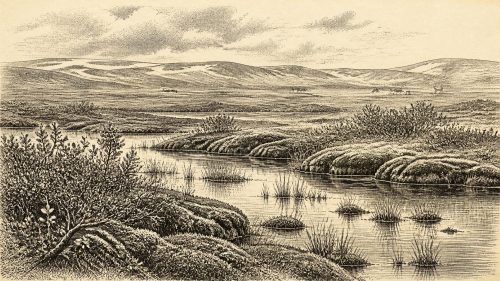
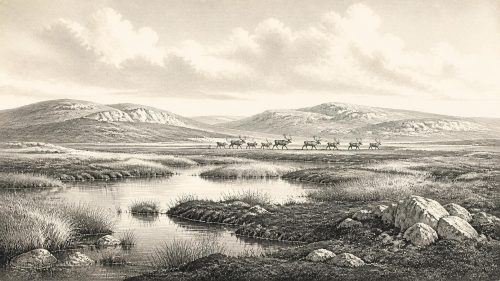
The evidence from the silts is nonetheless vivid. Plant and animal remains indicated open tundra vegetation and a periglacial regime: ground exposed to intense cold, seasonal freezing and thawing, and sparse cover rather than woodland. Mosses, sedges and aquatic plants show that this was not simply a featureless frozen waste. There were wet hollows and freshwater habitats, set within a treeless landscape able to support specialised cold-climate life. The record is evidence for a local environment, not a precise map of the whole island; but it gives Ireland’s Ice-Age past a rare ecological texture.
Before the Greatest Ice Expansion
At this stage the British–Irish Ice Sheet was developing in a changing climate, but the exact extent of ice over Ireland remains debated. Older reconstructions often envisaged repeated, extensive ice cover; newer chronological work has sharpened the history of the last major ice sheet while also stressing how uncertain pre-Last Glacial Maximum conditions remain. The Derryvree sequence proves that at least part of Fermanagh had been ice-free long enough for freshwater sediments and organic material to accumulate before a later advance. It does not prove that all Ireland was open at the same time.
The principal maximum of the last British–Irish Ice Sheet lay later, broadly after 30,000 years ago and especially during the interval around 27,000–21,000 years ago. Around this article’s notional date, Ireland should therefore be understood as a region in transition rather than as a single uniformly ice-covered or ice-free landmass. Some areas may have been exposed tundra or wetland; others may have supported local ice, been affected by glacier margins, or already carried deposits left by earlier advances. The coastline was also unlike that of today because global sea levels were much lower. Yet lowered sea level alone does not demonstrate a continuous, easily traversed land bridge to Britain or the Continent at this particular time.
Animals of an Open Country
Castlepook Cave, near Doneraile in north Cork, supplies the other major Irish line of evidence. Its collections, first excavated in the early twentieth century and later reassessed, include a striking Late Pleistocene fauna: reindeer, giant deer, woolly mammoth, brown bear, mountain hare, Arctic fox and spotted hyaena among it. These animals do not all belong to one brief episode. Cave deposits can accumulate over many thousands of years through carnivore activity, natural deaths, water movement and antiquarian excavation. The cave is consequently a time-averaged archive, not a snapshot of the landscape on one day in 30,144 BCE.
Even so, the fauna establishes an important point. Ireland was not always the species-poor island familiar from recent history. During overlapping portions of the Late Pleistocene, the island formed part of a wider north-west European world in which large grazing animals and powerful predators could reach, occupy or pass through suitable habitats. Reindeer imply open, cold-adapted country; mammoth and giant deer speak to extensive grazing landscapes, though their exact local habitats and dates differed. Hyaena remains show that carnivores, too, exploited this world. Their presence warns against picturing the period solely through ice: exposed land supported complex food webs wherever climate and access allowed.
Recent sedimentary ancient-DNA work at Castlepook has added promising indications of links between Irish fauna and wider Eurasian populations. It remains a preprint rather than a final peer-reviewed study, so it should be treated as provisional. Its central implication is nevertheless consistent with the fossils: Irish animal populations were not isolated curiosities, but part of changing continental-scale distributions shaped by climate, ice and sea level.
The Human Question
Human presence is the most delicate issue. A reindeer femur from Castlepook has been dated to roughly 33,000 radiocarbon years ago and bears a deep linear mark interpreted by Ruth Carden as damage made by a sharp stone tool during carcass processing. If that interpretation is sustained, it may be the earliest evidence that people handled an animal in Ireland, immensely earlier than the securely demonstrated terminal Palaeolithic activity at Alice and Gwendoline Cave in County Clare, dated to about 12,800–12,600 cal BP.
But the Castlepook claim must not be enlarged beyond the object itself. The dated bone is not a settlement. There is no securely associated hearth, stone-tool collection, dwelling floor, human burial or repeated butchery area from this age. The date also measures the animal bone, rather than the exact instant at which the mark was made. Around 30,144 BCE, the evidence permits no responsible assertion of a permanent Irish population, a named group, or a particular route by which people arrived. At most, it raises the possibility of fleeting human visits or carcass processing within a broader Palaeolithic landscape.
No Polities, No Proven Trade
Political affairs, diplomacy and warfare are beyond the evidence. There were no states, kingdoms, territories or institutions identifiable in Ireland at this date, and no written language from which intentions or alliances can be recovered. Equally, there is no Irish evidence for trade networks, agriculture, domesticated livestock, permanent villages or formal religious practice. Such absences matter. They prevent later historical categories—Irish peoples, tribal territories, Celtic culture or national origins—from being projected backwards into a world tens of millennia older than the earliest texts.
Interpretation can still go a little further if its limits are kept visible. If people did reach Ireland in this period, their subsistence would almost certainly have depended on mobile hunting, gathering and close knowledge of seasonal resources, as in contemporary cold-climate societies elsewhere in Europe. But that is a comparative inference, not a fact demonstrated by an Irish campsite. Similarly, caves may have offered shelter to animals and perhaps occasionally people, but Castlepook’s record chiefly documents fauna and preservation, not domestic life.
A History of Evidence
The most important development around this notional year was environmental rather than political: Ireland was part of a rapidly changing Ice-Age north-west Europe, where open tundra wetlands and large mammals existed in some ice-free intervals before later glacier expansion transformed the terrain. Derryvree’s silts preserve freshwater life beneath a drumlin; Castlepook preserves a much richer mammal community than later Ireland would know. Together they show that the island’s deep past was dynamic, connected and ecologically varied.
They also demonstrate why caution is essential. Modern calendar labels give a useful point of entry, but prehistoric Ireland at 30,144 BCE cannot be narrated year by year. Its history survives in calibrated ranges, bones, pollen, seeds, insects, sediments and the shapes of landforms. Those remains reveal a cold, open and unsettled world in the historical sense—one whose human story, if there was one at that moment, remains almost entirely beyond recovery.
Primary Sources
- A Middle Midlandian Freshwater Series at Derryvree, Maguiresbridge, County Fermanagh, Northern Ireland
- Pleistocene Glaciations in Ireland
- Irish Pleistocene Biostratigraphy
- The Irish Quaternary Fauna Project
- Pattern and Timing of Retreat of the Last British–Irish Ice Sheet
- Bayesian Modelling the Retreat of the Irish Sea Ice Stream
- Growth and Retreat of the Last British–Irish Ice Sheet, 31,000 to 15,000 Years Ago: the BRITICE-CHRONO Reconstruction
- The Timing and Magnitude of the British–Irish Ice Sheet Between Marine Isotope Stages 5d and 2
- Deglaciation Chronology of the Donegal Ice Centre, North-West Ireland
- Character of Advance and Retreat of the Southwest Sector of the British-Irish Ice Sheet During the Last Glaciation
- Using Novel Methods to Track British and Irish Ice Sheet Dynamics Since the Late Pleistocene, Along the West Porcupine Bank, NE Atlantic
- The Colonization of Ireland: A Human Ecology Perspective
- First Evidence of a Late Upper Palaeolithic Human Presence in Ireland
- New Insights on the Fauna of Ireland's Younger Dryas and Early Holocene from Alice & Gwendoline Cave
- The IntCal20 Northern Hemisphere Radiocarbon Age Calibration Curve (0–55 cal kBP)
- A Stratigraphic Framework for Abrupt Climatic Changes During the Last Glacial Period Based on Three Synchronized Greenland Ice-Core Records
- Sedimentary Ancient DNA Reveals Late Pleistocene Faunal Connectivity Between Ireland and Eurasia
- Castlepook Cave, County Cork, 2022: Excavation Report
- Archaeological Heritage of County Cork
- Heritage Artefacts of County Cork
- Quaternary Data and Maps
- An All-Ireland Quaternary Map
- Introduction to the Late Quaternary and Holocene of Northern Ireland