Bogbean Between Fermanagh Tills30915 BCE
Around 30,915 BCE, Ireland’s history is reconstructed from fragmentary Late Pleistocene environmental evidence rather than annual events. Beneath Fermanagh’s Derryvree drumlin, freshwater sediments dated broadly to 36,900–31,700 calibrated BP preserve bogbean, mountain avens, insects, sedges and grasses, indicating treeless, cold periglacial wetland during an ice-free interval between glacial advances. Castlepook Cave in Cork contains time-mixed remains of mammoth, reindeer, giant deer, predators and smaller cold-adapted animals, demonstrating changing habitable phases. A modified reindeer femur may indicate human butchery, but cannot prove settlement. Growing British-Irish ice sheets increasingly disrupted habitats, access and preservation, leaving a dynamic, uncertain landscape for later investigators.
Dateline
Modern calendar-year precision is not available for Ireland in 30,915 BCE. No inhabitants left a written calendar, and no excavated settlement, ruler, battle or ceremony can be assigned to this numbered year. The label is a modern convenience: it lies roughly 32,864 years before AD 1950, the conventional reference point for radiocarbon dating. The responsible subject is therefore a broad environmental horizon in the later Pleistocene, within Marine Isotope Stage 3 (MIS 3), rather than an annual chronicle.
The evidence nearest to this point is revealing but uneven. It consists principally of freshwater sediments sealed beneath a drumlin at Derryvree near Maguiresbridge in County Fermanagh, and of animal bones accumulated over long periods in Castlepook Cave, near Doneraile in County Cork. These records establish that parts of Ireland supported cold-stage plants and animals before the Last Glacial Maximum. They do not establish an island-wide landscape at a single moment, still less a named human community.
A Date Within a Range
Derryvree offers the clearest local guide. Roadworks in 1969 cut through a drumlin and exposed two thick, distinct beds of till: unsorted sediment laid down directly by glacier ice. Between them lay fine sands, freshwater silts and organic material. The sequence is unusually valuable because its order is secure. Ice had first crossed this part of Fermanagh and laid down the lower till. Afterwards, at least locally, open water and wet ground existed long enough for sediment, plants and insects to accumulate. A later ice advance buried the deposit beneath a second till sheet.
Organic material from this freshwater series gave the radiocarbon determination BIRM-166, 30,500 radiocarbon years BP, with a substantial uncertainty of +1,170/−1,030 years. A radiocarbon age is not a calendar age. Atmospheric carbon-14 has varied through time, and the result must be calibrated against independently dated records; at this depth in time the calibration curve gives a broad rather than pinpointed answer. Published discussion places the Derryvree horizon broadly within about 36,900–31,700 calibrated years BP. The modern year 30,915 BCE falls within that wide window, but it cannot be equated with the formation of a particular pool, the growth of one plant or an event in a human life.
This caution matters because Ireland’s Late Pleistocene record is patchy. Later glaciers scraped, redeposited or covered large tracts of the island. A deposit found beneath till is an exceptional survival, not a complete national archive. Other Fermanagh sites, including Hollymount near Maguiresbridge and Greenagho near Belcoo, also preserve evidence for cold, non-glacial intervals. Together they show that the island’s ice history involved advances, retreats and ice-free pockets rather than one unbroken frozen state.
Fresh Water in Open Country
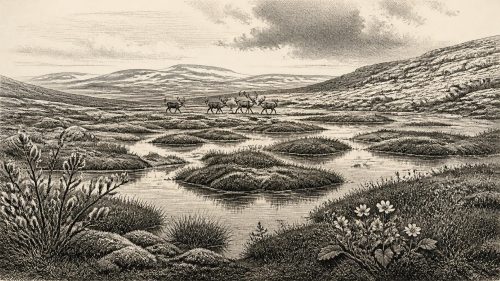
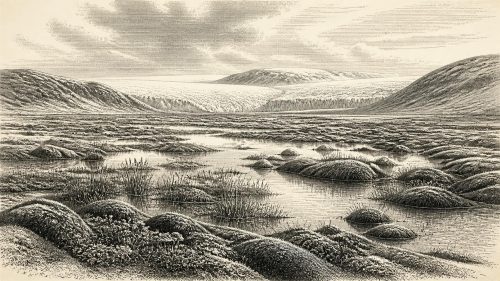
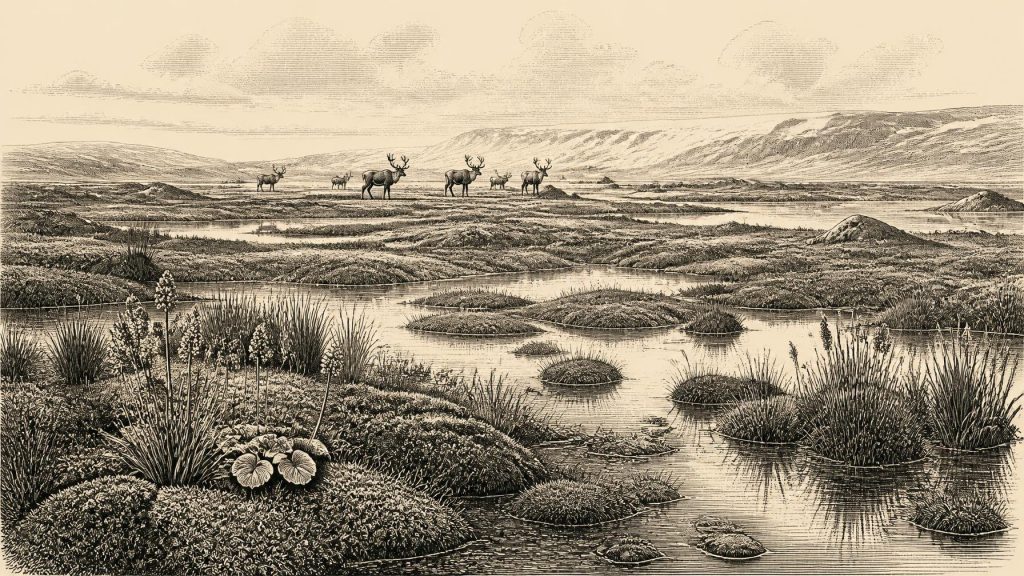
At Derryvree, plant remains, pollen and insects provide direct evidence for a treeless, periglacial wetland landscape. Freshwater mosses, sedges, grasses and low herbs were present. Fossils of bogbean (Menyanthes trifoliata) and mountain avens (Dryas octopetala) are especially evocative: both are plants associated with cold or Arctic-alpine conditions today. Juniper and dwarf woody vegetation may have occurred in sheltered places, but the evidence does not support a woodland scene. This was open country with short growing seasons, severe winters and low vegetation exposed to wind.
The phrase “tundra” is useful only if handled carefully. It describes the broad ecological character suggested by the fossils—open, cold-adapted ground—not a uniform blanket of vegetation across all Ireland. The Derryvree deposit records a freshwater hollow with mossy margins, decaying plant matter and shallow pools. Conditions at a dry ridge, limestone cave entrance or distant coast could have been different. The insect assemblage indicates habitats around wet, plant-rich ground, showing that even a rigorous climate supported a functioning local food web.
Everyday life at this date can therefore be described confidently for plants and animals, but not for people. There were no fields, livestock, houses, roads, pottery, monuments or metalworking. Nothing supports farming, trade networks, political authority, diplomacy, formal religion or a learned tradition in Ireland at this point. Such absences should not be filled with invented Ice Age clans. They reflect both the likely conditions of a cold Pleistocene landscape and the severe limits imposed by the surviving evidence.
Castlepook’s Animal World
Far to the south-west, Castlepook Cave—also called Mammoth Cave—preserves Ireland’s richest known assemblage of mammals from before and during the last cold stage. Excavations undertaken in the early twentieth century recovered more than 2,000 bones. Subsequent research and redating have identified a varied fauna that includes woolly mammoth, reindeer, giant deer, brown bear, wolf, fox, Arctic fox, mountain hare, lemmings and spotted hyena. The cave is consequently vital evidence that animals repeatedly reached and lived in, or at least moved through, Ireland during parts of the Late Pleistocene.
Its limitations are as important as its riches. Castlepook was not excavated to modern standards, and the remains came from cave sediments affected by water movement, carnivore activity and old digging. Bones from different episodes can be mixed together. A cave bone proves that an animal was present in the wider landscape or was carried into the cave; it does not automatically prove where it grazed, died or was hunted. Nor should the entire animal list be compressed into one imagined season around 30,915 BCE.
Nevertheless, the fauna indicates a landscape far removed from modern Ireland. Reindeer and lemmings point to cold open environments; mammoth and giant deer indicate that substantial herbivores could find enough forage during favourable phases; wolves and spotted hyenas occupied the upper levels of the food chain. Hyenas may have used caves as dens or scavenging sites, helping to explain why carcass remains accumulated there. The National Museum of Ireland’s Castlepook collections are therefore evidence both of animal dispersal and of natural bone-accumulation processes.
The Reindeer Femur Question
A reindeer femur from Castlepook has made this period especially important for Irish archaeology. Palaeozoologist Ruth Carden identified a deep linear modification on the bone as consistent with cutting or chopping by a sharp stone tool during butchery. The bone has been presented as dating to roughly 33,000 years ago, close in broad terms to the date considered here. If that interpretation is sustained, it would be evidence that a person or people processed reindeer in Ireland during the Upper Palaeolithic, much earlier than the long-accepted record of post-glacial occupation.
That is a significant possibility, not proof of a settled population. The find is one modified bone from an old cave collection, not a sealed camp floor. No securely associated stone tools, hearth, dwelling, burial, human remains or dense scatter of butchered remains of comparable age has been recovered. The radiocarbon result dates the animal bone; interpreting a mark as humanly made is a separate taphonomic judgement. Neither point can tell us whether people killed the reindeer, encountered an already dead animal, remained for a day or returned repeatedly.
Accordingly, there is no secure basis for describing a political community, kin group, territory, language, ritual practice or trade route in Ireland in 30,915 BCE. If humans did visit, they would have moved through a demanding north-west European world shaped by lowered sea levels, changing coastlines and climatic fluctuations. Their presence would have been fleeting in the evidence now available. The archaeological silence is meaningful, but it is not absolute proof that nobody ever came.
Ice, Access and Change
The larger trend was towards major environmental reorganisation. The British–Irish Ice Sheet did not simply appear at one date: recent reconstruction shows sustained growth between about 31,000 and 26,000 years ago, followed by its maximum volume around 23,000 years ago. This chronology concerns a changing ice-sheet system across Britain, Ireland and adjacent shelves, not a guarantee that every Irish district was simultaneously ice-covered. Yet it explains why habitat, drainage, coast and possible movement routes became progressively less stable.
For the Derryvree wetland, renewed glaciation eventually brought burial beneath till. For animals, advancing ice and colder conditions would have fragmented forage and altered corridors of movement. For any human visitors, the practical challenges would have been formidable: finding game, fuel, shelter and safe passage through a landscape where conditions could change across short distances and longer climatic oscillations. None of this demonstrates conflict or diplomacy. It shows instead why continuity of settlement would have been difficult to establish and harder still to preserve archaeologically.
The most accurate picture of Ireland around 30,915 BCE is therefore neither an empty white ice sheet nor a populated prehistoric homeland. It is a fragmentary, dynamic late-Ice-Age landscape. At Derryvree, cold-adapted plants and insects occupied freshwater ground during an ice-free interval. At Castlepook, a diverse fauna—including formidable predators and large herbivores—left a time-averaged record in limestone passages. A single reindeer bone raises the possibility of human butchery. Beyond those hard-won traces, the history remains deliberately—and instructively—unknown.
Primary Sources
- A Middle Midlandian Freshwater Series at Derryvree, Maguiresbridge, County Fermanagh, Northern Ireland
- Early Midlandian–Middle Midlandian, Pleistocene, Northern Ireland
- Irish Pleistocene Biostratigraphy
- The Irish Quaternary Fauna Project
- A Reconsideration of the Radiocarbon Dating of the Marine Isotope Stage 3 Fauna from Southern Ireland
- Castlepook Cave, County Geological Site Report
- Spotted Hyena Skull
- Heritage Artefacts of County Cork
- Growth and Retreat of the Last British–Irish Ice Sheet, 31,000 to 15,000 Years Ago: the BRITICE-CHRONO Reconstruction
- Pattern and Timing of Retreat of the Last British-Irish Ice Sheet
- Radiocarbon Constraints on the Age of the Maximum Advance of the British-Irish Ice Sheet in the Celtic Sea
- Trimlines, Blockfields and the Vertical Extent of the Last Ice Sheet in Southern Ireland
- The IntCal20 Northern Hemisphere Radiocarbon Age Calibration Curve (0–55 cal kBP)
- IntCal History
- The Archaeology of Caves in Ireland
- New Insights on the Fauna of Ireland's Younger Dryas and Early Holocene from Alice & Gwendoline Cave
- Red Deer in Ireland: A Population Genetics Perspective
- Palaeolithic Ireland – New Evidence Emerges from the Emerald Isle
- Menyanthes trifoliata
- Dryas octopetala