
Maguirebridge’s Three-Leaved Pool30914 BCE
Dateline
30,914 BCE is a useful modern label, not a date at which Ireland’s past can be read year by year. No written record, calendar, settlement sequence or archaeological layer can isolate a particular Irish day, season or generation so far back. In archaeological terms the point lies roughly 32,864 years before the conventional reference year of AD 1950, within the Late Pleistocene and Marine Isotope Stage 3, a long, climatically unstable part of the last Ice Age. The responsible account is therefore built from broad calibrated ranges, glacial sediments, fossil plants and cave fauna. It can illuminate conditions in and around Ireland; it cannot furnish an event for this numbered year.
A Date Inside a Range
The closest Irish environmental anchor is at Derryvree, near Maguiresbridge in County Fermanagh. Road works in 1969 cut through a drumlin, exposing freshwater silts, fine sands and organic deposits sealed between two thick tills: unsorted sediment left by moving glacier ice. The sequence gives an unusually clear order of events. Ice first deposited the lower till; a period followed in which an ice-free freshwater environment accumulated mud and organic remains; later glacier ice overrode or buried the deposit beneath the upper till. That relative sequence is secure, even though the duration of each phase cannot be reduced to an annual timetable.
Organic material from the Derryvree freshwater bed, laboratory determination BIRM-166, produced a radiocarbon age of about 30,500 years before present, with a large uncertainty of +1,170 and −1,030 years. Radiocarbon years are not calendar years: atmospheric carbon-14 has varied through time, so measurements must be calibrated against independently dated records. Published calibration places the Derryvree material broadly at about 36,900–31,700 calibrated years before present, approximately 34,950–29,750 BCE. Thus 30,914 BCE falls within the possible age range of this Irish archive, but it cannot be tied to a particular sediment layer, flower, animal or episode at the pool.
This distinction matters. A deposit formed over time is not a contemporary snapshot of the entire island. Derryvree demonstrates that, during a broad Middle Midlandian interval, its locality was ice-free long enough for freshwater sediments and organic material to gather between glacial advances. It does not prove that every region of Ireland was simultaneously free of ice, nor that the climate was constant. At this depth in time, even excellent chronological evidence has margins measured in centuries or millennia.
Wetlands Between Glaciers
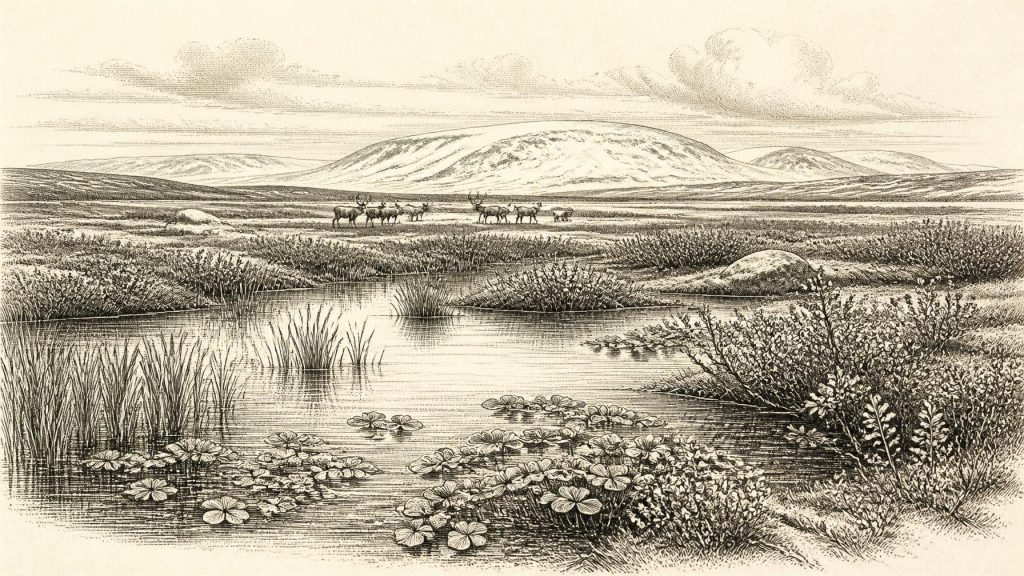
The Derryvree deposits nonetheless offer a vivid, carefully limited view of an Irish landscape compatible with this broad horizon. Plant macrofossils, mosses and pollen point towards a cold, open environment with freshwater and wet ground rather than a closed forest. Sedges, dwarf willow, clubmoss and bogbean or water clover (Menyanthes trifoliata) are among the remains used to reconstruct such conditions. The three-leaved bogbean, which gives this article its title, is evidence that plants associated with wet, shallow-water habitats grew there during the deposit’s formation. It is not evidence that one can identify a particular bogbean plant in 30,914 BCE.
The best interpretation is of a varied periglacial wetland: shallow pools, muddy margins, sedge-rich ground and sparse low vegetation, within a wider treeless or very lightly wooded landscape. Periglacial does not mean an empty white wilderness. Cold-climate plants, invertebrates and small mammals could exploit sheltered, waterlogged niches, while frost action, seasonal meltwater and short growing seasons shaped the ground. The landscape would have changed quickly in ecological terms as temperature, snowfall, ice margins and drainage shifted. A marsh beside a pool may have been productive in summer yet exposed and severe in winter.
Irish evidence must also be placed in a North Atlantic setting. Greenland ice-core records show that the last glacial period was punctuated by abrupt shifts between relatively milder interstadials and colder stadials. The date in question falls close to a time of considerable climatic volatility rather than within a stable ‘Ice Age climate’. Northern Atlantic conditions influenced Irish temperatures, precipitation, sea ice and glacier behaviour, but they did not make Derryvree a weather station for the whole island. Local relief, water and proximity to ice would have mattered greatly.
Cave Fauna and Open Country
For animal life, the principal Irish evidence comes from cave collections, especially Castlepook Cave, also called Mammoth Cave, near Doneraile in north County Cork. Excavations conducted in the early twentieth century recovered a remarkable assemblage including remains attributed to reindeer, giant deer, brown bear, wolf, fox, hare, lemming, woolly mammoth and spotted hyaena. Castlepook is important because it establishes that a much richer cold-stage fauna reached Ireland during parts of Marine Isotope Stage 3 than survives on the island today.
It would be misleading, however, to arrange all those species together in a single scene set in 30,914 BCE. Cave deposits may mix material accumulated over long periods; carnivores can carry bones into dens; older excavations did not always preserve the stratigraphic information expected today; and recent radiocarbon reassessment has shown that some earlier dates were substantially too young. The assemblage supports the existence of changing open-country food webs, but not a census for this year. Reindeer in particular fit the general image of cold, open habitats, while hyaena remains demonstrate that Ireland’s Pleistocene fauna was neither uniform nor exclusively Arctic.
Sea level was lower than today, and the geography of the Irish Sea region differed substantially from the modern map. Mammals evidently reached Ireland at various points in the Late Pleistocene, perhaps through changing combinations of exposed coastal plains, shallow-water crossings, ice and land connections. Yet the route taken by any particular herd, predator or possible human visitor remains uncertain. The fossil record demonstrates arrival and survival at broad scales; it does not demonstrate a permanent corridor, a single migration route or an unbroken mainland connection at this precise moment.
The Castlepook Question
Castlepook also raises the most intriguing, but still provisional, question about people in Ireland at this time. A reindeer femur in the National Museum of Ireland collection has been identified as bearing a deep mark interpreted by zooarchaeologist Ruth Carden as the work of a sharp stone tool during carcass processing. County Cork heritage material associates the bone with an age of about 31,000 BCE. If the mark is confirmed as humanly made, it would be potentially momentous evidence that Upper Palaeolithic hunters handled a reindeer in Ireland far earlier than the better-established evidence for post-glacial human activity.
The limits of the claim are as important as its promise. The bone’s date concerns the animal, not a precisely timed act of butchery. A modified bone is not by itself a camp, a settled population or proof that hunters lived in the cave. No securely associated hearth, stone-tool assemblage, dwelling floor, burial, food store or repeated butchery area has yet been recovered at Castlepook for this age. The cave may have been used principally by carnivores, which could have transported scavenged carcass remains underground. Ongoing investigation is needed to test the mark, the bone’s context and whether further in-situ evidence survives.
What Cannot Be Written
Consequently, political affairs, diplomacy and warfare cannot responsibly be described for Ireland in 30,914 BCE. There are no known polities, named peoples, leaders, languages or territorial institutions. Nor is there evidence for religious observance, art, formal learning, exchange networks or a settled economy. If people were present, they may have belonged to highly mobile foraging groups familiar with the wider north-west European world; that is a reasonable comparative possibility, not a demonstrated Irish social history. Later Gaelic identities, Celtic languages and medieval traditions have no place in this reconstruction.
Everyday life is likewise recoverable only by inference. The ecology could have supported animals valuable for meat, hide, bone, antler and fuel, while wetlands supplied water and concentrated plant and animal resources. But no Irish site of this date securely records how people sheltered, cooked, organised kinship or moved through the landscape. The evidence speaks more confidently of sedimentation, vegetation, fauna and ice than of human institutions. Its silences are historical facts, not gaps to be filled with picturesque invention.
Iceward Change
The larger trajectory was towards more extensive glaciation. The Last Glacial Maximum in Ireland came later, with major Irish Ice Sheet advances generally placed around 27,000–23,000 calibrated years ago. At roughly 32,864 years before present, Ireland was not yet at that maximum, but its environments were already subject to the cold oscillations and shifting ice limits that preceded it. Derryvree’s organic bed, entombed between tills, embodies that unstable history: an interval of freshwater life was ultimately sealed by renewed glacial action.
For this reason, the most important Irish development around 30,914 BCE was environmental rather than political. Ireland contained, or had recently contained, local ice-free refuges and cold wetlands amid a changing glacial landscape. Open-country mammals moved through the wider region; cave deposits retained fragments of their histories; and a single marked reindeer bone poses an unresolved question about human presence. The record is fragmentary, but it is not empty. Beneath a Fermanagh drumlin and in a Cork cave lie the traces from which Ireland’s deepest known past can cautiously be reconstructed.
Primary Sources
- A Middle Midlandian Freshwater Series at Derryvree, Maguiresbridge, County Fermanagh, Northern Ireland
- A reconsideration of the radiocarbon dating of the Marine Isotope Stage 3 fauna from southern Ireland
- The Irish Quaternary Fauna Project
- Trimlines, blockfields and the vertical extent of the last ice sheet in southern Ireland
- Response of the Irish Ice Sheet to abrupt climate change during the last deglaciation
- New insights on the fauna of Ireland's Younger Dryas and Early Holocene from Alice & Gwendoline Cave
- The IntCal20 Northern Hemisphere Radiocarbon Age Calibration Curve (0–55 cal kBP)
- The Greenland Ice Core Chronology 2005, 15–42 ka. Part 1: constructing the time scale
- A 60 000 year Greenland stratigraphic ice core chronology
- Rapid global ocean-atmosphere response to Southern Ocean freshening during the last glacial
- Spotted Hyena Skull
- Heritage Artefacts of County Cork
- 2022:564 – Castlepook Cave, Castlepook South, Cork
- Archaeological Survey
- Figure 6.— The subdivision of the Quaternary Period in Ireland
- Late Quaternary Environmental Change & Archaeology: Case Studies in the Lower Bann Valley & Belfast District
- Field Guides
- Ireland's Palaeolithic Archaeology – Fleeting Footprints in a Frozen Land
- UCD School of Archaeology Research Day 2022
- Research Groups and Publications