
Doneraile’s Reindeer and Reedbeds30990 BCE
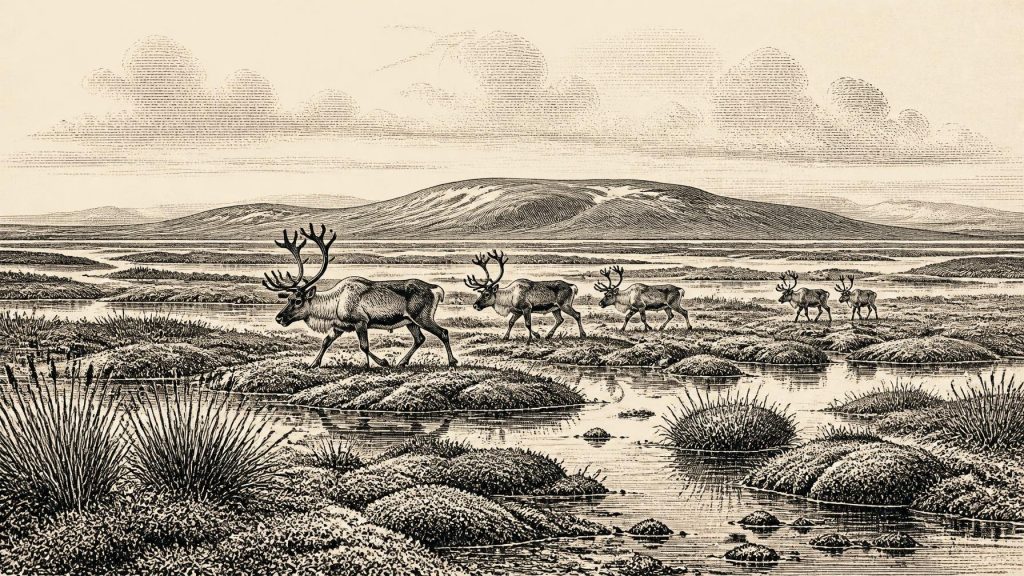
Around 30,990 BCE, Ireland was a cold, climatically unstable landscape of treeless wetlands, open grazing country and expanding ice. Derryvree’s buried freshwater sediments indicate ice-free tundra-like conditions, although their radiocarbon date represents a broad calibrated range, not a single year. Castlepook Cave preserves mixed remains of mammoth, reindeer, giant deer, hyaena and other cold-adapted fauna, demonstrating Ireland’s ecological links with north-western Europe. A cut-marked reindeer bone may record Palaeolithic butchery, but cannot prove permanent settlement. No political, cultural or economic communities are identifiable. Later ice-sheet expansion buried or destroyed much evidence, leaving fragmentary environmental and faunal archives from this period.
Dateline
The label 30,990 BCE gives a useful position in a modern chronological sequence, but it cannot identify an event that happened in one Irish calendar year. No written record, settlement sequence or dated human life allows that degree of precision. Expressed in the convention used by Quaternary scientists, the point is roughly 32,939 years before AD 1950; radiocarbon and environmental evidence must be read as calibrated ranges, often spanning centuries or millennia. The responsible picture is therefore of Ireland during the cold, changeable Marine Isotope Stage 3, shortly before the great expansion of the last Irish Ice Sheet, rather than of a named people or a particular happening.
A Date Within Broad Ranges
The nearest important environmental archive is Derryvree near Maguiresbridge in County Fermanagh. There, road works exposed organic freshwater silts and sands sealed between two layers of glacial till. The classic radiocarbon determination from this deposit, Birm-166, was 30,500 ± 1,200 radiocarbon years BP. Modern calibration has been published as a broad interval of about 36,900–31,700 calibrated years BP. Thus 30,990 BCE falls near the younger end of a range represented by the Derryvree sediments, but not at a point which can be isolated within them.
That distinction matters. The organic layer demonstrates that its locality was ice-free while a cold freshwater environment existed; it does not provide a nationwide weather report, a precise annual chronology, or a continuous record of every intervening year. Nor does a radiocarbon date tell us that every plant or animal found in a different Irish deposit lived at the same moment. Ireland’s surviving evidence from this period is fragmentary because later glaciers eroded, buried and rearranged much of the earlier landscape.
An Open, Cold Landscape
The Derryvree plant remains point to a treeless, tundra-like wetland or muskeg landscape, not to the familiar wooded and rain-rich Ireland of later millennia. Sedges, mosses, dwarf shrubs and cold-tolerant herbs could grow around shallow water, saturated ground and seasonal pools. Bogbean and water-milfoil are among the fossils used to reconstruct freshwater conditions. Their presence is evidence for particular local habitats, while the wider interpretation—an open, strongly seasonal and cold environment—is supported by the associated plant assemblage and by comparison with other north-west European records.
In such a country, summer growth could be concentrated into a short season, while winter brought hard frosts, snow cover and frozen ground. Wind would have mattered greatly on exposed uplands and plains. Watercourses and wet hollows nevertheless created sheltered pockets of vegetation. The landscape was not a single blank of snow or an unbroken glacier. At this time, evidence from Fermanagh, western offshore areas and southern Ireland indicates that substantial ground remained ice-free in some regions, even though ice was building elsewhere and climatic conditions were deteriorating.
Sea level was far lower than it is today because vast volumes of water were held in northern ice sheets. Coastlines consequently lay beyond their modern positions, and the Irish Sea basin had a different geography. Yet lower sea level should not be turned automatically into a simple land bridge from Ireland to Britain or continental Europe. Routes across the wider north-west European landscape depended on changing shorelines, rivers, marshes, channels and ice margins. For animals and any people, movement was possible only through particular corridors at particular times.
Castlepook’s Animal Archive
The strongest Irish faunal evidence relevant to this broad period comes from Castlepook Cave, also called Mammoth Cave or Doneraile Cave, in north County Cork. Excavations undertaken largely in the early twentieth century by the naturalist Richard J. Ussher produced a remarkable but imperfectly recorded collection. Geological Survey Ireland regards the cave as Ireland’s richest vertebrate site for the period leading towards the Last Glacial Maximum. Its remains include woolly mammoth, reindeer, giant deer, brown bear, wolf, Arctic fox, mountain hare, lemmings and spotted hyaena.
This list should not be imagined as a single herd and its predators gathered outside the cave on one day. Cave bone assemblages accumulate over long periods, and at Castlepook water disturbance, carnivore activity and early excavation have mixed the evidence. A hyaena could drag in prey or scavenge a carcass; an animal could die near an entrance; water could move bones from their original resting place. The fauna nevertheless establishes something significant: pre-maximum Ireland could support, or intermittently receive, a richer cold-stage mammal community than the later island’s fauna might suggest.
Reindeer are especially evocative because they indicate open grazing country and potentially seasonal movement. Mammoth and giant deer required substantial feeding grounds, while hyaenas, wolves and bears occupied different ecological roles as predators or omnivores. Lemmings and Arctic fox reinforce the cold character of the wider habitat. These animals do not prove that every valley in Ireland looked alike, but they rule out any picture of a uniformly forested, isolated island. Ireland was connected ecologically to a larger north-west European world, even if its exact routes of recolonisation and local extinctions remain debated.
The Human Question
One Castlepook find gives this date unusual importance: a reindeer femur bearing a deep surface incision that zooarchaeologist Ruth Carden has interpreted as consistent with stone-tool butchery. Public reports described the bone as about 33,000 years old, and its possible modification has been presented as evidence that people processed a reindeer in Ireland far earlier than the previously accepted archaeological record allowed. If that interpretation is sustained, it would show a human visit during the later Palaeolithic, broadly within the cold-stage world discussed here.
But the finding must be described carefully. The bone came from an old cave collection rather than a modern, intact occupation layer. Dating establishes the age of the animal bone, not automatically the exact moment when an incision was made. No securely associated hearth, stone-tool assemblage, dwelling floor, burial or repeated occupation horizon has yet been recovered at Castlepook for this period. Recent work has identified surviving Pleistocene, faunal-bearing deposits with considerable potential, but potential is not the same as proof of a camp or settled population.
Accordingly, the most cautious conclusion is that Ireland may have been visited by hunter-gatherers who exploited a reindeer carcass, perhaps while following animal movements through a wider landscape. It cannot support a claim that the island had a permanent human population at 30,990 BCE. Nor can it identify whether the visitors were few or many, how long they remained, which route they travelled, or whether they returned. The absence of evidence is partly a consequence of preservation, but it remains an absence.
Life Without Recorded Communities
There is no basis for political history at this date. No kingdom, chiefdom, border, diplomatic relationship, war, treaty or named community can be reconstructed. Later identities—Irish, Gaelic and Celtic—belong to vastly later historical and linguistic contexts and must not be projected back into the Pleistocene. If people were present, their social arrangements, languages and kinship systems are unknown.
The same restraint applies to religion, culture and learning. There are no Irish cave paintings, portable artworks, graves or ceremonial places securely assignable to around 30,990 BCE. A possible butchery mark can illuminate a practical action: the use of a sharp implement to dismember or process an animal. It cannot reveal myths, rituals, artistic traditions or systems of teaching. The wider European Upper Palaeolithic shows that Homo sapiens elsewhere possessed sophisticated technologies and symbolic cultures, but Irish evidence cannot yet demonstrate which, if any, of those practices reached this island.
Economy and trade must also be framed as possibilities rather than institutions. If hunters reached Ireland, subsistence would probably have depended on mobile foraging, the opportunistic use of animal carcasses and knowledge of seasonal terrain. Reindeer meat, fat, hides, sinew and bone were valuable resources to Palaeolithic peoples elsewhere, but no Irish assemblage of this age documents their full use. There is no evidence for exchange networks, managed herds, farming, pottery, metalworking or permanent markets. The only securely visible economy is the natural one: plants feeding herbivores, herbivores sustaining carnivores, and freshwater wetlands offering local ecological resources.
Towards the Ice Maximum
The long-term development deserves greater emphasis than any hypothetical human episode. Within several millennia, the last British-Irish Ice Sheet expanded dramatically. Reconstructions place its maximum extent much later, broadly between about 26,500 and 19,000 years ago, with regional advances and retreats that did not occur everywhere simultaneously. By then, ice had transformed much of Ireland and removed or concealed earlier deposits. The Derryvree organic bed is precious precisely because later till sealed a small record of a living cold landscape beneath the advancing glacial history.
Around 30,990 BCE, then, Ireland was neither the familiar green island nor simply an ice-covered void. It was a climatically unstable northern landscape of open vegetation, reed-fringed and mossy water, grazing mammals and formidable predators, with glaciers increasingly important in its future. Castlepook and Derryvree provide different kinds of testimony: one a cave archive of animals, the other a buried wetland archive of plants and sediment. Together they reveal a world that can be reconstructed in broad outline, while reminding us that its people—if present at all—remain almost invisible.
Primary Sources
- Castlepook Cave: County Geological Site Report
- The Irish Quaternary Fauna Project
- The Irish Quaternary Fauna Project (full text)
- Late Quaternary Stratigraphy and Glacial History of Southern Ireland
- The Quaternary of South Fermanagh: Field Guide
- The Quaternary of the Mourne Mountains and Down: Field Guide
- Exploring the complexity of the last British-Irish Ice Sheet: a new reconstruction
- Growth and Retreat of the Last British–Irish Ice Sheet, 31,000 to 15,000 Years Ago: the BRITICE-CHRONO Reconstruction
- Trimlines, Blockfields and the Vertical Extent of the Last Ice Sheet in Southern Ireland
- Dimensions and Chronology of the Last Ice Sheet in Western Ireland
- Maximum Extent and Dynamic Behaviour of the Last British–Irish Ice Sheet West of Ireland
- Early Deglaciation of the British-Irish Ice Sheet on the Atlantic Shelf Northwest of Ireland Driven by Glacioisostatic Depression and High Relative Sea Level
- Early Deglaciation of Western Ireland and Ice-Sheet Extent on the Atlantic Shelf Northwest of Ireland
- Stratigraphic and Palaeo-Geomorphological Evidence for the Glacial-Deglacial History of the Last British-Irish Ice Sheet in the North-Western Irish Sea
- Middle Midlandian Interstadial Deposits at Greenagho, Near Belcoo, County Fermanagh, Northern Ireland
- Freshwater Organic Deposits and Stratified Sediments Between Early and Late Midlandian (Devensian) Till Sheets, at Aghnadarragh, County Antrim, Northern Ireland
- Cenozoic: Tertiary and Quaternary
- Archaeological Heritage of County Cork
- Heritage Artefacts of County Cork
- Castlepook Cave, County Cork: 2022 Excavation Report
- Ireland’s Palaeolithic Archaeology – Fleeting Footprints in a Frozen Land
- New Insights on the Fauna of Ireland’s Younger Dryas and Early Holocene from Alice & Gwendoline Cave
- New Insights on the Fauna of Ireland’s Younger Dryas and Early Holocene from Alice & Gwendoline Cave (author manuscript)