Cork’s MIS 3 Fauna30991 BCE
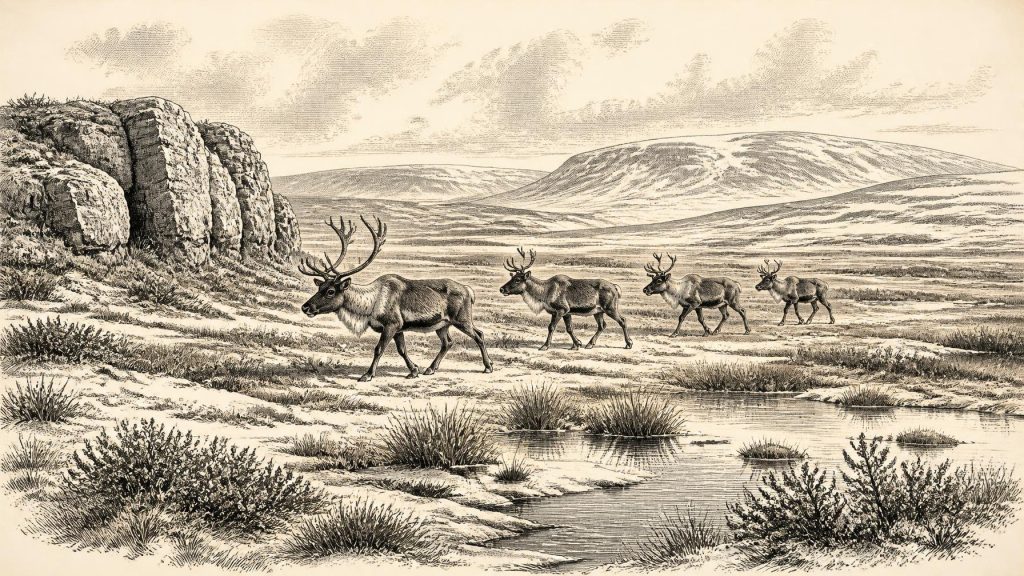
Around 33,000 years before present, during Marine Isotope Stage 3, Ireland experienced a variable Ice Age environment rather than a precisely datable historical year. Castlepook Cave in County Cork preserves fauna including mammoth, reindeer, giant deer, predators and cold adapted mammals, although its disturbed deposits combine material from different periods. Revised radiocarbon dating increased its importance. A reindeer femur, dated about 31,000 BCE, bears a possible stone tool cut mark, potentially Ireland’s earliest evidence of human activity. However, no hearths, tools or settlements confirm occupation. Open steppe tundra supported animals; later glaciation erased much evidence and reshaped Ireland profoundly thereafter.
Dateline
The label 30,991 BCE is a modern chronological convenience, not a year that can be recovered from Ireland’s deep past. No contemporary calendar, written record, named people or datable event exists. At this depth of time, archaeologists work with radiocarbon determinations, calibrated probability ranges, stratigraphy and environmental proxies. The safest setting is the later part of Marine Isotope Stage 3, roughly 33,000 calendar years before present, well before the fullest expansion of the Last Glacial Maximum. It was an Ice Age world, but not necessarily one in which every part of Ireland lay continuously beneath ice.
The most significant Irish evidence relevant to this broad interval comes from Castlepook Cave, near Doneraile in north County Cork. Its deposits and museum collections preserve a remarkable, though complicated, record of Pleistocene animals. A reindeer femur from the cave has been presented by County Cork heritage authorities as dating to about 31,000 BCE and as bearing a deep mark interpreted by zooarchaeologist Ruth Carden as the work of a sharp stone tool. If that interpretation is sustained, it may be Ireland’s earliest known indication that people processed an animal. It does not establish that a particular hunting party was present in this numbered year.
A Date of Ranges, Not an Occasion
Radiocarbon measurements do not provide the precision implied by a BCE year. They estimate the age of organic material by measuring surviving radioactive carbon, then require calibration against changing atmospheric carbon levels. For dates approaching the practical limits of radiocarbon dating, calibrated ranges can span centuries or more. A measurement on a reindeer bone primarily dates the animal’s death; it cannot, by itself, identify the exact moment when a surface mark was made, the place where the carcass was cut, or the identity of the person who may have handled it.
The period is therefore better understood as a broad horizon around the thirty-third millennium before present. It belongs to the Late Pleistocene, when climatic conditions across north-west Europe shifted repeatedly between colder and somewhat milder phases. Ireland’s record is unusually fragmentary because later ice movement eroded, reworked and buried many older surfaces. Caves, protected sediment pockets, marine records and deposits sealed beneath glacial material have consequently become disproportionately important archives.
Modern re-dating has changed the picture. The Irish Quaternary Fauna Project first brought together evidence from cave collections, but later accelerator mass spectrometry and improved ultrafiltration of bone collagen showed that several earlier dates were too young. Re-dating at Castlepook produced ages thousands of radiocarbon years older than previous determinations for some specimens. That revision gives the cave genuine importance for pre-Last Glacial Maximum Ireland, while also demonstrating why older collections and inherited chronologies must be treated cautiously.
Castlepook’s Uneven Archive
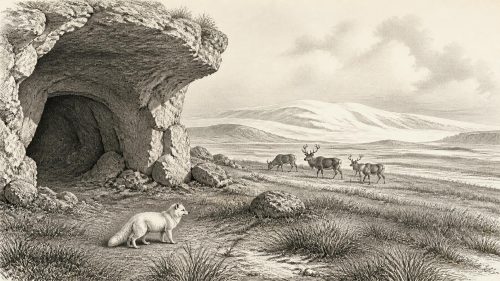
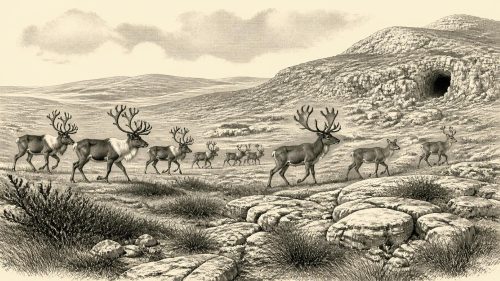
Castlepook is sometimes called Mammoth Cave, an apt reminder of the large mammals represented there. Its wider Pleistocene assemblage has included woolly mammoth, reindeer, giant deer, brown bear, wolf, Arctic fox, mountain hare, lemmings and spotted hyaena. These remains demonstrate that cold-stage animal communities reached Ireland during Marine Isotope Stage 3. They do not demonstrate that all these species lived together in one valley, one season or one generation. Individual bones may belong to separate climatic episodes spread across many millennia.
Nor was the cave a simple snapshot of the landscape outside its entrance. Carnivores could drag carcass parts into a den; water could move sediments and bones; roof collapse could disturb deposits; and antiquarian excavations between 1904 and 1913 removed much material before the routine use of modern recording, sieving and geoarchaeological sampling. Castlepook is valuable precisely because it has retained evidence despite these processes. Yet its complexity prevents the cave from being described responsibly as a securely excavated hunting camp.
The marked reindeer femur must be read in that light. A sharp incision on fresh bone can be consistent with stone-tool butchery, but specialists must distinguish such marks from carnivore damage, trampling, sediment abrasion, breakage, weathering and damage caused during recovery. The specimen is therefore important proposed evidence for human activity, not proof of a permanent population. No securely associated hearth, lithic assemblage, dwelling floor, human burial or concentration of butchered animal remains of comparable age has yet been recovered in Ireland.
Open Country and Mobile Animals
The animal evidence nevertheless permits a restrained reconstruction of the setting. Reindeer, lemmings, Arctic fox and mountain hare point to cold, open habitats rather than the dense woodland familiar from later Holocene Ireland. Grassland, herb-rich steppe-tundra, dwarf-shrub vegetation and wet ground probably formed a changing mosaic, governed by local relief, drainage, soils, exposure and the proximity of ice. Mammoth and giant deer show that, at intervals, the landscape could support large herbivores; wolves and spotted hyaenas indicate predators and scavengers within that wider ecosystem.
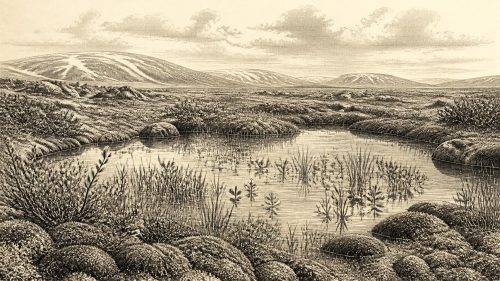
This was not a timeless frozen waste. Even a generally cold phase contained seasonal and regional contrasts. Low vegetation may have supported grazing and browsing animals in favourable places, while valleys and limestone country offered shelter, water and routes through the terrain. Derryvree near Maguiresbridge in County Fermanagh, although not securely tied to this exact date, preserves intertill organic deposits that show how freshwater pools, sedges, mosses and cold-adapted plants could survive within unstable glacial landscapes. Such evidence helps illuminate Irish environments broadly comparable to this phase, rather than describing north Cork on a particular day.
Sea level was lower than today, exposing more of the continental shelf and altering coastlines beyond recognition. However, the exact accessibility of Ireland from Britain and continental Europe at this moment remains uncertain. Changing sea levels, ice margins, tidal waters and exposed plains make simplistic claims about a continuous land bridge unsafe. If people did reach Ireland, they may have travelled through a shifting north-west European landscape that combined broad lowlands, water crossings and glacial barriers. The Irish evidence cannot yet determine their route.
People: A Possibility, Not a Population
The Castlepook femur opens a major question about the earliest human presence in Ireland. A stone-tool mark, if confirmed, would fit a world in which Upper Palaeolithic groups elsewhere in north-west Europe moved across large territories, using lithic tools and exploiting seasonally available animal resources. Reindeer could provide meat, fat, hide, sinew, antler and bone. Yet none of those uses, apart from the possible processing represented by the single mark, can be demonstrated at Castlepook itself.
It would be unjustified to turn that possibility into a story of an Irish tribe, settlement or migration. There is no evidence for a village, a named group, a social hierarchy, an established territory or continuous occupation. At most, the bone may record a brief incursion by a very small and highly mobile party, perhaps one that encountered, hunted or scavenged a reindeer. It cannot show whether visitors stayed for hours, days or a season; whether they returned; or whether they crossed from Britain, travelled along an exposed shelf, or came by another route.
The distinction matters because the better-attested record of human activity in Ireland is vastly later. At Alice and Gwendoline Cave in County Clare, a butchered brown-bear patella has calibrated dates around 12,890–12,678 cal BP, although its cave context has also prompted debate. Early Holocene settlement evidence, including Mount Sandel in County Londonderry, is later again. Castlepook would therefore push the possible human story back by many millennia, but its claim rests on a far narrower evidential base than those later horizons.
No Politics, Diplomacy or Ritual Record
Political affairs cannot responsibly be reconstructed for Ireland at this time. There are no known rulers, communities, boundaries, alliances, battles or diplomatic contacts. Nor is there evidence for religion, formal burial, art, language, teaching institutions or ritual practice in Ireland around this horizon. Absence of evidence is not proof that people lacked beliefs, speech, knowledge or social relationships; it means that Irish archaeology has not recovered material capable of describing them.
Likewise, there is no demonstrable trade network. The possible use of a stone tool would imply practical knowledge of cutting technology, but no associated tool survives at Castlepook and no source of stone can be linked to the femur. There is no basis for claims about exchange, craft specialisation or organised hunting. The only defensible economic description is ecological: large herbivores, predators and small cold-adapted mammals moved through an environment in which any human visitors, if present, would have depended on mobility and immediate local resources.
Ice Ahead
Whatever short-lived opportunities existed in this broad period, they were followed by increasingly severe glacial conditions. Research on the British–Irish Ice Sheet indicates extensive advance across Ireland and its offshore shelves later in the Last Glacial Maximum, especially after about 26,000 cal BP. Ice erosion and deposition transformed the terrain, helping to explain the scarcity of surviving open-air Palaeolithic evidence. Much of the physical Ireland visible today—its tills, drumlins, sands and gravels—was shaped or inherited from those later ice-sheet processes.
For 30,991 BCE, then, the responsible historical picture is not a dated event but a fragile window. Castlepook’s fauna proves that Ice Age animals inhabited or reached Ireland during the wider period. Its marked reindeer femur may preserve an exceptionally early human trace. Between those two statements lies the necessary discipline of deep-time history: evidence can enlarge Ireland’s past, but it cannot yet supply the people, places and episodes that later centuries record.
Primary Sources
- A Reconsideration of the Radiocarbon Dating of the Marine Isotope Stage 3 Fauna from Southern Ireland
- New Insights on the Fauna of Ireland’s Younger Dryas and Early Holocene from Alice & Gwendoline Cave
- The Irish Quaternary Fauna Project
- Late Pleistocene Chronostratigraphy and Ice Sheet Limits, Southern Ireland
- Radiocarbon Constraints on the Age of the Maximum Advance of the British–Irish Ice Sheet in the Celtic Sea
- Dimensions and Chronology of the Last Ice Sheet in Western Ireland
- Pattern and Timing of Retreat of the Last British-Irish Ice Sheet
- Radiocarbon Constraints on the History of the Western Irish Ice Sheet Prior to the Last Glacial Maximum
- Oscillating Retreat of the Last British-Irish Ice Sheet on the Continental Shelf Offshore Galway Bay, Western Ireland
- Timing and Pace of Ice-Sheet Withdrawal Across the Marine–Terrestrial Transition West of Ireland During the Last Glaciation
- The IntCal20 Northern Hemisphere Radiocarbon Age Calibration Curve (0–55 cal kBP)
- Bayesian Analysis of Radiocarbon Dates
- AMS Radiocarbon Dating of Ancient Bone Using Ultrafiltration
- AMS Radiocarbon Dating of Middle and Upper Palaeolithic Bone in the British Isles: Improved Reliability Using Ultrafiltration
- Freshwater Organic Deposits and Stratified Sediments Between Early and Late Midlandian (Devensian) Till Sheets at Aghnadarragh, County Antrim, Northern Ireland
- Mammoth and Musk Ox ESR Dated to the Early Midlandian at Aghnadarragh County Antrim, Northern Ireland and the Age of the Fermanagh Stadial
- Irish Quaternary Vertebrates
- Heritage Artefacts of County Cork
- The Mesolithic in Ireland: When Was It?
- Outreach and Education Resources
- Field Guides
- The Exploration of Castlepook Cave, County Cork
- The Exploration of the Caves of County Clare
- Late Pleistocene Glaciation of the Mourne Mountains, Northern Ireland