Awbeg Valley Reindeer Country30989 BCE
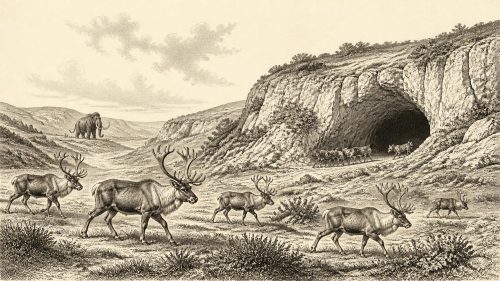
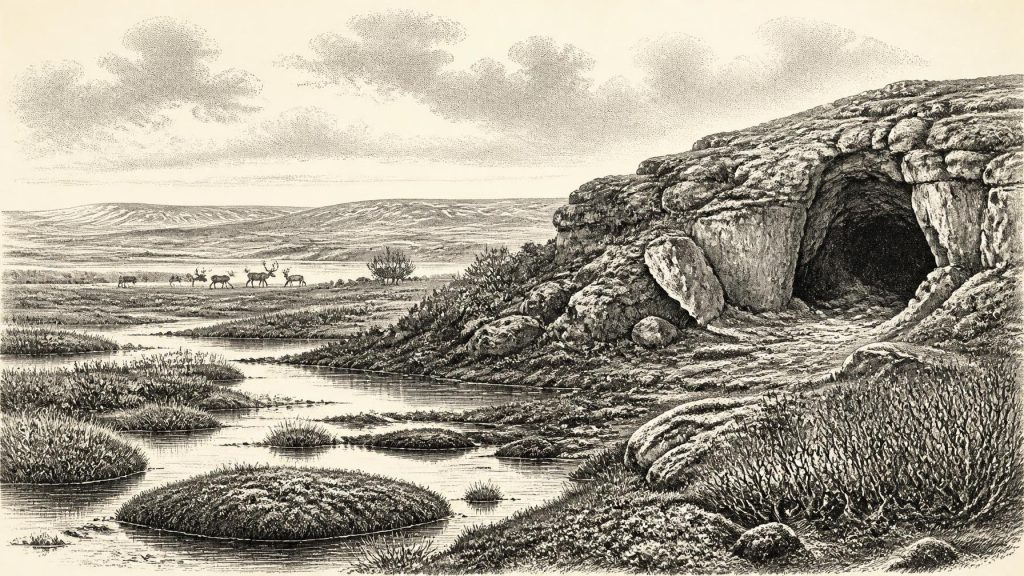
Around 30,989 BCE, Ireland was a climatically unstable Late Pleistocene landscape, not a place with recoverable annual history. Derryvree, County Fermanagh, preserves evidence of treeless tundra wetlands, with cold-adapted plants, insects and shallow freshwater habitats. Castlepook Cave, County Cork, contains remains of mammoth, reindeer, giant deer, predators and smaller northern animals, accumulated across several episodes rather than one event. A marked reindeer femur may record butchery by Upper Palaeolithic people, suggesting brief human presence, but no settlement, tools, hearths or burials are securely associated. Ireland remained ecologically connected intermittently with north-west Europe before advancing ice and changing seas restricted movement.
Dateline
30,989 BCE is not a date at which Irish history can be written year by year. It is a modern calendar label projected far beyond the reach of written records, annual chronologies or securely dated events. In archaeological terms it falls at about 32,900 calibrated years before present (cal BP, where “present” is 1950), within Marine Isotope Stage 3 of the Late Pleistocene. Dates from this depth of time carry substantial uncertainty: radiocarbon ages must be calibrated, deposits may represent long episodes rather than a single moment, and older excavations rarely recorded layers to modern standards. The responsible question is therefore not what happened in Ireland in one exact year, but what evidence illuminates the island during the broad interval around it.
A Cold, Changing Island
Ireland at this time belonged to the last Ice Age, but it was not yet simply the wholly ice-covered country familiar from images of the Last Glacial Maximum. The climatic sequence was unstable. Colder and somewhat milder phases altered the reach of ice, the extent of open ground, vegetation and animal movement. The later maximum expansion of the British–Irish Ice Sheet lay ahead, principally after about 27,000 cal BP, although ice was already an important and growing force in northern and upland parts of the region. One should not imagine a fixed national landscape: conditions varied sharply between sheltered lowlands, mountain margins, caves, wetlands and areas nearer advancing ice.
Sea levels were much lower than today because large quantities of water were held in continental ice sheets. Ireland’s coastlines and surrounding seas consequently differed radically from modern ones. Yet low sea level does not by itself demonstrate a dry land bridge usable by people or animals at every point. The Irish Sea basin, local ice masses, changing shorelines and routes across exposed or shallow terrain make the geography of movement difficult to reconstruct. Faunal evidence shows that large mammals did reach Ireland intermittently during the Late Pleistocene; the precise paths, timing and conditions of each arrival remain matters for investigation.
Derryvree’s Periglacial Wetland
The clearest environmental evidence relevant to this broad horizon comes from Derryvree near Maguiresbridge, County Fermanagh. Road cutting through a drumlin exposed freshwater silts and fine sands sealed between two tills: a rare survival of an organic landscape episode between glacial advances. The deposit produced a conventional radiocarbon age of 30,500 +1,170/−1,030 BP. That is not an exact equivalent of 30,989 BCE, and its calibrated age is a range rather than a point. It nevertheless places the deposit in the Middle Midlandian, or MIS 3, world broadly relevant to this article.
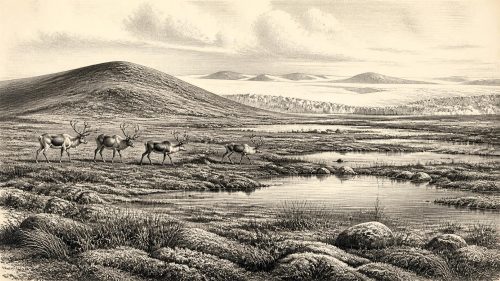
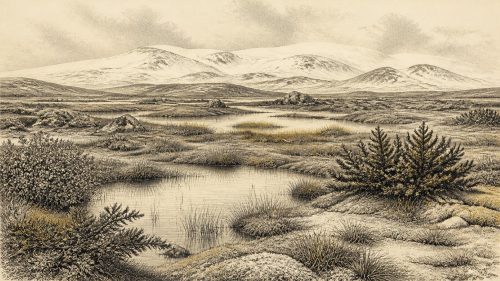
Its pollen, plant macrofossils, mosses and insects indicate an open, treeless tundra or muskeg environment: wet ground with shallow pools, sedges, mosses and herb-rich vegetation, affected by severe frost and short summers. Finds included plants adapted to cold, exposed conditions, among them dwarf willow, mountain avens, sedges, clubmosses and the aquatic bogbean. Such remains are evidence, not illustration. They establish that at least one part of Fermanagh supported freshwater habitats and sparse tundra vegetation during a cold interval. They do not allow us to map every hill, valley or coastline across Ireland in a single season.
Derryvree also cautions against treating Ice Age Ireland as lifeless. It was austere, but ecologically varied. Pools and wet hollows could sustain aquatic plants; mossy, waterlogged ground trapped pollen and insect remains; drier patches carried scattered herbs and grasses. The seasonal rhythm was probably exacting: long cold winters, frost-disturbed soils, limited woody cover and a brief growing period. There is no evidence here for farming, managed pasture or deliberate landscape clearance. This was a world shaped by climate, water, animals and ice rather than by settled human land use.
Castlepook’s Animal Archive
In the south, Castlepook Cave near Doneraile in County Cork is the key faunal archive. Also called Mammoth Cave, it lies in the Awbeg Valley beneath the Ballyhoura Hills. Excavations undertaken between 1904 and 1913 recovered a remarkable assemblage, but their early date matters: bones came from complex cave passages, sands, fissures and deposits disturbed over long periods by water, collapse, carnivores and excavation itself. Castlepook is therefore not a neatly sealed campsite or a single contemporaneous animal bone-bed.
Even with that warning, the cave demonstrates that Ireland was repeatedly part of a wider north-west European animal world before the Last Glacial Maximum. Its recorded cold-stage fauna includes woolly mammoth, reindeer, giant deer, brown bear, wolf, Arctic fox, mountain hare, stoat, collared and Norwegian lemmings, and spotted hyaena. Improved radiocarbon methods have revised some older measurements substantially, underlining why individual dates from historical collections must be treated carefully. The strongest conclusion is that the cave accumulated evidence from more than one Late Pleistocene episode, not that every species stood together in the Awbeg Valley in 30,989 BCE.
For the broad period around 32,900 cal BP, reindeer are particularly evocative but should not be romanticised. Their presence indicates open-country grazing opportunities and ecological connection with Britain and continental Europe. Mammoth and giant deer point to a large-herbivore fauna capable of exploiting cold landscapes, while lemmings and Arctic fox reinforce the northern character of parts of the environment. Spotted hyaenas are especially significant. Their bones, teeth and coprolites, together with gnawed material, suggest that caves could function as carnivore dens or scavenging places. A bone in Castlepook need not record where an animal died, nor even where it was first consumed.
The Marked Reindeer Femur
A reindeer femur from the Castlepook collection has transformed discussion of this period. It carries a deep linear modification interpreted by zooarchaeologist Ruth Carden as a cut or chopping mark made with a sharp stone implement on fresh bone. Public heritage material assigns the specimen broadly to about 31,000 BC, while news reporting has described it as approximately 33,000 years old. These are useful broad guides, not an annual date or a published stratigraphic horizon that can be equated precisely with 30,989 BCE.
If the mark is confirmed as humanly made and contemporary with the animal’s death, it is important evidence for Upper Palaeolithic processing of a reindeer in Ireland. It would imply at least a brief human incursion into the island during the last Ice Age, vastly earlier than the secure record of post-glacial settlement. It might represent hunters using a stone edge to dismember a carcass, perhaps somewhere outside the cave before a scavenger carried part of it inside. That is a reasonable interpretation of a modified animal bone; it is not evidence for a permanent village, a large population or a named people.
Equally important is what has not yet been found for this horizon. There is no securely associated hearth, stone-tool assemblage, dwelling floor, burial, art panel or repeatedly occupied camp published from Castlepook. There are no human bones. Recent excavation has sought intact deposits and further evidence, but the old collection cannot by itself resolve every question. The femur is best understood as a potentially momentous, tightly limited clue: it may record an action by one or more people, rather than continuous habitation.
Society Without States
Political affairs, diplomacy and warfare cannot responsibly be reconstructed for Ireland at this date. There were no known states, kingdoms, chiefs, boundaries or written agreements, and no evidence from Ireland for a local community with institutions that can be described in those terms. Nor is there evidence for religious monuments, formal burials, ritual practice, language, storytelling or teaching. Silence in the archaeological record is not proof that people lacked social lives or beliefs; it means that no specifically Irish evidence survives that can identify them.
If the Castlepook bone represents human activity, the most that can be inferred is a small, mobile group capable of using a stone cutting tool and exploiting a large animal. Comparable Upper Palaeolithic communities elsewhere in Europe possessed sophisticated knowledge of animal behaviour, weather, materials and seasonal movement. They made tools, clothing and shelters, and maintained social connections across considerable distances. Such wider European evidence provides context, but it must not be converted into an invented Irish camp, trade network, ritual system or artistic tradition. No Irish artefact of this age has yet established such particulars.
Movement, Not Trade
The relevant economy was ecological rather than commercial. Reindeer, mammoth, giant deer and smaller mammals moved through shifting habitats; carnivores followed prey and scavenging opportunities; any human visitors would have depended upon mobility, knowledge and portable technology. “Trade” is too strong a word for the evidence. There are no identified imports, exchange goods, quarries, workshops or routes in Ireland from around this date. What can be said is that animal dispersal and any possible human movement connected Ireland intermittently to the wider north-west European world before ice and changing seas later made those connections more difficult.
The chief development around 30,989 BCE was thus environmental precariousness. Ireland was an Ice Age landscape of open tundra, cold wetlands, caves, large herbivores and formidable predators, moving towards more extensive glaciation. Derryvree preserves a northern wetland snapshot; Castlepook preserves a southern faunal archive and perhaps a trace of human butchery. Together they offer a richer picture than an empty frozen island, while firmly limiting what can be claimed about people. This is not yet the history of an Irish society in the later sense. It is the deep prehistory of a changing island at the north-western edge of Eurasia.
Primary Sources
- A reconsideration of the radiocarbon dating of the Marine Isotope Stage 3 fauna from southern Ireland
- The Irish Quaternary Fauna Project
- A Middle Midlandian Freshwater Series at Derryvree, Maguiresbridge, County Fermanagh, Northern Ireland
- Palaeoecology: Field Guide
- Irish Pleistocene biostratigraphy
- First evidence of a Late Upper Palaeolithic human presence in Ireland
- Heritage Artefacts of County Cork
- Archaeology Research Excavation Grant 2022: Final Report
- Castlepook Cave, Co. Cork: Excavation Report 2022
- Sedimentary ancient DNA reveals Late Pleistocene faunal connectivity between Ireland and Eurasia
- Growth and retreat of the last British–Irish Ice Sheet, 31,000 to 15,000 years ago: the BRITICE-CHRONO reconstruction
- The timing and magnitude of the British–Irish Ice Sheet between Marine Isotope Stages 5d and 2
- Trimlines, blockfields and the vertical extent of the last ice sheet in southern Ireland
- The colonization of Ireland: A human ecology perspective
- New insights on the fauna of Ireland's Younger Dryas and Early Holocene from Alice & Gwendoline Cave
- Occurrence of mammalia relicts at site Castlepook Cave
- Pleistocene Vertebrates in the British Isles
- Castlepook Caves
- The exploration of Castlepook Cave, Co. Cork
- The Late Quaternary history of east-central Ireland