
The Castlepook Cut Mark30963 BCE
Around 30,963 BCE, Ireland’s evidence is environmental rather than historical, and the date falls only broadly within calibrated ranges. At Derryvree, County Fermanagh, organic sediments between tills document an ice-free interval, freshwater wetland, cold-adapted plants and insects, but not island-wide conditions. Castlepook Cave, County Cork, yielded diverse Late Pleistocene fauna, including reindeer, mammoth, giant deer and predators, accumulated over long periods. A reindeer femur, possibly bearing a stone-tool cut mark, may indicate Upper Palaeolithic butchery and a brief human visit. It cannot prove settlement. Falling temperatures preceded the Last Glacial Maximum, whose later ice substantially reshaped Ireland and obscured evidence.
Dateline
Modern calendar-year precision is not available for Ireland in 30,963 BCE. Nobody on the island left a written calendar, a named ruler, a settlement sequence or an event that can be assigned to that particular year. The number is a modern chronological label, equivalent in simple arithmetic to about 32,912 years before the radiocarbon convention of AD 1950, but it should not be confused with an archaeological date. The responsible setting is the later part of the Late Pleistocene, during Marine Isotope Stage 3 (MIS 3): a long, climatically unsettled phase of the last Ice Age before the fullest expansion of the Last Glacial Maximum.
The evidence is fragmentary, local and often difficult to date. Yet it shows that Ireland was not simply an empty sheet of ice throughout this era. In particular, buried freshwater sediments in County Fermanagh record an ice-free interval with cold-adapted plants and insects, while cave deposits in County Cork preserve the bones of animals that moved through a very different Irish landscape. One reindeer bone from Castlepook Cave has also raised the possibility of a much earlier human visit than was once accepted. It is an important possibility, not a licence to invent an Ice Age Irish community.
A Date Within a Broad Interval
The closest securely relevant environmental sequence is at Derryvree, near Maguiresbridge in County Fermanagh. Roadworks cut through a drumlin there in 1969 and exposed organic silts and fine sands trapped between two layers of till: the unsorted sediment deposited by glacier ice. The order of events is clear. Ice first occupied the locality and left the lower till; an interval without overriding ice allowed freshwater and organic sediment to accumulate; then a later ice advance buried the deposit beneath another till.
Organic material from the freshwater series produced a conventional radiocarbon determination of about 30,500 radiocarbon years before present, with a large uncertainty. Using modern calibration, this has been discussed as broadly about 36,900–31,700 calibrated years BP, or approximately 34,950–29,750 BCE. The requested year lies inside that wide span, but cannot be located in a particular layer, season or human lifetime. Calibration is essential because radiocarbon years are not identical to calendar years; at this depth of time, ranges are necessarily broad and liable to refinement as methods improve.
This distinction matters. Derryvree supplies direct evidence for a local sequence of water, sediment, vegetation and invertebrate life. It does not date an island-wide episode, prove that all of Ireland was ice-free at once, or identify what occurred in 30,963 BCE specifically. It is best understood as a rare surviving window into conditions between glacial episodes, preserved precisely because later ice sealed it.
Fresh Water Beneath the Drumlin
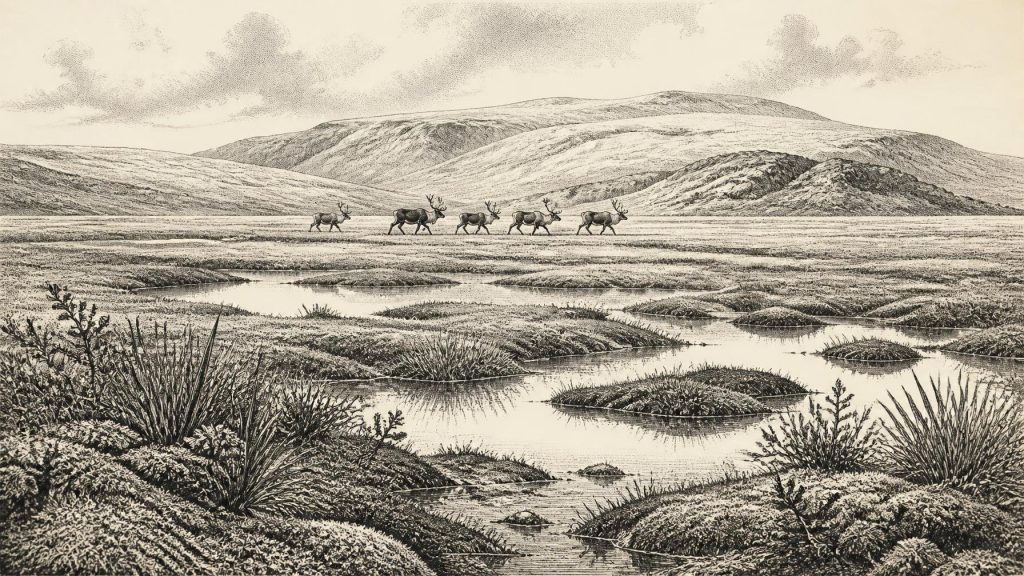
The Derryvree fossils make the Ice Age tangible. Pollen, plant macrofossils and insects indicate cold, open, wet ground rather than the oak-and-hazel woodland associated with much later Irish prehistory. Mosses, sedges, low herbs and dwarf shrubs could occupy saturated margins and exposed soil; aquatic plants signal standing or slowly moving fresh water. The deposits have been interpreted as a periglacial wetland or muskeg-like mosaic of pools, sedgebeds and waterlogged ground.
That reconstruction is an interpretation built from direct remains, stratigraphy and comparison with northern environments. The firm evidence is more limited but still impressive: a freshwater basin existed at Derryvree, plants grew around it, insects lived in and near it, and the locality was not then covered by glacier ice. Short growing seasons, severe winters, frost action and a generally treeless terrain are consistent with the fossil assemblage and wider glacial context. Familiar Irish fields, woodland, peat bog and settled lakeshore are not.
Other inter-till deposits in Fermanagh, including sites near Belcoo, support the larger conclusion that ice cover during the Midlandian cold stage was episodic and regionally varied. They do not make the regional picture simple. Much evidence has been eroded, redeposited or hidden beneath later glacial sediment, and the timing, thickness and extent of ice before the Last Glacial Maximum remain matters of active research. A wetland in Fermanagh is therefore not evidence for a uniformly hospitable Ireland from Cork to Donegal.
The Animal World of Castlepook
Far to the south, Castlepook Cave near Doneraile in north County Cork provides a complementary, though equally complicated, record. Excavations beginning in the early twentieth century produced an extraordinary collection of Late Pleistocene animal bones. Subsequent radiocarbon work by the Irish Quaternary Fauna Project demonstrated that Ireland supported a considerably richer mammal fauna between at least about 45,000 and 20,000 years ago than survives today.
Castlepook has yielded remains attributed to reindeer, woolly mammoth, giant deer, brown bear, wolf, Arctic fox, mountain hare, lemmings and spotted hyaena. This is not a roll call from one day, one season or one perfectly preserved ecosystem. Cave deposits accumulated over long periods. Carnivores dragged in carcass parts, gnawed bones and disturbed deposits; water, sediment movement and early excavation methods added further complications. A mammoth bone proves that mammoths reached the wider Irish landscape during the relevant broad interval, not that mammoths and every other recorded species stood together outside the cave in 30,963 BCE.
Even so, the assemblage demonstrates that cold-stage Ireland could sustain grazing animals, browsing animals, predators and scavengers. Reindeer in particular point to open country and seasonal mobility. Mammoth and giant deer evoke an extensive terrestrial world beyond the cave entrance, while hyaena remains warn against treating caves as straightforward human food stores. The cave was part of a landscape used and re-used by animals, not an excavated village.
The Reindeer Femur Question
Castlepook is especially important because a reindeer femur has been presented by palaeozoologist Ruth Carden and County Cork heritage publications as bearing a deep mark made with a sharp stone tool during butchery. The object is assigned approximately to 31,000 BCE, close to the modern label considered here. If the interpretation of the mark is correct, it would indicate that a person or people processed a reindeer in Ireland during the Upper Palaeolithic, vastly earlier than the long-established record of post-glacial settlement.
The finding must be described cautiously. The bone is a single artefact from an old cave assemblage, not a sealed camp floor. No securely associated stone tools, hearth, dwelling, burial, human remains or substantial concentration of butchered food waste of comparable age has been recovered. Nor does the bone establish whether hunters killed the animal, processed it at the cave, arrived as a larger group, stayed for days or weeks, or ever returned. Carcass remains may have been moved after butchery by carnivores or other natural processes.
The direct evidence is therefore a reindeer bone and a proposed stone-tool modification. A brief visit by mobile hunters following animal herds is a reasonable hypothesis, but it remains an inference. There is no basis for identifying a resident population, language, ethnicity, named archaeological culture or biological identity for any possible visitors. Later Ice Age glaciation probably destroyed or buried much of the evidence that might have resolved those questions.
Movement Without Known Routes
At this date, global sea levels were lower than today because immense volumes of water were held in continental ice sheets. This altered coastlines and widened some coastal plains. It does not, however, prove an easy, permanent land bridge between Ireland and Britain. The Irish Sea basin, changing relative sea level, local glaciers and the changing shape of exposed land complicate every proposed route. Animals evidently reached Ireland during the Late Pleistocene, but precisely how particular herds, predators or potential human visitors crossed remains unresolved.
There is no evidence for trade, maritime exchange, cultivated crops, domestic livestock or permanent farming settlements. Nor is there evidence from which to reconstruct political authority, diplomacy, warfare, formal religion, artistic traditions or systems of learning in Ireland at this point. Their absence from the account reflects the nature of the record, not a claim that all human thought or social relations were absent if people did visit. Archaeology simply cannot recover them from a possible cut mark and scattered environmental archives.
Approaching a Colder Ireland
Thirty thousand years ago, Ireland was moving towards the severe conditions of the Last Glacial Maximum, conventionally placed around 26,500–19,000 calibrated years BP. Later ice sheets reshaped much of the island, scouring bedrock, depositing till and erasing vulnerable surfaces. Modern reconstructions show that the growth and maximum extent of the British–Irish Ice Sheet varied between sectors rather than occurring as one instantaneous national event. The Fermanagh wetland and Cork fauna belong to the unstable pre-maximum world from which that later, more extensive glaciation emerged.
For Ireland around 30,963 BCE, the most defensible history is therefore environmental and provisional. Cold freshwater lay in at least one northern basin between episodes of ice. Open habitats supported plants and animals adapted to a demanding climate. Large mammals ranged across parts of the island over the wider period, and a reindeer femur from Cork may preserve Ireland’s earliest known trace of human action. Beyond that, silence is not a gap to be filled with invented chiefs, camps or ceremonies. It is the defining condition of Ireland’s deep past.
Primary Sources
- Outreach and Education Resources
- South Fermanagh: Irish Quaternary Association Field Guide 16
- The Quaternary of Northern Ireland: Irish Quaternary Association Field Guide 17
- The Irish Quaternary Fauna Project
- The Irish Quaternary Fauna Project
- Heritage Artefacts of County Cork
- The Archaeological Heritage of County Cork
- The IntCal20 Northern Hemisphere Radiocarbon Age Calibration Curve (0–55 cal kBP)
- Growth and Retreat of the Last British–Irish Ice Sheet, 31,000 to 15,000 Years Ago: The BRITICE-CHRONO Reconstruction
- Growth and Retreat of the Last British–Irish Ice Sheet, 31,000 to 15,000 Years Ago: The BRITICE-CHRONO Reconstruction
- BRITICE-CHRONO Maps and GIS Data of the Last British-Irish Ice Sheet 31 to 15 ka
- Late Pleistocene Chronostratigraphy and Ice Sheet Limits, Southern Ireland
- Trimlines, Blockfields and the Vertical Extent of the Last Ice Sheet in Southern Ireland
- Dimensions and Chronology of the Last Ice Sheet in Western Ireland
- Oscillating Retreat of the Last British-Irish Ice Sheet on the Continental Shelf Offshore Galway Bay, Western Ireland
- Response of the Irish Ice Sheet to Abrupt Climate Change During the Last Deglaciation
- Phylogeographic, Ancient DNA, Fossil and Morphometric Analyses Reveal Ancient and Modern Introductions of a Large Mammal: the Complex Case of Red Deer (Cervus elaphus) in Ireland
- First Evidence of a Late Upper Palaeolithic Human Presence in Ireland
- First Evidence of a Late Upper Palaeolithic Human Presence in Ireland
- The Mesolithic in Ireland: When Was It?
- New Insights on the Fauna of Ireland's Younger Dryas and Early Holocene from Alice & Gwendoline Cave
- Archaeological Excavations at Killuragh Cave, Co. Limerick