
Castlepook’s Fossil Corridor30964 BCE
At around 30,964 BCE, Ireland’s evidence records a broad, uncertain Late Pleistocene horizon rather than a datable year. Derryvree, County Fermanagh, preserves an ice-free interlude between glacial tills, when cold, treeless wetlands supported sedges, mosses, low shrubs, insects and freshwater life. Castlepook Cave, County Cork, contains Ireland’s richest cold-stage vertebrate assemblage, including mammoth, reindeer, giant deer, bear and hyaena, though its bones accumulated over extended periods. A cut-marked reindeer bone may indicate early human butchery about 33,000 years ago, but cannot prove settlement. The record chiefly reveals changing ice, habitats, animal movements and profound uncertainty across the island over time.
Dateline
Modern calendar-year precision is not available for Ireland in 30,964 BCE. No written calendar, settlement sequence or securely dated event can identify that particular year, and it would be misleading to pretend otherwise. The label is a modern chronological convenience: it falls roughly 32,913 years before AD 1950, the reference point conventionally used for “before present” dating. The responsible subject is therefore a broad Late Pleistocene interval, not an annual chronicle. Ireland lay within Marine Isotope Stage 3, a climatically unstable part of the last Ice Age, and the evidence comes chiefly from buried environmental deposits and animal remains rather than from human sites.
A Date Within a Range
The closest important Irish environmental record is at Derryvree, near Maguiresbridge in County Fermanagh. Roadworks exposed a drumlin whose internal layers preserved a striking sequence: an older glacial till below, freshwater sands and organic silts in the middle, and a later till above. Till is the unsorted debris left directly by glacier ice. The sequence therefore establishes a simple but valuable order of events: ice had covered the locality; an ice-free interval allowed water, sediment, plants and small animals to accumulate; then glacier ice returned and sealed the deposit beneath fresh debris.
Organic material from the Derryvree bed yielded the radiocarbon determination BIRM-166, conventionally reported as 30,500 radiocarbon years BP, with a substantial uncertainty. A radiocarbon age is not a calendar age. Atmospheric carbon-14 has varied through time, so results must be calibrated against independently dated records. At this depth of time, both the laboratory uncertainty and the shape of the calibration curve create broad probability ranges. Published discussion places the Derryvree deposit broadly around 36,900–31,700 calibrated years BP; a more recent regional ice-sheet model places its age at about 33,500 ± 1,200 calibrated years BP. The modern label 30,964 BCE lies within this general chronological window, but does not date the formation of a single pool, plant, animal death or human visit.
That distinction matters. The evidence can illuminate conditions across a long phase of late Ice Age change. It cannot supply a named leader, a battle, a ritual calendar or even a reliably reconstructed season for this numbered year.
Wet Ground Between Glaciers
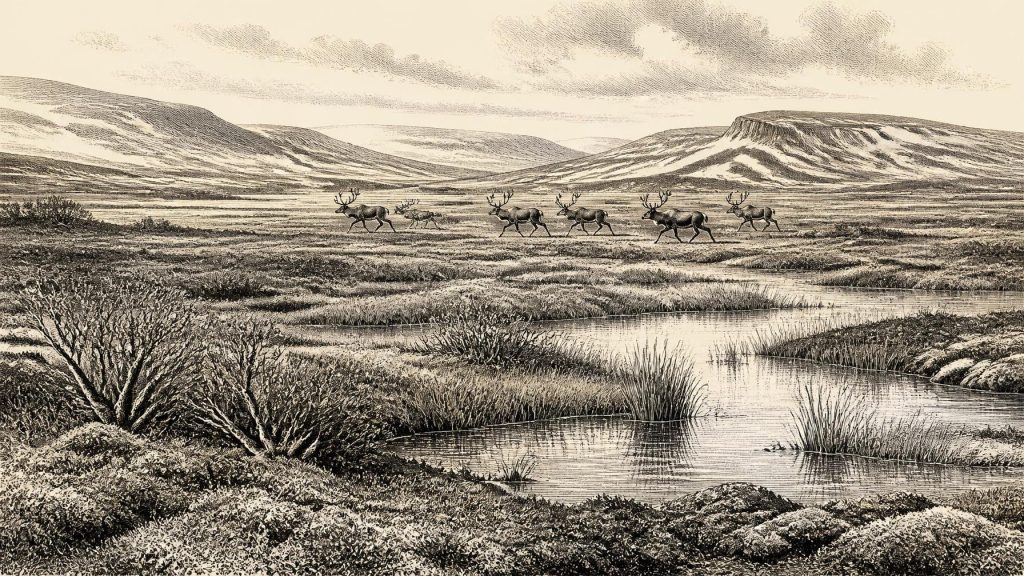
Derryvree is especially important because it offers a local landscape rather than a bare list of fossils. Its plant and animal remains indicate an open, treeless environment under periglacial conditions: ground shaped by intense cold, seasonal freezing and thawing, but not permanently covered by ice at the site. The deposit has been described as tundra or muskeg, a waterlogged mosaic of shallow pools, sedgy ground, mosses and low herbs. Fossil pollen, seeds and mosses include plants suited to cold, damp, exposed settings, among them bogbean, sedges, mountain-avens, dwarf willow, juniper and clubmoss.
This was not an Irish landscape of dense woodland, enclosed fields or familiar coasts. Its vegetation was low and patchy, responding to waterlogging, frost disturbance and short growing seasons. Insects and plant remains indicate freshwater habitats amid open ground. Yet Derryvree should not be treated as a miniature map of the whole island. It records one lowland location in Fermanagh during an interval that may have lasted many centuries or longer. Upland districts, western coasts and areas nearer active ice could have differed sharply.
The wider climate was not static. Marine Isotope Stage 3 was marked by abrupt shifts in temperature and ice extent across the North Atlantic world. Ireland was heading towards the much more extensive glaciation of the Last Glacial Maximum, but that maximum lay later. Around the broad horizon represented by Derryvree, conditions could include locally ice-free terrain, cold wetlands and open animal range, while glaciers persisted or re-advanced elsewhere. The apparent contradiction is the point: Ice Age Ireland changed rapidly by region and through time.
The Castlepook Animal World
For the larger animals of this period, the key Irish archive is Castlepook Cave, also known as Mammoth Cave, near Doneraile in north County Cork. Early twentieth-century excavations recovered more than 2,000 bones from its passages and chambers. The National Museum of Ireland and Geological Survey Ireland regard it as Ireland’s richest known cave assemblage for vertebrate life leading towards the Last Glacial Maximum.
The collection includes woolly mammoth, reindeer, giant deer, brown bear and spotted hyaena; other cold-stage finds include wolf, Arctic fox, Norwegian lemming, collared lemming and mountain hare. Together they demonstrate that Ireland was periodically accessible to a varied Pleistocene fauna. They do not prove that every species lived side by side, or even in the same century. Castlepook was a cave repository, not a neatly sealed campsite. Carnivores carried material in, water disturbed deposits, and excavations took place before modern recovery standards. Radiocarbon results from individual bones also span a long interval rather than one episode.
Spotted hyaena is particularly revealing. Its remains, including chewed bones and a skull, suggest that the cave functioned at least partly within a carnivore landscape: a place where carcasses could be dragged in, consumed, scattered and later reworked. A mammoth or reindeer bone in the cave is evidence that such animals reached southern Ireland; it is not automatically evidence that people hunted them there. The best reconstruction is of shifting open country supporting mobile herbivores and predators, with caves preserving only a distorted fraction of that world.
A Reindeer Bone and Human Possibility
One Castlepook find has transformed discussion of Ireland’s earliest human presence. A fragment of reindeer femur bears a deep mark interpreted by palaeozoologist Ruth Carden as having been made on fresh bone by a stone tool during butchery. It has been publicly reported as dating to about 33,000 years ago. If that interpretation is sustained, it is evidence that one or more people handled a reindeer carcass in Ireland during the wider period under consideration, far earlier than the formerly accepted post-glacial evidence for people on the island.
But the correct conclusion is deliberately narrow. A marked bone can indicate carcass processing; it cannot by itself demonstrate a permanent settlement, a population of known size, a language, an ethnic identity or an established route of migration. No associated hearth, stone-tool assemblage, dwelling floor, burial or art has yet been recovered from a securely dated Irish context of this age. Nor can the mark tell us whether people killed the animal, scavenged it, or processed it elsewhere before the bone entered the cave deposits.
It is tempting to imagine Upper Palaeolithic hunters following reindeer across a wide exposed plain. Such people elsewhere in north-west Europe possessed sophisticated stone technologies and deep knowledge of seasonally changing animal landscapes. Yet those wider European comparisons remain context, not direct proof for Ireland. At Castlepook, the evidence supports a possible fleeting human action, not a securely documented Irish community.
Society Without a Chronicle
Accordingly, political affairs, diplomacy and organised warfare are beyond the reach of the evidence. There are no polities to name and no grounds for projecting later Irish identities, “tribes” or territories into the Late Pleistocene. Religion, formal learning and artistic culture are equally undocumented in Ireland at this date. Absence of evidence does not prove that visitors had no beliefs, stories, skills or social ties; it means that the surviving Irish record cannot responsibly describe them.
The same caution applies to economy and trade. If the cut-mark interpretation is correct, the practical value of a reindeer is clear: meat, fat, hide, sinew and bone were potentially useful resources, and a sharp stone edge could divide tissue. This is an inference from the mark and from well-attested hunter-gatherer practices elsewhere, not proof of a local Irish hunting economy. There is no evidence for farming, herding, metalworking, pottery, markets or sustained exchange networks. Nor is there a basis for claiming a land bridge. Lower sea levels and changing ice altered the geography of the Irish Sea region, but the exact routes by which animals, and perhaps people, reached Ireland remain unresolved.
What This Horizon Means
For Ireland around the notional date of 30,964 BCE, the largest development was environmental. A cold, largely treeless island or archipelago contained wetlands such as Derryvree and, during suitable intervals, supported a remarkable large-mammal fauna in the south. The approaching growth of the British–Irish Ice Sheet would later bury, scour and destroy much of this evidence. That geological violence helps explain why the record is so sparse and why one silt bed or incised bone carries unusual weight.
This is not a year of kings, monuments or recorded decisions. It is a horizon revealed by silt beneath a Fermanagh drumlin and fossils in a Cork cave: evidence for a changing Ice Age environment, for animal movement into Ireland, and perhaps for one exceptionally early human encounter with a reindeer. The uncertainty is not a weakness to be edited away. It is the central historical fact.
Primary Sources
- A Middle Midlandian Freshwater Series at Derryvree, Maguiresbridge, County Fermanagh, Northern Ireland
- Exploring Controls of the Early and Stepped Deglaciation on the Western Margin of the British-Irish Ice Sheet
- Figure 6.— The Subdivision of the Quaternary Period in Ireland
- Castlepook Cave: County Geological Site Report
- Spotted Hyena Skull
- Archaeological Heritage of County Cork
- Heritage Artefacts of County Cork
- Exploration of Castlepook Cave, Co. Cork
- Pleistocene Vertebrates in the British Isles
- The Irish Quaternary Fauna Project
- Ireland’s Palaeolithic Archaeology – Fleeting Footprints in a Frozen Land
- Castlepook Cave, Castlepook South
- The IntCal20 Northern Hemisphere Radiocarbon Age Calibration Curve (0–55 cal kBP)
- IntCal Publications
- The Problem of a Late Quaternary Landbridge Between Britain and Ireland
- Deglaciation, Earth Crustal Behaviour and Sea-Level Changes in the Determination of Insularity: A Perspective from Ireland
- Pleistocene Rodents of the British Isles
- The Colonization of Ireland: A Human Ecology Perspective
- New Insights on the Fauna of Ireland's Younger Dryas and Early Holocene from Alice & Gwendoline Cave
- Mammals: National Museum of Ireland Natural History Collections
- Castlepook Caves
- Irish Caves Database: Mammoth Cave