
Derryvree’s Moss Assemblage30962 BCE
At about 30,962 BCE, Ireland lay within the climatically unstable MIS 3, before the Last Glacial Maximum. Derryvree’s Fermanagh freshwater deposits, sealed between glacial tills, document an interval of cold, largely open tundra and periglacial wetland conditions. Mosses, sedges, grasses and aquatic plants indicate pools, marshes and frost-affected ground, rather than familiar woodland. Crag Cave records episodic milder conditions, while Castlepook’s mixed fauna demonstrates cold-stage habitats supporting large mammals and predators. A possibly tool-marked reindeer bone suggests Upper Palaeolithic human activity, but remains unconfirmed and does not establish settlement. Later ice destroyed or buried much evidence, leaving exceptional environmental archives.
Dateline
Modern calendar-year precision is not available for Ireland in 30,962 BCE. Nobody on the island used a calendar of BCE years, and the surviving evidence cannot identify an event, a visit or an environmental change in one particular year. The date is best treated as a convenient point within the Late Pleistocene, during Marine Isotope Stage 3 (MIS 3), a long and climatically unsettled portion of the last glacial cycle. In calendar terms it is about 32,912 years before AD 1950. The strongest directly relevant Irish record is a dated environmental deposit whose calibrated range includes that point, rather than an annual historical chronicle.
A Date Within a Broad Range
The key evidence comes from Derryvree, near Maguiresbridge in County Fermanagh. Road works in 1969 cut through a drumlin and revealed freshwater silts, fine sands and organic muds lying between two substantial layers of till: unsorted debris laid down by glacier ice. The sequence establishes a clear relative history. Ice had occupied the locality; an interval then followed in which water, plants and small animals could leave deposits; later ice advanced and sealed the evidence beneath another till sheet.
Organic material from the freshwater series produced radiocarbon determination BIRM-166, 30,500 +1,170/−1,030 radiocarbon years BP. This is not the same thing as a calendar age. Atmospheric carbon-14 levels changed through time, so radiocarbon measurements must be calibrated using independently constructed curves. Published discussion of this determination gives a broad calibrated span of about 36,900–31,700 calendar years BP, or roughly 34,950–29,750 BCE. More recent ice-sheet modelling uses the deposit as evidence for ice-free conditions around this broad horizon. Thus 30,962 BCE falls plausibly within the Derryvree interval, but it cannot be assigned to a particular layer, plant, animal or day of wetland life.
Fresh Water Beneath the Drumlin
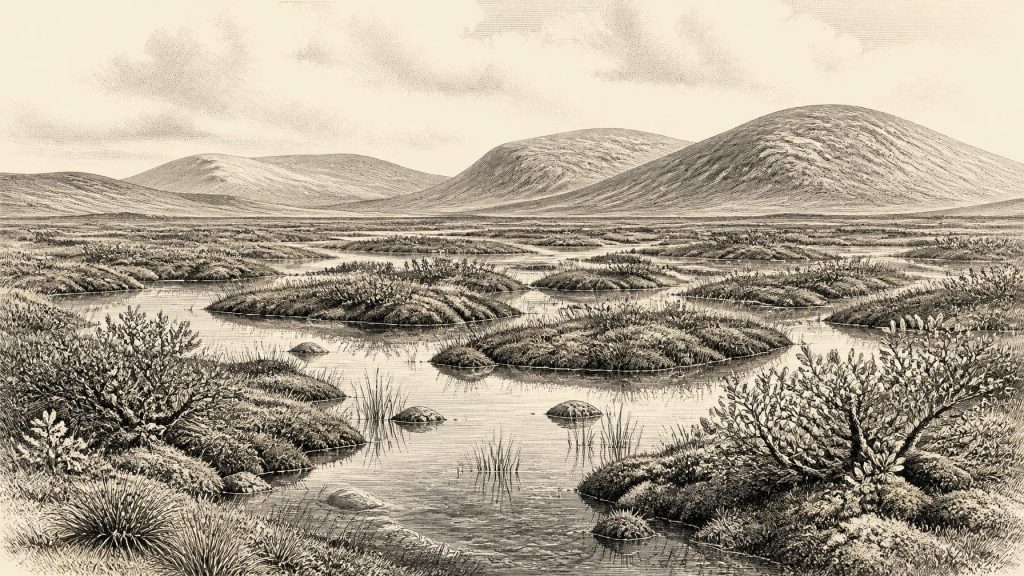
Derryvree is valuable precisely because so little evidence of this antiquity survived later glaciation. Its organic beds preserve pollen, plant macrofossils, mosses and invertebrate remains. Together, these indicate cold, largely open tundra vegetation and a periglacial regime: a landscape shaped by severe frost, seasonal freezing and thaw, saturated ground and short growing seasons, but not necessarily covered by glacier ice at that particular locality.
The record should not be turned into a photograph of the whole island. Pollen was poorly preserved, and isolated grains of pine and hazel do not demonstrate nearby woodland; wind transport or redeposition are possible. The firmer evidence is for herbaceous and wetland vegetation. Mosses, sedges and grasses accompanied plants associated with cold, open ground and shallow freshwater habitats, including mountain-avens, dwarf willow, lesser clubmoss, bogbean and water-milfoil. These remains suggest low vegetation around pools, marshy hollows and slow-moving water. They do not permit a detailed reconstruction of every slope or season.
For people accustomed to later Ireland’s wooded landscapes, Derryvree offers a strikingly different prospect. There were no oak woods, hazel scrublands, farm fields or blanket bogs of the familiar Holocene kind. Ground conditions may have changed rapidly across short distances: wetter vegetation in sheltered depressions, sparse herbs and grasses on better-drained surfaces, and frost-disturbed soil where winter cold penetrated deeply. Productive summer months could support plants and insects, while winter imposed far harsher constraints.
Ice Was Advancing, Not Yet Supreme
This was not the Last Glacial Maximum, the later period when the British–Irish Ice Sheet attained its greatest extent. The main maximum in and around Ireland came thousands of years afterwards, broadly between about 27,000 and 20,000 years BP, with important regional differences in timing and ice behaviour. At the horizon represented by Derryvree, Ireland was instead part of an unstable North Atlantic world in which glaciers, sea level, drainage and vegetation changed repeatedly.
Other evidence reinforces that caution. Uranium-thorium dating of broken and reworked speleothems at Crag Cave in County Kerry shows that cave calcite formed episodically during MIS 3. Calcite growth required percolating water and conditions not dominated by continuous deep permafrost or overriding ice above that cave. It is evidence for recurring milder phases in south-west Ireland, not proof that Crag Cave and Derryvree had identical weather or that the entire island was ice-free simultaneously. The responsible conclusion is regional variability: ice-free ground and freshwater habitats existed in some places during parts of MIS 3, while glacier growth was becoming increasingly important.
Castlepook’s Animal Archive
County Cork supplies a different kind of evidence. Castlepook Cave, also known as Mammoth Cave, near Doneraile contains Ireland’s richest known assemblage of vertebrate remains from the period leading towards the Last Glacial Maximum. More than 2,000 bones have been recovered from its passages and chambers. The assemblage includes woolly mammoth, reindeer, giant deer, brown bear, wolf, fox, mountain hare, collared lemming, Norwegian lemming and spotted hyaena.
These animals support the broader picture of a cold-stage landscape capable of sustaining large herbivores and formidable carnivores. Reindeer and lemmings particularly fit open, cold-adapted habitats; mammoth and giant deer indicate that, at least during suitable phases, Ireland contained enough forage and connected territory for large mammals. Spotted hyaena remains are especially significant because the cave seems to have served, at least in part, as a carnivore repository or den. A hyaena skull from Castlepook is held by the National Museum of Ireland.
Yet the cave must not be read as a single moment or a single living herd. Its fossils accumulated over a long period, were affected by carnivores and water movement, and were excavated under early twentieth-century methods that did not meet modern stratigraphic standards. Individual dates span many millennia. Castlepook therefore demonstrates a varied Late Pleistocene fauna in Ireland, but does not show that every recorded species lived together in 30,962 BCE, or that the Cork fauna precisely matched the Fermanagh wetland.
The Reindeer Bone Question
One Castlepook object has particular importance for human history: a reindeer femur reported to carry a deep mark interpreted as having been made on fresh bone by a sharp stone tool during butchery. The bone has been publicised as being about 33,000 years old. If the modification is confirmed as a human-made cut or chop and is contemporary with the animal’s death, it would be evidence that people reached Ireland in the Upper Palaeolithic, far earlier than the long-established record of post-glacial settlement.
The limits of that inference matter. A marked bone is not a settlement. Castlepook has not yielded a securely associated hearth, stone-tool assemblage, dwelling surface, burial, food store or repeated concentration of butchered animals of this age. Nor does one possible butchery episode reveal whether a person or small group stayed briefly, hunted repeatedly, crossed from Britain by a route now altered by sea-level change, or left descendants. The date of the animal is also not a calendar date for the cut itself. Around 30,962 BCE, human presence in Ireland must therefore be described as a significant but limited claim under continuing archaeological investigation, not as an established population history.
What Cannot Yet Be Written
There is no evidence for political affairs, named leaders, diplomacy, territorial states, warfare, organised religion, formal learning or trade networks in Ireland at this time. There are no known Irish houses, villages, farms, cultivated crops, pottery, monuments, graves or written records belonging securely to this horizon. It would be misleading to supply invented hunters’ camps, tribal identities, rituals or social rules merely because comparable practices are known elsewhere in Ice Age Europe.
If people did enter Ireland, the most that can responsibly be inferred is that they possessed the practical knowledge needed to survive in a cold, mobile landscape and perhaps to process a large animal with a stone edge. Even that inference rests upon the disputed interpretation of one bone modification. Derryvree, by contrast, records everyday ecological life more securely than human society: wet-ground plants growing, organic matter collecting in freshwater, insects inhabiting the margins, and winter cold repeatedly reshaping the terrain.
A Landscape of Evidence
The greatest development relevant to this date was environmental rather than political. Ireland was entering a phase of profound glacial transformation. Later ice would scour, bury and rearrange much of the surface on which any animals or people had moved, helping explain why the archaeological record is so fragmentary. The Derryvree beds survived because they were sealed within a glacial sequence; Castlepook’s bones survived because limestone caves protected them. Both are exceptional archives rather than typical samples of the ancient landscape.
For 30,962 BCE, then, Ireland is best understood through this conjunction of wetland silt, mosses, plant fossils, cave fauna, ice deposits and carefully qualified dating. The evidence establishes an intermittently ice-free, cold and ecologically active island region within MIS 3. It does not furnish a year-by-year narrative in the usual sense. Its history is the history of what endured: a Fermanagh freshwater world trapped beneath a drumlin, and a Cork cave preserving traces of animals—and perhaps, though not yet conclusively, people—on the threshold of a much larger advance of ice.
Primary Sources
- A Middle Midlandian Freshwater Series at Derryvree, Maguiresbridge, County Fermanagh, Northern Ireland
- Palaeoecology
- Figure 6.— The Subdivision of the Quaternary Period in Ireland
- Exploring Controls of the Early and Stepped Deglaciation on the Western Margin of the British Irish Ice Sheet
- Episodic Speleothem Deposition Tracks the Terrestrial Impact of Millennial-Scale Last Glacial Climate Variability in SW Ireland
- Spatio-Temporal Dynamics of Speleothem Growth and Glaciation in the British Isles
- Castlepook Cave
- Archaeological Heritage of County Cork
- Heritage Artefacts of County Cork
- Spotted Hyena Skull
- Occurrence of Mammalia Relicts at Site Castlepook Cave
- Pleistocene Vertebrates in the British Isles
- The Irish Quaternary Fauna Project
- Mammoth Cave
- 2022:564 – Castlepook Cave, Castlepook South, Cork
- Reindeer Bone Found in Cork Cave Shows Human Activity in Ireland 33,000 Years Ago
- Archaeology Research Excavation Grant 2022
- The Deglaciation of the Western Sector of the Irish Ice Sheet from the Inner Continental Shelf to its Terrestrial Margin
- Stratigraphic and Palaeo-Geomorphological Evidence for the Glacial-Deglacial History of the Last British-Irish Ice Sheet in the North-Western Irish Sea
- Deglaciation Chronology of the Donegal Ice Centre, North-West Ireland
- Quaternary Geological Map of Ireland
- Deposits of the Last Glaciation
- BSBI: Menyanthes trifoliata
- BSBI: Myriophyllum alterniflorum
- The IntCal20 Northern Hemisphere Radiocarbon Age Calibration Curve (0–55 cal kBP)
- IntCal20 Issue
- New Insights on the Fauna of Ireland’s Younger Dryas and Early Holocene from Alice & Gwendoline Cave