Muskeg Beneath Two Tills30900 BCE
Around 30,900 BCE, Ireland’s past is reconstructed from environmental evidence rather than records or communities. At Derryvree, County Fermanagh, organic wetland deposits between two glacial tills indicate a cold, treeless, tundra-like landscape of pools, mosses, sedges and Arctic-alpine plants during an interstadial interval. Ice margins, drainage and coastlines remained unstable, and conditions varied regionally. Cave remains, notably from Castlepook, County Cork, show diverse MIS 3 fauna, including mammoth, reindeer, giant deer and hyaena, though not necessarily contemporaneously. A cut-marked reindeer bone may suggest brief human activity, but cannot demonstrate settlement or continuous occupation. Dating permits only broad chronological ranges securely.

Dateline
The label 30,900 BCE is a modern point on a timescale, not a year that anyone in Ireland recorded or could have recognised. It corresponds approximately to 32,850 calendar years before AD 1950, the reference point conventionally used for ‘before present’ dating. At this depth in time, modern calendar-year precision is not available: radiocarbon results carry statistical uncertainty, require calibration, and generally identify intervals spanning centuries or millennia rather than a single season, let alone a named year.
The responsible subject is therefore Ireland during the later Pleistocene, in Marine Isotope Stage 3 (MIS 3), rather than an annual chronicle. The closest illuminating evidence is an organic deposit at Derryvree near Maguiresbridge, County Fermanagh. Its conventional radiocarbon age, 30,500 ± 1,200 radiocarbon years BP, calibrates broadly to about 36,900–31,700 cal BP, or roughly 34,950–29,750 BCE. The nominal year 30,900 BCE falls within that wide range, but no part of the deposit can be assigned securely to that particular year.
A Landscape Without a Chronicle
Ireland at this point was not the familiar island of later prehistory. There were no known farms, permanent villages, monuments, written languages, political territories or named peoples. Nor can archaeology recover a ruler, alliance, conflict or diplomatic encounter. Such categories depend upon human evidence that does not survive here for this period. What survives instead is a fragmentary natural archive: layers of silt and sand, pollen and plant macrofossils, insect remains, cave bones, and landforms remodelled by ice.
That archive is uneven. Later glaciers eroded, buried and redistributed much earlier ground, while many coastal landscapes of the period now lie beneath the sea. Ireland’s Late Pleistocene history must consequently be written with an unusual discipline. Sediment can demonstrate that water, vegetation or ice existed in a place; animal bone can show that a species reached an area; a modified bone may indicate human handling. None of these, by itself, proves a settled community, a particular route of arrival, or a continuous population across the island.
Derryvree’s Intervening Wetland
Derryvree is important because roadworks exposed a sequence beneath a drumlin. At its base lay till, the unsorted debris deposited by glacier ice. Above it were freshwater silts, sands and organic layers. Another till later sealed the sequence. This stratigraphy supplies a clear relative history: glacial ice had occupied the locality; a subsequent interval permitted standing or slow-moving freshwater and organic material to accumulate; then renewed glaciation covered the site again.
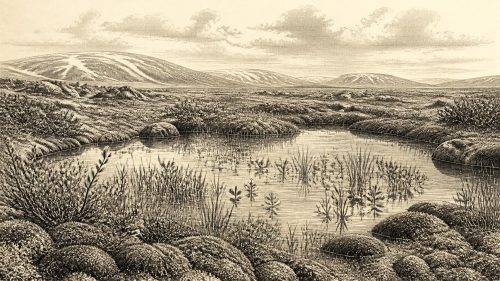
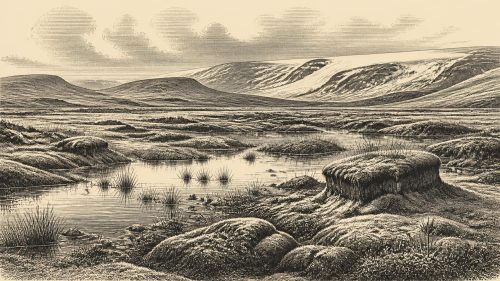
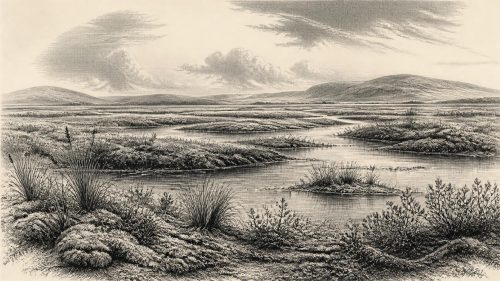
The intervening deposits have been described as a treeless muskeg environment: a wet, cold mosaic of shallow pools, saturated sediment, mosses and sedge-rich ground. Plant evidence includes grasses, sedges, herbs, juniper and Arctic-alpine taxa. Mosses were especially prominent. Insect evidence points towards open water and plant-rich wet ground. Together, these observations support a picture of exposed tundra-like wetland with a short growing season and severe winters. They do not establish a uniform climate for all of Ireland, whose terrain and proximity to ice margins would have created important regional variation.
The Derryvree record is also evidence against imagining the Ice Age as an uninterrupted white wilderness. Its landscape was certainly cold, but it included freshwater habitats capable of sustaining specialised plants and invertebrates. The term ‘interstadial’ can be misleading if taken to mean warmth comparable to the present. Here it denotes an interval less dominated locally by glacier ice, not a wooded or benign countryside. Trees were absent or extremely scarce; exposed ground, frost action and wet hollows were defining features.
Ice, Water and Changing Coasts
Thirty millennia ago, the British–Irish Ice Sheet was developing within a volatile climatic system. Reconstructions of its growth and later retreat show that ice margins did not advance everywhere at the same time or rate. Research on pre-Last Glacial Maximum ice also warns that the scale and timing of older advances remain incompletely resolved. It is therefore unsafe to state that the whole of Ireland was either ice-covered or ice-free in 30,900 BCE.
What can be said is more revealing than a simple map of ice. Derryvree records local conditions between glacial episodes, while other Irish deposits and landforms preserve evidence of cold, open environments and changing ice limits. These were not static landscapes. Ice altered drainage, dammed or diverted water, ground down bedrock and laid down till. Periglacial processes repeatedly froze and thawed soil. When fresh ice returned, it could erase habitats and preserve their remains only by burying them.
Lower global sea level also meant that the outlines of land and sea differed substantially from those of the modern Irish coast. Yet this should not be turned into a confident picture of a simple land bridge, a known shoreline or a routine migration corridor. Ice-sheet loading, changing sea level and local topography produced a complicated geography. The available evidence does not allow a precise reconstruction of how a person, animal or plant might have moved through every part of the Irish Sea region at this date.
Animals at the Western Edge
Cave deposits, particularly those at Castlepook Cave near Doneraile in north County Cork, provide the principal evidence for Ireland’s MIS 3 mammals. The broader faunal record includes woolly mammoth, reindeer, giant deer, brown bear, wolf, foxes, stoat, mountain or Arctic hare, lemmings and spotted hyaena. It is an arresting assemblage by modern Irish standards, but it must not be treated as a single herd or a single moment. Cave collections were accumulated over long periods, some were excavated more than a century ago, and their original contexts are often disturbed or poorly documented.
Recent redating has strengthened the conclusion that some Castlepook fauna belongs to MIS 3 and has also demonstrated the limits of older radiocarbon determinations. The evidence supports the presence of cold-adapted and open-country animals in Ireland during broad phases of the Late Pleistocene. It does not demonstrate that each species occupied every region simultaneously, or that Derryvree and Castlepook experienced identical conditions. A Fermanagh freshwater hollow and a Cork limestone cave were different environments separated by considerable distance.
For everyday ecology, the animal record implies seasonal movement, predation, scavenging and competition around scarce resources. Reindeer and giant deer required forage; hyaenas and wolves depended on animal populations; small mammals inhabited particular ground and vegetation conditions. These are ecological relationships, not evidence for an Irish economy in the later historical sense. There is no basis for describing pastoralism, agriculture, markets, craft production or long-distance trade at 30,900 BCE.
The Question of People
The most provocative possible human trace is a reindeer femur from the old Castlepook collection. It has been reported to carry a deep linear mark interpreted as damage made by a sharp stone tool while the bone was fresh. If that interpretation is confirmed, it may indicate that Upper Palaeolithic people butchered or otherwise processed a reindeer in Ireland during the wider MIS 3 period. It would be a major finding, extending the island’s possible human story far beyond the securely dated terminal-Pleistocene evidence from County Clare.
But the necessary cautions are substantial. The bone derives from an antiquarian collection rather than a modern excavation of an intact occupation surface. No associated hearth, stone-tool assemblage, dwelling floor, grave or repeated series of unambiguous butchered remains has yet established a resident population at Castlepook. Its dating and the bone modification should not be converted into a claim that people lived continuously in Ireland in 30,900 BCE. At most, the evidence raises the possibility of a brief human visit or activity episode within a much broader period.
If people did reach Ireland in this era, comparison with Upper Palaeolithic groups elsewhere in north-west Europe suggests mobile hunter-gatherers equipped to exploit large game and cope with severe seasonality. That is an interpretation drawn from wider European archaeology, not a directly demonstrated Irish social system. No Irish evidence from this horizon can identify kinship, language, leadership, gender roles, ritual practice, music, art, teaching or religious belief. Likewise, there is no evidence of warfare, diplomacy or formal political authority.
Knowledge Preserved in Mud
The strongest cultural achievement visible today is not an ancient monument but the survival of evidence itself. Derryvree’s silts and organic muds preserve a narrow environmental interval between ice advances; Castlepook’s bones preserve traces of animals that later vanished from Ireland; modern radiocarbon calibration allows scientists to translate laboratory ages into broad calendar ranges. Each improvement in excavation, bone pretreatment, dating and palaeoenvironmental analysis can revise the story.
For 30,900 BCE, then, Ireland’s history is chiefly environmental history. The evidence shows a cold, treeless and watery landscape in at least part of Fermanagh, positioned within an unstable Ice Age world of advancing and retreating glaciers. It shows that Ireland supported, at various times in the wider period, an unexpectedly diverse cold-stage fauna. It allows a carefully qualified possibility that people may have visited. It does not yield an annual event, a community or a polity. Respecting that distinction is not a limitation on the past; it is the means by which this exceptionally remote Irish past becomes intelligible.
Primary Sources
- A Middle Midlandian Freshwater Series at Derryvree, Maguiresbridge, County Fermanagh, Northern Ireland
- Irish Pleistocene Biostratigraphy
- Figure 6: The Subdivision of the Quaternary Period in Ireland
- References and Recommended Reading
- Soils of County Waterford
- A Reconsideration of the Radiocarbon Dating of the Marine Isotope Stage 3 Fauna from Southern Ireland
- The Irish Quaternary Fauna Project
- Growth and Retreat of the Last British–Irish Ice Sheet, 31,000 to 15,000 Years Ago: The BRITICE-CHRONO Reconstruction
- Growth and Retreat of the Last British–Irish Ice Sheet, 31,000 to 15,000 Years Ago: The BRITICE-CHRONO Reconstruction
- The Timing and Magnitude of the British–Irish Ice Sheet Between Marine Isotope Stages 5d and 2
- Pattern and Timing of Retreat of the Last British-Irish Ice Sheet
- Dimensions and Chronology of the Last Ice Sheet in Western Ireland
- The IntCal20 Northern Hemisphere Radiocarbon Age Calibration Curve (0–55 cal kBP)
- IntCal: International Radiocarbon Calibration
- Prehistoric Details
- Archaeology Research Excavation Grant 2022: Final Report
- 2022:564 – Castlepook Cave, Castlepook South, Cork
- Archaeological Heritage of County Cork
- Heritage Artefacts of County Cork
- First Evidence of a Late Upper Palaeolithic Human Presence in Ireland
- New Insights on the Fauna of Ireland’s Younger Dryas and Early Holocene from Alice & Gwendoline Cave