Castlepook’s Reindeer Season30814 BCE
Around 30,814 BCE, a modern filing label rather than a precise date, Ireland lay within the unstable, cooling later Marine Isotope Stage 3. Advancing and retreating ice, permafrost and changing sea levels created varied landscapes. Derryvree sediments in Fermanagh record treeless wetlands, tundra plants and freshwater habitats between glacial episodes. Castlepook Cave in Cork preserves reindeer, mammoth, giant deer, bears, wolves, Arctic foxes and hyaenas, indicating open cold country and past ecological connectivity. A possibly stone-cut reindeer bone may signal human activity about 33,000 years ago, but lacks secure context. Evidence confirms rich Pleistocene environments, while human settlement remains unproven.
Dateline
The label 30,814 BCE is useful only as a modern filing point, not as a date that people or animals in Ice Age Ireland could have recognised. No calendar, written record or archaeological sequence can resolve events on this island to an individual year at such depth. The responsible frame is the later part of Marine Isotope Stage 3 (MIS 3), within the Midlandian, Ireland’s regional name for the last glacial cycle. Ages are usually expressed as radiocarbon years before present, or as calibrated calendar ranges before present; both carry margins of error. Rather than a history of one year, this is a reconstruction of the changing Irish world broadly around the mid-to-late 30,000s before present.
A Land in an Ice-Age Transition
Ireland was not yet at the global Last Glacial Maximum, conventionally dated to about 26,500–19,000 years ago, but the climatic trajectory was already towards greater cold and expanding ice. The British–Irish Ice Sheet was a dynamic system, not a single fixed white blanket. Geological research indicates substantial Irish ice and major fluctuations before the Last Glacial Maximum, while continent-wide reconstructions show a general phase of ice-sheet growth from roughly 31,000 to 26,000 years ago. Consequently, no map can safely colour all of Ireland either wholly ice-covered or wholly ice-free for a point such as 30,814 BCE. Conditions differed sharply between regions and changed over spans far shorter than the duration of the glacial period.
For Ireland, this uncertainty matters. Later glaciers repeatedly scoured bedrock, redeposited sediment and destroyed or buried earlier landscapes. A cave deposit, a bed of lake silt, a shell-bearing coastal sediment or a boulder surface may each preserve a different portion of the story. The evidence establishes that the island was part of a cold North Atlantic world, subject to advancing and retreating ice margins, permafrost processes and changing sea levels. It does not permit a precise weather report for one notional year, nor does it show a stable national landscape in the way a modern map might imply.
Open Country and Cold Wetlands
The best inland environmental clue comes from Derryvree near Maguiresbridge in County Fermanagh. There, organic-rich freshwater silts were discovered between two tills: deposits left by ice on two separate occasions. The sequence demonstrates an interval when water, sediment, plants and small organisms accumulated after one glacial episode and before another. It is a powerful local record of interruption, not proof that all Ireland was ice-free simultaneously.
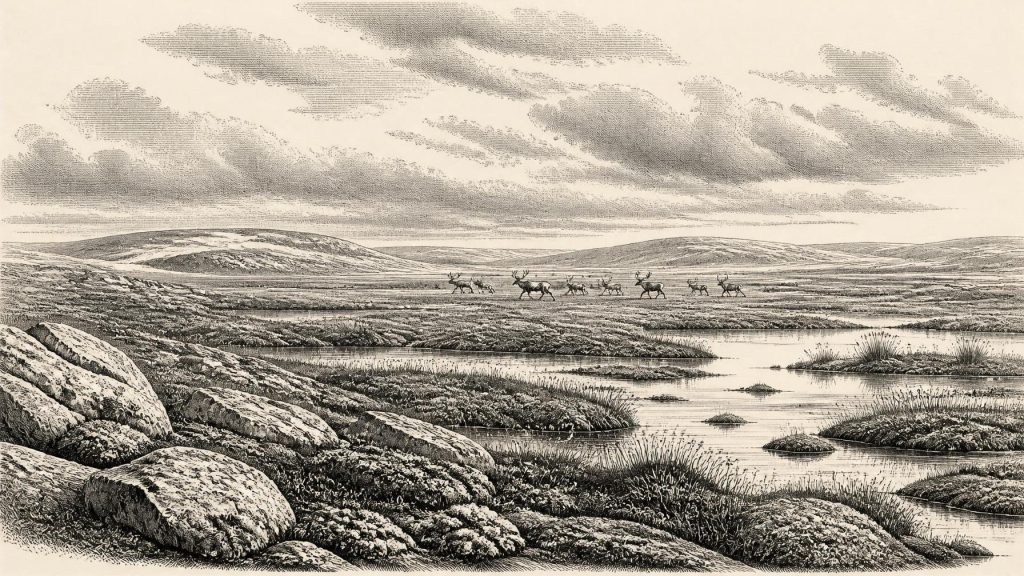
Its pollen, plant macrofossils and mosses indicate treeless, cold-country vegetation rather than woodland. Sedge-rich wet ground, shallow freshwater, mossy margins and hardy Arctic-alpine or tundra plants formed a landscape sometimes described as muskeg: waterlogged, peaty terrain in a severe climate. Plants recorded from such Middle Midlandian deposits include bogbean, dwarf willow, mountain-avens and lesser clubmoss, alongside aquatic and wetland taxa. This was not a bleak emptiness. It was a biologically active mosaic of pools, saturated soils, exposed mineral ground and low vegetation, but it was very unlike later forested Ireland.
Derryvree is particularly valuable because organic evidence is rare in Irish Pleistocene sequences. It provides direct evidence for local habitats; it cannot by itself date every species or reconstruct the whole island. Nevertheless, it makes clear that, at some points within MIS 3, northern Irish landscapes supported freshwater and terrestrial ecosystems between glacial advances. Around the broad horizon represented by 30,814 BCE, Ireland should therefore be understood as environmentally varied and unstable, with local refuges and open ground existing within a wider cooling world.
Castlepook’s Animal Archive
In the south, Castlepook Cave near Doneraile, County Cork, offers the principal faunal window. Excavations begun by Richard J. Ussher in the early twentieth century recovered a remarkable assemblage from the cave system, later joined by further finds. Reassessment and improved radiocarbon pretreatment have shown that some older determinations underestimated the antiquity of the material. The cave preserves evidence of a Pleistocene animal community including reindeer, woolly mammoth, giant deer, brown bear, wolf, Arctic fox and spotted hyaena. Not every specimen is necessarily contemporary with every other specimen, and the cave is an accumulated archive rather than a single living surface.
These animals point to open, cold habitats with large herbivores, scavengers and predators. Reindeer are well suited to tundra and open steppe-like country; Arctic fox and lemming remains reinforce the cold-climate signal. Mammoth and giant deer testify to the capacity of at least some Irish landscapes to sustain very large browsing or grazing mammals. Spotted hyaena is especially significant: it shows that Ireland’s Pleistocene carnivore community was once far richer than its recent fauna. Cave assemblages, however, may be shaped by carnivore activity, natural deaths, water movement and excavation history. They are evidence of animal presence, not a census of a single herd or season.
The wider implication is that Ireland was not ecologically isolated in the later historic sense. Fauna had reached it during earlier episodes of lowered sea level and altered geography, though the exact routes and timing varied by species and remain difficult to reconstruct. Lower sea level changed coastlines, but it does not justify casually assuming a simple, permanent land bridge from Ireland to Britain or continental Europe. The Irish Sea basin, ice margins and marine channels all mattered. Animal dispersal demonstrates connectivity over long timescales; it does not reveal the route taken by any particular group in any particular generation.
The Reindeer Bone Question
A reindeer femur fragment from Castlepook has brought this period unusual prominence. Public reporting in 2021 described a deep modification on the bone as a fresh-bone cut or chopping mark, plausibly made with a sharp stone tool, and associated the specimen with an age of roughly 33,000 years. If that interpretation is confirmed, it would be extraordinarily important: direct evidence that one or more Upper Palaeolithic people processed a reindeer in Ireland long before the well-established post-glacial settlement record.
Yet that conclusion must remain conditional. The bone came from collections formed during antiquarian excavations, not from a recently excavated occupation floor recorded to modern standards. No securely associated stone-tool assemblage, hearth, dwelling, human remains or repeated butchery horizon has yet established a Castlepook camp of this age. A modified bone, even if anthropogenic, records an encounter with an animal; it cannot demonstrate permanent settlement, population size, language, kinship, political organisation or continuous occupation. New excavation and analysis at Castlepook are important precisely because they may recover material in undisturbed context.
This distinction also corrects the temptation to describe a named hunting party or a dramatic kill. Reindeer may have been hunted, scavenged or encountered as carcasses. The mark’s form and the condition of the bone inform that question, but they do not identify the full sequence of events. It is appropriate to say that a possible human signal exists at Castlepook near this wider chronological horizon. It is not appropriate to write a year-specific story of Ireland’s first inhabitants as if it were settled fact.
Society Beyond the Evidence
There is no evidence for political institutions, diplomacy, territorial lordship, organised warfare, formal religion, monuments, farming, trade networks or literacy in Ireland at this time. Those absences are not merely gaps in the historical record; they reflect the kind of evidence presently available. If people did reach Ireland during MIS 3, they would have belonged to highly mobile Upper Palaeolithic hunter-gatherer societies known elsewhere in north-western Europe. That comparison can suggest broad possibilities—small groups, flexible movement, skilled stone-working and detailed environmental knowledge—but it cannot fill Ireland’s evidential silence with imported continental customs.
Nor can the Castlepook material establish an Irish economy. There is no demonstrated quarry, camp, exchange route, food-storage facility or repeated settlement pattern. The most secure economic facts concern non-human ecology: herbivores used the vegetation available in open country; carnivores exploited prey and carrion; cave spaces could act as traps, dens, shelters or repositories for bone. Should future work confirm human butchery, it would show practical use of animal resources and a technological capacity to employ sharp stone edges, but no more than that.
An Archive of Possibilities
The Ireland of this broad period was therefore a place of cold wetlands, open vegetation, large mammals, predators and advancing ice. Derryvree gives the environmental texture; Castlepook supplies the dramatic animal record; modern dating and glacial research provide the chronological framework. Together they overturn the old assumption that Ice Age Ireland was simply an empty, featureless frozen land. They do not, however, turn 30,814 BCE into a date of known human action.
The central historical lesson is methodological. The island’s deep past is reconstructed from sediments, bones, pollen, mosses, landforms and laboratory measurements, each with a limited reach. The evidence securely reveals a changing Pleistocene environment and a rich fauna. It suggests, but has not yet decisively proven, a human presence at Castlepook around this distant horizon. That boundary between observation and interpretation is not a weakness in Ireland’s earliest history. It is the discipline that allows the story to grow stronger when the next cave deposit, bone surface or buried wetland is properly dated and understood.
Primary Sources
- A reconsideration of the radiocarbon dating of the Marine Isotope Stage 3 fauna from southern Ireland
- Growth and retreat of the last British–Irish Ice Sheet, 31,000 to 15,000 years ago: the BRITICE-CHRONO reconstruction
- Radiocarbon constraints on the history of the western Irish ice sheet prior to the Last Glacial Maximum
- The timing and magnitude of the British–Irish Ice Sheet between Marine Isotope Stages 5d and 2: implications for glacio-isostatic adjustment, high relative sea levels and ‘giant erratic’ emplacement
- Dimensions and chronology of the last ice sheet in Western Ireland
- Exploring controls of the early and stepped deglaciation on the western margin of the British Irish Ice Sheet
- Timing and pace of ice-sheet withdrawal across the marine–terrestrial transition west of Ireland during the last glaciation
- The Last Glacial Maximum
- The IntCal20 Northern Hemisphere Radiocarbon Age Calibration Curve (0–55 cal kBP)
- A Middle Midlandian Freshwater Series at Derryvree, Maguiresbridge, County Fermanagh, Northern Ireland
- Figure 6—The subdivision of the Quaternary Period in Ireland
- Quaternary Site Descriptions
- The Irish Quaternary Fauna Project
- Occurrence of mammalia relicts at site Castlepook Cave
- Irish Caves Database: Mammoth Cave
- Archaeology Research Excavation Grant 2022: Final Report
- Excavations 2022: Castlepook Cave, County Cork
- The Archaeological Heritage of County Cork
- Heritage Artefacts of County Cork
- New insights on the fauna of Ireland’s Younger Dryas and Early Holocene from Alice & Gwendoline Cave
- First evidence of a Late Upper Palaeolithic human presence in Ireland