Juniper Marshland31627 BCE
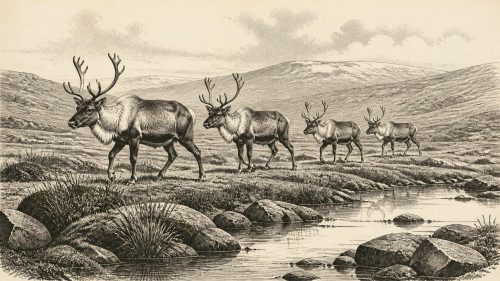
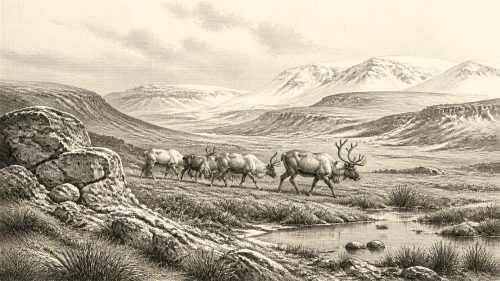
At the modern date 31,627 BCE, Ireland lay in the climatically unstable later Pleistocene, approaching the Last Glacial Maximum. Evidence is sparse and disrupted by later ice. Buried organic beds at Derryvree, County Fermanagh, indicate an ice-free interval with treeless, cold muskeg of mosses, sedges, herbs, dwarf willow and juniper. Castlepook Cave, County Cork, preserves remains of mammoth, hyaena, reindeer, giant deer and other fauna, indicating varied open habitats and links with wider Europe. A cut-marked reindeer femur may record human carcass processing, but cannot prove permanent settlement. No political, cultural or social history is recoverable; environmental change dominates here.
Dateline
The label “31,627 BCE” is a modern way of locating a point deep in prehistory, not a year that can be recovered from the Irish archaeological record. In the conventional system where “before present” is counted from 1950, it falls roughly 33,576 years ago. No written record, seasonal chronology, named individual or identifiable event permits calendar-year precision at this depth of time. The responsible history of Ireland at this point must therefore be framed through broader, calibrated chronologies and through fragmentary geological and fossil evidence.
That point lies within the later part of the Pleistocene, during Marine Isotope Stage 3: a long, climatically unstable interval of the last Ice Age. Ireland had not yet reached the fullest expansion of the last Irish ice sheet, generally placed at about 27,000–23,000 calibrated years before present. Yet it was already a cold, changing northern landscape, and its surviving record is exceptionally incomplete. Later ice, meltwater and erosion stripped away or rearranged many earlier deposits. What remains is not a continuous national story, but a handful of difficult archives: buried wetland sediments, cave bones, glacial landforms and, possibly, one modified animal bone.
A Marsh Between Ice Advances
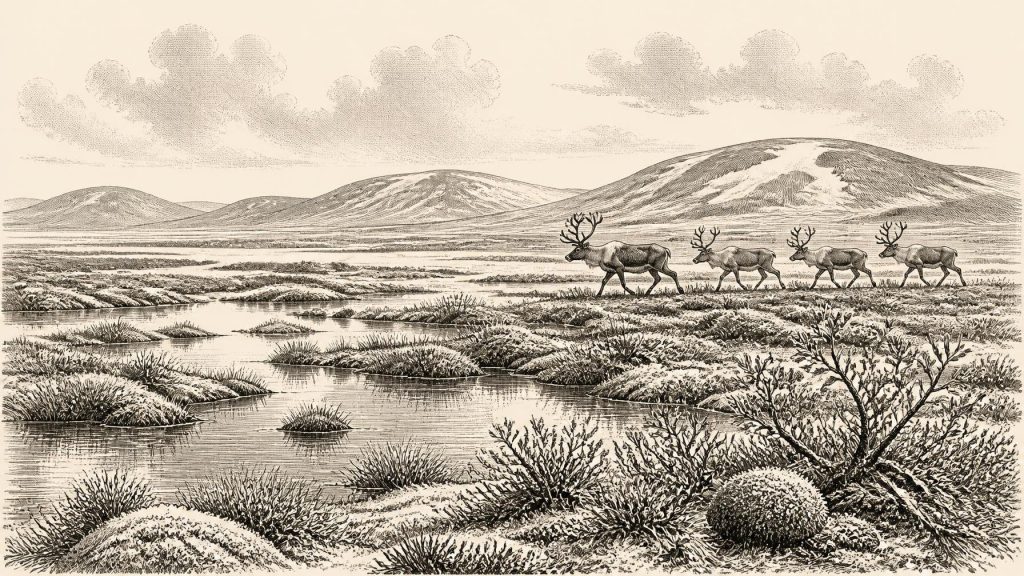
The clearest Irish environmental evidence relevant to this broad era comes from Derryvree, near Maguiresbridge in County Fermanagh. There, organic silts and sands were found between two deposits of glacial till. This stratigraphic position matters. It shows that, for a time, an ice-free or less ice-dominated environment developed after one advance and before a later one buried the deposits beneath fresh glacial material.
A radiocarbon determination from the Derryvree organic beds produced an age of 30,500 ± 1,100 radiocarbon years BP. Such an old result cannot be converted into one neat calendar date: calibration produces a range rather than a single answer, and the dated material belongs to a deposit accumulated over time. Nonetheless, it places the site broadly in the environmental world relevant to the thirty-fourth millennium before present, close enough to illuminate conditions around the modern label 31,627 BCE.
The plant and insect remains point to a treeless muskeg: a wet, peaty landscape of mosses, sedges, grasses, herbs and shallow pools. Fossils include plants associated with cold, open settings, among them dwarf willow and juniper. This was not an Irish landscape of later oak woodland, enclosed fields or boggy pasture. It was a seasonally severe terrain in which waterlogged hollows, frozen ground, exposed mineral soils and windswept vegetation existed beside one another. Cold winters are strongly indicated; summer warmth was sufficient for a living wetland community, but not for forest.
Derryvree also demonstrates a larger truth about the period. Ireland’s physical geography was unsettled. Ice masses expanded and contracted over millennia, while rivers, lakes and wet hollows formed, vanished and were overridden. The familiar outline of the island was not a reliable guide to its ancient habitats. Lower global sea levels exposed wider shelf areas, but the exact routes available to animals or people varied with sea level, ice, local relief and the persistence of marine channels. It is unsafe to picture a simple, permanent land bridge either to Britain or continental Europe.
Animals of the Cold Country
For evidence of animal life, Castlepook Cave near Doneraile in north County Cork is indispensable. Also known as Mammoth Cave, it is Ireland’s richest cave archive for Late Pleistocene vertebrates. Its collections, assembled principally during early twentieth-century excavations and later reassessed, include remains attributed to woolly mammoth, spotted hyaena, brown bear, wolf, reindeer, giant deer, foxes, hares and lemmings. Together they show that Ireland was, at intervals before the Last Glacial Maximum, part of a broader north-west European zone through which large mammals could disperse.
The cave should not be mistaken for a perfectly preserved snapshot of one day or one generation. Caves can be dens, traps, shelters, drainage channels and repositories for material dragged in by scavengers. Many Irish cave assemblages were excavated before modern standards of recording, and their deposits were disturbed or poorly documented. A mammoth bone, a hyaena bone and a reindeer bone from Castlepook cannot automatically be assumed to have been deposited in the same season, or even the same millennium. Radiocarbon results from old collections are vital, but they date individual specimens rather than an entire cave “occupation”.
Even so, Castlepook provides a compelling ecological outline. Reindeer and lemmings are especially suggestive of open, cold habitats; hyaenas, wolves and bears indicate a complex carnivore community; mammoths and giant deer attest to a landscape capable, at least intermittently, of sustaining large herbivores. The best interpretation is a mosaic rather than a uniform frozen desert. Open grassland, herb-rich ground, damp hollows and sheltered limestone country could support different species, while the severity and length of winter placed firm limits on plant growth and animal movement.
Recent sedimentary ancient-DNA work from Castlepook has added promising evidence for links between Irish animals and wider Eurasian populations. It has identified ancient DNA from a range of taxa and recovered mitochondrial sequences from Irish cave hyaenas and woolly mammoths. This research is currently a preprint rather than a peer-reviewed final publication, so its conclusions remain provisional. Its importance lies in reinforcing, rather than replacing, the fossil evidence: Ireland’s fauna was not wholly isolated, but belonged to changing Pleistocene networks beyond the present coastline.
The Reindeer Bone Question
One Castlepook object has particular relevance to any account of this era: a reindeer femur bearing a deep linear mark interpreted by zooarchaeologist Ruth Carden as damage made by a sharp stone tool while the bone was fresh. County Cork heritage publications have presented the bone as dating to about 31,000 BCE and as evidence that Palaeolithic hunters butchered reindeer in Ireland. If that interpretation is confirmed through continuing specialist study, it would be an extraordinarily early indication of human activity on the island.
The claim must be stated carefully. The specimen is not from a modern excavation of an undisturbed occupation floor. No securely associated hearth, stone-tool assemblage, dwelling, burial, human bone, ornament or repeatedly used campsite of comparable age has been found in Ireland. The radiocarbon age of an animal bone establishes when the animal lived and died; it does not by itself date the cut, identify the place of killing, prove that the animal was hunted rather than scavenged, or establish how long people remained in the vicinity. Identifying a mark as human-made is also a specialist judgement, requiring alternatives such as carnivore damage, sediment movement and later breakage to be excluded.
The most defensible conclusion is therefore limited but significant. Around the broad period represented by 31,627 BCE, Ireland may have been visited by Upper Palaeolithic people who processed a reindeer carcass. That possibility is not evidence for a permanent population. It cannot support a named culture, a settled territory, a continuous ancestry or an Irish “first community” at this date. The reindeer femur is an invitation to further fieldwork, especially at Castlepook, rather than a licence to fill the archaeological silence with certainty.
No Politics, but a Human Question
There is no basis for describing political affairs, diplomacy, warfare, leadership, law, language or ethnic identity in Ireland at this point. None of the institutional evidence that would make such subjects meaningful exists. Nor is there evidence for domestic settlements, food stores, farming, exchange networks, seafaring technology, ritual monuments or formal religious practice. Agriculture lay tens of thousands of years in the future. The later monuments, myths and languages often associated with Irish antiquity have no demonstrable connection to this Ice Age landscape.
If people were present, comparison with better documented Upper Palaeolithic groups elsewhere in north-west Europe suggests that they would have been highly mobile hunter-gatherers dependent on close knowledge of animal behaviour, weather, fuel and shelter. But that is an interpretation drawn from neighbouring regions, not a reconstruction demonstrated by Irish finds. Ireland provides no excavated camp from which to infer group size, social organisation, clothing, hunting equipment, art or belief. The absence of evidence is partly the result of destructive glaciation and submerged landscapes; it is nevertheless a real limit on what can be claimed.
Approaching the Great Freeze
The most important long-term development was environmental, not political. Ireland was moving towards the Last Glacial Maximum, when the Irish component of the British–Irish Ice Sheet expanded across much of the land and continental shelf. Research indicates that the southern Irish coast remained ice-free until after about 45,700 calibrated years BP and before the later major advance, but the detailed timing and extent of ice growth varied by region. Within several thousand years of the point represented here, conditions would become far less hospitable and much of the evidence for earlier landscapes would be sealed beneath or erased by ice.
Thus Ireland around 31,627 BCE was neither a familiar island society nor an empty abstraction. It was a cold, biologically active and unstable Pleistocene landscape: mossy Fermanagh wetlands lay between episodes of glaciation; Cork caves accumulated the remains of animals from open-country ecosystems; and a single marked reindeer bone raises the unresolved possibility of human contact. The scale of the uncertainty is itself part of the history. At this depth of time, Ireland’s past survives not in annals or monuments, but in silts beneath drumlins and bones in limestone darkness.
Source References
Hover over a number to see the source. Select it to open the source.

- [1] The colonization of Ireland: A human ecology perspective
- [2] First evidence of a Late Upper Palaeolithic human presence in Ireland
- [3] New insights on the fauna of Ireland's Younger Dryas and Early Holocene from Alice & Gwendoline Cave
- [4] Quaternary Science Reviews 339 (2024) 108827
- [5] The Irish quaternary fauna project
- [6] Irish Pleistocene biostratigraphy
- [7] Figure 6.— The subdivision of the Quaternary Period in Ireland
- [8] Irish Quaternary Association Field Guide 16
- [9] Castlepook Cave: Cork County Geological Site Report
- [10] Heritage Artefacts of County Cork
- [11] Archaeological Heritage of County Cork
- [12] Ireland: Submerged Prehistoric Sites and Landscapes
- [13] Advances in Irish Quaternary Studies
- [14] Response of the Irish Ice Sheet to abrupt climate change during the last deglaciation
- [15] Maximum extent and dynamic behaviour of the last British–Irish Ice Sheet west of Ireland
- [16] The deglaciation of the western sector of the Irish Ice Sheet from the inner continental shelf to its terrestrial margin
- [17] Timing and pace of ice-sheet withdrawal across the marine–terrestrial transition west of Ireland during the last glaciation
- [18] Growth and retreat of the last British–Irish Ice Sheet, 31,000 to 15,000 years ago: the BRITICE-CHRONO reconstruction
- [19] The problem of a late quaternary landbridge between Britain and Ireland
- [20] Occurrence of mammalia relicts at site Castlepook Cave
- [21] Sedimentary ancient DNA reveals Late Pleistocene faunal connectivity between Ireland and Eurasia
- [22] Phylogeographic, ancient DNA, fossil and morphometric analyses reveal ancient and modern introductions of a large mammal: the complex case of red deer in Ireland
- [23] Reindeer bone found in Cork cave shows human activity in Ireland 33,000 years ago
Primary Sources
- The colonization of Ireland: A human ecology perspective
- First evidence of a Late Upper Palaeolithic human presence in Ireland
- New insights on the fauna of Ireland's Younger Dryas and Early Holocene from Alice & Gwendoline Cave
- Quaternary Science Reviews 339 (2024) 108827
- The Irish quaternary fauna project
- Irish Pleistocene biostratigraphy
- Figure 6.— The subdivision of the Quaternary Period in Ireland
- Irish Quaternary Association Field Guide 16
- Castlepook Cave: Cork County Geological Site Report
- Heritage Artefacts of County Cork
- Archaeological Heritage of County Cork
- Ireland: Submerged Prehistoric Sites and Landscapes
- Advances in Irish Quaternary Studies
- Response of the Irish Ice Sheet to abrupt climate change during the last deglaciation
- Maximum extent and dynamic behaviour of the last British–Irish Ice Sheet west of Ireland
- The deglaciation of the western sector of the Irish Ice Sheet from the inner continental shelf to its terrestrial margin
- Timing and pace of ice-sheet withdrawal across the marine–terrestrial transition west of Ireland during the last glaciation
- Growth and retreat of the last British–Irish Ice Sheet, 31,000 to 15,000 years ago: the BRITICE-CHRONO reconstruction
- The problem of a late quaternary landbridge between Britain and Ireland
- Occurrence of mammalia relicts at site Castlepook Cave
- Sedimentary ancient DNA reveals Late Pleistocene faunal connectivity between Ireland and Eurasia
- Phylogeographic, ancient DNA, fossil and morphometric analyses reveal ancient and modern introductions of a large mammal: the complex case of red deer in Ireland
- Reindeer bone found in Cork cave shows human activity in Ireland 33,000 years ago