

Cork’s Reindeer Butchery31512 BCE
Around 31,512 BCE, Ireland was a fluctuating, cold MIS 3 landscape rather than a uniformly ice-covered wilderness. Dating cannot identify events in a precise calendar year, and evidence is fragmentary after glacial erosion. Freshwater deposits at Derryvree, Fermanagh, show locally open tundra wetlands with hardy vegetation between 36,900 and 31,700 years ago. Castlepook Cave, Cork, preserves diverse fauna including reindeer, mammoth, giant deer, predators and smaller cold-adapted animals. Cutmarks on a reindeer femur, dated about 33,000 years ago, may record Ireland’s earliest human butchery. They suggest brief mobile hunter visits, not settlement, while routes, cultural identity and continuity remain unknown.
Dateline
The label 31,512 BCE gives a useful point of orientation, but it cannot describe a recoverable Irish calendar year. For this depth of time, archaeologists work with radiocarbon determinations, stratigraphic sequences and calibrated ranges, each carrying margins of error. In conventional conversion, this numbered year falls roughly 33,462 years before AD 1950, within the later part of Marine Isotope Stage 3 (MIS 3), a fluctuating cold interval before the Last Glacial Maximum. The responsible question is therefore not what happened in Ireland in that exact year, but what the surviving evidence can tell us about the island during the broader period around 35,000–30,000 calibrated years ago.
An Island Between Cold Phases
Ireland was not yet the uniformly ice-covered landscape often imagined by reference to the later peak of the last glaciation. The maximum expansion of the last British–Irish Ice Sheet lay later, principally around 26,000–21,000 years ago, although its precise growth and regional configuration remain matters of active research. Around the notional date represented here, ice, snowfields, meltwater and frost processes were important forces, but local conditions could differ greatly from one part of the island to another. An ice-free wetland in Fermanagh does not prove that all Ireland was simultaneously ice-free; equally, evidence for advancing ice elsewhere cannot by itself describe every valley or lowland.
This unevenness is fundamental. Subsequent glaciers eroded, redeposited and buried older deposits, removing many possible traces of landscapes, animals and people. Ireland’s early Upper Palaeolithic record is therefore exceptionally fragmentary. It preserves intervals and places rather than a continuous national narrative. The absence of a house floor, hearth or tool scatter is not evidence that no person ever entered the island; it is, however, a firm reason not to invent a settled population, named community or year-specific event.
Derryvree’s Wet Ground
The closest major environmental evidence comes from Derryvree near Maguiresbridge, County Fermanagh. There, organic freshwater deposits survived between glacial tills beneath a drumlin. Their conventional radiocarbon determination, about 30,500 ± 1,100 radiocarbon years BP, has been calibrated in published discussion to a broad range of approximately 36,900–31,700 calibrated years BP. That range embraces the approximate chronological position of 31,512 BCE, but it is a range, not a date stamp on a particular season or generation.
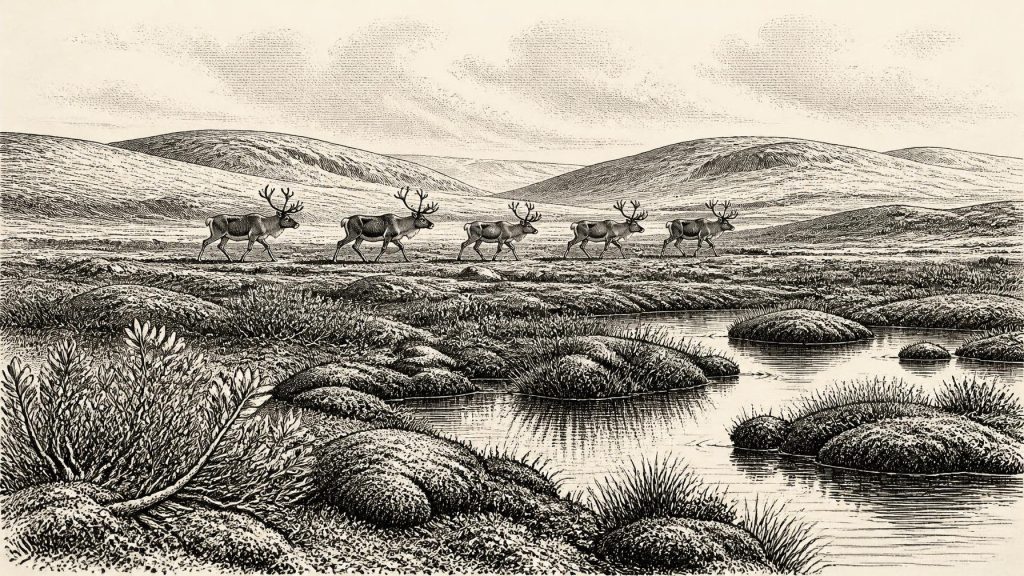
Pollen, plant macrofossils, mosses and insect remains from the Derryvree sequence point to open, treeless or very sparsely wooded ground with wet hollows and shallow freshwater. Sedges, mosses, bogbean, water-milfoil, dwarf willow, juniper and cold-adapted herbs indicate a tundra or muskeg-like mosaic rather than modern Irish pasture or woodland. The useful image is not an empty white wilderness: it is a low, exposed landscape in which pools, seepages and waterlogged ground could support resilient vegetation, while frost, wind and a short growing season set strict limits on productivity.
That evidence illuminates environment rather than human society. It shows that at least one part of northern Ireland could sustain freshwater life during a colder interval of the last glacial cycle. It does not establish a permanent village at Derryvree, nor demonstrate that its plants and insects formed a single unchanging community across thousands of years. Deposits accumulated over time, and their organisms reflect changing local conditions. Nevertheless, they provide a rare glimpse of the kind of refuges that could exist between major advances of ice.
Castlepook and the Reindeer Bone
The most consequential evidence for possible human activity is far to the south at Castlepook Cave, near Doneraile in north County Cork. This limestone cave system, historically known as Mammoth Cave, produced Ireland’s most important assemblage of pre-Last Glacial Maximum vertebrate remains. Its deposits have yielded reindeer, woolly mammoth, giant deer, brown bear, wolf, foxes, mountain hare, lemmings and spotted hyena. The cave was repeatedly accessible to animals and carnivores, while sands, fallen blocks and stalagmite floors divide or disturb its deposits. It is an archive of a changing landscape, not a neatly sealed snapshot.
Recent reassessment of Irish cave fauna has also shown why caution is needed. Improved pretreatment and redating can alter older radiocarbon results, and animals represented in the same cave were not necessarily contemporaries. Some Castlepook material belongs broadly to MIS 3; individual specimens span substantial chronological intervals. Thus it would be wrong to place mammoths, hyenas, giant deer and every reindeer bone together in one imagined scene for 31,512 BCE.
One reindeer femur fragment from Castlepook bears deep marks interpreted as the result of cutting or chopping with a stone tool. Reported in 2021 as dating to roughly 33,000 years ago, it has been presented as evidence that people were active in Ireland far earlier than the long-accepted post-glacial settlement record. If that interpretation is sustained, it indicates a brief visit by Upper Palaeolithic hunters or butchers, rather than proof of a continuous population. A cutmarked bone can show contact between people and an animal carcass; it cannot reveal the number of people involved, their language, identity, route of arrival or whether they returned.
Hunting, Not a Known Settlement
The reindeer bone is nevertheless important because it changes the scale of reasonable possibility. Reindeer were a mobile, cold-adapted resource, providing meat, fat, hide, sinew, antler and bone. Across north-western Europe, hunter-gatherers followed seasonal animal movements and made sophisticated use of stone, wood, hide and other perishable materials. A small party reaching Cork might have carried a portable toolkit and left little behind. Caves could offer shelter, a landmark or a place where carcasses were processed, but there is no securely dated Irish hearth, dwelling, grave, food store or diagnostic stone-tool industry of this age.
It follows that no specific cultural label should be imposed upon Ireland at this point. Upper Palaeolithic communities on the European mainland developed distinctive technologies, ornaments, images and social networks, but Castlepook has not produced the artefactual sequence required to assign its possible visitors securely to one of those traditions. The cautious conclusion is narrower and more valuable: humans may have made short incursions into a habitable Irish landscape before the later ice expansion, probably in connection with large-game procurement.
Everyday life, if people were present, would have been organised around mobility and risk. Clothing, windbreaks, fires and knowledge of animal behaviour would have mattered more than fixed architecture. Waterlogged patches could be dangerous under thin ice; caves could be occupied by hyenas or bears; weather could change access to prey and routes. These are informed comparisons with Upper Palaeolithic lifeways elsewhere, not direct observations of an Irish camp. Ireland supplies no evidence for farming, pottery, metalworking or permanent fields at this date.
Animals, Predators and Open Country
The fauna from Castlepook makes clear that Ireland could support more than a handful of hardy survivors during parts of MIS 3. Reindeer and lemmings suit open, cold conditions; mammoth and giant deer point towards productive grass-herb vegetation in at least some landscapes; wolf and spotted hyena indicate a carnivore guild able to exploit large herbivores and carrion. Hyenas in particular may have accumulated bones in the cave, complicating any effort to identify human agency from bone damage alone. The contrast between Fermanagh’s wetland plants and Cork’s cave fauna suggests a patchwork of habitats rather than one uniform ‘mammoth-steppe’ across the island.
There are important absences as well as presences. The fossil record is shaped by preservation, discovery and nineteenth- and early twentieth-century excavation methods. Castlepook is unusually rich because caves protect bones; open-air sites are much less likely to survive glacial erosion. A species not found in the Irish record cannot automatically be declared absent from the island, but neither can it be inserted into a reconstruction simply because it lived in Britain or continental Europe.
No Politics, No Proven Diplomacy
Conventional historical headings such as politics, conflict and diplomacy have little direct application here. There were no states, kingdoms, written agreements or known leaders in Ireland. Nor is there evidence for territorial warfare. The most meaningful forms of negotiation may have been ecological: moving through a landscape shared with competing predators, choosing safe routes, and deciding when a carcass or shelter was worth the danger. If small human groups crossed to Ireland, their journeys imply knowledge of the wider north-west European world, but the nature of any crossing remains unresolved. Lower global sea levels did not automatically create a simple dry land bridge across every part of the Irish Sea, and regional ice and relative sea level made routes complex.
There is likewise no direct evidence for religion, ritual, art, schooling, formal trade or exchange within Ireland around this time. Personal ornament, story, teaching and spiritual practices were certainly possible among contemporaneous hunter-gatherers elsewhere, but possibility is not proof. The enduring cultural achievement visible in the Irish record is instead scientific: stratified mud, pollen grains, animal collagen, cave sediments and cutmarks allow later investigators to reconstruct a world otherwise erased by ice.
A Briefly Habitable Ireland
For the period around 31,512 BCE, Ireland should be understood as a changing frontier within the North Atlantic glacial world. Derryvree demonstrates that freshwater wetlands and tundra vegetation existed locally during a late MIS 3 interval. Castlepook preserves evidence for a diverse cold-climate fauna and, potentially, the earliest known human butchery activity on the island. Neither site permits a conventional annual chronicle. Together, however, they replace an older image of an entirely lifeless, permanently sealed Ireland with one of episodic habitability: wet ground, open country, large animals, dangerous carnivores and perhaps small parties of people whose passing left almost no trace.
Primary Sources
- The Irish quaternary fauna project
- A reconsideration of the radiocarbon dating of the Marine Isotope Stage 3 fauna from southern Ireland
- The exploration of Castlepook Cave, County Cork
- Castlepook Cave
- A Middle Midlandian Freshwater Series at Derryvree, Maguiresbridge, County Fermanagh, Northern Ireland
- Figure 6.— The subdivision of the Quaternary Period in Ireland
- Late Pleistocene chronostratigraphy and ice sheet limits, southern Ireland
- Radiocarbon constraints on the age of the maximum advance of the British–Irish Ice Sheet in the Celtic Sea
- New data for the Last Glacial Maximum in Great Britain and Ireland
- Growth and retreat of the last British–Irish Ice Sheet, 31,000 to 15,000 years ago: the BRITICE-CHRONO reconstruction
- Dimensions and chronology of the last ice sheet in Western Ireland
- Deglaciation chronology of the Donegal Ice Centre, north-west Ireland
- Stratigraphic and palaeo-geomorphological evidence for the glacial-deglacial history of the last British-Irish Ice Sheet in the north-western Irish Sea
- Response of the Irish Ice Sheet to abrupt climate change during the last deglaciation
- The problem of a late quaternary landbridge between Britain and Ireland
- Sea-level change and inner shelf stratigraphy off Northern Ireland
- Holocene sea levels, Last Glacial Maximum glaciomarine environments and geophysical models in the northern Irish Sea Basin, UK
- Prehistoric Details
- Archaeological Heritage of County Cork
- 32564: Castlepook Cave, Castlepook, Cork
- The Quaternary of Western Ireland. INQUA Field Guide Pre:GL-2
- Irish Quaternary Association Publications
- Reindeer bone found in Cork cave shows human activity in Ireland 33,000 years ago