
Castlepook’s Reindeer Trace31579 BCE
Labelled 31,579 BCE, this period in Ireland belongs broadly to Marine Isotope Stage 3, not a datable calendar year. Before the Last Glacial Maximum, fluctuating cold conditions, low sea levels and changing routes linked Ireland intermittently with wider Europe. Derryvree sediments in Fermanagh record ice-free, waterlogged tundra vegetation and insects. Castlepook Cave in Cork preserves a disturbed important fauna, including reindeer, mammoth, giant deer, horse, predators and mammals. A marked reindeer femur, 33,000 years old, may indicate stone-tool butchery and Ireland’s earliest human visit. However, it proves neither hunting nor settlement; evidence remains fragmentary, and future study may revise conclusions.
Dateline
The label 31,579 BCE cannot denote an event in Ireland on a particular day, season or calendar year. No calendar, written record or year-by-year archaeological sequence exists for this depth of time. As a simple modern arithmetic conversion it falls about 33,529 years before 1950, but that is not itself a laboratory date. The responsible historical frame is a broad part of the later Pleistocene, within Marine Isotope Stage 3 (MIS 3), before the fullest growth of the last British–Irish Ice Sheet. Evidence for Ireland comes in uneven fragments: buried freshwater sediments, pollen and plant remains, insects, cave bones, ice-scoured landscapes and radiocarbon measurements with substantial uncertainty. They illuminate changing environments and occasional animal movements, not an annual chronicle.
A Changing Ice-Age Island
Around this notional date Ireland stood in the long cold interval generally called the Midlandian in Irish Quaternary studies and the Devensian in Britain. MIS 3 was not a single, uniform winter. It lasted roughly from 59,000 to 25,000 years ago and contained repeated abrupt shifts between colder stadials and relatively milder interstadials. The precise condition of every Irish region at 31,579 BCE cannot be reconstructed. Nor can a climatic change recorded in Greenland ice necessarily be transferred, year for year, to Cork, Fermanagh or the western seaboard.
What can be said is that the island was approaching, rather than yet living through, the Last Glacial Maximum. The maximum extent of the last ice sheet is generally placed considerably later, around 27,000–23,000 calibrated years before present in Ireland and adjacent seas. Earlier ice advances had already transformed the landscape, and later ice would override or disturb much of what survived. This is one reason why the Irish record is so sparse. The absence of campsites, tools and hearths from this period does not prove that no person ever set foot on the island, but it emphatically prevents claims for a settled population.
Sea level was far lower than today because vast quantities of water were locked in continental ice sheets. Ireland was not therefore the familiar Atlantic island of the modern map. The Irish Sea basin was reduced and reshaped, while coastal plains now drowned lay beyond present shores. Yet low sea level should not automatically be translated into an easy, continuous land bridge or a simple migration route. Ice margins, rivers, marshes, exposed sediment, sea ice and changing channels all affected movement. Connections to Britain and north-western Europe varied over time, and the routes available to animals need not have been equally passable to people.
Derryvree’s Cold Wetland
The closest Irish environmental evidence relevant to this broad period comes from Derryvree, near Maguiresbridge in County Fermanagh. Roadworks there exposed freshwater silts and fine sands sealed between tills beneath a drumlin. Organic material from the deposit produced a radiocarbon determination of 30,500 ± 1,170/1,030 radiocarbon years BP. It is not an annual date and it should not be treated as a precise match for 31,579 BCE; calibration at this antiquity yields wide ranges, while the deposit itself accumulated over time. Nonetheless, it securely belongs to the later part of MIS 3 and offers an unusually valuable Irish glimpse of a landscape that was ice-free locally before later glacier advance.
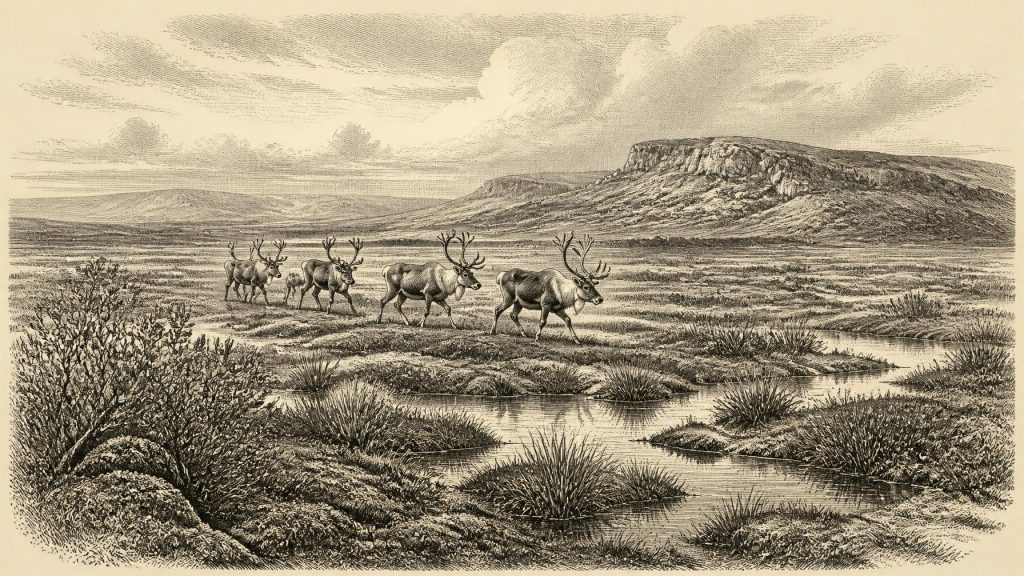
Plant macrofossils, pollen and insect remains indicate a cold, open and waterlogged environment. Mosses, sedges, grasses and herb-rich vegetation grew around shallow freshwater pools and channels: a tundra-like muskeg rather than woodland. Dwarf willow and other low plants could exploit the brief productive season. The record does not support an image of an entirely lifeless frozen waste. Water flowed, plants flowered and insects occupied wet ground. But it does rule out the closed oak-and-hazel woods associated with much later Ireland.
Even this picture needs restraint. Pollen can travel long distances, be redeposited from older sediment, or survive unevenly. A grain of pine or hazel pollen is not proof of a nearby forest. Derryvree is also one locality, not a complete map of the island. Its importance lies precisely in showing that the glacial world included local ecological opportunities: wetland habitats capable of supporting plant and animal life amid a generally severe climate.
Castlepook and the Animal Record
County Cork supplies the most evocative evidence. Castlepook Cave, near Doneraile in the Awbeg valley, is Ireland’s richest known cave archive for vertebrate fauna from before the Last Glacial Maximum. Early excavators recovered a very large collection, but antiquarian methods, subsequent loss of material and disturbance by water mean that the cave is not a neatly layered snapshot. Bones may have been moved within the system, introduced by carnivores, or collected without the precise contextual records expected today.
Nevertheless, direct dating and re-examination show that a striking range of large and small mammals reached Ireland during parts of MIS 3. The pre-maximum fauna associated with Castlepook includes reindeer, woolly mammoth, giant deer, horse, brown bear, spotted hyaena, wolf, Arctic fox, mountain hare, stoat and lemmings. These species did not necessarily live together at one moment, and their presence in a cave does not show that all occupied one small district. Taken collectively, however, they demonstrate that Ireland was intermittently part of wider north-west European ecological networks.
Reindeer are particularly apt indicators of open, cold-adapted grazing landscapes. Mammoths and giant deer imply extensive food resources during suitable phases, while hyaenas and wolves point to predators and scavengers operating across the same wider terrain. A cave assemblage is often a record of carnivore behaviour as much as of the animals hunted or eaten by people. Hyaenas may drag portions of carcasses into dens; bears can die in caves; flowing water can redeposit bones. Castlepook should therefore be understood as an archive of animal movement, death and bone accumulation over many millennia, rather than as a single Ice-Age hunting camp.
The Marked Reindeer Femur
One reindeer femur fragment from Castlepook gives this period exceptional historical interest. It has been reported as dating to about 33,000 years ago and carries a deep linear mark that zooarchaeologist Ruth Carden has interpreted as a cut or chopping mark produced on fresh bone by a sharp stone implement. County Cork heritage material accordingly presents the find as evidence that Stone Age hunters may have been stalking reindeer in Ireland around 31,000 BCE.
If that interpretation is sustained by continued specialist study, it would represent Ireland’s earliest known indication of human activity by a very large margin. It would suggest that a person or a small party processed a reindeer during an Upper Palaeolithic visit, perhaps taking meat, marrow, hide, sinew or other useful tissues. It does not establish that the animal was hunted rather than scavenged, that people lived in the cave, or that a community remained in Ireland across generations. No securely associated stone-tool assemblage, hearth, dwelling floor, human burial or repeated butchery surface has yet been published for the episode.
The caution is not pedantry but method. The femur derives from an old collection rather than a modern, sealed excavation context. Natural breaks, tooth damage, trampling and excavation damage can sometimes resemble human modification; conversely, a genuine cut mark must be assessed microscopically and in relation to the bone’s surface, anatomy and taphonomic history. The bone’s age dates the animal, not automatically the precise moment at which the mark was made or the time at which it entered the cave. It is a powerful trace, but a trace rather than proof of permanent settlement.
No Polities, but Possible Journeys
At this date there is no evidence for Irish political institutions, territories, chiefs, diplomacy, warfare, religion, language, art or formal learning. Terms such as tribe, kingdom and nation are not merely unknown; they are inappropriate for the available record. Nor can archaeology recover an everyday social world from a single modified bone. The material evidence does, however, make small-scale human mobility conceivable. Upper Palaeolithic groups elsewhere in north-west Europe were highly mobile hunter-gatherers whose knowledge of animal movements, seasonal weather, stone resources and safe routes was essential to survival.
Should people have reached Ireland during this phase, their presence was probably brief and contingent on a favourable combination of weather, terrain and animal availability. A visit could have involved a very small group, with little durable material left behind. Their technologies would have depended on perishable materials as well as stone: wood, hide, fibre, sinew and bone rarely survive in exposed Irish landscapes of this age. This is an inference from comparative Upper Palaeolithic archaeology, not a direct description of a Castlepook group.
What the Evidence Allows
The most important development around 31,579 BCE was environmental, not political. Parts of Ireland were capable, at certain times in MIS 3, of supporting cold-adapted wetlands and substantial mammals before the later ice-sheet maximum. Derryvree preserves the botanical signature of one such northern environment; Castlepook preserves an extraordinary, if complicated, faunal archive in the south. Together they overturn any notion that prehistoric Ireland was simply blank beneath permanent ice throughout the entire last cold stage.
Yet the history remains deliberately incomplete. There is no basis for narrating a village, a migration, a battle or a ritual in this nominal year. The responsible conclusion is more modest and more remarkable: Ireland was a shifting Ice-Age landscape of open ground, wet hollows, large herbivores and predators, periodically connected to wider European worlds. A reindeer bone from Castlepook may preserve the faintest sign that people also entered that landscape. Future excavation of undisturbed cave sediments, improved dating and microscopic analysis may strengthen, alter or overturn that interpretation. For now, the reindeer trace marks a question at the beginning of Irish human history, not a settled answer.
Primary Sources
- The Irish Quaternary Fauna Project
- New Insights on the Fauna of Ireland's Younger Dryas and Early Holocene from Alice & Gwendoline Cave
- Castlepook Cave, County Geological Site Report
- Heritage Artefacts of County Cork
- Palaeoecology: IQUA Field Guide
- The Subdivision of the Quaternary Period in Ireland
- Introduction to the Late Quaternary and Holocene of Northern Ireland
- Radiocarbon Constraints on the History of the Western Irish Ice Sheet Prior to the Last Glacial Maximum
- Radiocarbon Constraints on the Age of the Maximum Advance of the British-Irish Ice Sheet in the Celtic Sea
- Timing and Pace of Ice-Sheet Withdrawal Across the Marine-Terrestrial Transition West of Ireland During the Last Glaciation
- Timing and Pace of Ice-Sheet Withdrawal Across the Marine-Terrestrial Transition West of Ireland During the Last Glaciation
- Dimensions and Chronology of the Last Ice Sheet in Western Ireland
- Landscapes and Environments of the Last Glacial-Interglacial Transition: A Time of Amazingly Rapid Change in Ireland
- The Colonization of Ireland: A Human Ecology Perspective
- Irish Quaternary Vertebrates
- 2022:564 – Castlepook Cave, Castlepook South, Cork
- UCD School of Archaeology Research Day 2022
- The IntCal20 Northern Hemisphere Radiocarbon Age Calibration Curve (0-55 cal kBP)
- IntCal Data
- Ireland's Palaeolithic Archaeology – Fleeting Footprints in a Frozen Land
- Reindeer Bone Found in Cork Cave Shows Human Activity in Ireland 33,000 Years Ago
- Early Deglaciation of the British-Irish Ice Sheet on the Atlantic Shelf Northwest of Ireland Driven by Glacioisostatic Depression and High Relative Sea Level
- The Quaternary of Ireland
- Cenozoic: Tertiary and Quaternary