

Derryvree’s Frozen Reedline30820 BCE
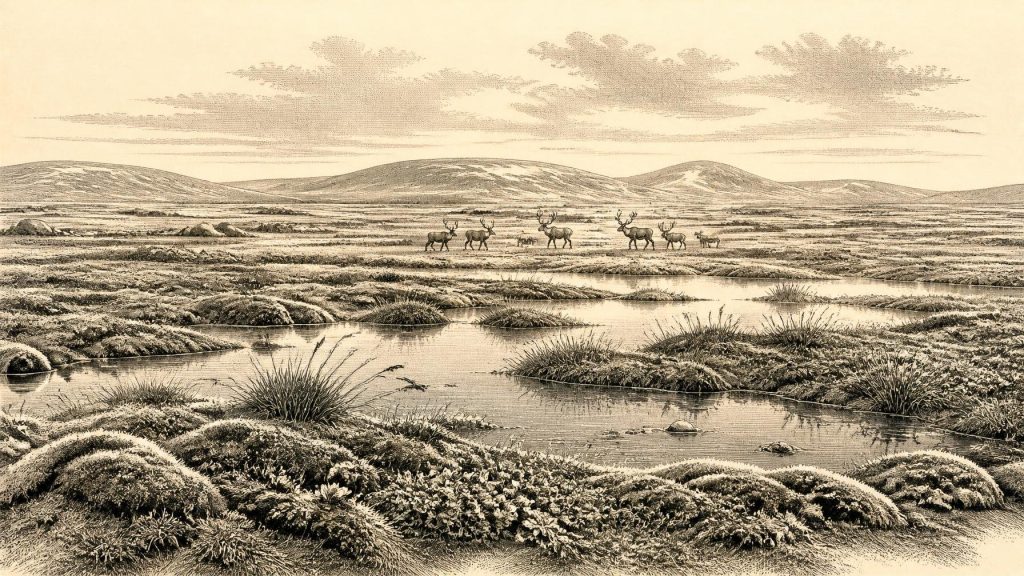
30,820 BCE is not a recoverable Irish event date but a point within a broad Late Pleistocene interval. At Derryvree, County Fermanagh, freshwater sediments between glacial tills record a temporary ice-free, cold, treeless wetland with tundra vegetation, later buried by advancing ice. Ireland comprised shifting local mosaics of periglacial ground, water and glaciers, rather than uniformly habitable or ice-covered terrain. Castlepook Cave, County Cork, preserves a diverse Marine Isotope Stage 3 fauna, including reindeer, mammoth, giant deer, predators and scavengers. A marked reindeer bone may indicate brief human activity, but cannot demonstrate settlement. Evidence reveals environmental change, not prehistoric society.
Dateline
“30,820 BCE” is a modern chronological label, not a year that can be recovered from Irish evidence. No written calendar, settlement sequence or annually dated record permits an event, person or season to be attached to it. In radiocarbon terms, the label falls about 32,770 years before AD 1950, within the Late Pleistocene and broadly within Marine Isotope Stage 3. The responsible history of Ireland at this depth of time is therefore not an annal of rulers or battles, but a reconstruction from buried sediments, fossil plants, animal bones and the changing behaviour of ice.
The closest important Irish environmental archive is at Derryvree, near Maguiresbridge in County Fermanagh. Road works in 1969 cut through a drumlin and exposed freshwater silts and fine sands trapped between two tills: unsorted deposits left by glacier ice. Organic material from the freshwater bed returned a conventional radiocarbon age of 30,500 +1,170/−1,030 years BP. Calibrated treatments place the deposit broadly at about 36,900–31,700 cal BP. The notional year 30,820 BCE therefore lies near the younger end of a large chronological range, not at a pinpoint within the sediment. Derryvree can illuminate a phase of Ice Age Ireland; it cannot tell us what happened on one named day or in one named year.
Between Two Advances
The structure of the Derryvree sequence is its most decisive evidence. A lower till shows that glacier ice had previously occupied the locality. Above it accumulated freshwater mud, silt and sand, together with organic remains. An upper till and associated sands later sealed this small landscape beneath another glacial episode. The sequence proves an interval in which ice no longer overrode that part of Fermanagh and standing or sluggish fresh water could exist. It does not prove that all Ireland was ice-free at once. Conditions on an upland, an Atlantic coast, a lowland basin and the Irish Sea margin could differ sharply, while later ice erosion has removed much of the earlier record.
At approximately 32,770 cal BP, Ireland was moving through the unstable climatic world before the fullest documented expansion of the last British–Irish Ice Sheet. The better-established maximum across many Irish and offshore sectors came later, broadly from about 27,000 to 23,000 years ago, although individual ice margins did not advance, peak or retreat simultaneously. The island should not be imagined either as uniformly green and habitable or as permanently entombed beneath ice. It was a changeable north-western edge of Europe, in which local ice-free ground, periglacial terrain, waterlogged hollows and advancing glaciers formed a shifting mosaic.
A Cold Wetland, Not a Forest
Derryvree’s fossils give that mosaic texture. Pollen was poorly preserved, but the available plant and animal evidence indicates open tundra vegetation and a periglacial climate: ground exposed to repeated freezing and thawing, short growing seasons and little or no woodland. Mosses, herbaceous pollen, aquatic and wet-ground plants, insects, sedges and organic mud record a shallow freshwater environment with saturated margins. Such evidence is more precise than a dramatic general image of an ‘Ice Age’. It points to local pools and wet ground rather than to an entirely dry polar desert.
The landscape around the water may have included sparse herb-rich ground and exposed mineral soils, with patches of vegetation able to exploit summer light and brief growth. Yet the evidence does not support a forested Ireland. Isolated grains from tree taxa need cautious treatment: they may have travelled far, been redeposited, or failed to represent local stands of trees. The most defensible conclusion is an open, cold and windswept environment in which wetland niches preserved life despite severe seasonal conditions.
Environment, in this period, was also regional change. Falling global sea levels exposed much larger continental shelves around Ireland and Britain than exist today. Coastlines, estuaries and travel routes were very different. But lowered seas did not automatically create a simple dry-land bridge from Ireland to Britain or the European mainland. Ice, marine channels, shifting shorelines and local relief mattered. The presence of mammals in Ireland demonstrates that animal movements occurred during favourable phases; it does not provide a map of a particular route in 30,820 BCE.
Cork’s Time-Deep Animal Archive
Far to the south, Castlepook Cave near Doneraile in County Cork provides the principal Irish animal archive relevant to this earlier cold stage. Excavations begun by Richard J. Ussher and colleagues in the early twentieth century recovered a striking assemblage from complex cave deposits: reindeer, woolly mammoth, giant deer, wolf, foxes including Arctic fox, lemmings, bear and spotted hyaena. A radiocarbon determination on mammoth bone, alongside later reassessment of the assemblage, places important parts of the fauna within Marine Isotope Stage 3.
These bones demonstrate that Ireland was intermittently part of a wider north-west European cold-stage ecological world. Reindeer are particularly suggestive of open country and seasonal movement; mammoth and giant deer indicate that large herbivores could reach and use Irish landscapes; hyaenas and wolves testify to predators and scavengers. A cave, however, is not a census of a single valley in a single year. Bones may have been carried in by carnivores, washed through fissures, disturbed by later activity or excavated before modern stratigraphic standards. Nor need every species have been contemporary. Castlepook supplies strong evidence for a varied Ice Age fauna over a broad period, not a guaranteed tableau of all its animals standing together at Derryvree.
The cave record also cautions against treating Ireland as isolated in a modern sense. Animal populations had arrived from beyond the island during periods when geography and climate allowed. The scale, timing and frequency of those movements remain uncertain. This was not trade in any human economic sense, and there is no evidence for managed herds, farming, stored grain, permanent villages or exchange networks in Ireland at this date. The economy visible in the evidence is ecological: grazing, browsing, predation, scavenging and movement through a difficult seasonal landscape.
The Reindeer Femur Question
One Castlepook object has raised the possibility of a human presence much earlier than Ireland’s securely demonstrated terminal-Pleistocene archaeology. A reindeer femur has been reported as bearing a deep mark interpreted as a fresh-bone cut or chopping trace from a sharp stone implement, and it has been associated in public heritage interpretation with an age of roughly 33,000 years ago. If that interpretation is confirmed, it would be evidence that one or more Upper Palaeolithic people handled or processed a reindeer in Ireland during this broad period.
That is an important possibility, but not a licence to invent a settlement. The femur is not a securely associated camp floor. No contemporary stone-tool assemblage, hearth, dwelling, burial, human skeleton, repeated occupation surface or substantial butchered bone concentration has been recovered with it. The date of animal bone and the identification of a surface modification are separate questions; both depend on context and taphonomic scrutiny. The most cautious reading is that the object may preserve a fleeting human action, not proof of a population, a named hunting party, a migration route or an enduring colony.
For comparison, the firm evidence for human activity at Alice and Gwendoline Cave in County Clare belongs far later, in the terminal Pleistocene, where a modified brown-bear patella has direct calibrated dates of roughly 12,810–12,590 cal BP. The contrast matters. It distinguishes a compelling but limited claim from a well-dated later archaeological context, and it prevents a prehistoric possibility from becoming an invented Irish origin story.
What Cannot Be Recovered
There were no detectable political institutions, borders, kings, diplomacy or warfare in the evidence for Ireland around this nominal year. Nor can archaeology identify a language, religion, kin group, social rank, artistic tradition or system of learning. If people briefly entered Ireland, they may have carried knowledge of hunting, animal processing, stone technology and travel inherited from the wider Upper Palaeolithic world, but that is an inference from continental comparison, not a recovered Irish culture.
Conflict is equally unrecoverable in human terms. The animal evidence certainly records a hazardous world in which predators competed for carcasses and caves could become dens, traps or natural repositories. Yet it cannot show combat between people, territorial politics or diplomacy. The clearest forces shaping life were climate, ice, water, vegetation and animal movement. The Derryvree freshwater bed is valuable precisely because it preserves this modest but powerful truth: even in a cold stage, Ireland contained local refuges of wetland life between glacial advances.
Thus 30,820 BCE is best understood as a point within a broad calibrated interval rather than a date of an Irish event. At Derryvree, a cold, treeless freshwater landscape had existed before later ice buried it. At Castlepook, cave deposits record a wider fauna of herbivores, carnivores and scavengers, and perhaps a brief human encounter with a reindeer. The evidence is fragmentary, time-averaged and regionally uneven. It nevertheless reveals an Ireland already shaped by great environmental change: not yet a historical society, but a living and contested Ice Age landscape at the edge of advancing ice.
Primary Sources
- A Middle Midlandian Freshwater Series at Derryvree, Maguiresbridge, County Fermanagh, Northern Ireland
- Palaeoecology: Irish Association for Quaternary Studies Field Guide
- The Subdivision of the Quaternary Period in Ireland
- Exploring Controls of the Early and Stepped Deglaciation on the Western Margin of the British Irish Ice Sheet
- A Reconsideration of the Radiocarbon Dating of the Marine Isotope Stage 3 Fauna from Southern Ireland
- The Irish Quaternary Fauna Project
- The Exploration of Castlepook Cave, County Cork
- Occurrence of Mammalia Relicts at Site Castlepook Cave
- Heritage Artefacts of County Cork
- Pleistocene Vertebrates in the British Isles
- The IntCal20 Northern Hemisphere Radiocarbon Age Calibration Curve (0–55 cal kBP)
- Dimensions and Chronology of the Last Ice Sheet in Western Ireland
- Pattern and Timing of Retreat of the Last British-Irish Ice Sheet
- Early Deglaciation of the British-Irish Ice Sheet on the Atlantic Shelf Northwest of Ireland Driven by Glacioisostatic Depression and High Relative Sea Level
- Oscillating Retreat of the Last British-Irish Ice Sheet on the Continental Shelf Offshore Galway Bay, Western Ireland
- Exposure-Age Constraints on the Extent, Timing and Rate of Retreat of the Last Irish Sea Ice Stream
- Stratigraphic and Palaeo-Geomorphological Evidence for the Glacial-Deglacial History of the Last British-Irish Ice Sheet in the North-Western Irish Sea
- New Insights on the Fauna of Ireland's Younger Dryas and Early Holocene from Alice & Gwendoline Cave
- New Insights on the Fauna of Ireland's Younger Dryas and Early Holocene from Alice & Gwendoline Cave (PDF)
- Irish Caves Database: Mammoth Cave, Castlepook
- The Late Quaternary History of East-Central Ireland
- Maximum Extent and Dynamic Behaviour of the Last British-Irish Ice Sheet West of Ireland