
Castlepook Arctic Fox30819 BCE
Around 30,819 BCE, Ireland was a climatically unstable Late Pleistocene landscape rather than a setting for datable human history. Derryvree sediments in Fermanagh record changing glacier, freshwater and tundra conditions, with sparse herbs, mosses and wetland plants during an interstadial interval. Ice cover and coastlines varied, while intermittent faunal connections linked Ireland with wider Europe. Castlepook Cave in Cork yielded mammoth, reindeer, giant deer, predators and Arctic fauna, though its mixed deposits cannot form a single snapshot. A marked reindeer femur may indicate human butchery, yet without tools, hearths or settlements it remains limited evidence of human contact before glaciation.
Dateline
The label 30,819 BCE gives a useful place in a modern timeline, but it cannot identify an event in Ireland on a particular day, season or year. No people then living in or visiting this region used a calendar that can be translated into a BCE year, and the scientific evidence comes with much broader margins of uncertainty. In radiocarbon terms, the date falls roughly 32,800 calendar years before AD 1950, within the Late Pleistocene and Marine Isotope Stage 3 (MIS 3), a climatically unstable part of the last Ice Age. It is best treated as a point within a long environmental horizon, not as an annual chronicle.
For Ireland, the evidence nearest to this horizon is uneven and often difficult to date. It consists principally of glacial sediments, fossil plants, animal bones and cave deposits. These materials can show that cold-country ecosystems existed, that ice advanced and retreated, and that animals moved into the north-western edge of Europe. They cannot establish a government, tribe, religion, language, settlement network or named person. The temptation to supply those absences with a story should be resisted. Around this notional date, Ireland’s history is primarily a history of land, ice, water, plants and animals, with only a highly tentative possibility of human contact.
Dating a Deep-Past Landscape
Radiocarbon ages are not calendar ages. The amount of radioactive carbon in the atmosphere has changed over time, so a laboratory result must be calibrated against independently dated records. At more than 30,000 years ago, calibration produces wide ranges, not year-level precision. The classic Irish reference point is Derryvree, near Maguiresbridge in County Fermanagh. Roadworks in 1969 cut through a drumlin and revealed freshwater silts, sands and organic layers between two tills: unsorted sediments laid down by glacier ice. Organic material from the intervening deposits produced a conventional radiocarbon age of 30,500 +1,170/-1,030 radiocarbon years BP.
That result is exceptionally valuable, but it should not be misread as proof that a Derryvree pool existed in 30,819 BCE. When calibrated, its central estimate lies substantially earlier, broadly around 36,000 calibrated years before present, and the large error range must remain visible. What the sequence securely demonstrates is a sequence of change: glacier ice had occupied the Fermanagh locality; a non-glacial freshwater environment subsequently developed; and a later ice advance covered and preserved it. Derryvree is therefore an environmental archive for the wider Middle Midlandian world, rather than a diary of this exact numbered year.
The wider ice-sheet history adds another warning against false precision. The fullest Last Glacial Maximum came later, with reconstructions placing major growth and maximum extent of the last British–Irish Ice Sheet after this period, broadly between about 27,000 and 20,000 years ago. At 30,819 BCE, Ireland was approaching, rather than necessarily experiencing everywhere, that later maximum. Ice cover, exposed ground and periglacial terrain probably varied sharply by district and through time. A frozen upland, an open lowland, a lake basin and a cave could preserve very different records without being exactly contemporary.
Open Tundra, Wet Ground
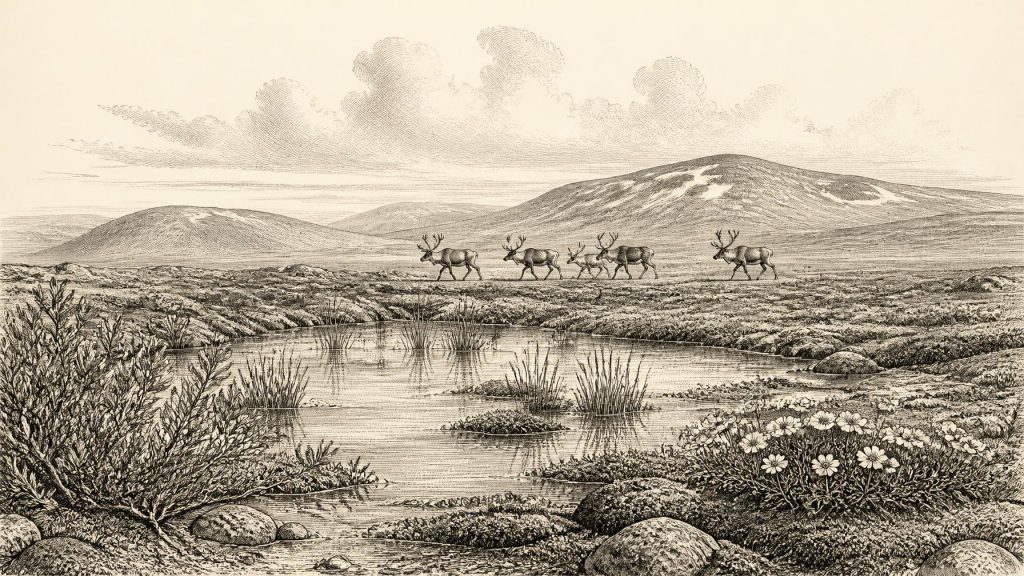
Derryvree’s biological remains provide the clearest picture of conditions that could have characterised parts of Ireland during a cold MIS 3 interval. The flora was dominated by herbs and mosses associated with open tundra and periglacial climate. Plant macrofossils include dwarf willow, mountain-avens, sedges, clubmosses, mosses and aquatic or wet-ground plants such as bogbean and alternate water-milfoil. Pollen was poorly preserved, but the available evidence likewise points towards sparse herb-rich vegetation. Occasional pine and hazel pollen is unlikely to demonstrate local woodland; it may have travelled long distances or derived from older deposits.
This was not the green, wooded island familiar today. In a cold landscape, frost repeatedly disturbed exposed soils, winter snow lay longer, and growing seasons were short. Low shrubs, grasses, herbs and mossy wetlands could nevertheless support grazing animals and smaller mammals. Freshwater silts show that water continued to move and pond in some places despite the cold. The important qualification is geographical: Derryvree records south Fermanagh, not every valley and coast. It supports an interpretation of open, treeless or nearly treeless country in suitable areas, not a uniform national map.
Sea level was far lower than today because much water was locked in global ice sheets, and the shorelines of the Irish region lay beyond their modern positions. Yet it would be careless to portray Ireland automatically as a simple, dry peninsula joined permanently to Britain or the continent. The Irish Sea basin, local glaciers, changing sea level and the precise timing of land connections made movement complicated. Recent genetic work on cave sediments supports broad Late Pleistocene faunal connectivity between Ireland and Eurasia before the Last Glacial Maximum. It does not provide a route map for a particular year, nor prove that every species or person crossed by the same means.
Caves and a Mobile Fauna
County Cork’s Castlepook Cave, near Doneraile, is the most important Irish faunal site for this broad period. It is also called Mammoth Cave because early twentieth-century excavation recovered conspicuous woolly mammoth remains. Subsequent study and dating of the museum collections have identified a much richer Ice Age assemblage, including woolly mammoth, reindeer, giant deer, brown bear, spotted hyaena, wolf, Arctic fox, mountain hare, stoat and lemmings. Together these animals indicate that Ireland, at intervals before the Last Glacial Maximum, supported or received elements of the wider north-west European cold-stage fauna.
That conclusion must be framed carefully. Cave assemblages are not snapshots. Hyaenas and other carnivores may have dragged carcass parts underground; water, sediment movement and later excavation could mix material of different ages; and many of Castlepook’s earliest investigations took place between 1904 and 1913, before modern excavation standards. The Irish Quaternary Fauna Project used accelerator radiocarbon dating to improve the chronology, while later work has shown how earlier measurements can be revised by improved pretreatment. A bone dated from a cave is evidence for the animal, not automatic proof that all animals in the collection lived together.
The animals do, however, illuminate everyday ecological pressures. Reindeer and giant deer required extensive forage; mammoths signal access to broad open habitats; predators and scavengers competed for carcasses; and cave shelters could be dens, scavenging places or traps rather than homes. Animal movements were probably seasonal and responsive to snow cover, forage and ice barriers. The archaeological record cannot tell whether reindeer herds crossed north Cork in a particular winter, but it can responsibly place their species among the resources and hazards of a Pleistocene landscape.
A Single Marked Bone
Castlepook also holds the most provocative possible evidence for humans in Ireland so early. A reindeer femur fragment recovered from the cave bears a deep surface mark that zoologist Ruth Carden has interpreted as a cut or chop made by a sharp stone implement during carcass processing. County Cork’s heritage publication assigns the object approximately to c. 31,000 BC, close enough to this article’s modern date label to make it essential evidence. If the mark was made by a person on fresh bone, it would indicate a human encounter with a reindeer in Ireland long before the better-established terminal-Pleistocene evidence from County Clare.
But it cannot responsibly be expanded into a settled Palaeolithic Ireland. The femur is a single object from an old and complicated cave collection. There is no securely associated stone-tool assemblage, hearth, dwelling, burial, human bone or intact camp floor of comparable age. Nor can the bone reveal whether a hunter killed the animal, found it already dead, removed meat in the open and left a remnant later carried into the cave by a carnivore. The age of a bone, the cause of a mark and the duration of a human visit are separate questions requiring separate evidence.
Accordingly, society is almost wholly beyond recovery here. If people did visit, the practical knowledge implied would have been considerable: using a sharp stone edge, handling a large carcass and surviving a cold, highly seasonal environment. Reindeer could potentially supply meat, marrow, hide, sinew, antler and bone, but the Castlepook femur cannot show which of these were taken. No evidence supports farming, pottery, metalwork, permanent villages, long-distance commerce or formal political authority. There is equally no material basis for reconstructing religious observance, artistic traditions, diplomacy, warfare, kin groups or language.
History Without an Annual Event
Conflict and diplomacy, in their usual historical sense, leave no trace at this depth of time. Predation and scavenging were real ecological contests, but they are not evidence of human war. Trade likewise cannot be demonstrated: no imported artefact, exchange network or production site has been identified for Ireland around this date. Learning was embodied rather than written—if people were present at all—in skills of movement, observation, tool use and survival. Such capacities are plausible inferences from Upper Palaeolithic life elsewhere in Europe, but they must not be mistaken for discoveries made in Ireland.
The most important development around 30,819 BCE was therefore environmental instability on the threshold of more extensive glaciation. Freshwater sediments under Fermanagh drumlins preserve evidence of an earlier open tundra; the Cork caves preserve the remains of a surprisingly diverse cold-stage fauna; and Castlepook’s marked reindeer femur presents a serious but still limited possibility of human action. Ice later eroded or buried many landscapes that might once have preserved camps and tracks. That helps explain why the record is fragmentary, but it does not turn absence into evidence. Ireland at this point was a changing Pleistocene borderland: biologically connected at times to a wider European world, sparsely documented, and not yet available for a conventional political or social history.
Primary Sources
- A Middle Midlandian Freshwater Series at Derryvree, Maguiresbridge, County Fermanagh, Northern Ireland
- Palaeoecology
- Figure 6.—The Subdivision of the Quaternary Period in Ireland
- A Reconsideration of the Radiocarbon Dating of the Marine Isotope Stage 3 Fauna from Southern Ireland
- The Irish Quaternary Fauna Project
- New Insights on the Fauna of Ireland's Younger Dryas and Early Holocene from Alice & Gwendoline Cave
- Sedimentary Ancient DNA Reveals Late Pleistocene Faunal Connectivity Between Ireland and Eurasia
- Occurrence of Mammalia Relicts at Site Castlepook Cave
- Heritage Artefacts of County Cork
- The IntCal20 Northern Hemisphere Radiocarbon Age Calibration Curve (0–55 cal kBP)
- A Stratigraphic Framework for Abrupt Climatic Changes During the Last Glacial Period Based on Three Synchronized Greenland Ice-Core Records: Refining and Extending the INTIMATE Event Stratigraphy
- Growth and Retreat of the Last British–Irish Ice Sheet, 31,000 to 15,000 Years Ago: the BRITICE-CHRONO Reconstruction
- Pattern and Timing of Retreat of the Last British-Irish Ice Sheet
- Trimlines, Blockfields and the Vertical Extent of the Last Ice Sheet in Southern Ireland
- Dimensions and Chronology of the Last Ice Sheet in Western Ireland
- Oscillating Retreat of the Last British-Irish Ice Sheet on the Continental Shelf Offshore Galway Bay, Western Ireland
- Early Deglaciation of the British-Irish Ice Sheet on the Atlantic Shelf Northwest of Ireland Driven by Glacioisostatic Depression and High Relative Sea Level
- Timing and Pace of Ice-Sheet Withdrawal Across the Marine–Terrestrial Transition West of Ireland During the Last Glaciation
- The Deglaciation of the Western Sector of the Irish Ice Sheet From the Inner Continental Shelf to its Terrestrial Margin
- A North-Western Habitat: the Paleoethology and Colonisation of a European Peninsula