Maguiresbridge Road-Cut Wetland30750 BCE
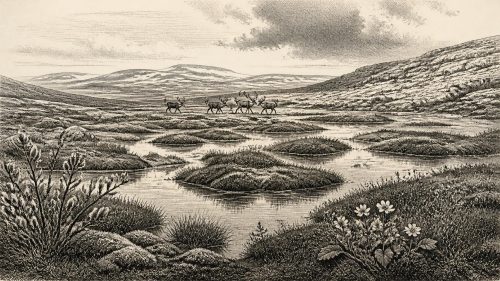
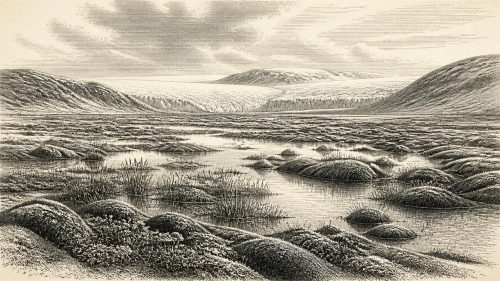
Around 30,750 BCE, Ireland lay within the volatile Late Pleistocene, although no evidence permits reconstruction of a single year. At Derryvree near Maguiresbridge, Fermanagh, freshwater silts between two tills record a treeless tundra wetland formed during an interval between glacier advances, with cold-adapted plants and seasonal waterlogged habitats. Castlepook Cave, Cork, preserves a time-mixed fauna including mammoth, reindeer, giant deer, bears, wolves, foxes and hyenas, demonstrating varied cold-stage ecosystems. A possibly cut-marked reindeer bone may indicate transient Upper Palaeolithic visitors, but settlement remains unproven. Changing ice, sea levels and later glaciation obscured Ireland’s earlier landscapes and evidence from this era.
Dateline
An Approximate Year
30,750 BCE is a modern chronological label, not a recoverable year in Ireland’s deep past. No Irish community then used a calendar known to archaeology, and no deposit, bone or landform can be assigned responsibly to that single year. In the conventional framework of years before present, measured from AD 1950, the label falls at roughly 32,700 calibrated years BP, within the Late Pleistocene and Marine Isotope Stage 3 (MIS 3). This was part of the last Ice Age: a long and climatically volatile interval, not one unchanging frozen age. The evidence is strongest for broad environmental conditions and animal life; it is markedly weaker for people. The appropriate history of Ireland at this point is therefore one of dates with wide margins, buried sediments, cave bones and the changing limits of ice.
The nearest major Irish environmental record is the Derryvree freshwater series, exposed by roadworks in 1969 near Maguiresbridge, County Fermanagh. Its organic silts and fine sands lay between two separate sheets of till, the unsorted debris deposited by glacier ice. The sequence proves an important order of events: ice had crossed the locality, a freshwater and wetland environment later developed there, and another ice advance subsequently buried it. Organic material from the deposit produced the radiocarbon determination BIRM-166, conventionally dated to 30,500 radiocarbon years BP, with a substantial error range. Published calibrations have placed the deposit broadly between about 36,900 and 31,700 calibrated years BP. That span encompasses 30,750 BCE, but it does not make Derryvree a snapshot of that precise year.
A Wetland Between Ice Advances
Derryvree is exceptionally valuable because most evidence from this far back has been scoured away, reworked or concealed by later glaciation. The two tills enclosing its organic layer are not merely geological background: they show that Ireland’s ice-age history involved advance, withdrawal and renewed advance. Around the date represented by this article, parts of the island could not simply be imagined as either wholly ice-covered or wholly habitable. Conditions varied through time and place. A locally ice-free basin in Fermanagh existed amid a cold-stage world in which ice margins, frozen ground and meltwater were all important features of the landscape.
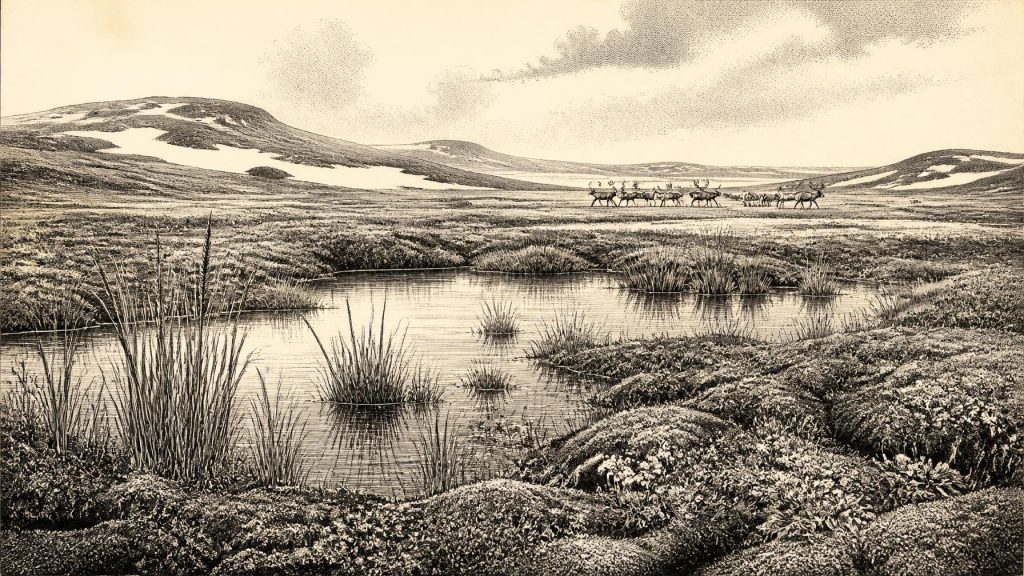
The freshwater deposits preserve a treeless tundra or muskeg environment. Muskeg is waterlogged, peat-forming ground: not a modern Irish bog transferred unchanged into the past, but a cold, wet mosaic of shallow water, saturated margins, mosses, sedges and low-growing herbs. Fossil plant material includes bogbean, while lesser clubmoss and other cold-adapted plants reinforce the picture of open ground. The presence of aquatic and wetland vegetation is especially revealing. Even in severe conditions, pools and marshy margins could support life through the growing season. The evidence does not furnish a thermometer reading for a particular day, nor does it demonstrate a uniform climate across Ireland; it does show that this was not a forested landscape resembling later prehistoric Ireland.
Freeze-thaw processes would have affected the surrounding ground. Permafrost or seasonally frozen soils, sparse vegetation beyond wet hollows, and powerful seasonal contrasts are reasonable inferences from the cold-adapted flora and wider glacial setting. Yet water remained central. Fine sediment settled in quiet freshwater; plants grew, died and became incorporated into the accumulating deposits. Such settings were ecological refuges on a small scale, supporting insects and other invertebrates as well as the plant communities preserved as fossils. Derryvree consequently gives a rare impression of everyday natural processes in Ireland during MIS 3: not human domestic life, but the yearly rhythm of thaw, standing water, brief growth and renewed cold.
Castlepook’s Composite Animal Record
More than 300 kilometres to the south-west, Castlepook Cave near Doneraile in north County Cork provides the richest Irish vertebrate archive for the period before the Last Glacial Maximum. Its long limestone galleries yielded more than 2,000 bones during excavations begun in the early twentieth century. The assemblage includes woolly mammoth, reindeer, giant deer, brown bear, wolf, fox, mountain hare, lemmings, Arctic fox and spotted hyena. It is an arresting corrective to any idea that Ice-Age Ireland was an empty white expanse. Large herbivores, predators and scavengers moved through at least some Irish landscapes during the wider middle-to-late Pleistocene interval.
But Castlepook must not be read as a single scene, or as a zoo list for 30,750 BCE. Its deposits accumulated over a long period, were affected by water movement, and were excavated using methods far removed from present-day standards. The cave functioned in part as a repository of animal remains, and spotted hyenas are likely to have contributed to that process by carrying carcass parts into their den. Different bones may represent different centuries, climates and pathways into the cave. A mammoth, reindeer and hyena recovered from the same cave system need not have occupied one valley at the same time. The cautious conclusion is nonetheless significant: Ireland supported a varied cold-stage fauna before the greatest late-glacial expansion of the British–Irish Ice Sheet.
Reindeer were particularly well suited to open, cold terrain and could have ranged widely in search of forage. Mammoths and giant deer indicate that substantial herbivore biomass was available somewhere within the broader regional landscape, while wolves and hyenas show that scavenging and predation formed part of its food web. Their presence is direct palaeontological evidence, rather than a reconstruction borrowed wholesale from continental Europe. It does not, however, reveal herd sizes, migration routes, seasonal behaviour or the exact appearance of the Cork countryside in any one year. Ireland’s surviving fossil record is selective, and caves preserve some animals and activities far better than others.
People: A Possibility, Not a Settlement
The most debated object relevant to this period is a reindeer femur from Castlepook. Re-examination of the old collection identified a deep linear modification that has been interpreted as a fresh-bone chop or cut mark, potentially made by a stone tool. Public reporting of the find linked the animal to approximately 33,000 years ago and proposed Upper Palaeolithic human butchery. If that interpretation is upheld, it would be profoundly important: it would show that people reached Ireland far earlier than the long-established terminal-Pleistocene evidence for human activity.
That possibility should not be inflated into a settled Ireland. The bone is a single item from a complex cave assemblage, not a sealed living floor. No securely associated hearth, lithic assemblage, dwelling, burial, repeated food-processing site, art or other occupation surface of comparable age has been published from Castlepook. A date on an animal bone dates the animal’s death within a statistical range; it does not independently date every mark upon it, identify the mark-maker beyond doubt, or tell us whether one person, a small travelling party or nobody was present. The responsible description for 30,750 BCE is therefore that human presence in Ireland is possible and potentially suggested by this specimen, but permanent occupation, population size and cultural affiliation remain unproven.
No Polities, No Recorded Beliefs
There is no evidence from Ireland at this depth of time for political institutions, rulers, diplomacy, warfare, territorial boundaries or organised trade. Nor can religion, language, kinship systems, artistic traditions, formal learning or social hierarchy be reconstructed from the Derryvree wetland and Castlepook bones. It would be misleading to fill those silences with imagined Ice-Age tribes. Even if mobile hunter-gatherers did make brief visits, the Irish evidence presently cannot reveal their names, their relationships with communities elsewhere, or whether they returned regularly.
The same restraint applies to economy and settlement. There was no agriculture, herding or built village demonstrable in Ireland at this date. If people handled the Castlepook reindeer, the practical possibilities include meat, marrow, hide, sinew and bone; these are general properties of a hunted reindeer, not resources proven to have been taken at Castlepook. What can be said securely is that the animal world offered mobile sources of food and raw material to any humans who entered it, while severe climate and unstable geography imposed powerful constraints. The evidence favours transient movement through a difficult landscape over claims of a known, enduring settlement.
An Unstable North-Western Islandscape
Ireland formed part of a wider north-west European environmental zone, but its position at the Atlantic edge mattered. Sea level was lower than today, changing coastlines and the extent of the surrounding shelf, while glacial growth and retreat repeatedly altered habitats. It does not follow that there was a simple, permanent land bridge available to people or animals. Routes into Ireland, if they existed at particular times, depended on changing sea, ice and terrain and remain poorly resolved. The Derryvree sequence itself warns against simple maps: an apparently local wetland archive survives between evidence of two ice incursions.
Later growth of the British–Irish Ice Sheet would transform and bury much of this world. The Last Glacial Maximum lay ahead, with extensive ice reaching its peak after this period. That later ice is one reason the earlier record is so fragmentary. It removed soils, disturbed sediments and erased open-air evidence that might once have clarified whether people visited, how animals moved, and how long favourable habitats endured. Derryvree and Castlepook matter precisely because they survived that destructive history. Together they show an Ireland of cold open ground and freshwater pockets, populated by hardy plants and a striking fauna, but not yet an Ireland that can be assigned a political history or a securely documented human society.
For 30,750 BCE, then, the most important development was environmental rather than historical in the conventional sense. Ireland was passing through an unstable phase of the last Ice Age. In Fermanagh, freshwater silts recorded life in a tundra wetland between glacier advances. In Cork, cave deposits retained traces of reindeer, mammoth, giant deer, carnivores and scavengers from a wider span of cold-stage time. These are firm foundations for understanding the island’s Pleistocene world. Beyond them lie possibilities that future dating, excavation and scientific re-examination may sharpen, but which responsible history must presently leave open.
Primary Sources
- A Middle Midlandian Freshwater Series at Derryvree, Maguiresbridge, County Fermanagh, Northern Ireland
- Irish Pleistocene Biostratigraphy
- The Irish Quaternary Fauna Project
- The Exploration of Castlepook Cave, County Cork
- Castlepook Cave: County Geological Site Report
- Figure 6: The Subdivision of the Quaternary Period in Ireland
- New Insights on the Fauna of Ireland’s Younger Dryas and Early Holocene from Alice & Gwendoline Cave
- The IntCal20 Northern Hemisphere Radiocarbon Age Calibration Curve (0–55 cal kBP)
- The Timing and Magnitude of the British–Irish Ice Sheet Between Marine Isotope Stages 5d and 2
- Growth and Retreat of the Last British–Irish Ice Sheet, 31,000 to 15,000 Years Ago: The BRITICE-CHRONO Reconstruction
- Early Deglaciation of the British-Irish Ice Sheet on the Atlantic Shelf Northwest of Ireland Driven by Glacioisostatic Depression and High Relative Sea Level
- Stratigraphic and Palaeo-Geomorphological Evidence for the Glacial-Deglacial History of the Last British-Irish Ice Sheet in the North-Western Irish Sea
- Freshwater Organic Deposits and Stratified Sediments Between Early and Late Midlandian (Devensian) Till Sheets, at Aghnadarragh, County Antrim, Northern Ireland
- Maximum Extent and Dynamic Behaviour of the Last British–Irish Ice Sheet West of Ireland
- Menyanthes trifoliata: Fossil Record in Fermanagh
- Selaginella selaginoides: Fossil Record in Fermanagh
- Introduction to the Glacial Sand and Gravel Landscapes of Northern Ireland
- Mammoth Cave
- Castlepook Cave, Co. Cork, 2022
- Heritage Artefacts of County Cork 2021
- The Exploration of Castlepook Cave, Co. Cork. With 3 Plates
- References and Recommended Reading