The Castlepook Femur Debate30749 BCE
Around 30,749 BCE, Ireland lay within the unstable climatic conditions of Marine Isotope Stage 3, supporting cold-adapted fauna but lacking a securely documented human population. Castlepook Cave, County Cork, preserves mixed remains of mammoth, reindeer, giant deer, hyaena and other animals, accumulated over long periods and subject to disturbance. A marked reindeer femur may bear a stone-tool cut, potentially indicating Upper Palaeolithic butchery and Ireland’s earliest human activity. However, no associated tools, hearths, settlements or human remains confirm this interpretation. Later glaciation destroyed much evidence. The bone remains important but provisional, suggesting a possible brief visit rather than permanent occupation.
Dateline
The label 30,749 BCE is a modern way of placing a remote point in time, not a year that can be recovered from Ireland’s prehistoric record. No Irish event, person, season or political decision can be dated to this particular calendar year. Treated arithmetically, it lies about 32,700 years before the conventional radiocarbon “present” of 1950, during the later part of the Last Glacial Period. Archaeologists instead work with broad scientific chronologies, especially calibrated radiocarbon ranges, geological sequences and climatic phases. For Ireland, the appropriate setting is Marine Isotope Stage 3 (MIS 3), a long and unstable interval before the Last Glacial Maximum.
This was not yet the familiar green, wooded island of later prehistory. Nor was it necessarily a single, uniformly frozen scene. The climate of north-west Europe swung repeatedly between colder stadials and relatively milder interstadials. Ice-sheet growth, lowered sea level, changing coastlines, permafrost and sparse vegetation all reshaped the possibilities for animal and human movement. Scholarship differs over the precise timing and extent of early advances of the British–Irish Ice Sheet, which is itself a warning against drawing a neat map for one nominal year. Around this horizon, Ireland was entering a period in which expanding ice would eventually transform or remove much of the earlier land surface.
A Calendar Date Without a Calendar
At this depth of time, even the language of dates needs care. A radiocarbon result is not automatically a calendar age: atmospheric carbon levels changed in the past, so radiocarbon determinations must be calibrated against independently dated environmental records. The IntCal20 curve extends that work back to 55,000 calibrated years before present, but its ranges can remain wide. A BCE conversion adds another layer of apparent precision. Thus 30,749 BCE should be read as an approximate chronological filing point, not as the anniversary of an Irish hunt or settlement.
The most relevant evidence comes from contexts that overlap only broadly with this date. Directly dated animal remains from Irish caves demonstrate that a surprisingly rich Late Pleistocene fauna reached the island during MIS 3. The Irish Quaternary Fauna Project placed a range of mammals in Ireland between at least about 45,000 and 20,000 radiocarbon years ago, while subsequent redating has shown that some early measurements from southern caves had underestimated the true age of bones by thousands of radiocarbon years. These revisions matter because they shift parts of the Castlepook record at Doneraile, County Cork, decisively into MIS 3.
North Cork’s Cave Archive
Castlepook Cave, once called Mammoth Cave, is the central Irish site for understanding this distant interval. Antiquarian excavations conducted between 1904 and 1913 recovered a large but difficult collection of bones from its passages and chambers. It includes reindeer, woolly mammoth, giant deer, brown bear, wolf, Arctic fox, mountain hare, lemmings and spotted hyaena. Such an assemblage is evidence for animals in Ireland over a long span; it is not a photograph of one moment. Cave deposits can accumulate slowly, be disturbed by water, burrowing, carnivores, excavation and later redeposition. Bones from separate millennia may therefore occur together in a museum collection or even in the same excavated area.
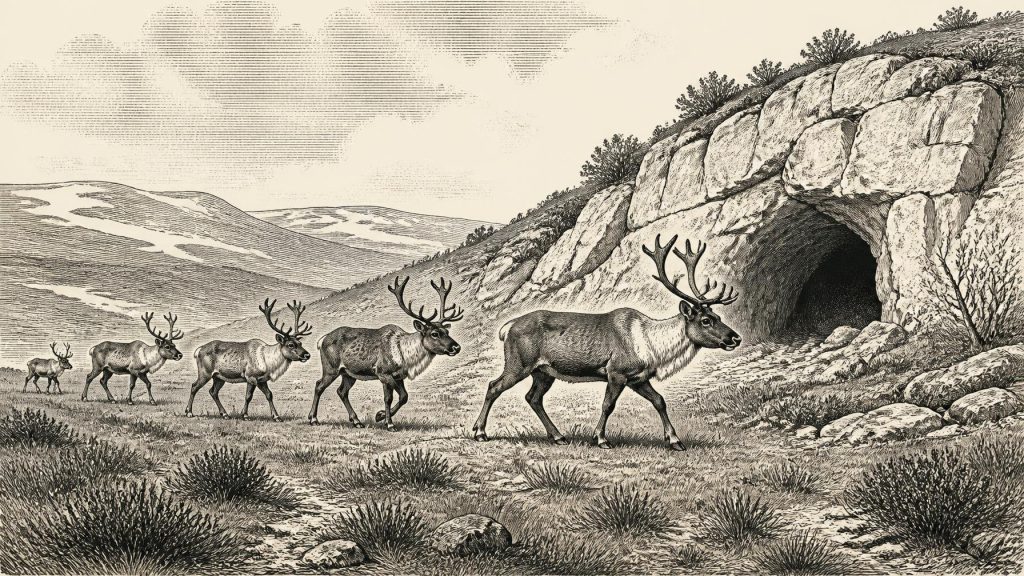
That limitation is especially important at Castlepook. The cave was probably used at times as a carnivore den or scavenging place. Hyaenas and other animals could drag limbs into shelter, gnaw them, scatter them and mix them with older material. A mammoth bone or reindeer limb found in a cave does not prove that mammoths or reindeer lived permanently at the cave mouth; still less does it establish that people did. Yet the range of fauna is a powerful indication that parts of Ireland supported an open, cold-adapted ecosystem at different points during the wider Ice Age interval.
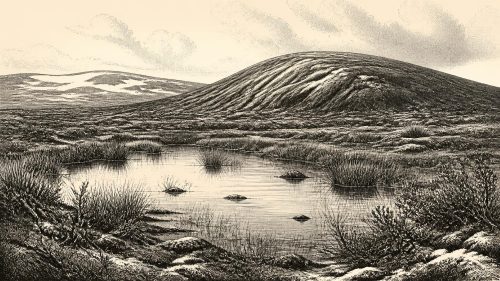
The fauna suggests a landscape very unlike later forested Ireland: exposed ground, grasses, sedges, herbs and dwarf shrubs, broken by wetter hollows, streams and sheltered terrain. Reindeer are well suited to cold, seasonal country. Lemmings and Arctic fox point towards severe conditions, while mammoth, giant deer, wolf, bear and hyaena reveal a food web with large herbivores and major predators. The exact mix varied through time and place. It would be wrong to place every listed species together on a single north Cork hillside in 30,749 BCE, but their dated presence demonstrates that Ireland was not biologically empty throughout MIS 3.
The Mark on a Reindeer Bone
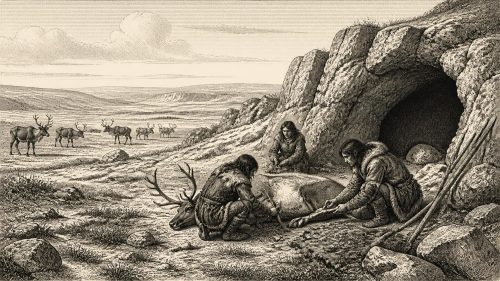
The most consequential, and most debated, object is a reindeer femur from Castlepook. It has been identified in County Cork heritage material and by zooarchaeologist Ruth Carden as bearing a deep linear mark made on fresh bone with a sharp stone implement, consistent with carcass processing. Public presentations place the bone broadly around 31,000 BCE or describe an age of roughly 33,000 radiocarbon years. These are useful approximations, but they should not be confused with a calibrated date range for an action performed on a known day. The age of the animal, the date of the mark and the later arrival of the bone in its recorded cave context are related questions, not one identical fact.
If the mark is genuinely a stone-tool cut, it is potentially Ireland’s earliest known trace of human activity. It would show that a person handled a reindeer carcass on the island during the Upper Palaeolithic, far earlier than the well-established post-glacial record. It may indicate cutting meat, separating tissue, or obtaining useful hide, sinew, marrow or fat. It does not prove that the animal was killed at Castlepook, that butchery occurred inside the cave, or that hunters made a camp there. County Cork’s own interpretation allows the possibility that carnivores later carried discarded remains underground.
The distinction between evidence and interpretation is crucial. The evidence is a reindeer femur, its reported modification, its scientific dating programme and the wider cave fauna. The interpretation is that mobile hunter-gatherers visited Ireland and processed the animal. That interpretation is plausible and historically important, but it is not yet supported by a securely associated hearth, stone-tool assemblage, dwelling, human burial, human DNA or a stratified occupation floor of comparable age. Nor can one bone identify the visitors’ language, ancestry, culture, route of travel, group size or length of stay.
People, If Present
Should the Castlepook femur ultimately confirm human butchery, the people involved would have required sharp stone edges and detailed practical knowledge of animal bodies. In Upper Palaeolithic Europe, mobile communities relied on versatile stone tools, organic equipment that rarely survives, close observation of seasonal animal behaviour, and social ties extending beyond any one hunting ground. Those wider European comparisons can suggest possibilities, but they cannot fill Ireland’s evidential gaps with certainty. No Irish flint point, blade workshop, hearth or campsite securely belongs to this period.
Accordingly, there is no responsible political history for Ireland in 30,749 BCE. There were no known states, kings, borders, treaties or named communities. Warfare, diplomacy and organised leadership cannot be reconstructed from the material presently available. Nor is there evidence for farming, domestic livestock, cereal cultivation, metalworking, markets, long-distance trade or permanent villages. A brief hunting excursion, perhaps linked to the movement of reindeer or other prey, is a more defensible possibility than a settled population. Even that remains an inference from slender evidence rather than an established narrative.
Religion, art and learning are similarly beyond recovery in Ireland at this date. Human beings who may have entered the island would certainly have possessed knowledge, memory, skills and social practices, but archaeology has not recovered their stories. The cave itself must not be treated as a shrine simply because later Irish communities used caves in ritual, funerary and folkloric ways. Such later practices demonstrate the enduring importance of caves in Irish landscapes, not the beliefs of possible MIS 3 visitors.
Changing Ground and Lost Evidence
The environmental context also helps explain the silence of the archaeological record. Ice-sheet expansion after roughly this broad horizon, and the later Last Glacial Maximum between about 26,000 and 19,000 calibrated years before present, eroded, buried and rearranged landscapes across Ireland. Any exposed campsite, shoreline or hunting station could have been destroyed by ice, meltwater and periglacial processes. Lower sea levels also shifted coastlines far beyond their modern positions, leaving some potential landscapes now submerged or heavily altered. The scarcity of evidence therefore cannot prove that no one ever came; equally, destruction cannot be invoked as proof that an unseen population must have existed.
Later, much firmer evidence shows that humans reached Ireland again in the terminal Pleistocene. A butchered brown-bear patella from Alice and Gwendoline Cave in County Clare has been independently dated to 12,810–12,590 calibrated years before present. That discovery establishes human presence thousands of years after the Castlepook question, not continuity from it. Between the two lies a vast interval of changing climate, ice cover and missing archaeological deposits.
For this notional year, then, Ireland’s history is best told as a carefully bounded investigation. The island formed part of a dynamic Ice Age world in which cold-adapted mammals had reached its landscapes. Castlepook preserves an exceptional, if complicated, animal archive and a single marked reindeer bone with the potential to transform the chronology of human arrival. The bone may record a fleeting act of butchery by Upper Palaeolithic hunters. It cannot yet yield a village, a tribe, a ruler or a dated event. Its importance lies precisely in that tension: one small cut may open a human history, while demanding that the larger story remain provisional.
Primary Sources
- A Reconsideration of the Radiocarbon Dating of the Marine Isotope Stage 3 Fauna from Southern Ireland
- The Irish Quaternary Fauna Project
- Heritage Artefacts of County Cork
- Archaeology Research Excavation Grant 2022: Final Report
- The Colonization of Ireland: A Human Ecology Perspective
- First Evidence of a Late Upper Palaeolithic Human Presence in Ireland
- New Insights on the Fauna of Ireland’s Younger Dryas and Early Holocene from Alice & Gwendoline Cave
- The IntCal20 Northern Hemisphere Radiocarbon Age Calibration Curve (0–55 cal kBP)
- BRITICE Glacial Map, Version 2: A Map and GIS Database of Glacial Landforms of the Last British–Irish Ice Sheet
- Timing, Pace and Controls on Ice Sheet Retreat: An Introduction to the BRITICE-CHRONO Transect Reconstructions of the British-Irish Ice Sheet
- The Timing and Magnitude of the British–Irish Ice Sheet Between Marine Isotope Stages 5d and 2
- Maximum Extent and Dynamic Behaviour of the Last British–Irish Ice Sheet West of Ireland
- Trimlines, Blockfields and the Vertical Extent of the Last Ice Sheet in Southern Ireland
- Anthropogenic Changes to the Holocene Nitrogen Cycle in Ireland
- Investigating Seasonal Mobility in Irish Giant Deer Megaloceros giganteus (Blumenbach, 1799) Through Strontium Isotope Analysis
- Phylogeographic, Ancient DNA, Fossil and Morphometric Analyses Reveal Ancient and Modern Introductions of a Large Mammal: The Complex Case of Red Deer (Cervus elaphus) in Ireland
- The Archaeology of Caves in Ireland
- Archaeological Excavations at Killuragh Cave, Co. Limerick: A Persistent Place in the Landscape from the Early Mesolithic to the Late Bronze Age
- Advances in Irish Quaternary Studies
- British–Irish Ice Sheet and Polar Front History of the Goban Spur, Offshore Southwest Ireland Over the Last 250,000 Years