Waterford’s Pre-Glacial Deer30751 BCE
Around 30,751 BCE, Ireland was a changing Late Pleistocene landscape as the British–Irish Ice Sheet began major expansion. Radiocarbon-dated red-deer remains from Waterford demonstrate that large herbivores occupied suitable habitats before the Last Glacial Maximum, though this does not prove human presence. Castlepook Cave’s mammoth-steppe fauna, including mammoth, reindeer and hyena, reveals intermittent cold, open-country ecosystems, but revised dates prevent assigning all species to this period. A possibly cut-marked reindeer bone suggests human contact but cannot establish settlement. Sparse evidence instead records climatic transformation, animal populations, and uncertainty at Ireland’s archaeological frontier. Later glaciation destroyed much earlier evidence across island.
Dateline
“30,751 BCE” is a modern label, not a date that people in Ireland could have recognised or recorded. It falls roughly 32,700 years before the conventional archaeological present of 1950, during the Late Pleistocene and Marine Isotope Stage 3. Modern calendar-year precision is not available at this depth of time. Radiocarbon measurements carry statistical uncertainty and must be calibrated against changing atmospheric carbon levels; even then, they produce ranges rather than anniversaries. The responsible question is therefore not what happened in Ireland in one particular year, but what securely dated evidence can say about the island in this broad interval.
The answer is striking but limited. Ireland had no documented kingdoms, borders, settlements, monuments, written language or named peoples. There is no evidence for political affairs, diplomacy, organised warfare, formal religion, trade networks or schools. The surviving record is chiefly geological and zoological: cave bones, sediments, landforms and dates. Yet those traces show Ireland participating in a changing north-west European Ice Age world, one in which cold-adapted animals reached the island and the British–Irish Ice Sheet was beginning its major growth towards the Last Glacial Maximum.
A Date Range, Not a Diary Entry
At this time Ireland was not necessarily ice-covered in one uniform way. Ice-sheet histories are reconstructed from landforms, offshore sediment, cosmogenic exposure dating, radiocarbon evidence and modelling, and they continue to be refined. Older syntheses placed the main build-up of the British–Irish Ice Sheet after about 35,000–32,000 years ago, with maximum extent broadly between 27,000 and 21,000 years ago. The large BRITICE-CHRONO reconstruction likewise models steady expansion from 31,000 to 26,000 years ago. Around 30,751 BCE, then, Ireland stood near the opening of a long transformation: advancing ice, lower sea levels and increasingly severe conditions were altering habitats and routes of movement.
This does not allow a map precise to a single year, or a claim that every part of the island looked alike. Ice margins oscillated, local mountains and basins mattered, and the archaeological evidence is far too sparse to identify an Irish “season” or a particular migration. What can responsibly be said is that the relatively open landscapes which had supported large mammals were being compressed and disrupted as the climatic system moved towards full glacial conditions. Later ice would erode, bury or destroy much earlier evidence, making the surviving record unusually fragmentary.
The Waterford Deer Evidence
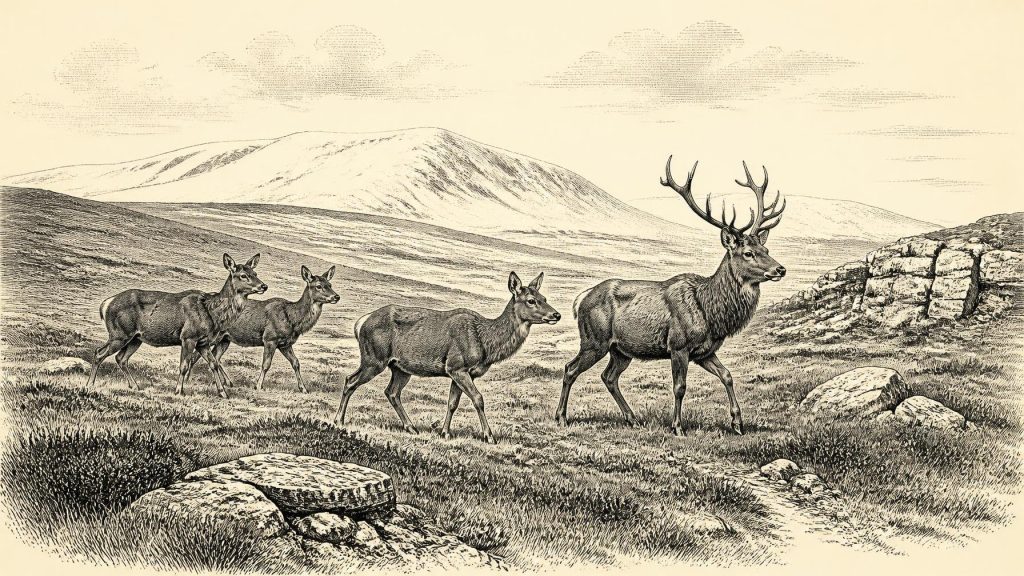
The closest securely dated animal evidence to this broad horizon comes from south-east Ireland. A study combining ancient DNA, osteology and radiocarbon dating identified pre-Last Glacial Maximum red-deer remains from caves at Shandon and Ballynamintra in County Waterford. The two calibrated determinations span 32,930–31,280 and 30,297–29,594 cal BP. The earlier of these ranges overlaps the approximate age represented by 30,751 BCE. It demonstrates that red deer had reached Ireland before the ice sheet attained its maximum extent.
This is evidence for animals, not automatically for people. A deer bone records the former presence of a species; it does not reveal a hunting camp, a household, a territory or a community. Nevertheless, it is an important correction to the familiar image of an entirely lifeless, frozen Ireland. At least in suitable places and phases before the Last Glacial Maximum, deer could live on the island. Their presence implies vegetation sufficient to support browsing and grazing animals, although it cannot alone reconstruct the exact mixture of grasses, herbs, dwarf shrubs and sparse woodland in County Waterford at one moment.
The deer also belonged to an earlier Irish population, not simply to the modern animal familiar from Killarney or Wicklow. The same research found a substantial gap in directly dated red-deer evidence after the Late Glacial, and concluded that surviving Irish red deer were introduced by people in the Neolithic. The Waterford specimens therefore represent a vanished Pleistocene episode in the island’s animal history. They should not be enlisted as proof of an uninterrupted lineage of red deer, or of continuous human hunting traditions, from Ice Age Ireland to the present.
Castlepook and the Mammoth-Steppe Fauna
County Cork provides the more spectacular, if chronologically complicated, window on this older world. Castlepook Cave, near Doneraile and also called Mammoth Cave, produced a large collection during excavations conducted for the Royal Irish Academy in the early twentieth century. The National Museum of Ireland describes it as the country’s most important site for mammal remains of the last cold stage. Its assemblage includes spotted hyena, woolly mammoth, reindeer, brown bear, wolf, Arctic fox, hare and giant deer. These species do not prove that all lived together at the same time, but collectively they show that Ireland periodically supported a cold, open-country fauna very different from the modern one.
Spotted hyena is particularly revealing. A carnivore capable of scavenging and hunting large prey, it indicates an ecosystem with substantial animal biomass and complex food relationships. A mammoth bone bearing damage attributed to hyena is an equally vivid reminder that caves could be used by carnivores and that bones were moved, gnawed, broken and redeposited. Cave assemblages are not simple snapshots. They may combine deaths, denning, scavenging, water transport and excavation disturbance across thousands of years. Their value is great, but their context must be tested specimen by specimen.
Recent re-dating has made that caution more pressing. Improved pretreatment of bone samples showed that some older Castlepook radiocarbon results were too young by roughly 5,000 to 12,000 radiocarbon years. The revised work suggests that giant deer and spotted hyena may have disappeared locally before about 40,000 cal BP, well before the period considered here. Castlepook therefore illuminates the broader MIS 3 fauna of southern Ireland, but cannot be used indiscriminately to place mammoth, hyena, reindeer and deer together at 30,751 BCE. Evidence and interpretation must remain separate.
The Question of Human Presence
There is a much-publicised reindeer femur from Castlepook reported to bear a deep mark interpreted by zooarchaeologist Ruth Carden as having been made by a stone tool during butchery. Public accounts have associated it with an age of roughly 33,000 years. If that diagnosis and chronological association are confirmed through full publication and contextual analysis, it would be exceptionally early evidence that people handled a reindeer in Ireland during the Upper Palaeolithic.
For the present, however, the claim must not be enlarged beyond the object. No securely associated stone-tool assemblage, hearth, dwelling floor, burial, human skeleton, artwork or stratified camp of comparable age has been published from Ireland. Nor does a marked limb bone establish whether people killed the animal, processed a carcass at the cave, arrived in a party of known size, remained for days or returned repeatedly. Castlepook’s old excavations also lacked the recording standards expected today. It is reasonable to treat the femur as an important lead for research, not as evidence for a settled population or an Irish society in the thirty-first millennium BCE.
The larger regional context makes brief human movement conceivable but not demonstrable. Upper Palaeolithic groups elsewhere in north-west Europe possessed sophisticated stone technologies, social connections and seasonal ways of life adapted to cold environments. Lower sea levels changed coastlines and exposed broad areas now submerged, but a lowered sea is not proof of a continuous, easily crossed land bridge between Ireland and Britain. Routes across the Irish Sea and the degree of separation remain matters of palaeogeographical reconstruction. Any visit to Ireland would have involved conditions and decisions now largely invisible to archaeology.
Life Without a Recorded Society
Nothing allows us to identify the language, beliefs, kinship, leadership or ritual of any people who may have entered Ireland at this time. Nor can the animal record establish an economy or trade. If people did visit, the likeliest interpretation is a small and mobile foraging episode connected to the pursuit or opportunistic use of large game, rather than farming, permanent settlement or exchange between named communities. That is an inference from the ecological setting and comparison with Upper Palaeolithic lifeways elsewhere, not a directly observed Irish fact.
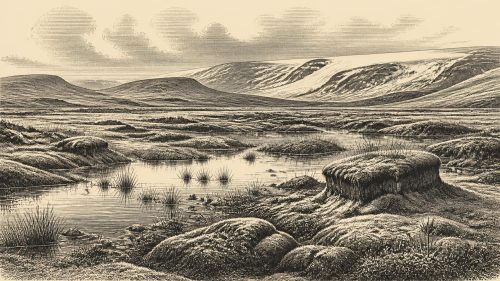
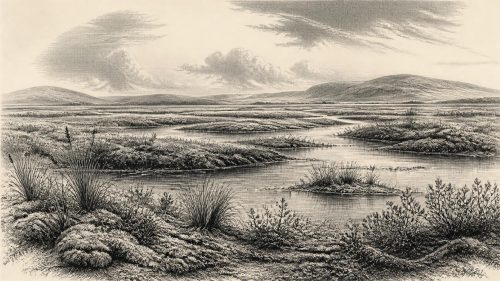
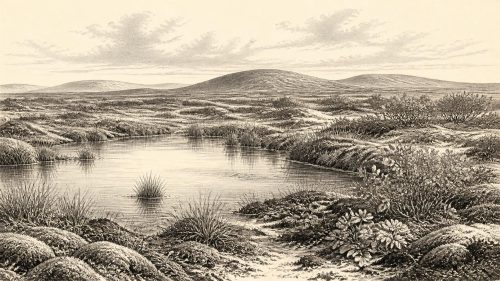
Environmental change, rather than human politics, is the central story. The growing British–Irish Ice Sheet was beginning to reshape drainage, coastlines and habitable ground on a grand scale. In later millennia, ice would scour bedrock, lay down till, and help create the physical foundations of many Irish valleys, lake basins, drumlin fields and wetlands. Around 30,751 BCE those familiar future landscapes did not yet exist in their modern form. The island was a shifting frontier between cold grassland or tundra-like habitats, caves used by animals, advancing ice and sea.
What This Year Can Mean
The most meaningful history of this date is therefore a history of thresholds. Calibrated red-deer dates from Waterford show that large herbivores were present in Ireland within the relevant broad timespan. The Castlepook archive demonstrates that southern Ireland was connected, intermittently and ecologically, to the wider Ice Age world of mammoth, reindeer and hyena. Ice-sheet research shows that this fauna occupied an island entering a major phase of glaciation. A possible cut-marked reindeer bone raises the prospect of human contact, but does not yet establish settlement.
That combination of certainty and uncertainty is not a weakness in the story; it is the story. Ireland around 30,751 BCE cannot be reconstructed as a nation before nations, or peopled with invented tribes and events. It can be understood as a cold and changing Pleistocene landscape whose rare bones, dated ranges and buried deposits preserve fleeting evidence of animals, climate and perhaps a human encounter at the edge of the archaeological record.
Primary Sources
- The IntCal20 Northern Hemisphere Radiocarbon Age Calibration Curve (0–55 cal kBP)
- The Irish Quaternary Fauna Project
- A reconsideration of the radiocarbon dating of the Marine Isotope Stage 3 fauna from southern Ireland
- Phylogeographic, ancient DNA, fossil and morphometric analyses reveal ancient and modern introductions of a large mammal: the complex case of red deer (Cervus elaphus) in Ireland
- Growth and retreat of the last British–Irish Ice Sheet, 31 000 to 15 000 years ago: the BRITICE-CHRONO reconstruction
- BRITICE-CHRONO maps and GIS data of the last British-Irish Ice Sheet 31 to 15 ka
- Extent and timing of the Last Glacial Maximum (LGM) in Britain and Ireland: a review
- The timing and magnitude of the British–Irish Ice Sheet between Marine Isotope Stages 5d and 2
- Dimensions and chronology of the last ice sheet in Western Ireland
- Trimlines, blockfields and the vertical extent of the last ice sheet in southern Ireland
- Stratigraphic and palaeo-geomorphological evidence for the glacial-deglacial history of the last British-Irish Ice Sheet in the north-western Irish Sea
- The problem of a late quaternary landbridge between Britain and Ireland
- The colonization of Ireland: A human ecology perspective
- New insights on the fauna of Ireland's Younger Dryas and Early Holocene from Alice & Gwendoline Cave
- Spotted Hyena Skull
- Ice Age Ireland
- Quaternary
- Geology of Ireland
- Outreach and Education Resources
- Origin of British and Irish mammals: disparate post-glacial colonisation and species introductions
- Could brown bears (Ursus arctos) have survived in Ireland during the Last Glacial Maximum?
- The Island of Ireland: drowning the myth of an Irish land-bridge?