Maguirebridge’s Dwarf Willow Record30748 BCE
Approximately 30,748 BCE falls within a broad, uncertain later MIS 3 chronology, not a datable Irish year. Derryvree, near Maguiresbridge, preserves freshwater silts and plants beneath and between tills, showing that Fermanagh experienced an ice-free wetland interval before glaciation. Dwarf willow, sedges, bogbean and other fossils indicate treeless, periglacial terrain with pools, mosses and sparse vegetation. Cave finds show intermittent presence of cold-adapted mammals, including reindeer, mammoth and giant deer, although remains derive from differing periods. A marked Castlepook reindeer bone may evidence human butchery, but cannot prove settlement. Ireland was undergoing uneven ice-sheet expansion, while human history remains unrecoverable.
Dateline
The label 30,748 BCE gives a false impression of precision. Ireland has no written record, calendar, named community or dated event that can be assigned to this particular twelve-month span. At this depth in time, chronology comes from radiocarbon measurements, stratigraphy and comparison with wider climatic records; each has margins of error. The responsible subject is therefore Ireland in the later part of the Last Glacial Period, within Marine Isotope Stage 3 (MIS 3), rather than an imagined annual chronicle.
Expressed in the conventional “before present” system, with 1950 as the reference year, this modern date-label falls around 32,700 calendar years ago. It sits within a broad interval illuminated by the important Derryvree deposits near Maguiresbridge, County Fermanagh, and by cave-fauna evidence from south and west Ireland. These sources can reveal a cold, changing country of open vegetation, freshwater pools, animals and advancing ice. They cannot identify a government, battle, treaty, household, religious rite or trading voyage in 30,748 BCE.
A Date Within a Range
The key northern record was exposed during roadworks in 1969 at Derryvree townland, about two kilometres north-east of Maguiresbridge. Workers cut through a drumlin: a streamlined hill largely built of glacial sediment. Beneath one sheet of till, the unsorted debris left by ice, lay fine sand, freshwater silt and organic material; another till sheet sealed the deposit above. The sequence has a straightforward but powerful implication. Ice had occupied the locality, then a non-glacial interval allowed a wetland or shallow-water environment to form, before a later glacier overrode and buried it.
Organic material from this freshwater series produced the radiocarbon determination BIRM-166, conventionally reported as 30,500 radiocarbon years BP, with a substantial uncertainty. A radiocarbon age is not a calendar age: atmospheric carbon-14 concentrations changed through time, so measurements must be calibrated against independently built curves. At such antiquity, calibration produces broad probability ranges rather than a single answer. Published discussion places the Derryvree evidence broadly within later MIS 3, commonly expressed in a calibrated span of roughly 36,900–31,700 years ago, or about 34,950–29,750 BCE. The year-label considered here lies inside that range, but it does not date a particular plant, pool or animal encounter.
This distinction matters. Derryvree demonstrates that this part of Fermanagh was locally ice-free at some point during the dated interval. It does not prove that every part of Ireland was simultaneously free of ice, nor that conditions endured unchanged for centuries. MIS 3 was climatically unstable. A landscape could alter greatly as temperatures, precipitation, snow cover, permafrost and the margins of local or regional ice masses shifted.
Water, Tundra and Permafrost
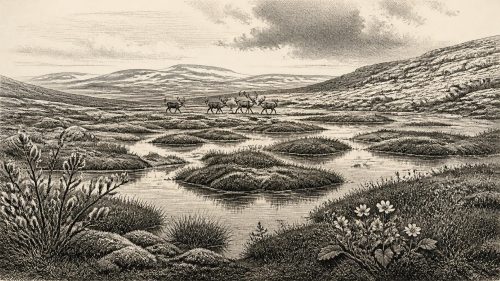
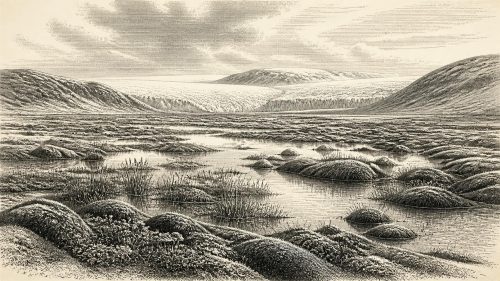
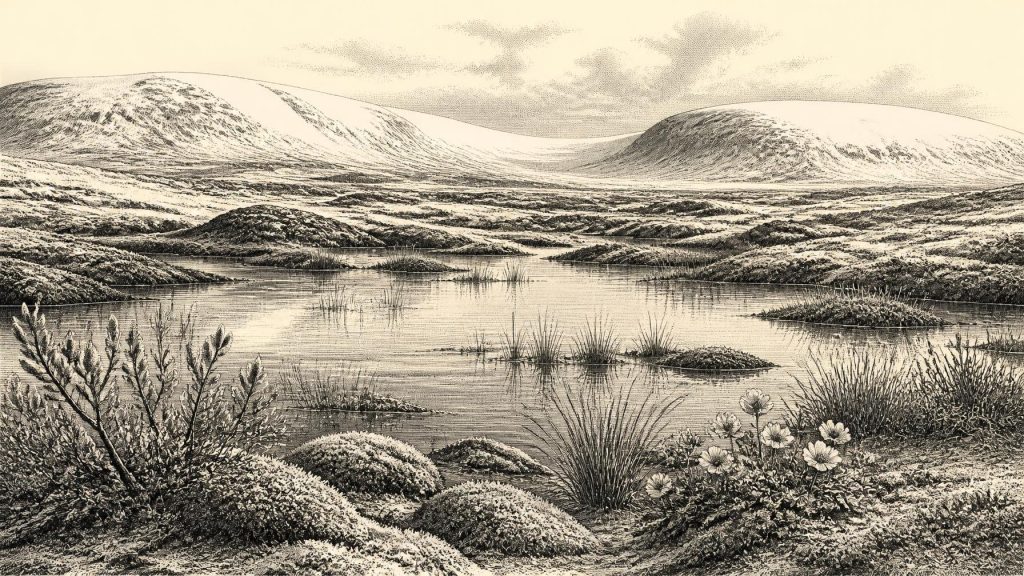
The Derryvree fossils make the ancient setting less abstract. Plant remains include sedges and mosses, together with species associated with cold, open ground and wet places: dwarf willow, mountain avens, lesser clubmoss, bogbean and the tundra plant Dryas octopetala. Their presence does not recreate a picturesque modern meadow. Rather, it indicates a treeless, periglacial mosaic of wet hollows, shallow fresh water, moss-rich ground and sparse vegetation. In such country, local shelter, soil moisture and season could make a major difference over short distances.
Bogbean is especially evocative because it needs freshwater. Its fossil seed confirms that, despite a severe climate, standing or slow-moving water supported aquatic and wetland life. Fine sediments likewise record low-energy deposition: water was carrying and settling silt rather than a river torrent continually scouring the site. The wider landscape probably included frost-shattered ground, seasonally frozen soils and exposed mineral surfaces, alongside reeds, sedges and mosses around pools. Trees were absent or exceedingly scarce in the local evidence. There is no basis for projecting the oak, hazel and pine woods of much later prehistoric Ireland back into this period.
Such environments were neither uniform nor lifeless. Insects, small animals and plants occupied niches around water and vegetation, while larger grazing animals could exploit open country. Yet the record is a sample from one favourable preservation setting, not a complete inventory of an entire island. It is sounder to speak of a cold, open Fermanagh wetland landscape than of a single island-wide ecosystem frozen in time.
Animals on a Changing Island
Irish cave collections provide the other major line of evidence. Many were excavated in the late nineteenth and early twentieth centuries, often before modern recording standards. Their bones are nevertheless important, particularly where accelerator radiocarbon dating has revisited old collections. Castlepook Cave near Doneraile in north County Cork, sometimes known as Mammoth Cave, has yielded remains attributed to mammoth, reindeer, giant deer, spotted hyaena, wolf, fox, hare and other Ice Age fauna. The Irish Quaternary Fauna Project showed that mammals entered Ireland during the long period before the Last Glacial Maximum and that the cave collections preserve evidence from more than one episode.
The cave evidence must not be compressed into a single imagined scene. Bones from different layers, galleries or excavations may be separated by thousands of years. Caves also accumulate remains in several ways: animals die there, predators drag in prey, water moves bone, and people may introduce or modify it. A mammoth bone demonstrates that mammoths reached the broader Irish landscape during part of the late Pleistocene; it does not mean that mammoth, hyaena, reindeer and giant deer stood together outside the cave in this exact year.
Nonetheless, the collective picture is clear in broad outline. Ireland was not simply an ice-covered void throughout the whole of MIS 3. At least intermittently, parts of the island provided routes and habitats for cold-adapted and open-country mammals. Reindeer are particularly relevant to this year-label because a femur from Castlepook has been reported as approximately 33,000 years old. It bears a deep linear mark interpreted by zooarchaeologist Ruth Carden as damage made with a sharp stone tool during carcass processing.
The Reindeer Bone Question
If the Castlepook mark is confirmed as a fresh-bone cut made by a stone tool, it is potentially momentous: it would indicate a human presence in Ireland in the Upper Palaeolithic, far earlier than the previously secure evidence of terminal-Pleistocene activity. County Cork heritage material reasonably presents the object as an important possibility. But its limits are equally important. The femur derives from an old cave collection, not from a recently excavated, sealed occupation floor. The date concerns the animal bone, not automatically the instant of cutting. No securely associated hearth, stone-tool assemblage, dwelling, burial, human remains or substantial concentration of butchered food waste of comparable age has yet been recovered.
Accordingly, the bone can support a narrow proposition: a person or people may have processed a reindeer in Ireland during this broad pre-Last Glacial Maximum interval. It cannot establish permanent settlement, a population size, a language, kinship system or a continuous occupation of the island. Nor can it tell us whether the animal was hunted, scavenged, butchered at another location and later taken into a carnivore den, or encountered during a brief seasonal visit. Current work at Castlepook is seeking undisturbed deposits and stronger contextual evidence precisely because these questions remain open.
Ice Sheet in Formation
At about 32,700 years ago, Ireland was moving towards the much larger ice expansion conventionally called the Last Glacial Maximum, but had not necessarily reached one uniform island-wide maximum. Recent reconstructions of the British–Irish Ice Sheet stress rapid and regionally uneven growth between about 32,000 and 30,000 years ago. They also warn against treating ice extent as a simple on-or-off condition. Ice caps, flowing outlets, marine margins and relatively open lowland environments could coexist in different sectors.
This is why Derryvree’s buried wetland is so valuable. It preserves direct local evidence of a freshwater interlude between glacial advances. The later till above it records the eventual destruction or burial of that landscape by ice. For the inhabitants of the ecosystem—plants, insects and animals—the most significant “political” force was not a kingdom but changing climate and ice. The growth of glaciers altered drainage, vegetation, animal corridors and the availability of sheltered ground.
What Cannot Be Recovered
There is no evidence for political authority, diplomacy, organised warfare, law or named territories in Ireland at this date. Nor is there evidence for a settled village economy, farming, long-distance trade network, monuments, literacy, formal learning or identifiable religious practice. The absence of evidence is especially decisive here because the archaeological record is so slight and because later ice movement removed, reworked or buried many earlier land surfaces.
Even if the Castlepook reindeer bone represents human butchery, everyday life can only be discussed by cautious comparison with Upper Palaeolithic hunter-gatherers elsewhere in north-west Europe. Such groups possessed sophisticated knowledge of animal movement, stone-working and seasonal landscapes. But no Irish hearth, tool kit or camp of this age currently permits those capabilities to be attributed directly to a community in Ireland. Comparison may suggest questions for excavation; it cannot fill the Irish record with invented people or customs.
The strongest history of 30,748 BCE is therefore environmental and evidential. Derryvree’s dwarf willow, sedges, bogbean and freshwater silts record a cold but biologically active northern landscape between phases of ice. Castlepook’s fauna records that large mammals moved through at least parts of Ice Age Ireland, while one marked reindeer bone raises the possibility of a fleeting human encounter. Together they show an island on the threshold of profound glacial change: not a blank space, but a fragmentary archive whose silences must be respected as carefully as its discoveries.
Primary Sources
- A Middle Midlandian Freshwater Series at Derryvree, Maguiresbridge, County Fermanagh, Northern Ireland
- Growth and Retreat of the Last British–Irish Ice Sheet, 31,000 to 15,000 Years Ago: The BRITICE-CHRONO Reconstruction
- The Timing and Magnitude of the British–Irish Ice Sheet Between Marine Isotope Stages 5d and 2
- Behavioural Tendencies of the Last British–Irish Ice Sheet Revealed by Data–Model Comparison
- Exploring Controls of the Early and Stepped Deglaciation on the Western Margin of the British Irish Ice Sheet
- The Irish Quaternary Fauna Project
- First Evidence of a Late Upper Palaeolithic Human Presence in Ireland
- The Colonization of Ireland: A Human Ecology Perspective
- New Insights on the Fauna of Ireland's Younger Dryas and Early Holocene from Alice & Gwendoline Cave
- Ireland's Palaeolithic Archaeology – Fleeting Footprints in a Frozen Land
- Heritage Artefacts of County Cork 2021
- The Archaeological Heritage of County Cork
- 2022:564 – Castlepook Cave, Castlepook South, Cork
- Archaeology Research Excavation Grant 2022
- Irish Association for Quaternary Studies Guide 13
- Irish Association for Quaternary Studies Guide 16: References and Recommended Reading
- Menyanthes trifoliata in Fermanagh
- Salix herbacea in Fermanagh
- Dryas octopetala in Fermanagh
- Red Deer Phylogeography and Population History in North-West Europe