
Derryvree’s Ice-Free Silts30716 BCE
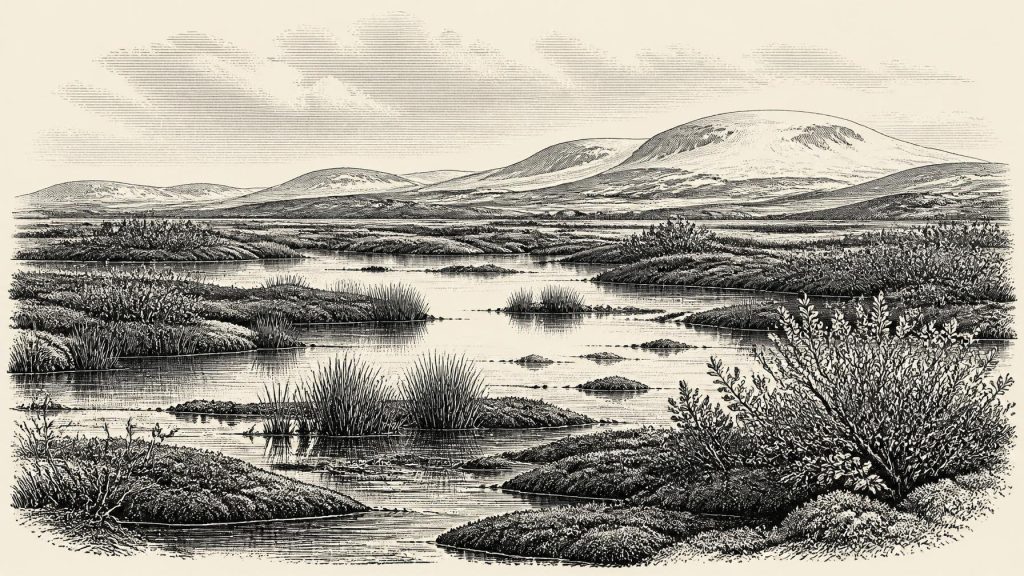
Approximately 30,716 BCE, Ireland lay within the unstable MIS 3 phase of the last Ice Age, although no annual event can be dated so precisely. At Derryvree, County Fermanagh, freshwater silts and beds preserved between glacial tills demonstrate a local ice-free interval. Plant and insect remains indicate cold, treeless wetland, with pools, sedges, mosses, dwarf willow and arctic-alpine flora. Castlepook Cave, County Cork, records a MIS 3 fauna, including reindeer, mammoth, giant deer and carnivores, but its disturbed deposits cannot prove contemporaneity. No secure evidence establishes human settlement; a possible cut-marked bone remains inconclusive. Later glaciation reshaped this Pleistocene landscape.
Dateline
The label 30,716 BCE is a modern convenience, not a date that can be recovered from the Irish archaeological record with year-by-year precision. No one in Ireland used a calendar of this kind; no contemporary text, settlement sequence or securely dated human artefact allows a historian to identify an event in that particular year. The responsible approach is instead to place it within a broad Late Pleistocene context. It falls in Marine Isotope Stage 3 (MIS 3), part of the last Ice Age, when climate in the north Atlantic region shifted repeatedly between colder and somewhat milder episodes.
The most informative Irish evidence near this notional date comes not from a human site but from a buried freshwater deposit at Derryvree, close to Maguiresbridge in County Fermanagh. Its organic beds were radiocarbon dated to 30,500 ± 1,100 radiocarbon years before present (BP, where “present” conventionally means AD 1950). Radiocarbon years are not calendar years. Modern calibration, using the IntCal20 curve, places the determination within a broad and non-annual calendar range that encompasses 30,716 BCE. It would be wrong, however, to treat that range as proof that a particular plant, animal or pool existed in this exact numbered year.
Freshwater Between Ice Advances
Derryvree is important because of its stratigraphy: layers of freshwater silt and organic sediment lay between older and younger tills, the unsorted deposits left directly by glacier ice. This sequence securely shows that, after one episode of glaciation and before another, the locality was free of overriding ice long enough for water, sediment, plants and insects to accumulate. The deposit is therefore a rare Irish witness to an interval of environmental change during the Middle Midlandian, the traditional Irish term for this part of the last glaciation.
Its limits matter as much as its value. Derryvree records conditions in one Fermanagh basin, not the whole island. It cannot establish that all Ireland was ice-free at once, nor can it draw an exact coastline, map every glacier margin or settle the disputed timing of all advances of the British–Irish Ice Sheet. Later ice moved across much of Ireland, eroding older sediments, rearranging drainage and concealing or destroying evidence. Derryvree survived because an ephemeral wetland was sealed beneath later glacial material.
The sediment is nevertheless direct evidence that this was not simply a lifeless sheet of ice. Fossil pollen, plant macrofossils and insects indicate open, cold-country vegetation with freshwater and saturated ground. The assemblage has been interpreted as tundra or muskeg: a treeless mosaic of pools, sedge-rich margins, mossy ground and sparsely vegetated terrain subject to severe winters. Such terms are reconstructions, rather than photographs of the landscape, but they rest on physical traces of organisms and on the water-laid sediments in which those traces were preserved.
A Cold Wetland Landscape
The plants identified from Derryvree offer a particularly vivid, if local, picture. They include indicators of wetland and cold open habitats: sedges and grasses, mosses, dwarf willow, mountain avens, bogbean and aquatic water-milfoil. Bogbean and water-milfoil show that open or slow-moving freshwater persisted at least seasonally; dwarf willow and mountain avens are familiar arctic-alpine plants, well suited to exposed, cold ground. Juniper and herb pollen complement the evidence for a largely treeless landscape. There was enough summer thaw and biological productivity for plants to flower, insects to breed, and organic matter to enter the basin, even though the climate remained harsh.
This was not an Irish bog in the modern sense, clothed in heather or bounded by fields and roads. Nor should it be imagined as uniform, snowbound tundra. Pools, thawed margins, frost-shattered ground and low vegetation could stand close together, while conditions changed over short distances according to shelter, drainage and the presence or absence of ice. The wider landscape was dynamically connected to glacier growth, meltwater and permafrost processes. Water could sustain a local ecological community while colder, drier or ice-covered country lay beyond it.
At this depth in time, environmental change was the principal force shaping what can be called Ireland’s history. Global sea level was substantially lower than today because much water was locked in continental ice sheets. Yet the local geography of the Irish Sea and Atlantic shelves was also affected by the weight of ice depressing the land and by changing relative sea level. It is unsafe to claim a particular dry-land route between Ireland, Britain and continental Europe for 30,716 BCE. The available evidence instead supports a more cautious conclusion: land, shallow sea, coastal lowlands and ice margins were configured very differently from the modern island, and their arrangements could alter dramatically over millennia.
Mammoths and Carnivores in Cork
Castlepook Cave near Doneraile, County Cork, provides the complementary animal record. It has yielded Ireland’s richest known Late Pleistocene vertebrate assemblage, including reindeer, woolly mammoth, giant deer, brown bear, wolf, arctic fox, mountain hare, lemmings and spotted hyaena. The animals are striking evidence that Ireland could support, or at least receive, a much richer cold-stage fauna than the later island’s familiar mammals suggest. Reindeer and lemmings are especially consistent with open, cold environments; mammoth, giant deer and large carnivores point to food webs beyond anything seen in historic Ireland.
But Castlepook is not a single moment preserved untouched underground. Much of its collection was recovered during older excavations, before modern recording standards, from cave sediments affected by water, animal activity and disturbance. Bones may represent animals brought in by hyaenas, carried by floods, moved within the cave or deposited in separate periods. Subsequent radiocarbon reassessment has shown that several old determinations understated the age of material. Direct dates now establish that some of the fauna belongs to MIS 3, but do not prove that every recorded species lived together or that all were present in 30,716 BCE.
Used properly, the Cork evidence strengthens rather than oversimplifies the Fermanagh picture. Across a long climatic interval before the Last Glacial Maximum, parts of Ireland were ecologically connected to north-western Europe sufficiently for large herbivores and predators to reach them. Reindeer imply mobile grazing animals capable of using seasonal resources; hyaenas, wolves and arctic foxes indicate predators and scavengers operating within that system. The cave itself may have served as a den, refuge or trap-like repository for bones, not as a neutral sample of every animal living outside.
The Unsettled Human Question
No securely documented house, hearth, burial, stone-tool scatter, ornamental object or repeated hunting camp can be assigned to Ireland around this date. There is likewise no evidence for a resident population, a named people, language, political authority, diplomacy, organised warfare, shrine, formal learning or exchange network. Those absences should not be filled with an invented tribal history. Political affairs and religion, in the ordinary historical sense, are simply beyond the reach of the available Irish record.
One reindeer bone from Castlepook, of broadly relevant age, has been discussed as bearing a possible cut mark made during carcass processing. If that interpretation is ultimately confirmed, it may indicate a brief encounter between an Upper Palaeolithic person and an animal in Ireland during MIS 3. It does not demonstrate permanent settlement, a community, or a continuing tradition of occupation. A mark on a bone dates neither its maker nor the length of a visit. The gap between such a possibility and proof of an inhabited landscape is substantial.
The firmer published evidence for Pleistocene people in Ireland is much later: a butchered brown-bear bone from Alice and Gwendoline Cave in County Clare, directly dated to the terminal Pleistocene, approximately 12,810–12,590 calibrated BP. That find establishes human activity in a far later and changing world. It cannot be projected backwards by almost twenty thousand years to populate the Fermanagh wetland or Castlepook’s cave passages.
An Island in Flux
For Ireland around 30,716 BCE, then, the best account is an evidence-led one. At Derryvree, a freshwater basin accumulated silts and organic material during an ice-free interval, supporting cold-adapted wetland plants and insects. In the wider MIS 3 period, the faunas of Castlepook show that reindeer, mammoth, giant deer and formidable carnivores occurred in southern Ireland, though not necessarily together or precisely at this date. Ice, water, frost and shifting habitats mattered more than human institutions.
Daily life, economy, culture and conflict can therefore be described only for the non-human communities securely represented by the evidence: plants exploiting a short growing season, insects living around productive wet ground, herbivores ranging across open country, and predators or scavengers using the resources those animals provided. Whether people occasionally entered that world remains an important research question, not an established annual event. Derryvree’s buried silts preserve the more defensible truth: Ireland was a cold, uneven and changing Pleistocene landscape, briefly hospitable in particular places, before later ice transformed it again.
Primary Sources
- A Middle Midlandian Freshwater Series at Derryvree, Maguiresbridge, County Fermanagh, Northern Ireland
- Irish Pleistocene Biostratigraphy
- The Irish Quaternary Fauna Project
- A Reconsideration of the Radiocarbon Dating of the Marine Isotope Stage 3 Fauna from Southern Ireland
- Castlepook Cave, County Cork: County Geological Site Report
- Castlepook Cave, Cork, Excavation Report 2022
- First Evidence of a Late Upper Palaeolithic Human Presence in Ireland
- New Insights on the Fauna of Ireland's Younger Dryas and Early Holocene from Alice & Gwendoline Cave
- Advances in Irish Quaternary Studies
- The Last Irish Ice Sheet: Extent and Chronology
- The Timing and Magnitude of the British–Irish Ice Sheet Between Marine Isotope Stages 5d and 2
- The IntCal20 Northern Hemisphere Radiocarbon Age Calibration Curve (0–55 cal kBP)
- Radiocarbon Dates from the Oxford AMS System: Archaeometry Datelist 31
- Pleistocene Vertebrates in the British Isles
- Occurrence of Mammalia Relicts at Site Castlepook Cave
- Menyanthes trifoliata L. in Fermanagh: Fossil Record
- Salix herbacea L. in Fermanagh: Fossil History
- Dryas octopetala L. in Fermanagh: Fossil Occurrence
- Myriophyllum alterniflorum DC. in Fermanagh: Fossil Occurrence
- The Caves of Fermanagh and Cavan: Irish Quaternary Association Guide References