
Hyenahall’s Open Corridor30691 BCE
Thirty thousand six hundred and ninety-one BCE is a modern label rather than a recoverable Irish year. Around 32,600 cal BP, Ireland experienced unstable Late Pleistocene conditions, with advancing and retreating ice, locally ice-free wetlands and tundra vegetation. Derryvree sediments in Fermanagh record freshwater habitats within a broad dated interval, not continuous island-wide conditions. Castlepook Cave in Cork preserves fauna, including mammoth, reindeer, giant deer and hyaena, demonstrating ecological links with north-west Europe, though not a proven land bridge. A modified reindeer bone may suggest human carcass processing, but sustained settlement remains unproven. Subsequent ice expansion erased or disturbed evidence.
Dateline
“30,691 BCE” is a modern chronological label, not a year that can be recovered from the Irish archaeological record. No contemporary calendar, writing, named community or annual sequence exists for Ireland at this depth of time. In radiocarbon terms, the label falls roughly around 32,600 calibrated years before present (cal BP, where “present” conventionally means AD 1950), within the Late Pleistocene and Marine Isotope Stage 3. The responsible history is therefore one of broad, overlapping date ranges: deposits, animal remains and changing ice margins can illuminate an interval around this point, but cannot identify an event in a particular year.
An Island in a Cold Interval
Ireland lay in the middle of the last Ice Age, but not yet at the Last Glacial Maximum. That later maximum, broadly dated to about 26,500–19,000 cal BP, saw the British–Irish Ice Sheet expand extensively across Ireland and its surrounding shelves. Around 32,600 cal BP, conditions were unstable and regionally varied. The island should not be imagined either as a uniformly ice-covered white desert or as a familiar green landscape merely made colder. Ice sheets and local glaciers had advanced and retreated repeatedly; open ground, frozen soils, seasonal waters and vegetated lowlands could occur in the same broad region at different times.
The best direct Irish evidence relevant to this notional date comes from buried sediments rather than settlements. At Derryvree, near Maguiresbridge in County Fermanagh, road works exposed freshwater silts, sands and organic material enclosed between two layers of glacial till. The lower till records an earlier ice advance; the overlying organic deposits record a period in which water and vegetation occupied the basin; the upper till shows that ice later returned. A conventional radiocarbon result from the organic material, calibrated with modern curves, has been placed broadly at about 36,900–31,700 cal BP, approximately 34,950–29,750 BCE.
That wide range contains 30,691 BCE, but it is not a date stamp for the Derryvree wetland. It tells us that, during part of this long interval, north-central Ireland included locally ice-free ground and freshwater habitats. It does not establish that every part of Ireland was simultaneously free of ice, nor that the deposit accumulated continuously. Calibration matters especially at this age: atmospheric radiocarbon changed through time, and even carefully measured samples translate into probability ranges rather than a single calendar year.
Derryvree’s Evidence
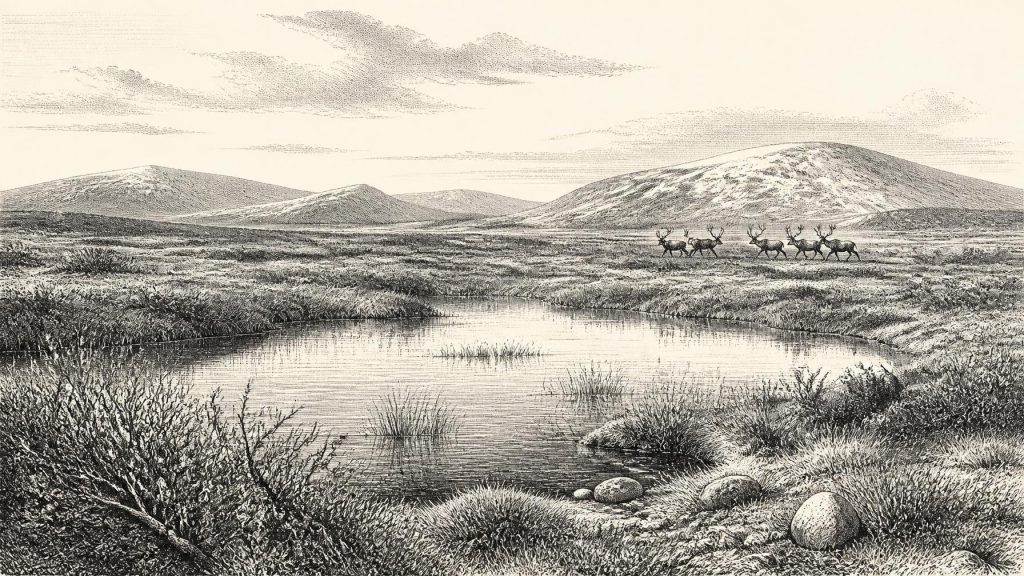
The plant and insect-scale record from Fermanagh is valuable because it gives the landscape texture. Organic layers include remains associated with cold, open environments: mosses, sedges, dwarf willow, mountain-avens, bogbean and water-milfoil. Such evidence suggests shallow fresh water, wet margins and tundra-like or sparsely vegetated ground nearby. The word “interstadial” is useful only if handled carefully. It means a relatively less severe interval within a glacial age; it does not mean warm, wooded or comfortable by modern Irish standards.
In practical terms, this was a land of short growing seasons, powerful winds and repeated freezing and thawing. Where snow lingered, meltwater could feed pools and channels. On better-drained ground, low herbs, grasses, sedges and dwarf shrubs may have formed patchy forage. The composition of vegetation would have shifted rapidly with temperature, moisture, snow cover and disturbance by frost. Trees were not the defining element of this landscape. The familiar oak, elm and hazel woods of much later prehistory belonged to a wholly different climatic world.
These environmental archives also explain why the evidence is fragmentary. Later ice could scour away soils, move boulders, remould valleys and bury older surfaces under till. An apparent absence of campsites is therefore not proof that none ever existed. Yet preservation difficulties cannot turn possibility into evidence. Archaeologists must distinguish between a landscape capable of supporting brief visits and one demonstrated to have held a human population.
Castlepook and Its Animals
County Cork’s Castlepook Cave, also called Mammoth Cave, provides the island’s richest assemblage of vertebrate remains from the period leading towards the Last Glacial Maximum. More than 2,000 bones have been recovered from its galleries, including those of woolly mammoth, reindeer, giant deer, brown bear and spotted hyaena; later cold-stage material includes Arctic fox, wolf and lemmings. Individual dates span a very long interval, so the assemblage is not a snapshot of one community living together on one day. It is a time-depth archive accumulated through animal activity, natural deaths, water movement, sediment movement and early excavation.
For an interval around 30,691 BCE, Castlepook nevertheless supports a central conclusion: Ireland was connected to wider north-west European ecological processes. Large herbivores and their predators reached the island at some stages of the Late Pleistocene. Their presence implies routes of dispersal across a changing Irish Sea world, but it does not permit a simple claim that a permanent dry land bridge existed at this precise moment. Sea level was lower than today, coastlines were different, and ice, water, terrain and season all affected movement. A route usable by mammoth or reindeer would not automatically be one routinely used by people.
Spotted hyaenas are especially important to interpretation. They could carry bones into caves, gnaw and break them, and create concentrations that look dramatic but are not human refuse. Castlepook’s long narrow galleries were a carnivore landscape before they became a museum collection. The cave’s evidence therefore warns against treating every fractured bone as a meal and every bone-rich layer as a camp floor. Water disturbance and the methods of antiquarian excavation have added further complications.
The Human Question
A reindeer femur from Castlepook has received particular attention because a deep modification has been interpreted as a fresh-bone cut or chop made by a sharp stone implement. If that interpretation is correct, it may indicate the processing of a carcass by Upper Palaeolithic people during the broader Middle Midlandian interval. It is an intriguing possibility, not proof of a settled Irish population. There is no securely associated hearth, stone-tool assemblage, dwelling, burial, repeated occupation surface or human skeleton from Ireland that can be assigned to c. 30,691 BCE.
The distinction is more than cautious wording. A mark on a bone, an animal’s radiocarbon age and the date of human action are separate questions. Moreover, radiocarbon science has improved markedly since many Irish cave bones were first dated. Better pretreatment has shown that some earlier measurements were unreliable or underestimated the true ages of specimens. Castlepook remains crucial, but its chronology is being refined rather than closed.
Nor can the absence of proof answer every question decisively. Small, mobile hunting parties leave light traces, and a landscape later overridden by glaciers is particularly hostile to their survival. A short seasonal visit could leave little more than a broken or cut bone. But history should not make that possibility into a narrative of tribes, territories or continuous colonisation. The evidence presently supports, at most, a debated indication of human contact with an Irish animal carcass somewhere within a much broader Late Pleistocene timeframe.
Life Without Political History
There were no known Irish polities, rulers, diplomatic relations, monuments, farms or trade networks to describe at this date. Those categories require evidence that does not survive here. If people did reach Ireland intermittently, their social world would have been that of small, highly mobile Upper Palaeolithic hunter-gatherer groups known elsewhere in Europe: cooperation in travel and food sharing, detailed knowledge of animal behaviour and weather, and skills in making portable equipment. Yet none of those practices can be assigned directly to an Irish group in 30,691 BCE.
Economy, in the narrow sense of production and exchange, was ecological rather than agricultural. No crops, domesticated livestock, pottery, metalworking or settled fields existed. Large herbivores offered potential food, hides, sinew, bone and antler, while freshwater places could provide waterfowl, fish or plant resources when seasonally available. Such possibilities are general inferences from Palaeolithic lifeways and the fauna, not excavated evidence of a specific Irish meal or camp.
Religion, art and learning are similarly beyond direct recovery. People elsewhere in Upper Palaeolithic Europe made sophisticated images, ornaments and ritualised deposits, but no equivalent securely dated Irish material is known from this interval. The most defensible form of “learning” visible in Ireland is ecological: the hard-won adaptation of plants and animals to a volatile cold environment, recorded indirectly in sediments, pollen, bones and landforms.
Approaching a Major Transformation
What makes this interval historically significant is its position before a decisive environmental change. After about 32,000 cal BP, the last Irish Ice Sheet grew towards its later maximum extent, though expansion was not uniform around the island. Much of the evidence discussed here was eventually buried, disturbed or erased by ice. Derryvree’s trapped wetland and Castlepook’s cave deposits survived precisely because unusual local circumstances protected fragments of the earlier world.
Thus Ireland around 30,691 BCE is best understood not as a year of recorded human affairs but as a cold, changing threshold. In Fermanagh, freshwater basins and low tundra vegetation existed during a locally ice-free interval. In southern caves, a varied mammal fauna records connections with the broader Ice Age world, while hyaenas and geological processes complicate every interpretation. Human presence remains possible, perhaps even suggested by one controversial modified reindeer bone, but not demonstrated as sustained settlement. The evidence is limited; its importance lies in showing that prehistoric Ireland’s deepest history was neither empty nor easily told.
Primary Sources
- Castlepook Cave, County Geological Site Report
- Spotted Hyena Skull, Castlepook Cave
- Heritage Artefacts of County Cork
- The Irish Quaternary Fauna Project
- A Reconsideration of the Radiocarbon Dating of the Marine Isotope Stage 3 Fauna from Southern Ireland
- The Last Irish Ice Sheet: Extent and Chronology
- Late Pleistocene Chronostratigraphy and Ice Sheet Limits, Southern Ireland
- Radiocarbon Constraints on the Age of the Maximum Advance of the British-Irish Ice Sheet in the Celtic Sea
- Timing and Pace of Ice-Sheet Withdrawal Across the Marine-Terrestrial Transition West of Ireland During the Last Glaciation
- Growth and Retreat of the Last British-Irish Ice Sheet, 31,000 to 15,000 Years Ago: the BRITICE-CHRONO Reconstruction
- The Timing and Magnitude of the British–Irish Ice Sheet Between Marine Isotope Stages 5d and 2
- Reconstructing the Last Irish Ice Sheet 2: a Geomorphologically-Driven Model of Ice Sheet Growth, Retreat and Dynamics
- South Fermanagh, Northern Ireland: Irish Quaternary Association Field Guide 16
- The Quaternary History of Ireland: Irish Quaternary Association Guide 17
- Quaternary Site Descriptions
- Outreach and Education Resources
- New Insights on the Fauna of Ireland’s Younger Dryas and Early Holocene from Alice & Gwendoline Cave
- An Island World? Hunter-Gatherers in Ireland
- The IntCal20 Northern Hemisphere Radiocarbon Age Calibration Curve (0–55 cal kBP)
- The Colonization of Ireland: A Human Ecology Perspective
- First Evidence of a Late Upper Palaeolithic Human Presence in Ireland