
Murder of Conchobar Máenmaige1189 CE
In 1189, Ireland remained divided among Anglo-Norman lordships, Gaelic dynasties and ecclesiastical centres. Conchobar Máenmaige Ua Conchobair, king of Connacht, was murdered by followers directed by a kinsman, provoking revenge and dynastic conflict. Violence spread through the north, midlands and Munster, where raids, deaths and destruction of castles exposed the fragility of colonial control. Armagh was burned and plundered, while Mellifont received the Airgialla overking Murchad Ua Cerbaill. Henry II’s death brought Richard I’s accession; William Marshal’s marriage to Isabel de Clare transferred Leinster’s lordship, though possession remained contested. Irish bishops attended Richard’s coronation, and Gerald of Wales promoted conquest.
Dateline
In 1189, Ireland’s political map was neither newly conquered nor securely divided. Anglo-Norman lordships held towns, castles and valuable routes in the east and south-east; powerful Gaelic dynasties still ruled, competed and made war across the greater part of the island; and ecclesiastical centres remained places of authority, wealth and learning. The surviving record for the year is unusually vivid in places, but it is not a continuous narrative. Irish annals preserve terse reports of killings, fires, raids and deaths, while English and Welsh-connected sources illuminate changes in the wider Plantagenet world. Taken together, they show an island where authority was contested at almost every level.
Assassination in Connacht
The year’s most consequential firmly dated Irish event was the killing of Conchobar Máenmaige Ua Conchobair, king of Connacht. The Annals of Ulster call him the “royal heir of all Ireland” and report that he was killed by his own followers at the direction of a kinsman, Conchobar Ua Diarmata. The Annals of Inisfallen also record his death, though it names a somewhat different group of killers. Such variation is a reminder that annalistic accounts were compiled from regional information and later copied; the secure point is that Connacht’s ruler was murdered in 1189 in a conflict within his own extended dynasty.
Conchobar’s death was not simply the removal of one king. He had risen amid the bitter struggle of the Ua Conchobair family, displacing his father Ruaidrí Ua Conchobair, the former king of Connacht whose earlier claims to high kingship had been gravely weakened after the Anglo-Norman arrival. Connacht was therefore already politically unsettled. The killing intensified that instability. The Annals of Ulster immediately adds that Cathal Carrach, Conchobar Máenmaige’s son, killed Conchobar Ua Diarmata in revenge. Vengeance did not settle succession: it made the royal kindred’s rivalries more dangerous and helped open a prolonged contest for Connacht.
Elsewhere in the north and midlands, the annals likewise describe power as personal, local and precarious. Domnall, son of Muirchertach Ua Lochlainn, was killed among the “Foreigners of Dál Araide”, while the ruler styled king of Fir Manach was deposed. A raiding party of Foreigners then entered that region; a confrontation followed in which Ua Cerbaill was defeated and Ua Máelruanaid was killed. The word rendered “Foreigners” in these texts generally refers to the Anglo-Norman newcomers and their adherents, though the annals do not always supply the detail needed to identify every force or commander. What is clear is that armed movement, deposition and retaliatory violence reached far beyond the better-known colonial centres around Dublin and Waterford.
Castles Broken in Munster
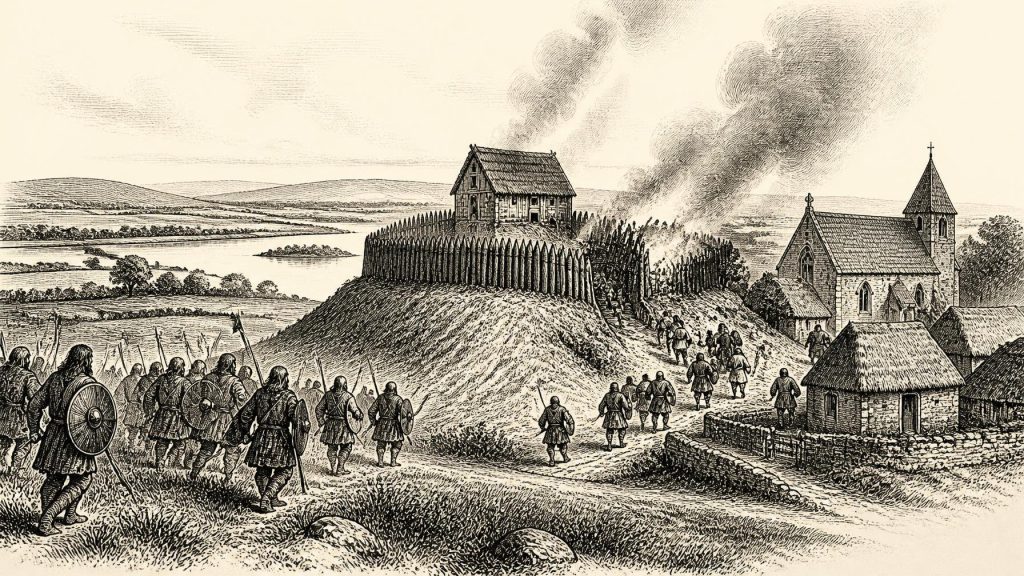
The southern record is especially striking. The Annals of Inisfallen, a source with strong Munster associations, reports warfare and heavy casualties in 1189, followed by the destruction of castles at Tipra Fachtna and elsewhere in the Déisi and Osraige. It then records that Cuilén Ua Cuiléin and Ua Faeláin went to Lismore, razed its castle, and killed “three or four score” people there. The annalist also says that the Déisi, all of Osraige and Cluain Uama were devastated and that a great slaughter was inflicted on the Foreigners.
These entries should not be turned into a modern campaign map. The opening of one annal is damaged, and the sources do not provide a full chronology, numbers for every force, or a reliable account of who controlled each locality from month to month. Yet the destruction of fortifications is important evidence in itself. Castles built or held by Anglo-Norman lords were intended to secure routes, extract resources and protect concentrated settlements. Their loss showed that masonry, timber defences and mounted garrisons could not by themselves guarantee control in a landscape where neighbouring rulers could mobilise fighting men and exploit local knowledge.
For people living in the affected districts, “devastation” meant more than a military result. It could involve burned dwellings, seized animals, interrupted cultivation, displaced households and danger on roads between churches, markets and estates. The sources do not permit a precise reconstruction of ordinary life in 1189, and they tell us much more about elites than about farmers, craftspeople or women. Still, their repeated attention to raiding, castle destruction and slaughter makes clear that conflict pressed directly upon communities as well as rulers. The south-east’s expanding lordships were economically promising, but in 1189 they remained exposed frontier societies rather than settled and uniformly governed counties.
Armagh and Airgialla
Religious institutions were central to this unsettled world: they were sacred places, repositories of status and property, and nodes in political networks. Murchad Ua Cerbaill, described by the Annals of Ulster as overking of Airgialla, died in the Great Monastery of Mellifont after undertaking chosen penance. His death at the Cistercian house reveals the continuing importance of monastic patronage and penitential retirement among the political elite. Mellifont, founded in 1142, was by then one of the most influential houses of the reformed Irish Church.
The same annals report that Armagh was burned, specifying the stretch from the Crosses of Brigit to Brigit’s regular church, including its close and third church. They also report that John de Courcy and the Foreigners of Ireland plundered Armagh. The entries stand close together, but they do not explicitly say that de Courcy’s force caused the fire; that causal link should not be asserted as fact. What can responsibly be said is that the ecclesiastical city, the foremost church centre of the north, suffered both burning and plunder in 1189. The damage was a reminder that churches did not stand outside political and military competition.
De Courcy’s involvement also captures a wider reality. His lordship in Ulaid had been built by conquest from 1177 and operated at the intersection of Anglo-Norman military practices and Gaelic politics. He was not merely an outsider acting from a distant royal command: he had acquired local allies, tenants and ecclesiastical connections, while remaining a disruptive force to rival rulers and church communities. Events at Armagh demonstrate the limits of describing Ireland in simple opposing blocs. Raids could involve settlers, locally recruited followers and Gaelic opponents; local dynastic quarrels might interact with the ambitions of men whose lands and loyalties crossed the Irish Sea.
A New King Across the Sea
A major change in the wider political framework occurred on 6 July 1189, when Henry II died in France. His son Richard I succeeded him and was crowned in Westminster on 3 September. John, Richard’s younger brother, nevertheless continued as lord of Ireland. This was significant for Ireland, but it did not produce a clearly documented, island-wide administrative reset in 1189. Older accounts sometimes make confident claims about appointments of governors in this year; the evidence and modern scholarship are less certain than those accounts suggest. The more important immediate fact was continuity of John’s lordship amid a new king’s accession and preparations for crusade.
One outcome was much clearer: in August 1189 William Marshal married Isabel de Clare, daughter of Aífe Mac Murchada and Richard de Clare, known as Strongbow. Through Isabel’s hereditary rights, Marshal acquired the lordship of Leinster and a formidable complex of lands in Ireland, Wales, England and Normandy. This was a political transformation, not merely an aristocratic wedding. Isabel’s inheritance connected the new couple to the legacy of the first Anglo-Norman conquest of Leinster and to claims over Wexford, Carlow, Kildare and parts of Ossory.
Nevertheless, a change of title was not the same as immediate command. John had held the Leinster inheritance in wardship and was reluctant to give up practical control; modern research indicates that Marshal did not secure possession until the winter of 1190. He did not personally arrive in Ireland in 1189, instead sending a representative, Reinalt de Kedeville, as seneschal around the end of the year or early in the next. Leinster was thus entering a new lordship, but its administration on the ground was still contested and incomplete.
In Louth, Bertram de Verdun was probably granted extensive lands shortly before he left Ireland in 1189. He had been custodian of Drogheda’s bridge and castle and is associated with the emerging settlement at Dundalk. The dating and precise terms of all his grants are not equally secure, so it is safer to treat 1189 as a moment of consolidation rather than claim a fully documented town charter. Even so, these developments point to the continuing importance of the northern coastal corridor: castles, bridges, estates and settlement were instruments through which lordship was projected between Dublin, Drogheda, Louth and Ulster.
Church, Writing and Connection
Ireland’s churchmen were not isolated from these wider changes. John Comyn, archbishop of Dublin, Ailbe Ó Máelmuaid or Albinus, bishop of Ferns, and Concors, bishop of Aghadoe, attended Richard I’s coronation. Their presence at Westminster on 3 September was ceremonial, but it also demonstrates the practical connections binding Irish dioceses to the Plantagenet court and the broader Latin Church. The ecclesiastical landscape included Irish-speaking clergy, reformed monasteries, cathedral chapters and bishops whose political relationships extended across the Irish Sea.
About the same time Gerald of Wales completed, or brought to an early completed form, his Expugnatio Hibernica, an account of the Anglo-Norman intervention in Ireland. Dedicated initially to Richard, it made a case for conquest and royal authority while presenting Gerald’s own highly partisan interpretation of Irish society and politics. It is an invaluable contemporary witness to the preceding generation, but not a neutral description of Ireland. Its appearance in 1189 matters because it shows that Ireland was being fought over not only with castles and raids, but also through stories designed to justify power.
Thus 1189 was a year of abrupt local shocks and slower structural change. A Connacht king was assassinated; castles fell in the south; Armagh suffered grave injury; and lordship in Leinster passed, at least in hereditary right, into the hands of William Marshal and Isabel de Clare. Across the sea, a new king inherited Henry II’s dominions, while Irish bishops participated in his inauguration. None of this created a single Ireland. Instead, the year exposes an island of overlapping jurisdictions, resilient regional powers and communities living with the immediate costs of contested rule.
Primary Sources
- The Annals of Ulster: Year U1189
- Annals of Inisfallen
- CELT Project: Annals of Inisfallen
- Annals of the Four Masters, Part 2
- Annales Hiberniae
- Annales Dominicani de Roscoman
- Annalium Hiberniae Chronicon ad annum MCCCXLIX
- John, lord of Ireland, 1185–1216
- The Pope, a Knight and a Bishop on the Edge of Christendom: The Politics of Exclusion in Thirteenth-Century Ireland
- Marshal, William
- Courcy, John de
- Lacy, Walter de
- De Verdun (de Verdon), Bertram
- John de Courcy, the First Ulster Plantation and Irish Church Men
- The Leinster Lordship of William Marshal, 1189–1219
- William Marshal and Ireland
- Isabel de Clare – Countess of Pembroke and Striguil
- Royal MS 13 A XIV
- Royal MS 13 B VIII, ff 34v-74r
- Irish Script on Screen: MS 700 (Giraldus Cambrensis)
- Expugnatio Hibernica: Conquest of Ireland
- Gesta Regis Henrici Secundi Benedicti Abbatis: The Chronicle of the Reigns of Henry II and Richard I
- Henry II ‘Curtmantle’ (r. 1154–1189)
- Castletown Dundalk