Maguire Pilgrimage1450 CE
In 1450 Thomas Óg Mág Uidhir, lord of Fermanagh, departed for Rome’s jubilee, demonstrating Gaelic lordship’s international religious connections and dependence on learned patronage. During his absence, Donnchadh Dunchadhach Maguire murdered Cathal Maguire, seized his wealth, and sought wider power; after negotiation, Edmond Maguire captured and mutilated him. Annals also record deaths of Clogher’s Maguire bishop, pilgrims and physician Tadhg Ó Cáiside, illustrating ecclesiastical and hereditary service networks. Elsewhere, Ó Néill raids, alliances and killings, and an Ó Raghallaigh settlement reshaped northern politics. Richard, duke of York, left Ireland in September, appointing Ormond deputy, thereby highlighting Ireland’s multiple political centres.
Dateline
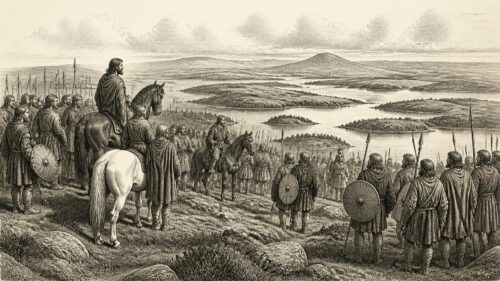
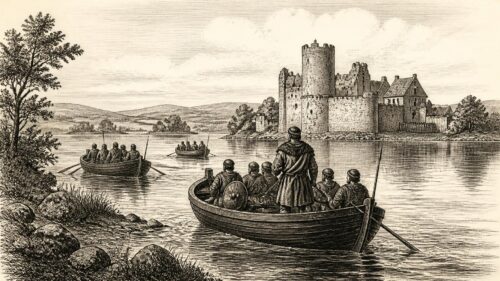
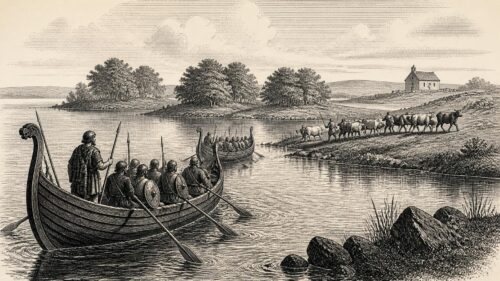
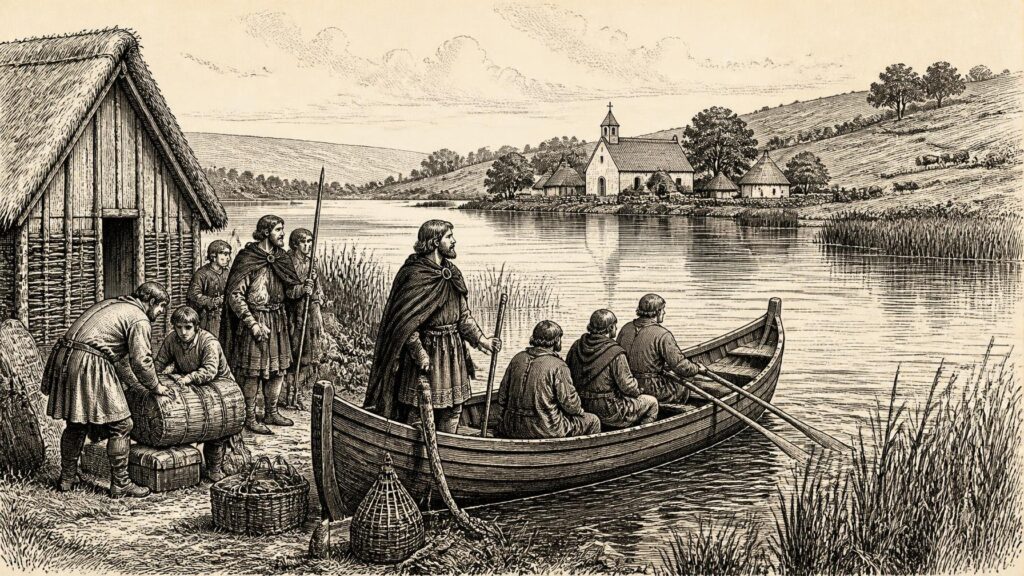
The clearest Irish story of 1450 begins not in Dublin but on the waterways and lordships of Fermanagh. Thomas Óg Mág Uidhir, lord of Fir Manach and grandson of Philip na Tuaighe, left Ireland for Rome during a jubilee year. His journey expressed the outward reach of a Gaelic lordship whose political world was intensely local but whose religious horizons extended to the centre of western Christendom. Yet the departure also exposed the danger of leaving a contested inheritance behind. Within a week, violence broke out among the Maguires; before the year was out, murder, negotiation and punitive mutilation had altered the balance within the ruling kindred.
The annalistic evidence is unusually rich, though it must be read carefully. The Annals of Ulster, written from an Ulster perspective, gives a sequence of events and several relative dates; the Annals of Loch Cé and the later Annals of the Four Masters preserve briefer, broadly compatible accounts. They illuminate particular places and families, especially in Ulster and Breifne, rather than providing a census of all Ireland. Silence in these records should not be mistaken for tranquillity elsewhere.
A Lord on the Road to Rome
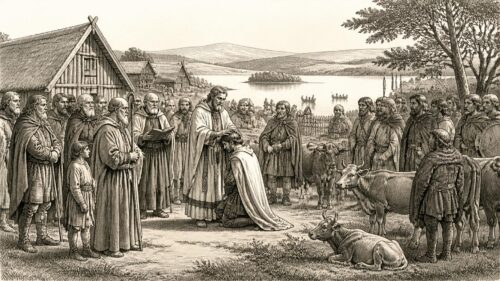
For 1450 the Annals of Ulster notes a Roman “year of the indulgences”, adding that the Golden Door had been opened. This was the jubilee proclaimed under Pope Nicholas V, an occasion that drew pilgrims towards Rome in the hope of spiritual benefits. Thomas Óg Mág Uidhir went there that year, leaving his residence “a month before Lammas” – in the period before 1 August. The wording matters: it firmly dates his departure by reference to the liturgical and agricultural calendar, but it does not supply a modern day and month.
His pilgrimage was no private excursion. The annalist calls him king of Fir Manach and mourns the effect of his absence upon Ireland’s learned community, poets and clerics. That praise is conventional in form, but it is still important evidence of what lordship required. A successful ruler was expected to sustain poets, churchmen and scholars through hospitality, gifts and commissions. The record says that no living Irishman had placed greater obligations upon such people or procured more poetic and learned compositions. Cultural patronage was therefore not an ornament to power: it helped publicise legitimacy, preserve genealogy and bind educated specialists to a lord’s household.
Rome was not beyond the reach of Irish travellers. Muircertach Ó Flannagáin of Tuath Rátha also travelled there in 1450 and died in Rome of plague a week after St Brigit’s feast, 1 February. Nicholas Ó Flannagáin, parson of Devenish on Lough Erne, likewise died there on pilgrimage. These notices do not prove that all three travelled together, but they show that the jubilee generated a recognisable movement of Irish pilgrims. The annal for the following year records Thomas’s return from Rome, confirming that his journey was completed despite the crisis at home.
Violence at Cnoc Ninnigh
Thomas’s absence opened a dangerous interval. A week after his departure, Donnchadh Dunchadhach Mág Uidhir, son of Thomas Mór, attacked Cathal, son of Thomas Óg, at Cathal’s own house at Cnoc Ninnigh. The attackers seized Cathal and his movable wealth, carried both to Gort an Fheadáin, and killed him. The Annals of Ulster calls the act fratricide; the later annals similarly describe it as treacherous. Whatever the precise kinship terms employed by different compilers, the essential point is secure: this was violence within the ruling dynasty, directed at a close relative of the absent lord.
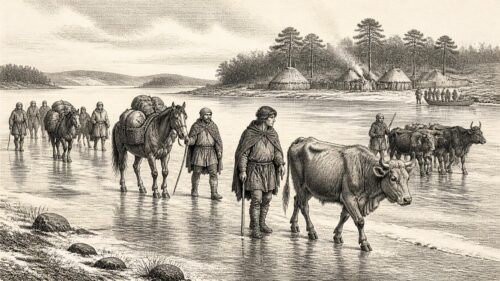
The entry offers a rare glimpse of the material stakes of such a seizure. Cathal was taken with his “spoil”, a word that could cover livestock, household goods and other portable resources. Cattle-raiding and the capture of goods were not marginal acts in a pastoral economy; they were means of inflicting loss, demonstrating dominance and financing armed followings. That Cathal was surprised in his own residence also shows that a lord’s house was both a domestic centre and a vulnerable political site. Protection depended less on an abstract state than on kin, retainers, alliances and the ability to answer aggression quickly.
Donnchadh did not stop after the killing. He went into Tullagh Dunchadha and made war on Edmond and Donnchadh Mág Uidhir, evidently seeking to turn a family murder into a wider redistribution of power. The next stage was negotiation. Edmond and Donnchadh met him at an agreed place, and peace was made. Such a settlement was not necessarily durable or disinterested; it was a practical effort to contain conflict among men whose rival claims could otherwise damage the whole lordship.
It did not end the matter. Edmond subsequently captured Donnchadh Dunchadhach at Gabhail Liúin, took him to Achadh Urchair, and cut off a foot and a hand as punishment for Cathal’s death. The annalist explicitly praises this retaliation. A modern reader need not share that judgement to understand its political language: physical mutilation made vengeance visible, deprived a rival of martial capacity and asserted that the killing had not gone unanswered. In 1450, as in many lordships, peace-making and exemplary violence were not opposites. Both were instruments for recovering an order damaged by a succession dispute.
Church, Medicine and Learned Service
Fermanagh’s troubles unfolded alongside several ecclesiastical losses. Piers Mág Uidhir, bishop of Clogher, died on the eve of St Nicholas’s Day, 5 December, on an island in Lough Erne, and was buried at Lisgool. The Annals of the Four Masters also places his death at Cleenish and burial at Lisgool. These details underline the close interweaving of episcopal office, monastic sites and the leading family of the region. The bishop was himself a Maguire: religious authority could reinforce a dynasty’s standing, even while its members quarrelled.
Other deaths recorded in the same year reveal a wider world of specialist service. Gilla-Pádraig, son of the “great archdeacon” Mág Uidhir, died on 9 November. Andrew Ó Droma died after returning from the Roman jubilee, aged fifty-five. Tadhg Ó Cáiside, described as chief physician of the Fir Manach, also died. The title was more than an honorific. Hereditary learned families supplied medicine, law, history, genealogy and poetry to aristocratic households. Tadhg’s death therefore marked the loss of a practitioner whose knowledge was valuable in everyday illness and injury, as well as in the status-conscious culture of a lordly court.
Change in the wider church was also firmly dated. William Silk, bishop of Meath, had died on 9 May; on 7 August Edmund Oldhall, a Carmelite friar with connections to the administration of Richard, duke of York, was appointed his successor. This was a different ecclesiastical setting from Lough Erne: Meath lay within the English lordship’s institutional heartland. But both the Meath appointment and the Clogher bishop’s death show that ecclesiastical offices in Ireland were connected to local landed power, religious orders, patronage and international papal authority.
Ulster and Breifne in Motion
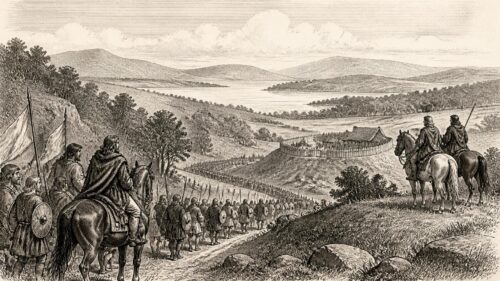
The northern annals also record conflict beyond Fermanagh. Henry Ó Néill and Art Ó Néill, sons of Eóghan Ó Néill, led a hosting into Trian Conghail to aid Mac Uibhilín. The notice is brief and does not identify a battle, so it cannot responsibly be enlarged into a major campaign. It does demonstrate, however, that Ó Néill military resources could be deployed in support of allies and clients across regional boundaries. Political authority in Ulster operated through such shifting relationships, not through fixed national frontiers.
Another episode began with the taking of prey. Niall, son of Henry Ó Néill, raided Muircertach Mac an Néill Buidhe and carried off spoil. He was overtaken; during the ensuing encounter Eóghan, son of Brian Ó Néill, struck Niall twice with a spear, killing him. Niall was buried at Armagh. The annal’s compressed account joins economy, warfare and sacred geography: the seizure of livestock or goods provoked armed pursuit, while burial at Armagh bestowed honour and linked a warrior’s memory to Ireland’s premier ecclesiastical centre.
In Breifne, John Ó Raghallaigh and Domnall Ó Raghallaigh the Fair made peace with one another, deposed Ferghal, son of Thomas Mór Ó Raghallaigh, and installed John as ruler of all Breifne. Ferghal accepted John’s stipend. This was not modern administration, nor a popular election. It was a negotiated reordering within a dominant family, secured by the transfer of authority and maintenance. Its appearance beside killings and raids is instructive: fifteenth-century Irish political life involved not merely recurrent disorder but bargaining, compensation and carefully managed submission.
York’s Departure
In the English lordship, Richard, duke of York, remained king Henry VI’s lieutenant. York had landed at Howth in July 1449 and sought support among the political community of the Pale and among neighbouring Gaelic lords. His arrangements with leading Irish figures were significant but temporary. In September 1450 he left Ireland for England, appointing the earl of Ormond as his deputy. His departure belongs securely to this year, although it should not be treated as an event that suddenly determined every Irish lordship.
The contrast is revealing. York’s government centred on the limited structures of the lordship around Dublin and on personal agreements with magnates; in Fermanagh, the Maguires governed through their own territorial, familial, ecclesiastical and cultural networks. Both worlds were connected to larger currents – York to English politics, Thomas Mág Uidhir and Irish pilgrims to Rome – but neither was simply directed from outside. The events of 1450 reveal an Ireland of many centres: Rome, Dublin, Armagh, Lough Erne, lordly residences, monasteries and meeting places where peace could be sworn or broken.
Source References
Hover over a number to see the source. Select it to open the source.

- [1] The Annals of Ulster, Year U1450
- [2] Annals of Loch Cé
- [3] Annála Connacht
- [4] Annals of the Four Masters: Textual and Bibliographical Information
- [5] Irish Texts at CELT
- [6] Richard of York
- [7] The Opening of the Holy Door – Jubilee 2000
- [8] A Jubilee Coin for the Jubilee 2025
- [9] Meath (Diocese)
- [10] The Church and Diocese of Meath in the 15th Century
- [11] The Structure of Politics in Theory and Practice: Colonial Ireland, 1210–1541
- [12] Duke Richard of York 1411–1460
- [13] The Wars of the Roses
- [14] Bardic Poetry and the MacMahons of Oirghialla
- [15] Bardic Poetry
- [16] bardic@tcd
- [17] What Is Bardic Poetry?
- [18] A Survival from a Sixteenth-Century Bardic School
- [19] Me Guidhir Fhearmanach: Text and Context
- [20] The Mendicant Orders of Medieval Dublin
- [21] The Diocese of Meath, Church of Ireland
Primary Sources
- The Annals of Ulster, Year U1450
- Annals of Loch Cé
- Annála Connacht
- Annals of the Four Masters: Textual and Bibliographical Information
- Irish Texts at CELT
- Richard of York
- The Opening of the Holy Door – Jubilee 2000
- A Jubilee Coin for the Jubilee 2025
- Meath (Diocese)
- The Church and Diocese of Meath in the 15th Century
- The Structure of Politics in Theory and Practice: Colonial Ireland, 1210–1541
- Duke Richard of York 1411–1460
- The Wars of the Roses
- Bardic Poetry and the MacMahons of Oirghialla
- Bardic Poetry
- bardic@tcd
- What Is Bardic Poetry?
- A Survival from a Sixteenth-Century Bardic School
- Me Guidhir Fhearmanach: Text and Context
- The Mendicant Orders of Medieval Dublin
- The Diocese of Meath, Church of Ireland