Connacht Holds Firm1188 CE
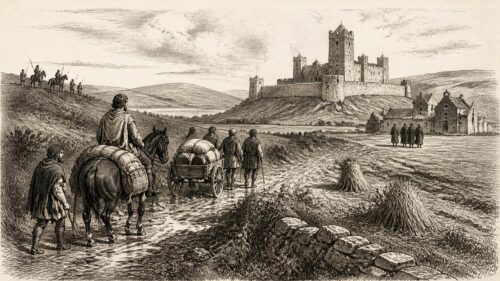
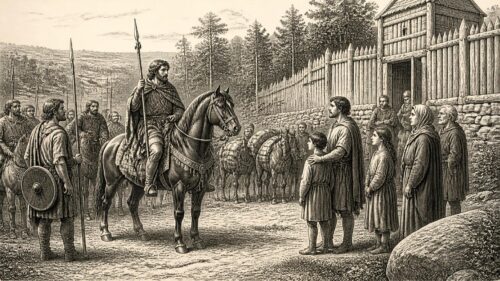
In 1188, John de Courcy led a broad Anglo-Norman expedition into Connacht, supported by Conchobar Ua Diarmata, but Conchobar Máenmaige Ua Conchobair and Domnall Mór Ua Briain defeated it near the Curlew Mountains after destructive raids through north Connacht. The failure confirmed limits to settler power and strengthened Conchobar briefly before his murder in 1189. Elsewhere, raiders from Magh Coba killed Ailech’s king Domnall Ua Lochlainn despite defeat, while Ruaidrí Ua Canannáin was murdered. Annals also record clerical deaths, pilgrimages, and domestic tragedy. Gerald of Wales’s Topographia circulated, promoting colonial assumptions challenged by annalistic evidence of complex, resilient Irish society.
Dateline
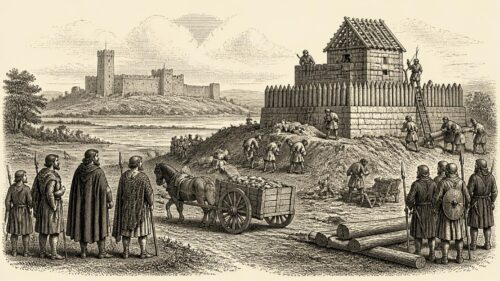
In 1188, the most consequential Irish event recorded by the annals was a failed Anglo-Norman-led expedition into Connacht. Its outcome mattered beyond one campaign. Since the English king Henry II’s intervention in Ireland, conquest had produced new lordships, castles and coastal centres of power, but it had not made the island politically uniform. Connacht remained under a vigorous Gaelic ruler, Conchobar Máenmaige Ua Conchobair, while Munster, the north and the Irish midlands contained their own shifting networks of kingship and allegiance. The fighting of 1188 demonstrated both the reach of the settler lords and the continuing capacity of Irish rulers to combine against them.
A Campaign into Connacht
The Annals of Ulster and the Annals of the Four Masters place a major hosting in Connacht during this year. John de Courcy, the Anglo-Norman lord whose power was centred in eastern Ulster, led the expedition with what the annals call the “Foreigners of all Ireland” and with Conchobar Ua Diarmata. That phrase should not be read literally as every settler in Ireland: it conveys an unusually broad mobilisation of Anglo-Norman forces and their followers. Ua Diarmata was a Connacht dynast or foster-member of the ruling family, and his participation reveals that the invasion was also a civil struggle within the Gaelic political order.
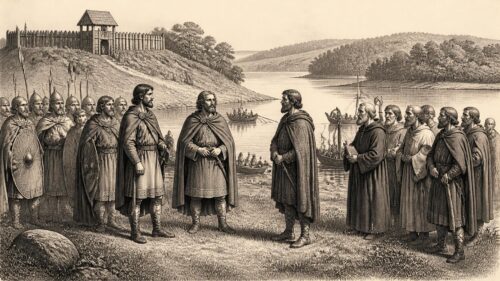
Conchobar Máenmaige, king of Connacht since his father Ruaidrí Ua Conchobair had been displaced from effective rule, assembled the men of Connacht. He received important assistance from Domnall Mór Ua Briain, king of Thomond, who came with a contingent from Munster. This alliance was no accident. Conchobar had built a wider following among Irish rulers during the 1180s, and both he and Domnall had reasons to resist further expansion from the east. The host which faced de Courcy was therefore not merely a local levy defending a border; it brought together provincial interests against an incursion that threatened Connacht’s political independence.
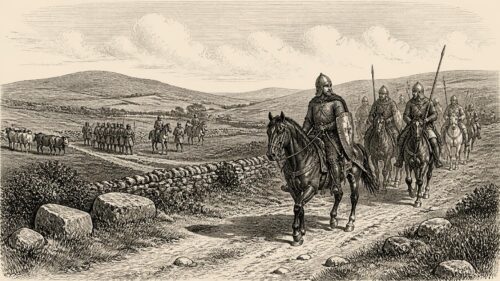
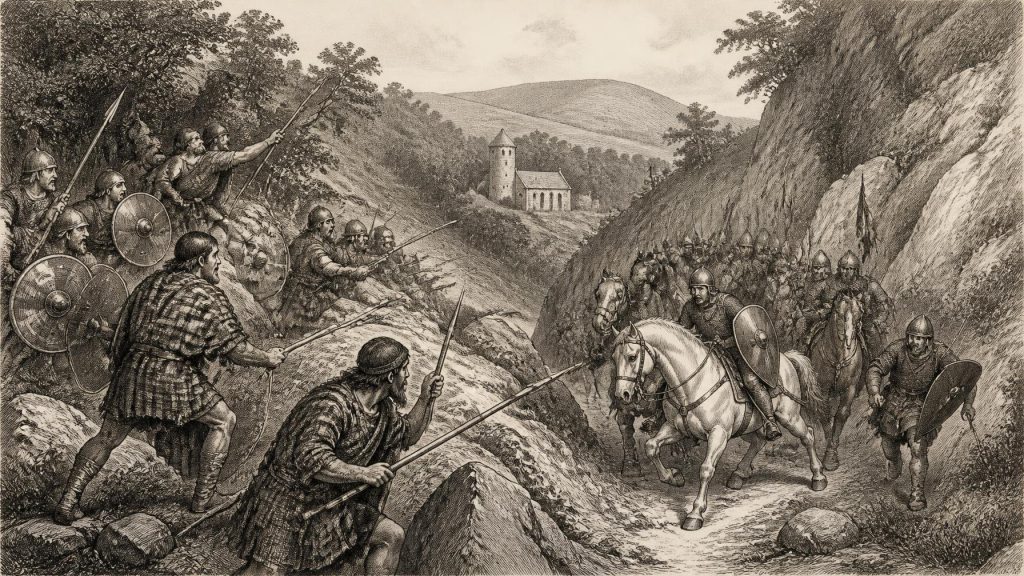
The route described in the annals traces a destructive arc through north Connacht. The invading force burnt some churches as it advanced, while allowing others to remain untouched. Such selectivity may reflect practical decisions, negotiated protections or uneven discipline; the evidence does not permit a simple conclusion. It does, however, show that ecclesiastical places lay directly in the path of armies and that clerical immunity was vulnerable in war. The host reached Eas Dara, the area of modern Ballysadare in County Sligo, apparently intending to move on towards Tír Chonaill. News then arrived that Cenél Conaill forces under Flaithbertach Ua Máeldoraid were gathering at Druim Cliabh, near Drumcliff. The expedition burned Eas Dara completely, turned back into Connacht, and moved towards the pass later identified with the Curlew Mountains.
There, in the district called Seghdais or Coirrshliabh in the annalistic accounts, Connacht and Munster forces attacked. The result was a serious reverse for de Courcy’s army. The Annals of Ulster say that many of the Foreigners were killed and that they left the country “by force” without any triumph. The related Annals of Boyle are still more emphatic, recording a defeat of John de Courcy at Tegais in which sixteen English barons, along with others, were killed before the survivors returned home in great confusion. Because medieval annals differ in wording, locations and detail, the precise scale of casualties cannot be securely reconstructed. Their agreement on the central point is nevertheless clear: the invasion failed, and Connacht was not overrun.
Limits of Lordship
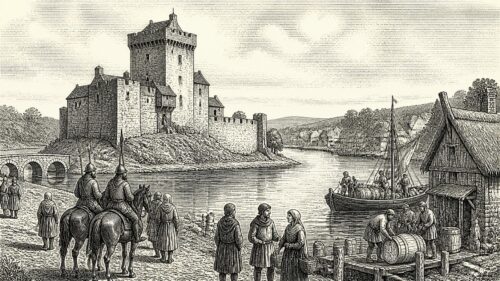
The defeat illuminates the uneven geography of power in 1188. De Courcy’s lordship in Ulster rested on castles, mounted warriors, alliances and access to the Irish Sea, but projecting that force westward meant crossing territories whose rulers could deny supplies, harass a column and concentrate defenders at narrow routes. The burning of Eas Dara also shows the cost to civilians and religious communities when rival armies manoeuvred through inhabited country. Yet the campaign was not a simple confrontation between fixed ethnic blocs. Ua Diarmata’s role on de Courcy’s side, and the presence of Irish troops alongside both armies, point to the importance of dynastic rivalry, service and local calculation.
Political authority at the island-wide level was particularly fragmented. John, Henry II’s son, bore the title Lord of Ireland after his unsuccessful visit of 1185, but no contemporary Irish source makes him the commander of the Connacht expedition. Henry II was still king of England and lord of Ireland in 1188; he would die in July 1189. His government’s claims were exercised in Ireland chiefly through magnates, churchmen and administrators with highly local interests. John de Courcy could act on a large scale, but 1188 showed that neither his military reputation nor the broader Angevin claim converted automatically into control of Connacht.
For Conchobar Máenmaige, victory strengthened a kingship already associated with resistance to castle-building and to settler expansion in the midlands. It did not create lasting security. His rule depended on rewarding allies and holding together a large, competitive Ua Conchobair kindred. He was killed by disaffected nobles in 1189. That later outcome should not diminish the significance of 1188: for one campaigning season, he successfully defended Connacht and made the province the centre of an effective Irish coalition.
War in the North
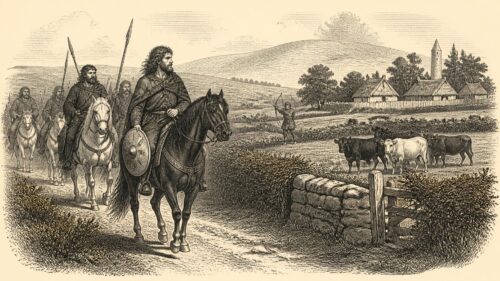
The year also brought violence to Tír Eógain. The annals report that men from the Anglo-Norman castle of Magh Coba, joined by a party of Uí Echach of Ulster, raided northwards as far as Léim Mic Néill and took cattle. Cattle were not simply food or movable wealth: they were a principal store of value and a measure of status, so their seizure was an economic blow and a political provocation. Domnall mac Áeda Ua Lochlainn, king of Ailech, pursued the raiders with his own followers and caught them at Cabhan na gCrann Ard.
Domnall’s force defeated the raiders and inflicted slaughter upon them, but the king himself was struck by a foreign spear and died in the fighting. The annalist praised him as a royal heir distinguished by appearance, judgement, learning and prudence. His body was carried that day to Armagh and honourably buried. The entry captures the double reality of warfare: a successful defence could still remove a ruler whose death altered the balance within a dynasty. It also shows how a castle garrison could serve as a base for raiding beyond the areas directly under Anglo-Norman settlement, while Gaelic kings retained the ability to strike back.
Further north-west, Ruaidrí Ua Canannáin, described as king of Cenél Conaill for a time and a royal heir of Ireland, was killed through treachery at the Bridge of Sligo after being drawn away from Druim Cliabh by Flaithbertach Ua Máeldoraid. A brother and followers died with him. The report of vengeance against Magnús Ua Gairb, who had taken part in the killing, underlines the obligation of kin and allies to avenge a slain lord. In 1188, as elsewhere in medieval Ireland, kingship was not a secure office inherited without contest; it was continually defended through kinship, hostage-taking, alliance, reputation and armed followings.
Church, Learning and Pilgrimage
Amid these conflicts, religious institutions remained centres of authority, travel and learning. Martin Ua Brolaigh died in 1188. The Annals of Ulster calls him the chief scholar of all the Gaels and chief lector of Armagh. The grand title is the annalist’s tribute rather than a measurable academic rank, but it conveys Armagh’s importance as a place of teaching and ecclesiastical prestige. His death is a reminder that learned clerics, readers and teachers formed a recognised intellectual class, even though their work is more often visible to us through brief obituary notices than through the routines of their schools.
Several other notices sketch the religious landscape. Amhlaim Ua Daighri travelled to Iona on pilgrimage and died there after what the annal calls chosen penitence. Étaín, daughter of Ua Cuinn and queen of Munster, died while on pilgrimage at Doire, probably Derry. The Annals of the Four Masters also records the death of Áed Ua Becháin, bishop of Inis Cathaigh, while the Annals of Boyle note the deaths of bishops of Conmaicne and Cork. Together these reports connect island monasteries, episcopal churches and royal households across Ireland and the Irish Sea. Pilgrimage was neither an escape from public life nor confined to men: it could be pursued by rulers and queens, and dying on such a journey could be remembered as a spiritually significant end.
One unusually domestic entry concerns Domnall Ua Canannáin, who cut open his foot with his own axe while chopping firewood at Doire and died. The annalist framed the death as a miracle of Columba, reflecting a saint-centred interpretation of misfortune. Behind that interpretation lies an ordinary task—preparing fuel—and a stark fact about life before modern medicine: an injury sustained in work could be fatal. Such moments are rare but valuable correctives to narratives made only of kings and armies.
Ireland in Writing
About this time Gerald of Wales’s Topographia Hibernica, or Topography of Ireland, was completed or began to circulate in an early form. Its exact stages of composition and public presentation are debated, so it is safer to connect it broadly with 1188 rather than assign a single publication day. Gerald had travelled in Ireland in 1183 and with Lord John in 1185. His work offered an English and Anglo-Welsh audience a vivid description of Ireland’s landscape, marvels, churches and peoples.
It is indispensable evidence for how a well-connected colonial cleric sought to explain Ireland, but it is not a neutral portrait. Gerald repeatedly represented the Irish as deficient and used such claims to support external lordship and reform. The events recorded in the Irish annals for 1188 provide an important counterpoint: they show organised provincial government, inter-regional alliance, learned ecclesiastics, pilgrimage, contested loyalties and resilient local communities. They also show a country scarred by raiding and political violence. Ireland in 1188 was neither a conquered possession nor an unchanging world beyond Europe, but a complex society in which new lordships and older dynasties struggled to determine its future.
Primary Sources
- The Annals of Ulster: Year U1188 (English translation)
- The Annals of Ulster: Year U1188 (Irish text)
- Annals of the Four Masters: Annal M1188
- The Annals in Cotton MS. Titus A. XXV: 1188 entries
- Courcy, John de
- Ua Conchobair, Conchobar Máenmaige (‘of Máenmag’)
- Ua Conchobair, Ruaidrí
- Cumin (Comyn), John
- Ua Conchobair, Cathal Mór Crobderg
- Mac Duinnsléibe, Ruaidrí
- Ua Conchobair, Tommaltach
- O'Melaghlin (Ó Máel Shechlainn), Cormac
- Royal MS 13 B VIII, ff. 1r–34v: Gerald of Wales, Topographia Hiberniae
- Harley MS 3724: Topographia Hiberniae, Laudabiliter, and other texts
- The Writings of Gerald of Wales
- Two Topographies of Gerald of Wales? A Study of the Manuscript Tradition
- From Kingdom to Colony: Framing the English Conquest of Ireland
- Giraldus Cambrensis in Topographia Hibernie: Text of the First Recension
- Exploring the Irish Annals
- Irish Texts at CELT