
Tairdelbach’s Divided Ireland1135 CE
In 1135, Ireland remained politically fragmented despite Toirdelbach Ua Conchobair’s strong, contested overlordship. Murchad Ua Máelshechlainn asserted Mide’s strategic river power by receiving hostages on the Shannon. Connacht endured dynastic killings, battles, raids and the destruction of Roscommon, while northern Uí Néill rivals, Munster factions and smaller kingdoms pursued warfare and shifting alliances. Malachy strengthened his disputed authority at Armagh by acquiring the Bachall Ísu, advancing church reform. Deaths of leading bishops and clerics, notably at Lismore, marked generational change. Fires damaged ecclesiastical centres, lightning struck towers, and plentiful mast harvest supported food supplies amid rural, maritime and market-based society.
Dateline
The surviving record of 1135 is unusually rich in short, vivid notices: fleets on the Shannon, battles at regional gatherings, churchmen dying at Lismore, monasteries in flames and lightning tearing into round towers. Yet the evidence must be handled carefully. The Annals of Ulster are missing for this period, while the Annals of Inisfallen have a long gap after 1130. The principal accounts come from the Clonmacnoise-related Chronicon Scotorum and Annals of Tigernach, supplemented by the much later Annals of the Four Masters. They often agree, but not always on names, responsibility or emphasis. Events recorded directly under 1135 can therefore be distinguished from the broader political and social conditions that gave them meaning.
Competing Kingships
Ireland had no single government in the modern sense. Power rested with provincial kings, overkings and numerous territorial rulers whose authority depended upon kinship, military following, tribute, hostages and alliances. Toirdelbach Ua Conchobair, king of Connacht, was the strongest claimant to the high-kingship, though his supremacy was contested and uneven. His rise had made Connacht a leading force in Irish affairs, supported by fortifications, fleets, ecclesiastical patronage and the strategic use of his sons as subordinate rulers.
The most striking diplomatic action recorded in 1135 involved Murchad Ua Máelshechlainn, the long-reigning king of Mide. The Four Masters state that he brought a fleet onto the Shannon and Lough Ree. Síl Muiredaig, the dominant royal kindred of Connacht, came with Toirdelbach’s son Conchobar, while the Uí Maine arrived under Tadc Ua Cellaig. Both parties left hostages with Murchad. Such hostages were political guarantees, securing submission, peace or agreed behaviour. The episode shows Mide’s continuing strategic importance between Connacht, Bréifne and the eastern kingdoms. It also demonstrates that inland waterways were political highways: boats moved warriors, supplies and royal authority through the centre of the island.
War in Connacht
Connacht itself experienced severe violence. Cathal son of Tadc Ua Conchobair, described by the Four Masters as heir-designate of Connacht, was killed by the men of Tethba, apparently with several companions. At Móin Mag, Conchobar son of Toirdelbach defeated the Uí Maine. Among the dead were Conchobar Ua Cellaig and Ua Mainnín, king of Soghain. The reference to the defeat of a fair suggests fighting at or around an important assembly. Fairs combined exchange, ceremony, law and political display, so armed confrontation there carried significance beyond an ordinary raid.
The Conmaicne also burned Mag nAí, Mag Luirg and Corann, three important districts of central and northern Connacht. About a month later, according to the Four Masters, the same force plundered and burned Roscommon, including houses and churches. The Annals of Tigernach and Chronicon Scotorum instead associate the attack with the men of Bréifne and report that Roscommon’s superior and lector were killed. The accounts may describe allied or overlapping forces, but certainty is impossible. What is clear is that the ecclesiastical centre of Roscommon suffered a destructive assault in which both buildings and learned clergy were lost.
Further instability followed. Ua Madadáin, ruler of Síl Anmchada and for a time of Uí Maine, was treacherously killed by a son of Gilla-Cáemgein Ua Cennétig, together with leading members of his retinue. In northern Connacht, Amlaíb son of Domnall Finn Ua Dubda, lord of Uí Amalgada, was slain by northern Uí Fiachrach. These notices reveal conflict operating at several levels simultaneously: provincial ambition did not suppress local rivalries over succession, territory and tribute.
Northern Conflict and Diplomacy
In the north-west, Ruaidrí Ua Canannáin, king of Cenél Conaill, was killed by opponents identified variously as the men of Mag Ítha or Cenél nEógain. The Four Masters add that Cenél Conaill retaliated by inflicting a major slaughter upon Cenél nEógain. This was part of the enduring contest between the two principal branches of the Northern Uí Néill. Leadership in this region remained unsettled after the death of the formidable Domnall Ua Lochlainn in 1121.
Diplomacy could alter the same regional balance. The men of Fernmagh broke with the men of Mide and made peace with Bréifne. The annal gives no treaty terms, but the change of alignment is significant. Smaller kingdoms survived by choosing allies carefully, and a local peace might protect cattle, roads and settlements while redirecting military pressure towards a former partner.
Munster’s Divisions
Munster remained divided between the interests of Desmond and Thomond. At the causeway of Cluain Cáein Modimóc, men of Thomond killed many from Desmond, including Finguine Ua Cáem, lord of Glennamain, and Mathgamain Ua Donnchada, lord of Cenél Laegaire. The fighting was costly for both sides: Áed Ua Conchobair, ruler of Corcu Modruad, and Cú Mara, lord of Uí Caisín, fell among the Thomond men. The precise circumstances are not preserved, but the prominence of the casualties points to more than a minor skirmish.
This violence belonged to the political fragmentation that followed the decline of Uí Briain supremacy. The former ruling family still possessed influence, but could no longer command Munster securely. One reminder of its earlier reach came with the death at Lismore of Domnall Gerrlámhach, son of the former high-king Muirchertach Ua Briain. Domnall had once exercised authority over Dublin’s Hiberno-Norse population and had also been associated with rule in Leinster. By 1135 he had entered religious life. His death in clerical habit marked the quiet end of a career linking Munster, Leinster, Dublin and the Irish Sea world.
Malachy and Armagh
The most consequential ecclesiastical development firmly dated to the year occurred on 7 July. Máel Máedóc Ua Morgair, better known as Malachy, obtained the Bachall Ísu, the Staff of Jesus, and removed it from the place where it had been kept. The Four Masters say that he purchased it. The relic was one of the chief insignia associated with the successor of Patrick at Armagh, and possession strengthened Malachy’s disputed claim to leadership there.
Malachy was advancing a reforming programme that favoured clearer diocesan organisation, canonical episcopal succession and closer conformity with wider western church practice. His struggle at Armagh was not simply a contest between religion and secular intrusion. It involved rival ecclesiastical families, regional kings and competing understandings of legitimate inheritance and office. The recovery of the staff was therefore both a devotional and political success. It did not instantly settle every dispute, but it helped prepare the way for Malachy’s resignation in favour of the more broadly acceptable Gilla Meic Liac in 1136.
Deaths in the Church
The number of prominent church deaths gives 1135 a sense of generational change. Cinaed Ua Baígill, bishop of Clogher and an eminent northern senior, died. So did a bishop Ua Cattáin, described as archbishop of Uí Chennselaig, and Máel Ísu Ua Finnachta, successor of the founder at Roscommon. Fiachra Mac Étig, a learned senior associated with Clonard and Mide, also died, while the lector Gilla Comáin Ua Congalaig was killed during the Connacht violence.
Particularly important was the death at Lismore of Máel Ísu Ua hAinmire, first bishop of Waterford and a major figure in Irish church reform. The Four Masters state that he had reached his eighty-eighth year. Trained within the Benedictine world and consecrated through Canterbury, he had advised Malachy and helped make Lismore a centre of reform, education and refuge. Another learned senior, Echmarcach Ua hAinmire, died there during the year. Together with Domnall Gerrlámhach’s death, these notices show Lismore attracting bishops, scholars, royal exiles and retired dynasts from far beyond its immediate territory.
Fire and Lightning
Ecclesiastical settlements faced physical as well as political dangers. Derry and its dependent churches burned on 30 March. Clonard, Kells, Rath Luraig and other churches were also burned, while Tigernach records fires at Cong, Annaghdown and Roscommon. The sources do not always state whether these outbreaks resulted from warfare, accident or the vulnerability of closely packed timber buildings, and it would be unsafe to assume a single cause.
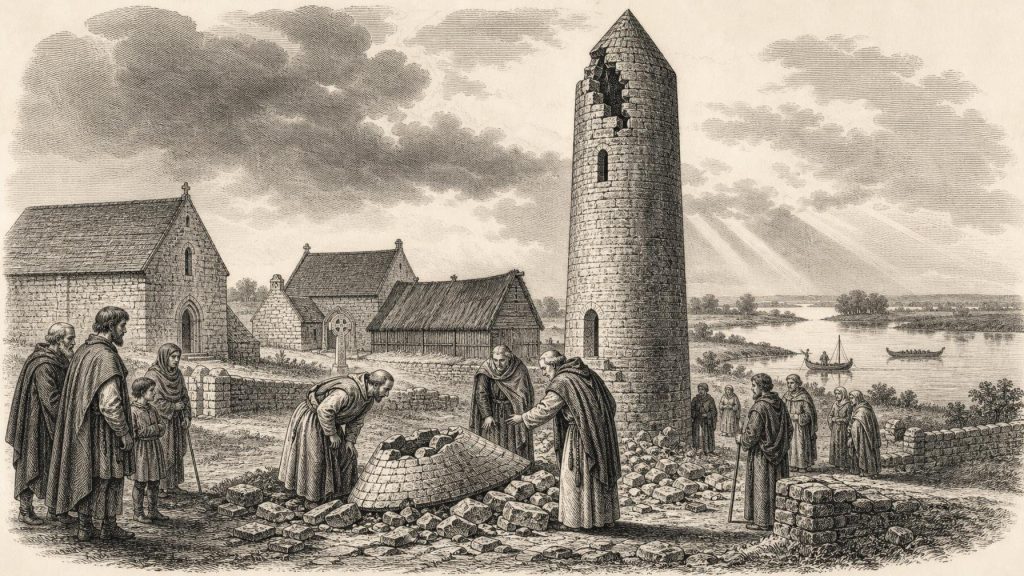
At Clonmacnoise, lightning struck the round tower constructed only about a decade earlier under Toirdelbach Ua Conchobair and the community’s ecclesiastical head. The bolt removed or shattered its upper portion. The tower at Roscrea was also pierced. These reports were memorable natural events, but they also record practical damage to belfries, landmarks, storehouses and symbols of institutional prestige.
Work, Food and Exchange
Chronicon Scotorum ends its account of the year’s Irish conditions with a rare economic observation: there was a great mast harvest. Mast meant the abundant nuts and seeds of woodland trees, especially acorns. This mattered because pigs could be driven into woods under a swineherd and fattened before winter slaughter. A heavy crop therefore promised additional meat and preserved food, while reducing pressure on grain and other fodder.
Broader archaeological evidence shows an overwhelmingly rural society of dispersed farmsteads, ecclesiastical settlements and royal centres. Cattle remained the principal store of agricultural wealth and supplied milk, butter, cheese, hides and traction; sheep, pigs, cereals and woodland resources complemented them. Meanwhile Dublin and Waterford continued as Christian Hiberno-Norse ports, centres of craft production and gateways to Britain and continental Europe. No major commercial event can be assigned specifically to 1135, but the year’s references to a fair, fleets, Waterford’s bishop and a former ruler of Dublin reflect an island connected by markets, rivers and sea routes.
A Contested Island
The annalists also noticed the death of Henry I and the accession of Stephen in England, although no immediate Irish campaign followed. For Ireland, 1135 was shaped above all by internal struggles: Connacht’s expansion, Mide’s river power, northern dynastic warfare, Munster’s divisions and the reform contest at Armagh. Against that violence stand quieter signs of continuity—learning at great churches, relics carried as emblems of authority, boats crossing inland waters and pigs feeding beneath a heavy fall of acorns. The year reveals a politically fragmented but highly connected society in which kingship, religion, landscape and everyday subsistence were inseparable.
Primary Sources
- Annals of the Four Masters, Part 24
- The Annals of Tigernach, Part 22
- Chronicon Scotorum: Annal CS1135
- Chronicon Scotorum
- TEI Header for the Annals of Ulster
- Annals of Inisfallen
- Ua Conchobair, Tairdelbach (O'Conor, Turlough)
- Ua Máelshechlainn, Murchad
- Malachy (Máel-M'áedóc) Ua Morgair
- Ua hAinmire, Máel-Ísu (Malchus)
- Ua Briain, Muirchertach
- Mac Murchada, Diarmait (MacMurrough, Dermot)
- Ua Conchobair, Conchobar
- The Cross of Cong
- The Viking Age in Ireland
- Clonmacnoise Visitor Guide
- Clonmacnoise Monastic Site
- Cong Augustinian Abbey and Monks Fishing House
- Irish School of Illumination
- The Economy of Early Medieval Ireland
- The Archaeology of Livestock and Cereal Production in Early Medieval Ireland, AD 400–1100
- Quercus robur
- Synchronisation of the Irish Annals
- St Bernard of Clairvaux's Life of St Malachy of Armagh
- History of the Diocese of Waterford and Lismore