Frontier, Faith and Succession1220 CE
Ireland in 1220 comprised competing lordships, Gaelic kingdoms, ecclesiastical communities and growing towns rather than a unified polity. Walter de Lacy’s attempted castle at Áth Liag was abandoned after Cathal Crobderg Ua Conchobair intervened, demonstrating limits to frontier expansion. Connacht’s succession remained insecure as a rival claimant sought western maritime support. At Derry, the successor to St Columba’s office prompted disputes resolved through local consent and Armagh’s arbitration. Papal intervention, church consecration and episcopal death illustrate religious connections and instability. Annalistic dating differs for several events. Trade, farming, crossings and markets linked regions, while conflict shaped movement, supplies and authority.
Dateline
Ireland in 1220 was not governed as a single political unit. The English crown claimed a lordship centred on Dublin and held through royal officers, castles and Anglo-Norman magnates, but its effective reach varied greatly. Gaelic kings continued to rule extensive territories, while church communities, towns and lordships all possessed their own sources of authority. The year’s surviving notices are few, yet they are unusually revealing: a contested fortress on the Connacht frontier, a failed maritime bid for a kingdom, and disputes over ecclesiastical succession expose the negotiations and rivalries that shaped daily power.
A Cautious Calendar
The evidence needs careful handling. The Annals of Ulster, compiled from contemporary and near-contemporary northern materials, enters several events under 1220. The later Annals of the Four Masters places others in 1220 that the Annals of Loch Cé assigns to 1221, while the Annals of Inisfallen dates the arrival of a papal legate to 1221. Such differences reflect the difficulties of medieval annalistic chronology, copying and the choice of when a year began; they do not automatically mean that one account is false. Accordingly, some developments can be placed firmly in 1220, while others belong more safely to the opening years of the decade and illuminate the situation during this calendar year.
A Castle at the Shannon Frontier
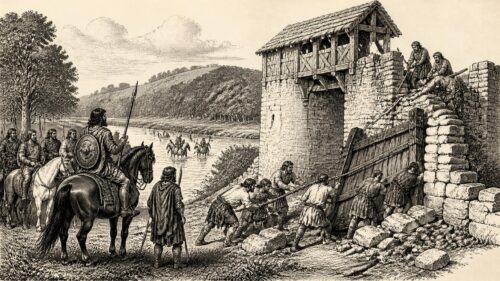
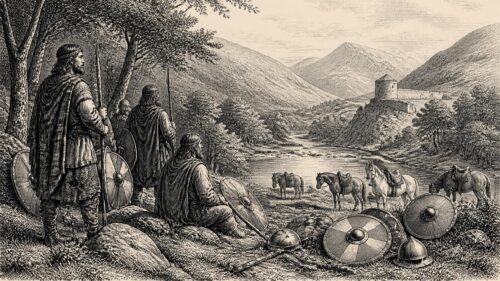
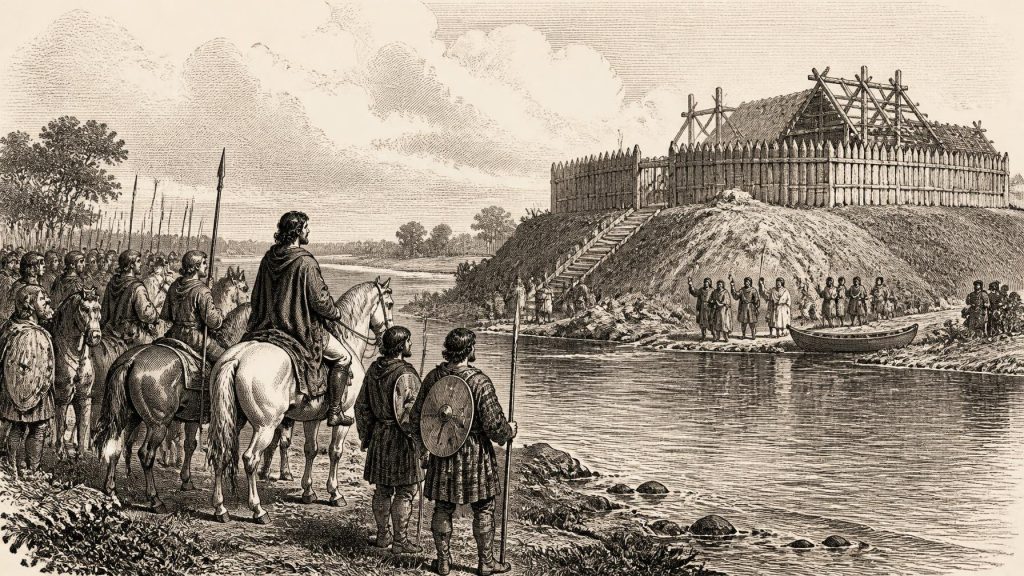
The clearest political confrontation reported under 1220 concerns Áth Liag, a strategically important crossing in the Shannon borderlands. Walter de Lacy, lord of Meath, led the English of Meath there and began building a substantial castle. This was more than a local building project. A fortress at a river crossing could hold a garrison, oversee movement, shelter stores and livestock, and signal a lord’s capacity to turn a contested route into a defended frontier. It also represented the practical, expensive work by which the lordship sought to extend influence beyond its more secure eastern lands.
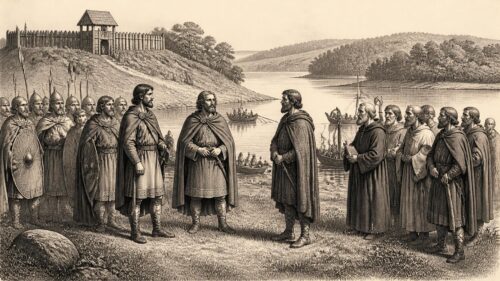
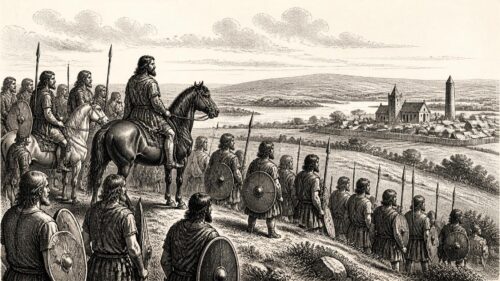
Cathal Crobderg Ua Conchobair, king of Connacht, responded decisively. The Four Masters says that he led an army east across the Shannon into Caladh. Faced by that advance, the English made peace with him, and the Connachtmen destroyed the unfinished castle. The account does not justify imagining a great pitched battle: its emphasis is on manoeuvre, intimidation, agreement and demolition. Yet its importance is plain. Cathal, who had long balanced accommodation with resistance in dealing with the English crown and its magnates, prevented a new de Lacy stronghold from becoming permanent.
The episode demonstrates that castles were instruments of politics rather than automatic proof of settled control. Building one required local security, supplies, labour and a garrison that could remain after the army departed. Cathal’s intervention denied all of these. Peace was not necessarily an end to rivalry; it was a temporary settlement reached when the castle’s position could not be maintained. For people living near the crossing, military activity meant requisitioned food, disrupted travel and the danger of plunder, even though the annals do not preserve their individual voices.
Connacht and the Western Sea
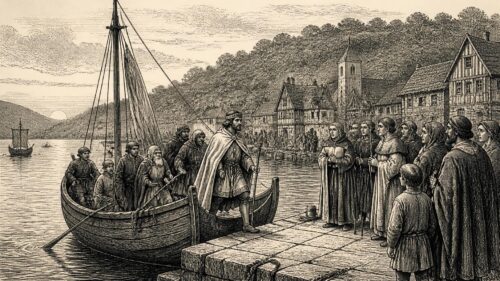
Connacht’s apparent success at Áth Liag did not remove its dynastic strains. Cathal Crobderg’s authority rested on a hard-won kingship, and the descendants of his older half-brother Ruaidrí Ua Conchobair retained claims and supporters. The annalistic tradition records that Diarmait, son of Ruaidrí, was killed by Thomas Mac Uchtraigh while returning from Insi Gall, the western islands. He had been assembling a fleet to seek the Connacht kingship. The Four Masters places this in 1220; Loch Cé places the same episode in 1221. It is therefore safest to treat it as an event of the 1220–21 turning point rather than insist on a date the sources themselves do not securely settle.
Its meaning is nevertheless clear. The Irish Sea and the Hebrides were not remote margins but connected political waters. A claimant could seek ships and armed support there, and the death of a would-be king during such an enterprise removed one immediate threat to Cathal. Máel Ruanaid Ua Dubda was also said to have drowned in the same fleet venture. The sea offered access to allies and mobility across the western seaways, but it was as hazardous as it was useful.
Other notices capture the violence of lordship at a smaller scale. Loch Cé records Dubhdara, son of Muiredach Ua Máille, killed in Cathal Crobderg’s camp after a dispute; the chronicler calls the act grievous even while attributing it to Dubhdara’s own misconduct. The entry is not a neutral court record, but it shows that a king’s camp was both a military headquarters and a place where discipline, personal enmity and political judgement could have fatal consequences. In Breifne, the killing of Cairnech Riabhach Mac Flannchadha and Ferghal Mag Samradáin by forces associated with Áed Ua Ruairc likewise points to enduring competition among regional lineages.
Derry’s Contested Inheritance
The most detailed firmly dated entry in the Annals of Ulster concerns Derry, one of the foremost Columban ecclesiastical centres. Fonachtan Ua Brónáin, successor of St Columba, died in 1220. His office, commonly described by the Irish term comarba, carried religious prestige, institutional authority and claims upon the resources and dependants of the Columban community. It was therefore unsurprising that his death produced more than a simple appointment.
The community of Derry selected Mac Cathmhaoil, whereas Áed Ua Néill and the Cenél nEógain favoured Flann Ua Brolcháin. The disagreement makes visible the close relationship between church office and secular power. Derry’s clergy were not passive spectators, but neither could the leading dynasty of Tír Eógain ignore the succession to so important a foundation within its political world. Flann was eventually excluded, and Derry’s community together with Cenél nEógain chose Muirchertach Ua Millugáin, already lector of Derry, as successor.
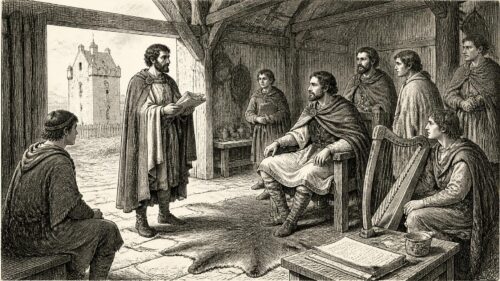
That compromise did not settle every issue. A further quarrel arose between the new abbot and Geoffrey Ua Daighri, the erenagh of Derry, over the lectorship. An erenagh was a hereditary ecclesiastical manager, closely concerned with the lands, dues and practical stewardship that sustained a church. The lector’s role, meanwhile, belonged to the learned life of the community: reading, teaching and the transmission of Latin and Irish ecclesiastical learning. The dispute went to the successor of St Patrick, the head of Armagh, who made peace; John, son of the previous lector, was then chosen to the office with the assent of Armagh, the Columban successor and Derry’s community.
This was not merely an internal clerical quarrel. It shows an Ireland in which older monastic inheritances, hereditary church offices, learned personnel and the increasingly organised diocesan hierarchy overlapped. Armagh’s arbitration supplied a recognised mechanism for settlement, but the consent of Derry and its Columban authority still mattered. The death by drowning of Áed Ua Máel Eóin, bishop of Clonmacnoise, also entered in the Ulster annals under 1220, is a reminder that episcopal vacancies could suddenly unsettle another great ecclesiastical centre.
Reform, Building and Belief
A papal representative named James came to Ireland to regulate ecclesiastical discipline, according to the Four Masters; the Annals of Inisfallen records his arrival under 1221. The precise year cannot be fixed with confidence, but the mission belongs directly to the circumstances of 1220. It indicates that Irish church affairs remained connected to Rome, and that questions of discipline, office-holding and church governance were matters of international as well as local concern.
At the same time, religious life was expressed through material institutions. Loch Cé records the consecration in 1220 of the church of the monastery of Buill in Connacht. Consecration marked the completion or formal dedication of a sacred building, made possible by land, patronage, craft skill and the labour of religious and lay communities. The record offers no detailed description of the church or its congregation, but it provides sound evidence that, amid conflict, investment in worship and monastic life continued.
Towns, Land and Everyday Exchange
The year’s annals concentrate on rulers, churchmen and violence, not on harvests, prices or household routines. It would be wrong to invent a national economic crisis or a universal experience from their silence. Broader evidence, however, places 1220 within an era of growth in the lordship’s more secure regions. Dublin, Waterford, Wexford, Cork and Limerick linked Irish producers and consumers to Irish Sea and wider European trade. New and expanding boroughs, including Kilkenny, gathered settlers, craftsmen, merchants and administrative personnel behind charters and, increasingly, defensive works.
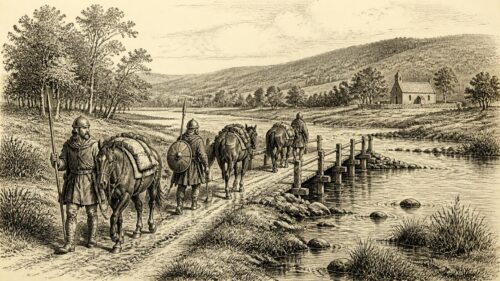
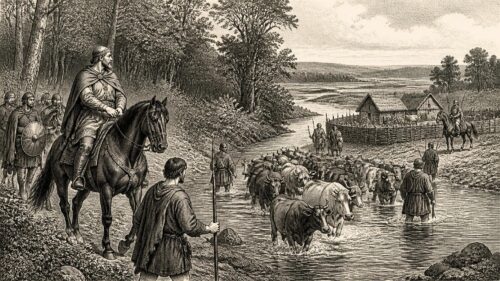
Most people still lived in rural communities. Mixed farming was important in the better-settled east and south-east, while cattle, hides, wool and fleeces were significant products of more pastoral districts. Markets, fairs, coastal shipping and river crossings tied these varied landscapes together, though barter remained important and monetised exchange was uneven. The struggle at Áth Liag mattered economically as well as militarily because control of a crossing affected the passage of people, animals and goods between Meath and Connacht.
Thus 1220 should not be reduced to a contest between two supposedly separate worlds. Gaelic rulers could make diplomatic settlements, use fleets and patronise churches; Anglo-Norman lords depended on local labour, food and territorial alliances; ecclesiastical communities preserved learning while negotiating with dynasties and papal authority. The fragmentary record reveals a country of connected regions, where a frontier castle could fail, a church succession could require arbitration, and control of Connacht remained vigorously contested.
Primary Sources
- The Annals of Ulster: Year U1220
- Annála Uladh: Annals of Ulster otherwise Annala Senait, Annals of Senat
- Annals of the Four Masters: Annal M1220
- CELT Project: Annals of the Four Masters
- Annals of the Four Masters: Editorial and Bibliographical Information
- Annals of Loch Cé: Annal LC1220 and LC1221
- CELT Project: Annals of Loch Cé
- Annals of Inisfallen: Annals AI1218–1227
- Annales Hiberniae
- Ua Conchobair, Cathal Mór Crobderg
- Marisco, Geoffrey de
- O'Neill (Ó Néill), Áed
- Lacy, Hugh de
- Burgh, Richard de
- The Pope, a Knight and a Bishop on the Edge of Christendom: The Politics of Exclusion in Thirteenth-Century Ireland
- Iona and the Shrine of Columba, c. 800–1200
- From Boom to Bust: The Lordship of Ireland and the European Commercial Revolution
- Irish Historic Towns Atlas: Kilkenny
- Late Medieval Ireland
- Anglo-Norman Trail
- Vikings to Victorians: A History of Dublin Castle to 1850
- Patent Rolls of the Reign of Henry III, A.D. 1216–1232
- Mac Carthaigh's Book
- CELT Project: Annála Connacht