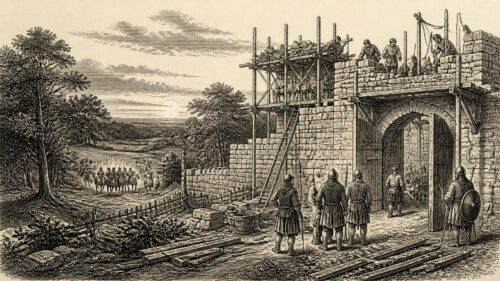
Walter de Burgh’s Last Summer1271 CE
Walter de Burgh, earl of Ulster and lord of Connacht, died at Galway in July 1271, leaving his young heir Richard vulnerable during a minority. His death coincided with Áed mac Fedlimid Ó Conchobair’s destruction of castles at Templehouse, Sligo and Athleague, weakening de Burgh authority across Connacht. Killings in Connacht, Annaly, Oriel and the Breifne borderlands further revealed fragmented lordship and shifting local alliances. Annalistic notices also record religious deaths, penitence and burial, reflecting political and spiritual culture. Although Anglo-Norman power endured, 1271 reduced its capacity while Áed’s Gaelic kingship remained formidable, making the year a significant turning point.
Dateline
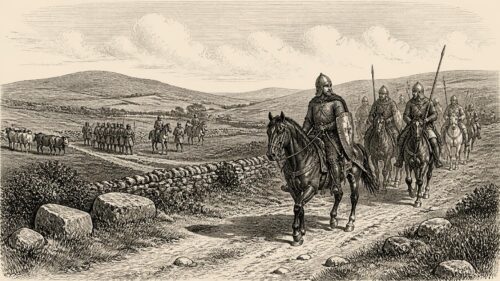
The death of Walter de Burgh, earl of Ulster and lord of Connacht, at Galway was the most consequential Irish event securely placed in 1271. The annals record that he died after an illness of a week, having made the religious preparation conventionally described as a ‘victory of penitence’; later biographical scholarship dates his death to 28 July. His passing removed the foremost Anglo-Norman magnate in the north and west at a moment when Connacht’s Gaelic king, Áed mac Fedlimid Ó Conchobair, was actively dismantling the military infrastructure of de Burgh power. The year was not a single campaign or a clear transfer of control. It was a sequence of deaths, killings and castle destructions which exposed how contested lordship remained in Connacht and along its borders.
A Magnate Dies at Galway
Walter de Burgh’s authority was potentially immense. He held Connacht through his family inheritance and had acquired the earldom of Ulster during the 1260s. Yet possession on parchment was not the same as effective command on the ground. In Connacht, his ambitions had repeatedly collided with those of Áed Ó Conchobair, king since 1265 and heir to a powerful Gaelic royal line. The conflict of 1270 had been especially destructive: Walter’s army had suffered a major reverse, and his brother William Óg de Burgh, given as a hostage in negotiations, was killed after Walter himself slew an Ó Briain opponent. That violence formed the immediate background to 1271, even though the annals do not describe another pitched battle between Walter and Áed in that year.
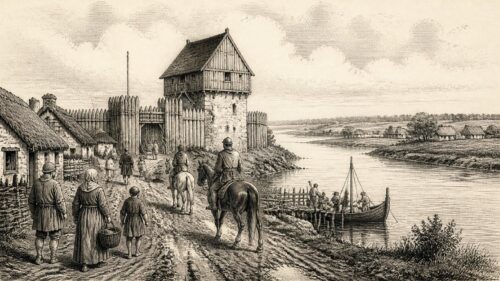
Walter died in the castle at Galway, the strongpoint and emerging borough through which de Burgh influence connected a coastal settlement, maritime traffic and the wider lordship of Connacht. The entry is brief, but its location matters. Galway was not simply a residence: it was one of the places from which an Anglo-Norman lordship sought to turn military conquest into durable control, through a castle, burgesses, landholding and communications by sea. Walter’s death there came when that project was under acute pressure inland.
His heir, Richard de Burgh, was still a child, born about 1259. The earldom and lordship therefore entered a minority, a period in which the interests of the royal government, guardians, tenants and neighbouring rulers could all bear upon its lands. Richard would not receive his inheritance until 1281. In 1271, however, the immediate significance was uncertainty. The death of an adult lord with personal followings and experience in war could not automatically restore castles, recruit troops or compel cooperation from rulers who had resisted him. The later fame of Richard as the ‘Red Earl’ should not obscure the weakness created by his father’s death.
Áed Ó Conchobair’s Broken Castles
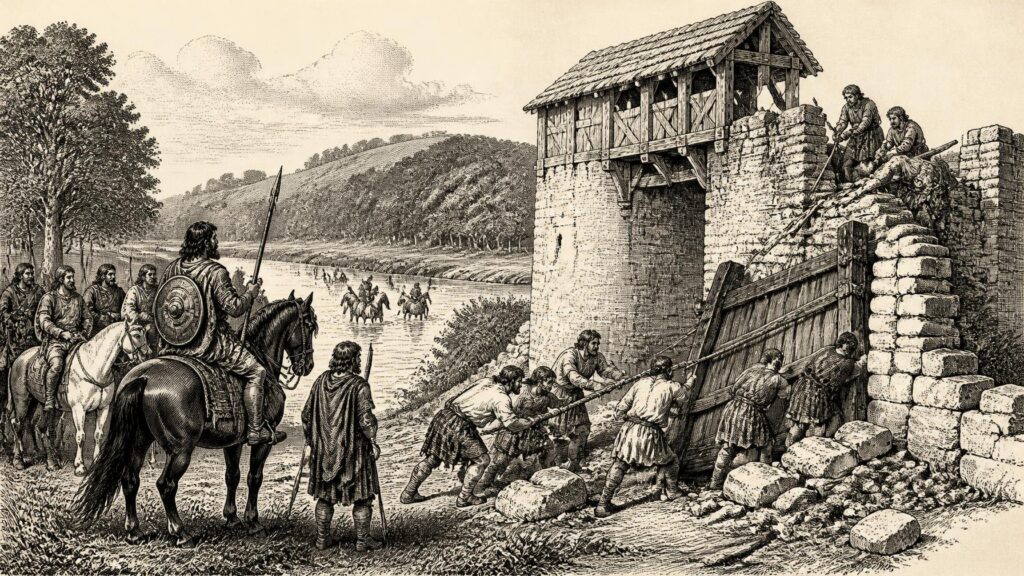
Three annalistic traditions independently place a striking achievement in 1271: Áed Ó Conchobair broke down the castles of Templehouse, Sligo and Athleague. Their agreement gives confidence in the year and in the broad fact of the operation, although none supplies a day, a detailed route, the size of Áed’s force or a technical account of how each stronghold was taken. ‘Broken down’ should therefore be understood as the destruction or disabling of fortified sites, not as a licence to imagine identical sieges at all three places.
The targets nevertheless reveal a coherent political purpose. Sligo Castle had been rebuilt only shortly before, after an earlier destruction by Áed and his allies. It stood near the estuary and the routes connecting north Connacht, the coast and the lordship of Tir Chonaill. Templehouse lay in the Corran district, another exposed northern zone where fortification represented an attempt to secure land, roads and exactions. Athleague, at a crossing of the River Suck near its junction with the Shannon system, was likewise more than a building: it was a nodal place for movement between Connacht and the midlands. Striking these sites weakened garrisons and the claims to authority that castles made visible.
The result was not the elimination of Anglo-Norman power from Connacht. Galway remained important, and other castles, towns and lordships survived. Nor did the destruction prove that all people in the vicinity supported the king of Connacht. Castles could be rebuilt, and their loss often brought retaliatory raids, heavier demands on tenants and new rounds of construction. But in the circumstances of 1271, Áed’s action demonstrated that de Burgh authority could not protect every outpost. It also shows why control of Connacht cannot be mapped as a simple division between an ‘English’ west and a ‘Gaelic’ interior: power was exercised unevenly, through particular river crossings, settlements, alliances and fortified enclosures.
Killings Across the Borderlands
The annals’ other notices are short, but together they show that insecurity extended well beyond the three demolished castles. Áed, son of the coarb of St Coman, was killed by Thomas Butler at Muine Ingine Crecháin. On the same day, Domnall Ó Flainn was killed at the upper end of Shrule by the son of Robin Lawless. Mathghamhain Ó Conchobair was killed by the ‘Foreigners’ of Dunmore. These reports identify places and opponents but do not explain motives. They may reflect raids, local feuds, service to rival lords or the aftermath of larger political contests. Responsible reading requires leaving such questions open rather than treating each death as a battle with a known cause.
The killing of Nicholas, son of John de Verdun and lord of Oriel, was politically weightier. The Annals of Connacht and the Annals of Loch Cé name Sefraid Ó Fearghail and the people of Muintir Anghaile as responsible. Nicholas belonged to a great Anglo-Norman family with interests in the north-east and midlands; Sefraid represented a leading Gaelic power in Annaly, the region around modern Longford. The episode demonstrates that the violence of 1271 was not confined to Connacht and was not reducible to the ambitions of Walter de Burgh and Áed Ó Conchobair. Lords, kin-groups and military retinues encountered one another across an intricate frontier of jurisdictions.
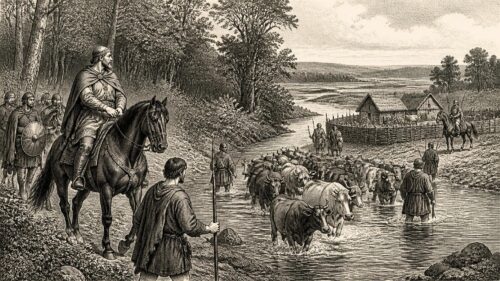
Another killing, that of Conchobar son of Tigernán Ó Conchobair by Máel Sechlainn Ó Ruairc and Clann Fermaige, points to the same complexity on the Connacht–Breifne border. Dynastic names recur on opposing sides because political loyalties did not follow modern ethnic or national categories. Gaelic rulers fought one another; Anglo-Norman families competed among themselves and formed local connections; people described by annalists as Gall, or ‘Foreigner’, could be central to regional rather than distant English politics. For rural households, such contests mattered through the passage of armed companies, the risk of plunder, obligations of food and transport, and the insecurity of roads and river crossings. The sources do not preserve their individual voices, but the geographical spread of killings suggests the reach of lordly conflict into ordinary landscapes.
Penitence, Burial and Record
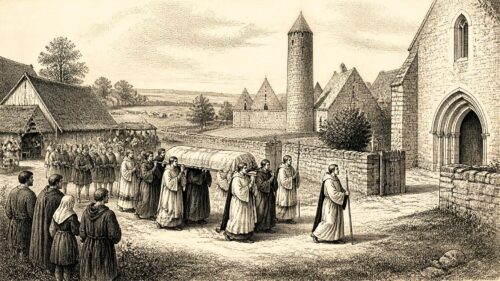
Religion appears in the record not as a separate sphere from politics but as part of how rulers and retainers sought honour, legitimacy and a good death. Imar Ó Birn, described as a trusted officer of Áed Ó Conchobair, died at Roscommon and was buried there on 29 January. Simon Magrath, deacon of Ardcarne, also died during the year. The repeated phrase ‘victory of penitence’ applied to Walter and Imar is an annalistic judgement: it signals that the dead had received or undertaken appropriate Christian repentance. It does not tell us the precise rites performed, but it shows the value placed on dying reconciled to God.
Roscommon’s religious houses had a special place in Connacht’s political world. The Dominican foundation there had been patronised by Áed’s father Fedlimid, and monasteries provided burial, prayer, learned personnel and a setting in which dynastic memory could be articulated. Galway’s castle, Roscommon’s friary and the destroyed castles at Templehouse, Sligo and Athleague were therefore not isolated landmarks. Each was embedded in networks of lordship, faith, labour and movement. Even the apparently private facts of illness, burial and penitence belonged to public political cultures.
What Can Be Said of 1271
1271 is unusually well anchored by the agreement of the Annals of Connacht, Loch Cé and the Four Masters on Walter de Burgh’s death and Áed Ó Conchobair’s destruction of the three castles. It is important, however, not to transfer into this calendar year events placed differently by every source. The Annals of Ulster’s entry labelled U1271 belongs to a chronological sequence that runs several years early at this point and records deaths now assigned to 1274. It is valuable evidence for the later crisis after Áed’s death, but not for the calendar year considered here.
The year’s firm outline is consequently both narrower and sharper. Walter de Burgh died at Galway; his young son inherited a vulnerable position; Áed Ó Conchobair damaged three important castles; and a series of killings marked Connacht, Annaly and the Breifne borderland. Together these developments made 1271 a hinge year. It did not settle Connacht’s future, but it visibly reduced the capacity of one lordship while leaving a formidable Gaelic kingship at the height of its power.
Primary Sources
- Annála Connacht
- Annála Connacht: 1271 entries
- Annals of Loch Cé A.D. 1014–1590: Annal LC1271
- Annals of Loch Cé A.D. 1014–1590: Irish text, Annal LC1271
- Annals of the Four Masters: Annals M1262–M1271
- Annals of the Four Masters: edition and chronological note
- The Annals of Ulster: Year U1271
- Annala Uladh: Annals of Ulster otherwise Annala Senait
- Burgh, Walter de — Dictionary of Irish Biography
- Burgh, Richard de — Dictionary of Irish Biography
- Galway: Irish Historic Towns Atlas, no. 28
- Sligo: Irish Historic Towns Atlas, no. 24
- Athlone: Irish Historic Towns Atlas, no. 6
- County Roscommon Urban Archaeology Survey: Roscommon Castle
- Extracts from the Urban Archaeological Survey County Roscommon
- Patronage of the Knights Hospitaller in Britain and Ireland
- The Fortunes of a Norman Family: the de Verduns in England, Ireland and Wales, 1066–1316
- Normans & Natives in Medieval Connacht
- Two Nations, One Order: the Franciscans in Medieval Ireland
- Free Gaelic People in English Ireland, c. 1250–c. 1327