Athlone Castle’s Brief Seizure1443 CE
In 1443, Muirchertach Ó Cellaigh briefly captured Athlone Castle, a key Shannon crossing, before James Dillon and William Boy Dillon recovered it; William Boy was killed, while Muirchertach received safe conduct. The episode illustrated contested authority and negotiated frontier politics. Annals also record deaths, feuds, raids, restitution and killings among Irish lordships, notably in Oriel, Ulster, Connacht, Ossory and the midlands. Aengus Mac Gilla-Fhinnein, abbot of Lisgoole, died on 17 September. Legal scholars Gilla na Naem Mac Aodhagáin and Hugh Mac Aodhagáin were commemorated. Differing annalistic dates complicate events in Thomond, showing Ireland’s connected institutions amid persistent conflict and rivalry.

Dateline
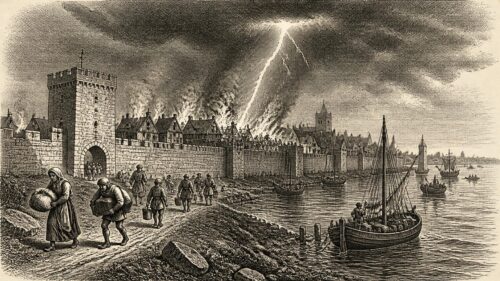
In 1443, a short and violent episode at Athlone revealed both the strategic value of the Shannon crossing and the fragmented character of political authority in fifteenth-century Ireland. The Annals of Connacht record that Muirchertach, a member of the Ó Cellaigh kindred of Uí Maine, captured Athlone Castle. James Dillon and William Boy Dillon then recovered it. Before surrendering, Muirchertach killed William Boy; nevertheless, he was allowed to leave under safe escort. No day or month is supplied, and the episode should not be dressed up as a prolonged siege. Yet its compact narrative is unusually revealing: a royal castle could be seized by a regional adventurer, recaptured by local colonial lords, and relinquished through negotiated terms rather than annihilation.
A Shannon Stronghold Tested
Athlone mattered because it commanded one of the most important crossings of the River Shannon, where routes between the English lordship in Meath and Leinster met the roads and waterways of Connacht. The stone castle had been founded for the Anglo-Norman administration in the early thirteenth century, replacing earlier defensive works. By 1443 it was no isolated outpost: it stood beside a settlement, bridge and river traffic, at a frontier where political jurisdictions overlapped and where the movement of armed companies, livestock, messengers and goods could be watched or obstructed.
The annal does not state Muirchertach’s numbers, method of entry or wider objective. It is therefore unsafe to call his act a rebellion against the English crown in any modern, national sense. The Dictionary of Irish Biography instead describes him as a renegade Ó Cellaigh scion acting apparently on his own initiative. What can be said is that the seizure challenged the authority of the English interest in Westmeath at a highly visible point on the Shannon. The response was prompt. The Dillons and “the English of Westmeath” appeared before the walls, suggesting that local lordly networks, rather than a large army dispatched from Dublin, provided the immediate force for recovery.
The ending is particularly striking. William Boy Dillon was killed before Muirchertach yielded, but the captor then received safe conduct across the river. This was not a triumph without cost for the recapturing side, nor a simple victory for the attacker. It shows the practical politics of a contested region, in which a settlement could be preferable to a destructive assault or a vendetta that might draw wider kin groups into conflict. Control of a castle was important; preserving relationships across the frontier could be important too.
Conflicting Calendars, Careful History
The surviving Irish annals make 1443 a year in which chronology must be handled with care. The Annals of Ulster, Annals of the Four Masters and Annals of Connacht preserve overlapping but not identical notices. Their annual headings are invaluable, but they were compiled or copied in different settings and sometimes assign the same death to adjacent years. The Annals of Connacht, for example, place the death of Síoda Mac Conmara, chief of Clann Chuiléin in Thomond, in 1443; the Annals of Ulster place it in 1444. The Connacht annalist also assigns the blinding and replacement of Mathgamain Ó Briain to 1443, whereas Ulster places that coup in 1444.
These are not trivial discrepancies. They mean that neither event should be presented as securely belonging to the calendar year 1443 simply because one chronicle says so. The more responsible picture is of a politically unsettled early 1440s, in which succession struggles affected both Thomond and neighbouring regions, while the precise placement of particular episodes remains uncertain. Athlone’s capture, by contrast, is firmly entered under 1443 in the Annals of Connacht, even though it lacks a more exact date.
Oriel’s Losses and Erne’s Abbot
The northern annals preserve several firmer notices. Maghnus, or Manus, son of Ardghal Mór Mac Mathghamhna, died during the year. The Annals of Ulster judged him fit to be king of Oirialla because of his hospitality, prowess and protection of learned companies from Ireland and Scotland. The Annals of the Four Masters likewise calls Manus heir to the lordship of Oriel and praises his hospitality and courage. Such language was not mere ornament. A lord’s status rested on military capacity, but also on maintaining dependants, hosting clerics and poets, rewarding professionals and offering protection to travellers and scholars.
His death came amid tension within the Mac Mathghamhna lordship. The same annals report that Eimher Mac Mathghamhna was killed by Eóghan Ó Néill, son of Niall Óg. They do not give a site, motive or sequence, and those gaps matter. It would be rash to turn the notice into a fully mapped campaign. It does, however, demonstrate how the politics of Oriel were entangled with the expanding influence of the northern Uí Néill, as well as with divisions inside lordly families.
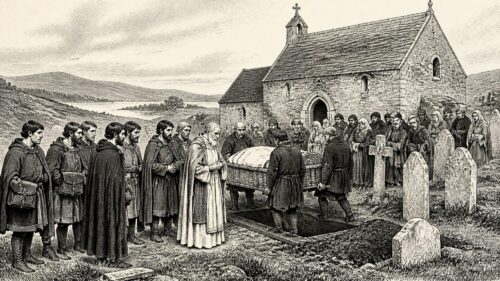
A date of 17 September is attached to one of the year’s clearest ecclesiastical notices. Aengus Mac Gilla-Fhinnein, abbot of Lisgoole on Lough Erne, died on the fifteenth day before the Kalends of October. His death is also noted in the Four Masters. Lisgoole was part of the dense religious landscape of Fermanagh, where monastic houses remained centres of worship, landholding, hospitality and literacy. The survival of a precise Latin-style date in the Ulster annal is a reminder that Irish historical writing drew on church calendars as well as genealogical and political memory.
Raiding, Restitution and Kinship
The annals record violence across several regions, often at a small but socially consequential scale. Hugh Boy Ó Néill made “great depredations” upon his senior kinsman, Murtough Roe Ó Néill. Murtough Roe demanded the restoration of the preys, after which the two made full peace. The wording points to a familiar political economy. Raiding was a means of pressure and enrichment, and “preys” commonly meant cattle and other portable wealth. But restitution could convert a quarrel into a settlement. The annal’s concluding phrase matters as much as its opening one: conflict within a ruling kindred did not inevitably become permanent war.
Other entries show how dangerous internal rivalries could be. Tadhg Ó Dubhda, son of the lord of Uí Fhiachrach, was killed by his own kinsmen; later, Mulrooney Ó Dubhda was treacherously killed by his brother. In the midlands, Ó Flyn of Síl Máelruain and members of his kin were killed by Clann Costello at the house of Ó Cillín. At Kilkenny, Fineen and Dermot, sons of the Mac Giolla Phádraig lord of Ossory, were treacherously slain, according to the Four Masters, at the instigation of MacRichard Butler. These notices give no licence to reconstruct motives that their writers did not know or record. Together, however, they show that authority was continually exposed to succession disputes, local feuds and calculated killings.
The death of Brian Ó Fearghail makes the human cost of such rivalries especially plain. The Four Masters says that he was imprisoned for two and a half years by Domhnall Boy Ó Fearghail on an island called Port-an-ghuirtín, and was killed and drowned while attempting escape. The Annals of Connacht identifies the place as the Inches of Gorteen and gives the length of captivity as four years. The records disagree on details, but agree on the essential event: a noble captive died while trying to break free from confinement imposed by a kinsman. Hostage-taking and detention were instruments of lordship, not marginal aberrations, and they could be prolonged and lethal.
Law, Learning and Public Hospitality
1443 was also marked by the deaths of learned men whose standing illuminates the institutional life of Gaelic Ireland. Gilla na Naem Mac Aodhagáin, ollamh of Ormond in law, died during the year. The Four Masters calls him broadly skilled in the arts and stresses that he kept a house of public hospitality. Another Mac Aodhagáin, Hugh son of Farrell, is described as ollamh in law for Lower Connacht and as the most fluent and eloquent Irishman of his time. The Annals of Connacht calls Gilla na Naem “the teacher of Ireland in his own art”.
An ollamh was not simply a clever individual. The title denoted recognised professional authority within hereditary learned lineages. Legal experts interpreted customary law, advised rulers and communities, drafted or remembered agreements, and trained successors. Their households could also receive students, poets, churchmen and travellers. Praise for hospitality therefore signals an operating social institution: learning required patronage, food, accommodation, books or manuscripts, and a network of clients who acknowledged the scholar’s standing.
The death of Solomon Ó Diarmata, called a famous wright by the Annals of Ulster, offers a smaller but valuable glimpse of skilled work. The annal does not specify whether he worked chiefly in wood, buildings or other materials, so his craft should not be defined too narrowly. Its decision to remember him nonetheless indicates the esteem in which exceptional artisans could be held. Alongside lords, abbots and jurists, the record preserves a maker.
A Divided Island, Connected Worlds
In the English lordship, James Butler, fourth earl of Ormond, was lord lieutenant during 1443. His government operated amid the bitter Butler–Talbot rivalry, which had already drawn in Archbishop Richard Talbot of Dublin and other office-holders. This context helps explain why the political geography of the island cannot be reduced to two fixed blocks, “English” and “Irish”. At Athlone, Dillons identified in the annal with the English of Westmeath acted in a zone deeply connected to Connacht dynasties. At Kilkenny, a killing linked the Mac Giolla Phádraigs of Ossory with a Butler cadet. In Oriel and Ulster, Mac Mathghamhna and Ó Néill affairs crossed older regional boundaries.
The year’s notices are brief, but their cumulative force is strong. Athlone Castle changed hands and was recovered; an abbot died on a date that can be placed precisely in September; heirs, lords and captives disappeared through sickness, murder and feud; raiders made peace after restitution; and two eminent legal scholars left a learned order sustained by hospitality and patronage. Ireland in 1443 was not a country without institutions. It was a country of castles, monasteries, law-schools, lordly households and negotiated settlements, all functioning amid competition that could at any moment turn into violence.
Primary Sources
- The Annals of Connacht
- Annála Connacht: Background Details and Bibliographic Information
- The Annals of Ulster
- Part 66 of The Annals of Ulster
- Annals of the Four Masters
- Part 8 of Annals of the Four Masters
- O'Kelly (Ó Ceallaigh), Aodh | Dictionary of Irish Biography
- Geneville (Joinville), Geoffrey de | Dictionary of Irish Biography
- Burgh, Richard de | Dictionary of Irish Biography
- O'Melaghlin (Ó Máel Shechlainn), Cormac | Dictionary of Irish Biography
- Ua Conchobair, Tairdelbach (O'Conor, Turlough) | Dictionary of Irish Biography
- Athlone Castle Museum
- Hare Island: Medieval Times
- Chronicon Scotorum
- Chronicon Scotorum: Bibliographic Information
- CELT: Select Bibliography of John O'Donovan
- The Genealogies, Tribes, and Customs of Hy-Fiachrach, Commonly Called O'Dowda's Country
- The Genealogies, Tribes, and Customs of Hy-Fiachrach: Bibliographic Information
- White Earl to the Great Earl, 1442–96
- ‘Irish’ Ireland and ‘English’ Ireland | A New History of Ireland: Volume II
- DIB Abbreviation Conventions
- A Chronology of Ireland