

Niall’s Capture in Uí Maine1163 CE
During 1163, Muirchertach Mac Lochlainn’s high-kingship remained influential but dependent on negotiation, payments and local compliance. Meath’s rulers were reshaped through deposition and gold payment, while his son Niall’s coercive progress ended with his capture in Uí Maine after offences against communities and churches. Assassinations, deaths and cattle-raiding reflected continuing regional rivalries. Ecclesiastical leaders died, yet monastic institutions retained traditional offices alongside diocesan reform. Glendalough suffered a destructive fire, whereas Derry’s Columban community built a huge lime-kiln, signalling organised construction. Learning, agriculture, cattle wealth and Irish Sea trade underpinned society, revealing a politically fragmented but connected Ireland at this time.
Dateline
The surviving annals present 1163 as a year of strained authority rather than decisive conquest. Muirchertach Mac Lochlainn remained the dominant claimant to the high-kingship, yet events in Meath and Connacht exposed the practical limits of power exercised through hostages, tribute and royal progresses. Regional rulers continued to pursue their own interests, sometimes through negotiation and payment, sometimes through cattle-raiding or assassination. At the same time, fires, ambitious building works and the deaths of prominent church leaders reveal an ecclesiastical landscape undergoing reform without abandoning older Irish institutions.
The High-King’s Authority
Mac Lochlainn’s supremacy rested on the military strength of Cenél nÉogain and a network of alliances extending into Airgialla, Leinster, Dublin and the midlands. He had forced Ruaidrí Ua Conchobair, king of Connacht, into submission in 1161, but this did not create a centralised kingdom. Ireland remained divided among provincial and regional dynasties whose obedience depended upon circumstances. A high-king had to travel, accept hostages, distribute rewards and intervene continually in disputed successions.
Meath demonstrated that instability clearly. The annals record the deposition of Diarmait Ua Máelshechlainn by the men of Meath and associate the resulting settlement with a payment of one hundred ounces of gold to Mac Lochlainn for the kingship of western Meath. The wording differs slightly between annalistic versions, making the precise arrangement uncertain, but the payment itself is consistently important. It shows Mac Lochlainn treating access to kingship as something requiring his approval and carrying a substantial financial price. It also shows that the people and leading families of Meath retained enough collective influence to remove a ruler, even while an external overking claimed the right to determine what followed. Diarmait’s fall was temporary; he remained a significant political figure and would recover power.
A Disastrous Royal Progress
The most revealing political episode firmly placed in 1163 concerned Niall, a son of Mac Lochlainn. He undertook what the Four Masters call a royal heir’s “feasting visitation” through Leth Cuinn, the northern half of Ireland. Such a progress was not tourism or ceremony alone. A prince and his armed household expected local communities to provide food, drink, fodder and accommodation. Properly managed, this displayed rank and renewed political relationships. Abused, it became coercive billeting.
Niall travelled through Ulaid, Airgialla, Tír Briúin and Meath. The annals accuse his company of committing violence in territories and churches, naming Kells, Ardbraccan, Fore, Eacharadh Lobrain and Clonmacnoise. The Annals of Tigernach connect the offence at Clonmacnoise with an enforced maintenance imposed upon the community of St Ciarán. Niall then crossed the Shannon at Athlone and entered Uí Maine with a force said to number 240 men.
There the progress ended in disaster. Conchobar Ua Cellaig, Conchobar Máenmaige and the Uí Maine attacked the company. Most of Niall’s followers were killed, while he was captured. The Four Masters add that he was ultimately conducted safely home following the decision of an assembly. Annalists interpreted the destruction of his retinue as the vindication of St Ciarán’s sanctuary. Politically, the incident was equally significant: even the high-king’s son could not demand unlimited hospitality without risking organised resistance.
Regional Violence
Elsewhere the year’s conflicts were local but serious. Cerball Ua Gilla Pátraic, king of southern Osraige, died, creating another potential adjustment within a kingdom positioned between Leinster and Munster. Cú Caisil Ua Finnalláin was treacherously killed by Áed Ua Ruairc. In northern Éile, a son of Finn Ua Cerbaill was slain by Domnall, son of Toirdelbach Ua Briain.
Mac Carthaigh’s Book records that Donnchad Mac Carthaigh, praised as a “candle of generosity and valour”, was treacherously killed by his kinsman Diarmait, son of Cormac Mac Carthaigh. The same source places a cattle-raid by Toirdelbach Ua Briain against Diarmait Mac Carthaigh under 1163; the raiders passed through Druim Fínghin and carried away many cows. These events belonged to the continuing contest between the Ua Briain rulers of Thomond and the Mac Carthaigh kings of Desmond. They were not minor disturbances to those affected: the loss of cattle meant the loss of food, rent, breeding stock and social standing.
Church Leaders and Communities
A notable group of ecclesiastical deaths is firmly recorded for the year. Máel Ísu Ua Laighenáin, bishop and abbot of Emly and long associated with Belach Conglais, died. Máel Ísu Ua Corcráin, successor of St Comgall and head of Bangor, was remembered as a leading figure of Ulster piety. The Four Masters also name Gilla Ciaráin Ua Draighnen, successor of St Féchín; Máel Ciaráin, the learned and devout chief elder of the men of Meath; and Gilla Brigte Ua Dimusaigh, successor of the two Sinchells.
The death of Caillech Domnaill, abbess of Clonbroney and successor of St Samthann, is a reminder that women continued to hold recognised leadership within important religious communities. These titles also demonstrate how older Irish offices survived beside the territorial dioceses promoted by twelfth-century reformers. A single man might still be remembered as bishop, abbot and successor of a founding saint, while the spiritual prestige and property of a church remained attached to its saintly lineage.
Fire and Construction
Glendalough suffered a major fire in 1163. The annals state that the settlement was burned together with the shrines or sacred enclosures of St Ciarán and St Kevin; the Four Masters also include the church of the two Sinchells. They do not explain whether the blaze resulted from warfare, accident or deliberate destruction, so no cause can safely be assigned. Glendalough was then a populous religious centre, place of pilgrimage and seat of learning as well as the focus of a wide estate. Fire therefore threatened churches, timber dwellings, workshops, manuscripts, relics and the livelihoods of lay families living around the monastery.
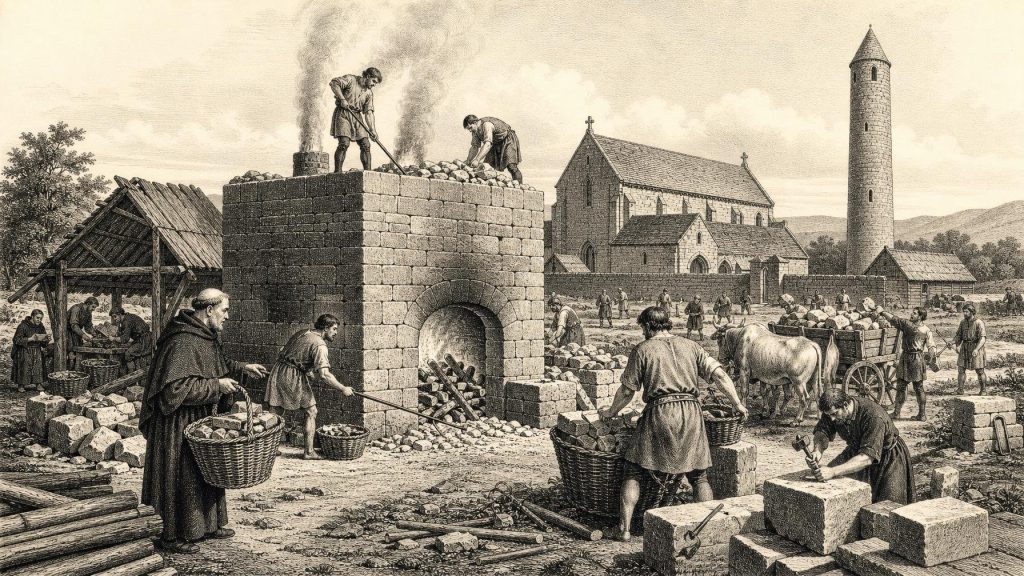
Another entry records construction on an extraordinary scale. Flaithbertach Ua Brolcháin, abbot of Derry and head of the Columban federation, and the community of Colum Cille built a vast lime-kiln in only twenty days. The Annals of Ulster give its dimensions as sixty feet on every side, while the Four Masters say seventy; the discrepancy advises caution about literal measurement. The annals do not name the location, although Derry is the probable setting because it was Flaithbertach’s principal foundation. Lime was essential for mortar, plaster and whitewashing, so the kiln suggests a large programme of stone building rather than an isolated devotional act. Its completion required fuel, quarried limestone, transport, skilled supervision and considerable organised labour.
Reform and Learning
The kiln belonged to a wider transformation already under way. Flaithbertach had received authority over Columban churches during the preceding years, while Gilla Meic Liac, archbishop of Armagh, worked to reconcile inherited monastic federations with the reformed episcopal church. Lorcán Ua Tuathail had recently succeeded Gregory as archbishop of Dublin. The Cistercian network established from Mellifont was expanding through houses including Bective, Baltinglass and Boyle. Boyle, founded in Connacht around 1161, was probably still in an early building phase in 1163. These foundations introduced new architectural plans and systems of estate management, but depended heavily upon Irish royal patrons, craftspeople and local resources.
The year also falls within the broad period in which the Book of Leinster was being compiled. Its work cannot be assigned specifically to 1163, and the manuscript developed over decades, but it represents the learned culture surrounding the politics of this generation. Áed Mac Crimthainn and other scribes assembled genealogy, poetry, saints’ lore, place-name learning, adaptations of classical narratives and a major version of the Táin Bó Cúailnge. Such scholarship served more than entertainment: genealogies and traditional histories helped rulers explain ancestry, territory and legitimate authority.
Work, Wealth and Exchange
The annals concentrate on kings and churchmen, but their language offers glimpses of ordinary life. Cattle remained the foundation of much rural wealth, supplying milk, meat, hides, traction and rent. Herding, dairying and the production of winter fodder shaped seasonal labour. Cereals were also cultivated, while smiths, carpenters, leatherworkers, masons and metalworkers supported farmsteads, courts and ecclesiastical settlements. Niall’s failed progress shows how elite households consumed local surpluses, and how burdensome compulsory hospitality could become.
The hundred ounces of gold associated with the Meath kingship belonged to an elite economy of weighed precious metal and units of account; it should not be mistaken for evidence that ordinary rural exchange routinely used gold coins. Cattle and goods remained central to rents, tribute and political rewards. Dublin, Waterford, Wexford, Cork and Limerick nevertheless sustained urban craft production and maritime commerce with Britain and continental Europe. A separate annalistic fragment placed under 1163 mentions a large fleet coming from Dublin during conflict involving Somerled of the Isles and Scotland, though damage to the text prevents a secure reconstruction. It still reflects Dublin’s integration into the Irish Sea world.
A Revealing Year
No single event in 1163 transformed Ireland, but the year exposed forces soon to have major consequences. Mac Lochlainn could demand gold for a midland kingship, yet his son could be defeated for abusing hospitality and sanctuary. Churches remained vulnerable to fire and armed intrusion, even as reformers commanded the resources to build in stone on an impressive scale. Regional feuds continued, learned communities preserved political memory, and trade linked Irish towns to wider seas. The high-kingship appeared powerful, but it still depended upon negotiation with communities capable of resisting it.
Primary Sources
- The Annals of Ulster: Year U1163
- The Annals of Tigernach: Annal T1163
- Annals of the Four Masters: Annal M1163
- Mac Carthaigh's Book: Annal MCB1163
- Derbforgaill: Twelfth-Century Abductee, Patron and Wife
- Mac Lochlainn, Muirchertach
- Ua Conchobair, Ruaidrí
- Ua Tuathail, Lorcán (O'Toole, Laurence)
- Mac Murchada, Diarmait (MacMurrough, Dermot)
- Ua Ruairc, Tigernán
- Mac Carthaig, Diarmait Mór
- Mac Crimthainn, Áed
- Gilla meic Liac (Gelasius)
- Ua Cerbaill, Donnchad
- Ua Tuathail, Muirchertach
- Glendalough Monastic Site and Visitor Centre
- Life in Glendalough
- Medieval Ireland 1150–1550
- Viking Collection
- Book of Leinster – Director's Choice
- Irish Script on Screen: Trinity College Dublin Manuscripts
- Mellifont Cistercian Abbey
- Old Mellifont Cistercian Abbey Monastic Site
- School of the West
- Agriculture, Settlement and Society in Early Medieval Ireland
- The Zooarchaeology of Medieval Ireland
- Martin of Tours, Irish Church Reform and the Cult of Saints
- The Origins of the Irish Parish
- Ireland in the Middle Ages