Cathal’s Penitent Death925 CE
In 925, Connacht underwent a decisive dynastic change after Cathal son of Conchobar, king since about 900, died in penitence. His son Domnall and other leading men were treacherously killed by their kinsman Tadc, who assumed the kingship and founded a durable ruling line. Annalistic chronology requires caution, but modern scholarship dates these events to 925. Elsewhere, Dubgall, king of Ulaid, was killed by his own people, while Lorcán, king of Brega, died in old age. These events exposed fragile regional kingship beneath Tara’s limited overlordship, amid church influence, rural continuity, Dublin’s maritime power, and competing dynastic interests across Ireland.
Dateline
The most securely dated Irish development of 925 was a change of kingship in Connacht, brought about not by a public battle but by death, kin-killing and succession within one ruling family. Cathal son of Conchobar, king of Connacht since about 900, died “in penitence”, according to the Annals of Ulster. His death was followed by the treacherous killing of his son Domnall and other prominent Connacht men by Cathal’s kinsman Tadc. Tadc then became king. The bare annalistic notices are unusually compressed, but their combination makes 925 a consequential year: a long-established provincial ruler died, his apparent successor was eliminated, and a new branch of the same dynasty took control.
A Year of Annalistic Caution
Medieval Irish annals do not always align neatly with a modern numbered calendar. Their compilers used different systems of year reckoning, and later copyists and editors preserved occasional chronological offsets. The events considered here occur in the entry conventionally associated with 925 in the Annals of Ulster, while related versions of the tradition can appear under a different numbered year in later compilations such as the Annals of the Four Masters. Modern reference scholarship nevertheless dates Cathal’s death to 925. That makes the year suitable for a close account of the political changes recorded in Connacht, Ulaid and Brega, while requiring care over claims of precise days, motives or locations that the evidence does not supply.
The annals were not contemporary newspapers. They are terse historical records, copied and reshaped over centuries, and they chiefly preserve matters that interested royal and ecclesiastical elites: deaths, killings, successions, raids, church offices and major assemblies. Their silences matter as much as their notices. They do not tell us what most people in Connacht ate during 925, whether a harvest was good, or how the inhabitants of an ordinary ringfort experienced the transfer of power. Yet they do show where political authority was vulnerable, and they indicate the human cost behind a change in a royal genealogy.
Cathal of Connacht
Cathal belonged to the Síl Muiredaig, a leading branch of the Uí Briúin Aí, whose rulers had dominated the kingship of Connacht since the later eighth century. He had succeeded his brother Tadc in 900 and had therefore ruled for roughly a quarter of a century by the time of his death. His position was important but not absolute. “Connacht” was a broad overkingdom made up of lesser peoples and lordships, not a centrally governed state with fixed institutions. A king such as Cathal depended on his own kindred, on subordinate rulers, on allies among church communities, and on an ability to extract food-renders, military service and hostages.
Cathal had operated in a political world dominated, though never wholly controlled, by the Uí Néill kings of the midlands and north. Early in his reign he attended a royal meeting with Flann Sinna, king of Tara, at Clonmacnoise. That venue was revealing. Clonmacnoise was a powerful ecclesiastical settlement on the Shannon corridor, a place of worship and learning but also a strategic meeting point where the interests of Connacht, Mide and the midlands converged. Cathal later fought alongside Flann and the king of Leinster against Cormac mac Cuilennáin of Munster at Belach Mugna in 908. Such cooperation shows that provincial kingship was sustained through shifting alliances, rather than by loyalty to a single Irish crown.
The phrase that Cathal died “in penitence” deserves attention. It does not permit a detailed reconstruction of his last illness or religious observance. It does, however, show that the annalist considered a penitential death worth recording. For a king, public preparation for death could affirm Christian status and help secure prayers from clerics and dependants. Political authority and religious patronage were deeply entangled. A ruler who endowed churches, protected ecclesiastical property or cultivated relations with major communities could acquire both practical support and moral standing; in turn, churches possessed literacy, land, dependants and prestige.
A Succession Settled by Killing
Cathal’s death did not produce an orderly accession by his eldest or most visible heir. The Annals of Ulster record that Domnall, Cathal’s son, was killed treacherously with other distinguished men of Connacht by Tadc, described as his kinsman. The later Annals of the Four Masters identify Tadc as Domnall’s brother and explicitly state that he assumed his father’s place. The agreement on the essentials is clear: the king died, a son named Domnall was murdered, and Tadc emerged as ruler. The sources do not preserve a speech, a battle narrative or an explanation for the killing. It would be irresponsible to invent a quarrel over inheritance, an ambush-site or a popular response.
Even so, the episode demonstrates that succession was not automatic. Irish royal succession did not follow a strict rule of eldest-son inheritance. Eligibility was normally concentrated within a royal kindred, but several adult men might possess plausible claims. That arrangement could preserve a capable ruling line, yet it also made rivalry lethal. Domnall’s killing removed not merely one individual but, as the annal carefully notes, other men of standing. Their loss may have altered the balance among Connacht’s local political networks as decisively as the removal of a single heir.
Tadc’s accession gave Connacht continuity at the level of dynasty while changing its immediate leadership. He remained king until his death in 956, and later Connacht kings descended from him. That later outcome should not be read back as proof that his seizure of power was inevitable in 925. Rather, it underlines how decisive the year proved to be. A succession achieved through violence could become the accepted basis for a durable royal line once surviving rivals, clients and church communities accommodated themselves to it.
Death and Division in the North
Connacht was not alone in seeing authority abruptly removed. The same annalistic year records the death of Dubgall son of Áed, king of Ulaid, who was killed “by his own people”. Ulaid centred on parts of the north-east, but its kingship was itself contested among powerful regional kindreds. A later annalistic account specifies the Cinél Máelche as Dubgall’s killers. The contemporary explanation is no fuller: no campaign is described, no cause named and no successor identified in the notice. The phrase “by his own people” is nevertheless stark evidence that the most immediate danger to a king often lay within his own political community rather than across a distant frontier.
Ulaid occupied a strategically exposed position. Its coasts and loughs opened towards the Irish Sea, Scotland and the Norse-controlled networks of the western seaways. Dublin’s Scandinavian rulers and armed groups operating around eastern Ulster were significant forces in the 920s. Yet Dubgall’s death should not be reduced to an encounter between “Irish” and “Viking” worlds. The annals explicitly present it as an internal killing. Local dynastic competition, regional lordship and maritime pressures all shaped north-eastern politics, and alliances could cross cultural as well as territorial boundaries.
Another obituary marked the passing of Lorcán son of Dúnchad, called king of Brega in the Annals of Ulster, who died in old age. Brega, the rich region around the lower Boyne and the approaches to Tara, was politically important because it lay close to the ceremonial and strategic heartland claimed by the Southern Uí Néill. Lorcán’s natural death contrasts with the killings in Connacht and Ulaid, but it still mattered. His death opened space for competitors within Brega at a time when Donnchad Donn of Clann Cholmáin was striving to sustain his own kingship of Tara.
Donnchad, Dublin and the Limits of Overkingship
Donnchad Donn had secured the kingship of Tara after the upheavals that followed the Norse victory at Dublin in 919, when Niall Glúndub and other leading Irish rulers were killed. By 925, Donnchad’s standing was substantial, but the events in Connacht, Ulaid and Brega reveal the limits of any supposed national control. He could claim high status, lead hostings and intervene in neighbouring regions; he could not prevent every provincial succession crisis or dictate every choice of local kindred. Ireland’s political map was made up of overlapping lordships, church territories, royal clientships and coastal powers.
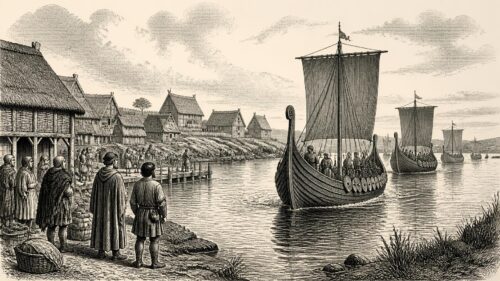
Dublin was one of the most consequential of those coastal powers. Under Gofraid, grandson of Ímar, it was a Hiberno-Scandinavian kingship connected to the wider Irish Sea world. Its wealth and military capacity rested on shipping, trade, tribute, raiding and the labour of enslaved captives, but its rulers were also enmeshed in Irish politics through warfare, diplomacy and alliances. The existence of Dublin did not make the rest of Ireland urban or commercially uniform. Most people lived in rural settlements, working land and livestock, while ecclesiastical centres and ports concentrated craft production, exchange and political attention.
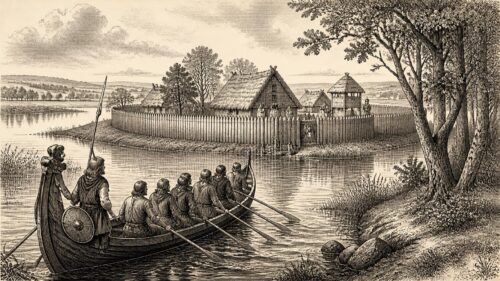
Cattle remained fundamental to wealth, food and social rank. Mixed farming supported households across the island: cattle, sheep, pigs and crops such as oats and barley all had roles in the rural economy. Ringforts and enclosed farmsteads remained familiar features of settlement, while some lakeside communities occupied or reused crannógs. These were not all isolated peasant homesteads; settlement form could express status, control of resources and concern for security. In a year when kings were killed by kinsmen, fortified enclosures and guarded access to land, livestock and waterways had obvious practical value.
Churches, Memory and Ordinary Continuity
Although no major ecclesiastical foundation or book production can be firmly assigned to 925, the year’s surviving record itself points to the importance of religious institutions. The annalists judged Cathal’s penitence meaningful, preserved royal genealogies and framed deaths within a Christian moral vocabulary. Monasteries and churches were not separate from secular society. They held land, employed skilled scribes and craftspeople, received patronage, offered burial and commemoration, and could provide places for negotiation. Clonmacnoise, Clonard, Armagh, Kildare and many lesser communities participated in the political geography within which kings operated.
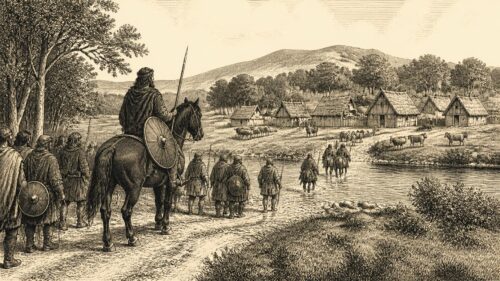
For the wider population, 925 probably brought more continuity than the annals imply. Families still tended animals, prepared fields, fished rivers and lakes, repaired dwellings, travelled to local assemblies and maintained obligations to lords and churches. But continuity was conditional. A new king might demand renewed submission, hostages or renders; the death of a local lord could unsettle protection and landholding; and the movement of armed men could disrupt farming and travel. The record cannot measure these effects in Connacht after Cathal’s death, but the political violence of the year makes them plausible consequences rather than remote abstractions.
Thus 925 is best understood not as a year of one island-wide event but as a moment when the fragility of early medieval kingship was exposed in several regions at once. Cathal’s penitential death, Domnall’s killing and Tadc’s accession reshaped Connacht. Dubgall’s death showed instability in Ulaid, while Lorcán’s passing altered the political field in Brega. Beneath these terse notices lay a society in which dynastic legitimacy, military force, church patronage, livestock wealth and control of strategic places were inseparable. The annals preserve only the uppermost layer of that world, but in 925 that layer was visibly in motion.
Primary Sources
- The Annals of Ulster: Year U925
- The Annals of Ulster: Year U926
- The Annals of Ulster: Year U927
- The Annals of Ulster: Year U928
- The Annals of Ulster: Year U929
- The Annals of Ulster: Year U930
- The Annals of Ulster
- Annals of the Four Masters, Part 3
- Annals of the Kingdom of Ireland
- Cathal
- Muirchertach na Cochall Craicinin
- Donnchad Donn
- Flann Sinna
- Amlaíb (Óláfr Godfridsson)
- Exploring the Irish Annals
- Vikings in Early Medieval Ireland
- Exile, Return And The Dublin-York Axis: The Context Of Church-Raiding, 914–941
- Landscapes of Kingship in Early Medieval Ireland, AD 400–1150
- Kingship, the Church, and Silver in Ireland
- Animals and the Economy of Medieval Ireland: A Zooarchaeological Analysis of the Faunal Remains from Caherconnell Cashel, Co. Clare
- Medieval Ireland: Territorial, Political and Economic Divisions
- Transformation
- The Changing Economy of the Irish Sea Province
- Crannogs / Cránnoga
- The Earthen Rath or Lios
- Viking Traders and Craftsmen
- How Did Early Church Sites Differ from One Another? A Comparative Approach within the Kingdom of Fir Maige, Ireland
- Dunseverick Castle