Reform and Reckoning1162 CE
In 1162 Muirchertach Mac Lochlainn’s loose high-kingship united northern, Meath and Connacht forces, yet failed to compel Dublin’s surrender; after plundering Fine Gall, he accepted 120 ounces of gold. Tribute arrangements in Meath and exemptions from coigny showed the political and local economic importance of land and provisioning. At Clane, Gelasius of Armagh led a synod reinforcing clerical discipline, Armagh’s educational primacy and church reform. Laurence O’Toole became archbishop of Dublin, while Derry’s sacred precinct was reorganised. Deaths, fires, relic enshrinement and raids exposed cultural vulnerability. Continuing regional warfare and dynastic rivalry undermined Mac Lochlainn’s seemingly dominant authority across Ireland.
Dateline
In 1162 Ireland stood at a revealing midpoint between political consolidation and renewed instability. Muirchertach Mac Lochlainn of Cenél nÉogain could still present himself as king of Ireland, while regional rulers continued to guard their own interests through shifting alliances, hostages, tribute and force. Dublin remained a wealthy Hiberno-Norse port capable of resisting a major royal army. At the same time, church leaders were reshaping dioceses, schools, monasteries and sacred precincts. The year is unusually well illuminated by the annals, although their accounts differ in detail and were not all written contemporaneously. Firmly recorded events must therefore be separated from plausible wider context.
A Powerful but Fragile High-King
Mac Lochlainn entered the year near the summit of his power. In 1161 he had forced submissions from important rulers, including Diarmait Mac Murchada of Leinster and Ruaidrí Ua Conchobair of Connacht. The Four Masters consequently described him as king of Ireland “without opposition”. Such language expressed acknowledged supremacy rather than government through a central administration. Provincial kings still commanded armies, collected tribute and made war, while Mac Lochlainn’s authority depended upon personal alliances and the willingness of subordinate rulers to provide hostages and troops.
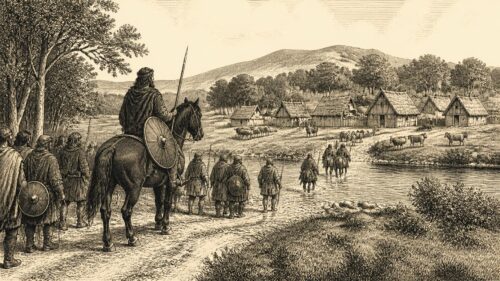
The composition of his army in 1162 demonstrates both the extent and the limits of that authority. The Four Masters say that he marched towards Dublin with the northern Irish, the men of Meath and a battalion of Connachtmen. Ruaidrí had therefore accepted, at least temporarily, a subordinate place within Mac Lochlainn’s coalition. Yet Ruaidrí remained king of Connacht and an ambitious political force. The apparent unity of the army concealed rivalries which would re-emerge as soon as Mac Lochlainn’s power weakened.
The Confrontation at Dublin
The most important secular event was Mac Lochlainn’s expedition against the Hiberno-Norse inhabitants of Dublin, whom Irish annalists commonly called the Foreigners. The Annals of Tigernach provide a striking motive: the army came to avenge an offence committed against the king’s wife. The entry does not explain the incident, and its allegation cannot be independently reconstructed. The Four Masters omit that motive and describe the operation more conventionally as an attempt to besiege Dublin.
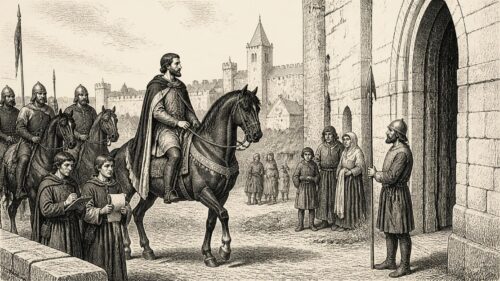
No decisive battle followed. Mac Lochlainn failed to obtain either hostages or an immediate submission and withdrew after his forces plundered Fine Gall, Dublin’s fertile northern hinterland. Leinster and Meath troops were initially left at war with the townspeople. Peace was subsequently arranged, with the Dubliners reportedly giving Mac Lochlainn 120 ounces of gold. The outcome was therefore neither a clear royal victory nor a Dublin triumph. The city had resisted the first pressure of the combined host, but its rulers still judged a substantial payment preferable to continued warfare.
Dublin’s resilience reflected its unusual character. Within its defences stood closely packed timber houses, workshops, churches and the cathedral of the Holy Trinity, later Christ Church. Its harbour connected the Liffey with ports around the Irish Sea and beyond. Craftspeople worked wood, bone, leather and metal, while merchants handled agricultural produce and imported goods. The annalistic payment was reckoned by weight and should not automatically be imagined as bags of locally minted coins, but such gold nevertheless indicates access to commercial wealth and bullion beyond the normal resources of a rural lordship.
Land, Tribute and Local Burdens
The same annalistic entry records that Diarmait Ua Máelshechlainn paid Ruaidrí Ua Conchobair 100 ounces of gold in connection with western Meath. Territory was not merely inherited soil: kingship over it could be negotiated through submission, payment and military backing. Control of Meath was particularly valuable because of its rich farmland, important churches and strategic position between Connacht, Dublin and the northern kingdoms.
Diarmait also freed Cill Ua Nilucáin and Ros Mide from royal coigny or cess in honour of God and St Ciarán. This exemption illuminates an everyday burden otherwise easily hidden by accounts of kings and battles. Communities could be required to feed and lodge rulers, troops, officials or their animals. Permanent immunity protected church tenants and agricultural supplies, while enhancing the donor’s reputation for piety. Cattle remained the most visible form of wealth: raids elsewhere during the year carried off herds, damaging households through the loss of food, traction, breeding stock and social standing.
The Synod of Clane
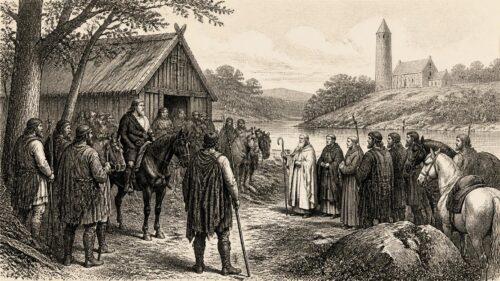
Ecclesiastical reform gave 1162 its most lasting significance. A major synod met at Clane in County Kildare under Gilla Meic Liac, or Gelasius, archbishop of Armagh and successor of Patrick. The Four Masters count twenty-six bishops and many abbots, assembled to establish discipline and good conduct among clergy and laity. The Annals of Tigernach also place Diarmait Mac Murchada of Leinster and Diarmait Ua Máelshechlainn of Meath at the gathering, showing how closely church reform and royal power were connected.
The best-recorded decree concerned education: no man was to serve as lector in an Irish church unless he had been an alumnus of Armagh. A lector was a senior teacher and scholar, not simply someone who read aloud during worship. The decision asserted Armagh’s primacy and attempted to create a recognised standard for those entrusted with scriptural and theological learning. It did not establish a university in the later medieval sense, but it testifies to organised schools, mobile students and competition between ecclesiastical centres.
The synod belonged to a reform movement already advanced by the councils of Ráith Bressail in 1111 and Kells-Mellifont in 1152. Irish Christianity retained powerful hereditary churches and devotion to founding saints, but it was also adopting clearer diocesan boundaries, metropolitan archbishops and forms of religious life associated with continental Europe. Clane sought moral regulation as well as institutional order, although the surviving annals do not preserve a complete set of its decrees. Claims about detailed legislation beyond what they record must therefore remain cautious.
Laurence Comes to Dublin
The death of Gréine, usually known as Gregory, archbishop of Dublin, created another important change. The annals praise his wisdom and knowledge of languages. Lorcán Ua Tuathail—Laurence O’Toole—was appointed as his successor by Gelasius of Armagh. Laurence came from the Uí Muiredaig dynasty of northern Leinster and had served for about nine years as abbot of Glendalough. His elevation made an Irish churchman archbishop of a city whose earlier bishops had looked towards Canterbury for consecration.
Laurence’s appointment therefore joined Dublin more firmly to the reorganised Irish hierarchy. It also suited Diarmait Mac Murchada, who exercised influence over Dublin and was connected to Laurence’s family by marriage. Laurence was nevertheless more than a royal dependant. His background at Glendalough associated him with ascetic piety and reform, and he supported communities of Augustinian canons. Developments linked to 1162 include the consolidation of reformed canonical life at Glendalough and Ferns and, around this period, its introduction at All Hallows in Dublin. Exact foundation dates remain uncertain, but the direction of change is clear.
Derry Reordered
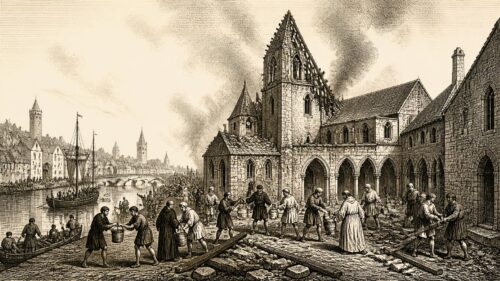
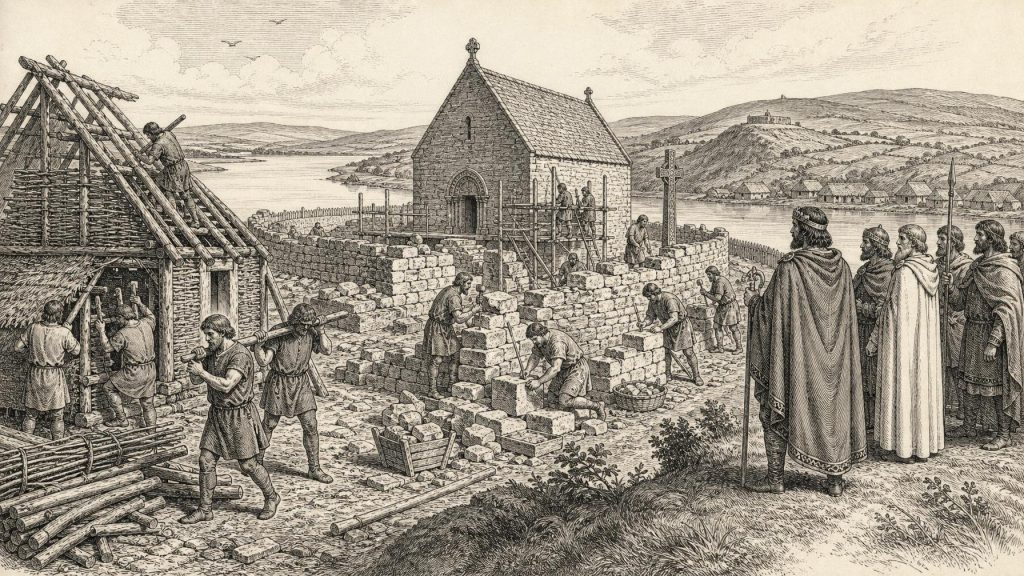
At Derry, reform physically altered the settlement. Flaithbertach Ua Brolcháin, successor of Colum Cille, acted with Mac Lochlainn to separate dwellings from the principal churches. The annals say that eighty houses or more were removed and that a stone enclosure, Caiseal an Urláir, was erected around the sacred centre. A curse was pronounced against anyone who crossed the boundary improperly.
This was no minor tidying operation. Derry was an inhabited ecclesiastical settlement containing clergy, craftspeople, dependants and families. The clearance displaced a substantial part of that community and sharply distinguished the clerical precinct from surrounding domestic space. It also began a documented building programme: a great limekiln followed in 1163 and a large new church in 1164. Royal patronage, masonry and controlled boundaries together proclaimed Derry’s rising status as the Irish headquarters of the Columban federation.
Books, Relics and Fire
The year’s notices reveal a learned culture vulnerable to death and violence. Cathasach Mac Comhaltáin, lector of Derry and a distinguished scholar, died. Diarmait Ua Laighnen, lector of Cloyne, was killed. Cairpre son of Samuel, described as Ireland’s leading master of penmanship, died at Armagh; the much later Four Masters assign his death to 4 February, an exact date not supplied by all surviving annals. Their careers remind us that manuscripts depended upon trained hands, institutional libraries and teachers capable of transmitting specialised scripts.
At Clonfert, clergy raised the relics of Bishop Máenenn and Cumméne Fota from the earth and enclosed them in a protective shrine. Such enshrinement strengthened local identity, pilgrimage and devotion. Loss accompanied renewal. The monastery at Newry burned with its furnishings and books, as did the yew reputedly planted there by Patrick; Emly and its church were also burned. Because books were copied by hand on costly prepared skins, the destruction of a library represented years of labour and memory, not merely damaged property.
Conflict Beneath the Surface
Regional violence continued despite Mac Lochlainn’s apparent supremacy. Donnchad Mac Gilla Pátraic, king of Osraige, died. Máel Sechlainn Ua Ruairc, heir of Bréifne, was killed following conflict involving Muintir Máelmórda. Raiding passed between Meath, Bréifne, Éile, Ormond and Uí Fáilge, while the Four Masters report open war and repeated depredations between Thomond and Desmond. These were not peripheral disturbances: they redistributed cattle, weakened dynasties and created grievances that could transform the balance of power.
Thus 1162 was not simply a prelude to the later Anglo-Norman landings. It was a year in which Irish rulers, Hiberno-Norse townspeople and reforming churchmen pursued their own competing programmes. Mac Lochlainn could summon a formidable coalition but could not force Dublin’s immediate surrender. Armagh strengthened its educational and ecclesiastical claims, Laurence O’Toole took charge of Dublin’s archbishopric, and Derry’s sacred landscape was dramatically rebuilt. Beneath those achievements, however, local warfare and political rivalry continued to erode the foundations of high-kingship.
Primary Sources
- Annals of the Four Masters: Annal M1162
- The Annals of Tigernach: Annal T1162
- The Annals of Ulster
- Annals of Inisfallen
- Mac Lochlainn, Muirchertach
- Ua Tuathail, Lorcán (O'Toole, Laurence)
- Gilla meic Liac (Gelasius)
- Mac Murchada, Diarmait (MacMurrough, Dermot)
- Mac Murchada (MacMurrough), Murchad
- From Kingdom to Colony: Framing the English Conquest of Ireland
- The Transformation of the Irish Church in the Twelfth Century
- Diarmait Mac Murchada and Romanesque Leinster: Four Twelfth-Century Churches in Context
- Glendalough
- Ferns Augustinian Abbey
- Baltinglass Cistercian Abbey
- Glendalough Monastic Site and Visitor Centre Highlights
- The Archaeological Remains of Viking and Medieval Dublin: A Research Framework
- Dublin's Foundations: A Viking Legacy
- Choral Evensong Celebrating the 800th Anniversary of the Canonisation of St Laurence O’Toole
- The Benedictine Shift – Iona’s Namescape
- The Archaeology of Early Christianity in the North of Ireland, Volume 2
- Derry-Londonderry Urban Archaeology Report
- County Kildare Urban Archaeology Survey
- Irish Jesuit Archives: Notes on Irish Synods, including Clane 1162