New Ross and the King1394 CE
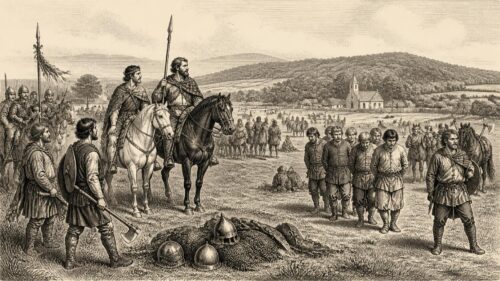
In 1394 Richard II landed at Waterford with an expedition, the first reigning English king to visit Ireland since 1210. Seeking to strengthen the weakened lordship, he targeted Leinster, where Art MacMurrough challenged crown authority. MacMurrough burned New Ross, seizing wealth and hostages, while Ormond retaliated by ravaging Leinster. Richard travelled through Kilkenny to Dublin, obtaining meetings, pledges and uncertain submissions rather than decisive control. Parliament and counsel in Dublin underscored reliance on magnates, clergy and towns. Elsewhere, inter-lordship violence, clerical deaths, church destruction and rebuilding, and learned men’s killings revealed a fragmented society. Royal prestige rose, but conflict endured.
Dateline
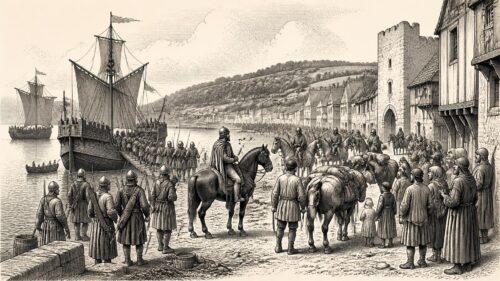
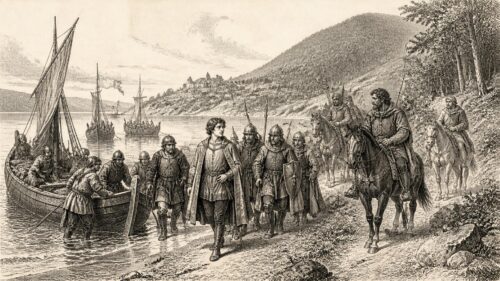
In 1394 Ireland became the setting for an exceptional royal intervention. Richard II of England crossed the Irish Sea and landed at Waterford on 2 October, the first reigning English monarch to come to Ireland since King John in 1210. His arrival was firmly dated and widely recorded. Much else assigned to the year must be handled more cautiously: Irish annals frequently group a season’s fighting and negotiations under a single annual heading, while surviving English records describe a campaign extending into 1395. Yet the events of autumn 1394 were decisive in their own right. They brought the largest royal force seen in Ireland for generations into a political landscape where Gaelic rulers, Anglo-Irish magnates, towns and churchmen all pursued their own interests.
A Royal Landing at Waterford
Richard’s expedition was not a simple invasion of an otherwise unified country. The English crown claimed the lordship of Ireland, but its effective authority had contracted greatly. It was strongest in Dublin and a chain of towns, castles and lordships in the east and south-east. Beyond, and often within, those areas, Gaelic dynasties and culturally mixed lordships commanded land, followers and military resources. Government in Dublin had long struggled to meet the costs of defence; local rulers also negotiated, fought and intermarried across the supposed boundary between “English” and “Irish”.
The immediate southern problem was Art Mac Murchadha Caomhánach, commonly called Art MacMurrough, king of Leinster. His power rested in the difficult country of south Leinster and the Wicklow uplands, but his reach extended into the settled lands claimed by the colonial administration. His conflict with the crown was sharpened by disputes over land, marriage connections and the payments known later as black rent. The expedition therefore aimed to restore royal prestige, protect the lordship’s southern marches and oblige powerful rulers to accept Richard’s authority on terms defined by the king.
Later writers repeated very large figures for Richard’s army, including 4,000 men-at-arms and 30,000 archers. Modern scholarship is more restrained, generally placing the force at roughly eight or nine thousand men. Even that lower estimate represents a formidable expedition: soldiers, archers, mounted men, servants, horses, weapons, food and ships had to be assembled across the Irish Sea. The fleet’s arrival made Waterford a military entrepôt as well as a port. Townspeople, merchants, clergy and labourers could expect requisitions, purchases, billeting and the intense movement of men and animals that accompanied a royal household on campaign.
New Ross Burns
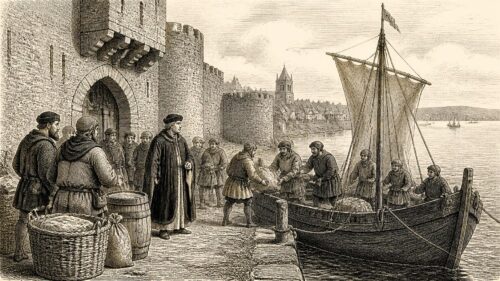
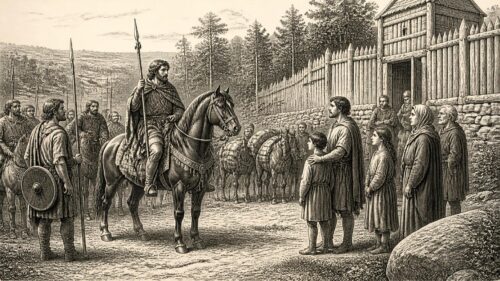
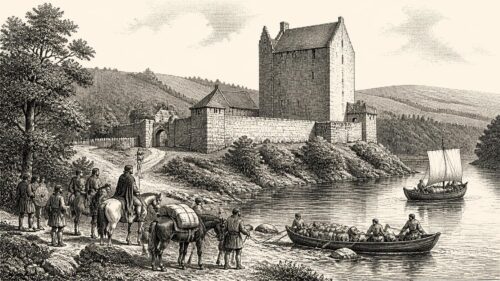
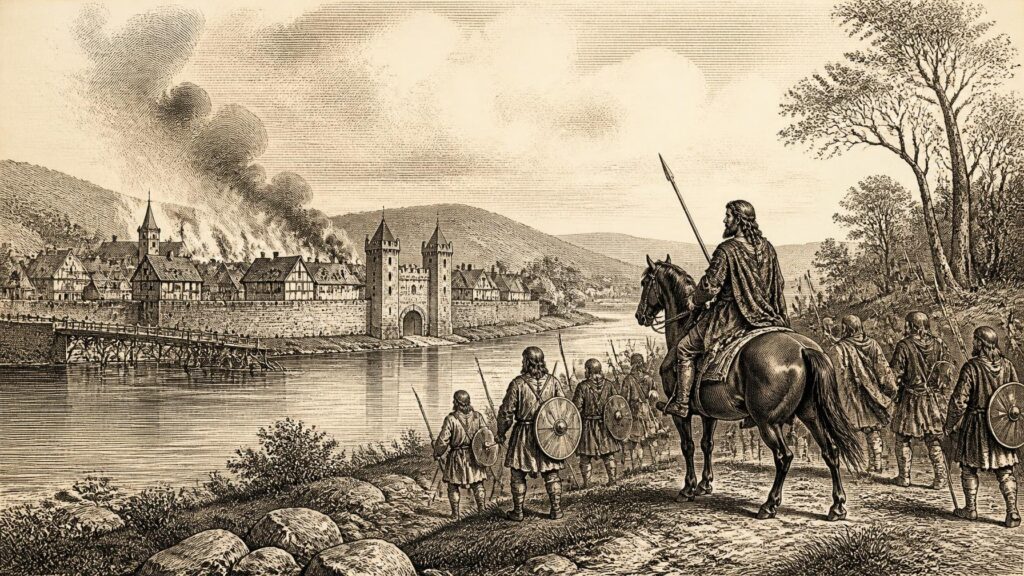
The most vivid Leinster counterstroke associated with the king’s arrival was Art MacMurrough’s attack on Ros Mhic Thriúin, New Ross. The Annals of the Four Masters say that he led an army against the English, burned the town “with its houses and castles”, and carried off gold, silver and hostages. The annal does not provide a day. Its position beside the notice of Richard’s landing should not be read as a precise sequence, but the attack belongs securely to the opening phase of the 1394 campaign.
New Ross was no incidental target. Its walled settlement and river position connected the colonial towns of the south-east with the commercial and agricultural resources of the hinterland. To burn its houses and fortified places was a direct challenge to the security which Richard had come to impose. The seizure of portable wealth and hostages was equally political. Hostages served as guarantees, bargaining counters and proof of military success; such warfare harmed households and disrupted local exchange as well as striking at lords and garrisons.
The response was not confined to the royal army. James Butler, third earl of Ormond and the king’s justiciar in Ireland, raised men and made a destructive march into Leinster. The Four Masters record the burning and spoiling of Gailine and territory associated with the O’Kellys of Magh Druchtain before Ormond returned home. Such entries reveal the character of campaigning: livestock, grain, buildings and the capacity to feed a lord’s following were targets. The contrast between royal pageantry at Waterford and hardship in the districts through which armies passed could hardly have been sharper.
Road to Dublin
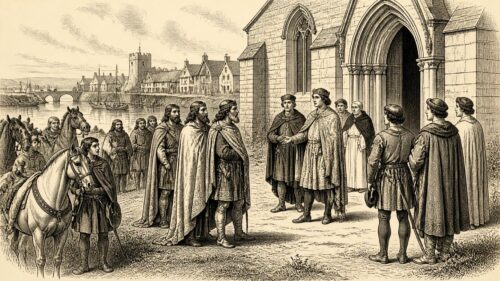
Richard moved north from Waterford through Kilkenny and the contested Leinster interior towards Dublin. The itinerary was itself a statement of power. Kilkenny was the principal centre of Butler influence and an important urban, ecclesiastical and administrative town; Dublin was the seat of the lordship’s central institutions. But a route through Leinster also exposed the limits of cavalry, archery and castles when confronted by local knowledge, wooded ground and mobile opponents.
Mac Carthaigh’s Book describes the king arriving with an immense force of English and Welsh troops, and reports fighting around Garbhchoill. It says that Art MacMurchadha, Ó Broin, Ó Nualláin and Ó Mórdha submitted, but adds that the latter leaders were taken to Dublin while Art returned home after promising to come back. The Four Masters presents a related but differently coloured account: Art came to the king’s household at the urging of English and Irish people of Leinster, was held after a complaint by Ormond, then released, while an O’Brien, an O’More and John O’Nolan remained in custody.
These are not neat, compatible reports of a final peace. They show negotiation under armed pressure, with personal appearances, pledges, detention and mediation by Leinster interests. Mac Carthaigh’s Book also preserves a starkly opposed statement that Art refused submission on any terms. Rather than choosing one annal as a complete narrative, it is safer to see the autumn as a contest in which Richard secured meetings and temporary compliance from some leaders, but did not extinguish Art’s independent power. The much more extensive formal submissions usually associated with Richard’s visit belong principally to the opening months of 1395, not securely to this calendar year.
Parliament, Counsel and Uneasy Authority
By late 1394 Richard was established at Dublin and had summoned the political and ecclesiastical elite to counsel. A parliament had been called for 1 December. The gathering mattered because royal government in Ireland could not operate merely through force of arms. It depended on magnates, bishops, abbots, royal officials, lawyers, interpreters and urban communities. Gaelic lords were not simply spectators in this process: they were potential allies, adversaries and negotiators whose cooperation could determine whether a royal settlement worked beyond town walls.
The campaign also exposed rival claims within the English lordship. Thomas de Burgh, Mac William Burke, is reported by the Four Masters to have gone to the king and received honour and leadership over the English of Connacht. That notice reflects Richard’s willingness to use recognition and patronage as instruments of rule, not only punishment. At the same time, the killing of Mac Jordan, lord of Baile Átha Leathan, by sons of John de Exeter “in treachery”, recorded by both the Four Masters and the Annals of Ulster, demonstrated that conflict among Anglo-Irish kindreds could be as consequential as conflict between crown forces and Gaelic rulers.
Richard’s visit therefore did not restore a tidy frontier between two peoples. The vocabulary of English records could label some men “Irish enemies” and others “English rebels”, but loyalties were more intricate. The royal court needed Ormond’s regional authority, churchmen who could translate and authenticate agreements, and the cooperation of families with kinship ties across political boundaries. The effort to turn those relationships into written, witnessed obedience would become far more visible in 1395.
Churches, Clergy and Learned Life
War and political change did not suspend religious life. The annals record the deaths of Gilla Domnaigh Ó hEógain, official of Lough Erne and erenagh of Inis Caoin; Matthew Mac Gille-Coisgli, vicar of Claininis, who died on 25 April; and Luke Mac Sgoloigi, vicar of Achadh Urchair, after forty-four years in office. Their notices illuminate a clerical world rooted in parishes, hereditary ecclesiastical offices and local communities, particularly in the north-west, far from the king’s Leinster route.
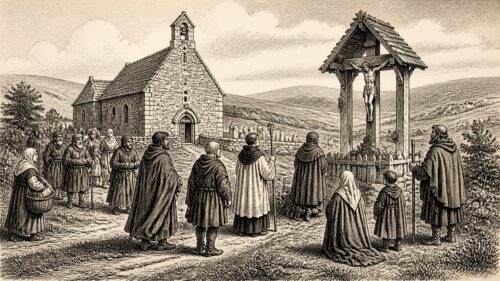
Mac Carthaigh’s Book records both destruction and construction of sacred places. It reports the burning of Colmán’s church at Lann Mic Luacháin, including relics and the saint’s shrine, during regional conflict; it also notes a church at Ceall Ghlas struck by lightning, with an image of Mary burned. These were grave losses of devotional objects and local status. Yet the same annal records the building of Patrick’s church at Lios Ó nDubhthaigh and another church at Ceall Easbuig Mune. Such notices are reminders that rebuilding, patronage and worship continued amid violence.
Learning too was bound to lordship and vulnerability. Cam Cluana Ó Dubhagáin, described as an ollamh of history, eloquence and poetry, was killed in captivity at Dublin according to Mac Carthaigh’s Book. The Four Masters also record the killing of the learned poet Tadhg Ó hEachaidhin in a dispute over the ollamship of the O’Neill. These entries should not be romanticised: poets and learned families held recognised professional roles, but their standing depended on patrons and could draw them into dynastic quarrels.
A Campaign Without Finality
The year ended with Richard II present in Dublin, his expedition imposing a spectacular new fact on Irish politics but not resolving its deepest disputes. In Fermanagh, the Annals of Ulster noted the birth of Thomas Maguire, future king of Fir Manach; in Oriel, they recorded the death of Brian Mac Cába, constable of Oirgialla; and in Tuath Ratha, the killing of Tadhg Ó Flannagáin marked another local succession struggle. Ireland in 1394 was not defined solely by one king’s march. It was a mosaic of lordships, churches, towns and households, each facing its own contests for land, office, security and honour.
Richard had gained access, submissions of varying quality and the appearance of renewed royal authority. Art MacMurrough had shown at New Ross that a Leinster king could still strike a fortified colonial town in the shadow of an English royal landing. The campaign’s achievements would have to be tested by winter negotiations and the next year’s formal agreements. For 1394, its enduring image is the contrast between the king’s fleet at Waterford and the smoke rising from New Ross: an assertion of imperial power met by a forceful declaration that Ireland could not be commanded from the coast alone.
Primary Sources
- Annals of the Four Masters, Annal M1394
- The Annals of Ulster, Year U1394
- Mac Carthaigh's Book, Annal MCB1394
- Annales Hiberniae
- Richard II
- Richard II and the Wider Gaelic World: A Reassessment
- The Rise and Fall of the Clann Éinrí Aimhréidh Uí Néill: Dynastic Feuding and Geopolitics in the Late Medieval Irish Sea World
- English Lordship of Ireland and the Irish Sea World: Re-assessing the Origins of the Kildare Ascendancy, c.1390–c.1513
- Irish Lords and English Rulers
- Thomas Holand – Richard II’s King of Ireland?
- Richard II in Ireland 1394–5 and Submissions of the Irish Chiefs
- A Discourse of Ireland Collected Out of the Records … Wherein It Appeareth What Submissions Were Made to Richard II at His First Being in the Realme of Ireland, 1394
- King Richard II's Two Visits to Kilkenny (1393 & 1399)
- Richard II and Art Mac Murchadha: Conflict in Carlow in 1394
- The English Invasion
- Royal Connections: A Chronicle of Waterford's Royal Visits
- Waterford City
- County Wexford Urban Archaeology Survey, Volume 1
- The Political Role of the Earls of Desmond in the Fourteenth Century
- King Richard II Leads a Military Expedition to Ireland and Visits Kilkenny Castle