BIRM-166’s Permafrost Fen30612 BCE
In 30,612 BCE, Ireland lay in a fluctuating Late Pleistocene interval before the Last Glacial Maximum. Derryvree, County Fermanagh, preserves freshwater deposits between glacial tills, dated by BIRM-166 to a broad calibrated range encompassing this notional year. They indicate a cold, treeless, waterlogged tundra mosaic, with sedges, mosses, aquatic plants and probably frozen ground. Castlepook Cave records animals including mammoth, reindeer and hyaena, but accumulated remains span millennia and cannot define one community. A possibly cut-marked reindeer bone suggests transient human activity, not settlement. No evidence supports Irish polities, farming or permanent Palaeolithic occupation; landscapes, ice and habitats shaped life.
Dateline
“30,612 BCE” is a modern chronological label, not a year from which Ireland preserves a record of a ruler, settlement, battle or named individual. At this depth of time, calendar-year precision is unavailable. The label lies roughly 32,560 years before the conventional radiocarbon baseline of AD 1950, within the Late Pleistocene and broadly within Marine Isotope Stage 3. What can responsibly be examined is an interval, not a day: Ireland during a climatically unstable part of the last Ice Age, before the fullest expansion of the British–Irish Ice Sheet.
The closest Irish environmental evidence comes from Derryvree near Maguiresbridge, County Fermanagh. There, a road cutting exposed freshwater silts, sands and organic deposits between two bodies of glacial till. The sequence is important because it records a simple but dramatic order of events: ice had occupied the locality; a period followed in which water, plants and organic sediment accumulated; then ice returned and sealed the deposit beneath further till. The organic layer produced the conventional radiocarbon determination BIRM-166, 30,500 years BP with a sizeable uncertainty. When calibrated using modern radiocarbon methods, this points to a broad range of approximately 36,900–31,700 calibrated years BP. The numbered year falls within that range, but cannot be attached to a particular season, generation, pool or plant.
A Landscape Between Ice Advances
Derryvree does not show that the whole island was ice-free at once. It demonstrates that this part of Fermanagh supported a non-glacial landscape during an interval between local ice advances. That distinction matters. The later Last Glacial Maximum, conventionally placed around 25,000–23,000 years ago for the British–Irish Ice Sheet’s greatest extent, was still ahead. Ice margins, sea level, vegetation and animal ranges had already changed repeatedly, however, and the evidence does not justify imagining a stable, mild Ireland waiting quietly for the main freeze.
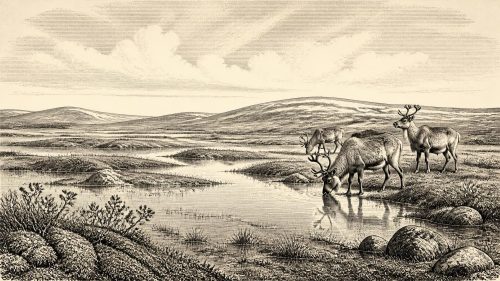
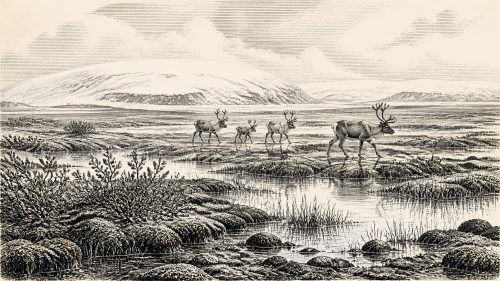
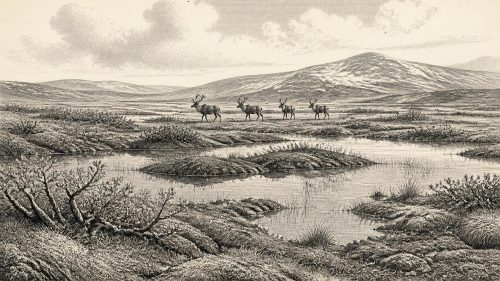
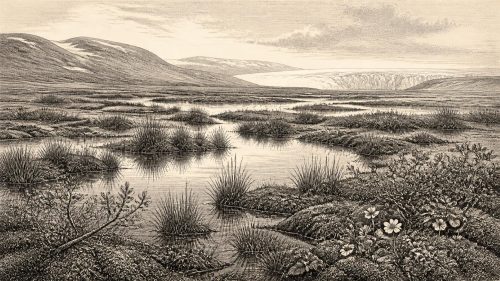
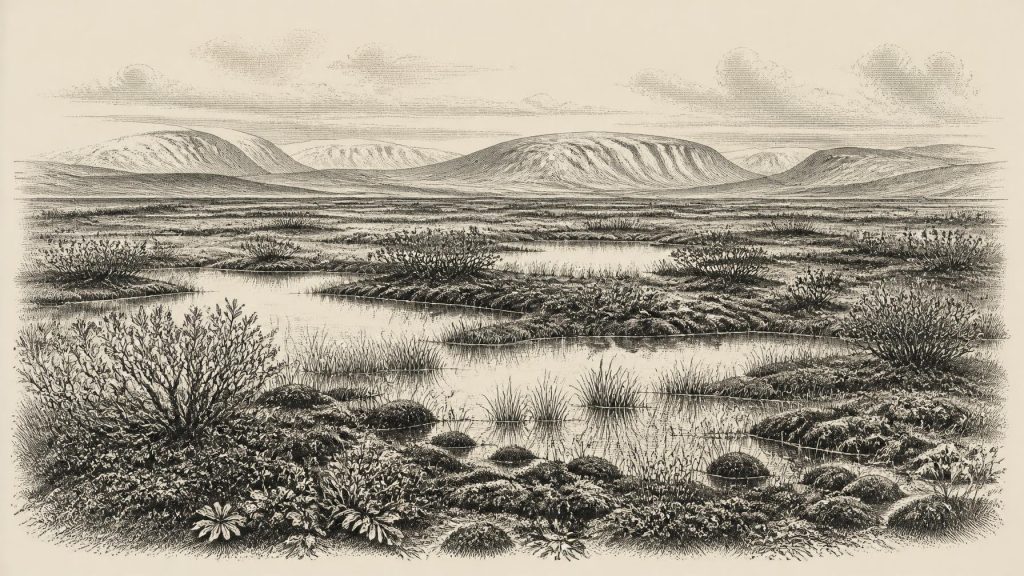
The Derryvree sediments instead evoke a cold, treeless and waterlogged setting. Pollen, plant macrofossils, mosses and small animal remains point to open tundra-like ground and freshwater. Sedges and mosses grew around sluggish water and shallow pools. Aquatic plants, including water-milfoil and bogbean, show that some water remained open long enough for a wetland community to form. Dwarf willow, mountain-avens, rosy saxifrage and alpine clubmoss in the wider assemblage belong to plants adapted to cold, exposed conditions. “Muskeg” and “tundra” are useful ecological comparisons, not claims that a modern northern landscape was reproduced exactly in Fermanagh.
Permafrost or seasonally frozen ground probably structured this environment. In a short growing season, thawed surface soils could become saturated because water could not easily drain through frozen or compacted ground beneath. The result was a patchwork rather than a uniform plain: wet hollows, sedge fringes, mossy ground, open water, frost-disturbed mineral soils and sparse vegetation on slightly drier rises. Wind exposure, snow cover, drainage and changing temperatures would have made conditions vary over very short distances. Derryvree gives a rare picture of this local ecological mosaic because the later ice protected it, while elsewhere erosion and fresh glacial deposition erased much of the contemporary surface.
Climate Without a Single Weather Report
Greenland ice cores reveal that the northern Atlantic world underwent abrupt swings between colder stadials and relatively milder interstadials during Marine Isotope Stage 3. Such records help explain why Ireland’s glacial history is complex, but they should not be mistaken for a weather diary from Fermanagh. An ice-core transition dated in Greenland cannot automatically be translated into a particular Irish summer or winter. The Derryvree age range is itself broad, while radiocarbon calibration becomes especially uncertain and non-linear so far back in time. The responsible conclusion is that the landscape developed during one of the fluctuating cold phases before the Last Glacial Maximum, not that it can be assigned a precise climate episode in 30,612 BCE.
Nor was Ireland necessarily connected to its present coastline. Sea levels were much lower globally because vast quantities of water were held in continental ice sheets, but the geography of the Irish Sea basin and the timing of changing ice margins were complicated. The fossil record establishes that mammals reached Ireland at various times; it does not securely reconstruct a single migration route or prove a permanent dry-land corridor at this particular point. For people as for animals, the sea, ice and available terrain were constraints whose exact local configuration remains uncertain.
Animals and the Cave Record
The best-known evidence for Ice Age animals in Ireland comes from limestone caves, especially Castlepook Cave, also known as Mammoth Cave, near Doneraile in north County Cork. Its collections include remains attributed to woolly mammoth, reindeer, giant deer, brown bear, wolf, Arctic fox, lemmings and spotted hyaena. They demonstrate that Ireland was periodically part of a wider north-west European world in which cold-adapted mammals and large predators could occur. A spotted-hyaena skull from Castlepook is now held by the National Museum of Ireland.
Yet Castlepook is not a snapshot of one flourishing animal community. The cave was used and modified over a long period. Bones accumulated through different processes: animals entering or dying in the cave, carnivore activity, water movement, excavation and later disturbance. Direct radiocarbon determinations from different specimens span many thousands of years. Improved laboratory pretreatment has also shown that several older determinations made on southern Irish cave fauna were substantially too young. Research published in 2020 consequently placed some Castlepook mammals much earlier than previously thought and suggested that giant deer and spotted hyaena may have disappeared locally before about 40,000 calibrated years BP.
That revision is a warning against placing every celebrated Ice Age species into a single scene dated to 30,612 BCE. Mammoth and reindeer are important evidence for the broad period, but the presence of a bone in an antiquarian cave collection does not show that its species stood beside a Derryvree pool in this notional year. The scientifically stronger picture is one of intermittent animal colonisation, local extirpation and shifting habitats across tens of millennia. Ireland’s surviving fossils reveal fragments of that history rather than a complete census.
The Human Question
Castlepook also raises a tantalising archaeological possibility. A reindeer femur has been reported as bearing a deep mark interpreted as having been made by a sharp stone tool during fresh-bone butchery, and public heritage material has associated it broadly with about 31,000 BC. If that interpretation is upheld, it would indicate that a person handled a reindeer in Ireland far earlier than the island’s traditionally accepted post-glacial settlement. It would be an important trace of human action, perhaps involving the removal of meat, hide, sinew or another useful tissue.
It is not, however, evidence for a settled Palaeolithic population. No securely associated hearth, stone-tool assemblage, dwelling surface, burial, food store or repeatedly occupied camp of this age has been identified in Ireland. The mark cannot establish whether an animal was hunted, found dead, processed elsewhere before a bone reached the cave, or used by a party that stayed only briefly. The National Museum of Ireland has accordingly continued to stress the absence of clear, substantial evidence for Palaeolithic occupation. The careful position is that a human presence around this broad period is possible and potentially supported by one remarkable object, but permanent residence, population size and cultural affiliation are unknown.
No Politics, but Real Social Limits
There is no evidence from which to infer polities, chiefs, diplomatic relationships, organised conflict, religious institutions, language, art or formal learning in Ireland at this date. Equally, there is no evidence for agriculture, herding, metalworking, villages, long-distance trade networks or exchange routes. These are not gaps that can be filled with familiar prehistoric imagery. If people were present, they would have lived by mobile foraging and close knowledge of a difficult environment; that is an inference from the possible butchery evidence and the wider Upper Palaeolithic context, not a demonstrated Irish settlement pattern.
The strongest economic story is therefore non-human and environmental. Wetland plants converted brief summers into organic matter; grazing animals, when present, converted sparse vegetation into mobile food resources for carnivores and perhaps occasional people; caves became traps, dens, shelters or sedimentary collectors. The principal “infrastructure” was the terrain itself: karst caves in Cork, shallow freshwater basins in Fermanagh, exposed ground, ice margins and changing coasts. Each was a setting through which life moved, not a built landscape controlled by an Irish community.
For this distant interval, the most important development is not a recorded event but the survival of evidence. The BIRM-166 wetland horizon preserves a moment when freshwater life persisted between episodes of glaciation. Castlepook preserves a longer, more complicated record of animals moving through southern Ireland, and perhaps of a human encounter with a reindeer. Together they make 30,612 BCE intelligible: not as a precise anniversary, but as part of an Ice Age Ireland that was cold, open, ecologically variable and repeatedly remade by water, frost, animals and advancing ice.
Primary Sources
- A Middle Midlandian Freshwater Series at Derryvree, Maguiresbridge, County Fermanagh, Northern Ireland
- The Irish Quaternary Fauna Project
- A Reconsideration of the Radiocarbon Dating of the Marine Isotope Stage 3 Fauna from Southern Ireland
- Growth and Retreat of the Last British–Irish Ice Sheet, 31,000 to 15,000 Years Ago: The BRITICE-CHRONO Reconstruction
- Stratigraphic and Palaeo-Geomorphological Evidence for the Glacial-Deglacial History of the Last British-Irish Ice Sheet in the North-Western Irish Sea
- The Timing and Magnitude of the British–Irish Ice Sheet Between Marine Isotope Stages 5d and 2
- Radiocarbon Constraints on the Age of the Maximum Advance of the British–Irish Ice Sheet in the Celtic Sea
- New Data for the Last Glacial Maximum in Great Britain and Ireland
- Quaternary Deposits and Glacial Stratigraphy in Ireland
- The IntCal20 Northern Hemisphere Radiocarbon Age Calibration Curve (0–55 cal kBP)
- The Greenland Ice Core Chronology 2005, 15–42 ka: Part 1, Constructing the Time Scale
- Independent Tephrochronological Evidence for Rapid and Synchronous Oceanic and Atmospheric Temperature Rises Over the Greenland Stadial-Interstadial Transitions Between c. 32 and 40 ka b2k
- Figure 6: The Subdivision of the Quaternary Period in Ireland
- Outreach and Education Resources
- Spotted Hyena Skull
- Prehistoric Details: Mell Flint Flake
- Ice Age Ireland: Cool Fossils
- Archaeological Heritage of County Cork
- The Mesolithic in Ireland: When Was It?
- Mammoth Cave, County Cork
- Occurrence of Mammalia Relicts at Site Castlepook Cave
- New Insights on the Fauna of Ireland’s Younger Dryas and Early Holocene from Alice & Gwendoline Cave