Bogbean Beside the Drumlins30561 BCE
30,561 BCE is an imprecise modern label for a Late Pleistocene interval, probably within Marine Isotope Stage 3. Derryvree, County Fermanagh, preserves freshwater sediments between tills, showing that glaciation was interrupted locally by cold, treeless wetlands supporting tundra plants, mosses and aquatic vegetation. Castlepook Cave, County Cork, contains chronologically mixed remains of reindeer, mammoth, giant deer, predators and smaller animals, evidencing a mobile cold-stage fauna. A possibly cut reindeer bone suggests fleeting Upper Palaeolithic human presence, but cannot establish settlement. No evidence supports claims about Irish societies, politics, culture or belief; this past is reconstructed cautiously from environmental traces alone.

Dateline
30,561 BCE is a useful modern label, not a recoverable year in Irish prehistory. No community in Ireland then kept a calendar from which an event, ruler or season can be identified. At this depth of time, radiocarbon uncertainty, calibration and the uneven survival of deposits rule out year-by-year history. The responsible view is therefore of a broad Late Pleistocene setting, probably within the middle part of Marine Isotope Stage 3, rather than of a single moment. The closest Irish environmental evidence comes from a freshwater deposit at Derryvree, near Maguiresbridge in County Fermanagh, while animal remains from Castlepook Cave in north Cork illuminate the kinds of creatures that moved through parts of the island during this long, unstable phase of the last Ice Age.
A Date Beyond Calendar Precision
The conventional radiocarbon determination most relevant to this period is BIRM-166 from Derryvree: 30,500 radiocarbon years before present, with a large published error range of +1,170/−1,030 years. “Before present” is conventionally counted from AD 1950; it is not the same as a BCE date. Because atmospheric radiocarbon changed over millennia, such measurements must be calibrated, and their calendar equivalents at this age are broad rather than annual. Modern calibration curves extend this far back, but they do not turn a single legacy sample into a precise historical timestamp. Derryvree can responsibly illuminate conditions spanning the later 30th millennium calibrated years before present, not prove what occurred on a particular day, or even in a particular human lifetime, in 30,561 BCE.
The date falls well before the fullest, island-wide phase of the Last Glacial Maximum, when the British–Irish Ice Sheet attained its greatest overall extent around 26,000 calibrated years ago. That later maximum should not be projected backwards unchanged. Ice-sheet margins grew and retreated asynchronously; some Irish districts could be glaciated while other areas retained exposed ground, lakes, wetlands or periglacial terrain. Ireland at this time was also not an island in the modern geographical sense. Sea levels were lower and the Irish Sea basin was profoundly altered, although the exact routes and barriers available at any one stage remain matters for reconstruction rather than certainty.
The Derryvree Freshwater Interval
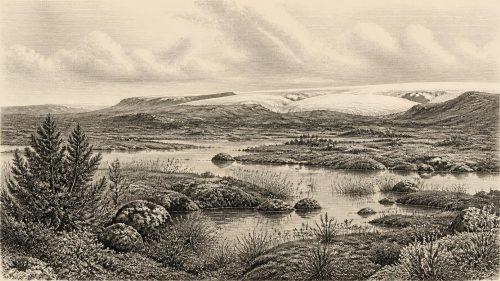
Derryvree is important because roadworks in 1969 exposed a sequence that glaciers had effectively sealed. Beneath and above lay two distinct layers of till, the unsorted debris deposited by ice. Between them was a body of freshwater silts and fine sands containing moss detritus, plant remains and small animal evidence. The order of the deposits provides the firmest conclusion: ice had affected the locality; a period then allowed water and organic sediment to accumulate; a later advance buried the basin beneath further glacial material. This is an environmental archive, not a settlement site, but it establishes that the Fermanagh landscape had not remained continuously covered by glacier ice.
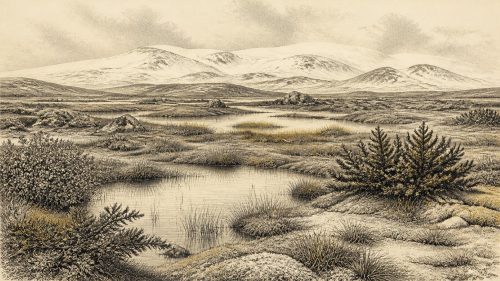
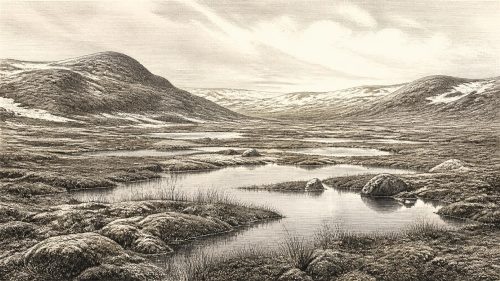
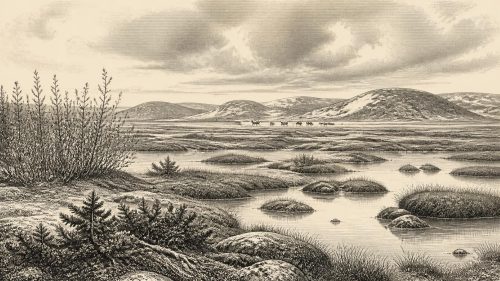
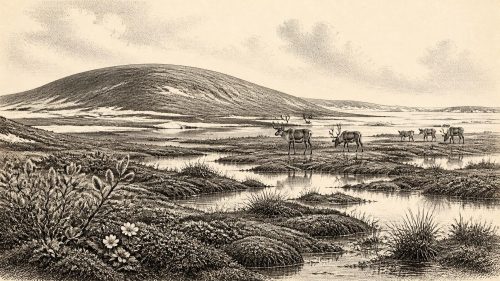
The fossils suggest open tundra or tundra-like ground under periglacial conditions. Dwarf willow, mountain avens, bogbean, lesser clubmoss and aquatic water-milfoil occur among the evidence reported from the deposit. Their combination matters. It indicates neither a forested Ireland nor a simple, lifeless white desert. Rather, the Derryvree basin appears to have supported shallow freshwater and wet ground, edged by low vegetation able to endure severe cold, short growing seasons, frost disturbance and limited shelter. Mosses and sedges could form local cover; aquatic plants could grow where water remained open in summer. Yet the surrounding terrain was treeless and exposed.
This picture must be kept local. Fossils in one Fermanagh hollow cannot supply a botanical map for all Ireland. The records nevertheless make a powerful corrective to the notion that cold-age Ireland was uniformly inert beneath ice. In favourable lowland basins, water, mud and vegetation supported small ecosystems. They also preserve a record precisely because later ice and sediment covered them. Elsewhere, erosion may have destroyed comparable deposits; absence of evidence is therefore a poor guide to the full range of habitats that once existed.
A Mobile Faunal World
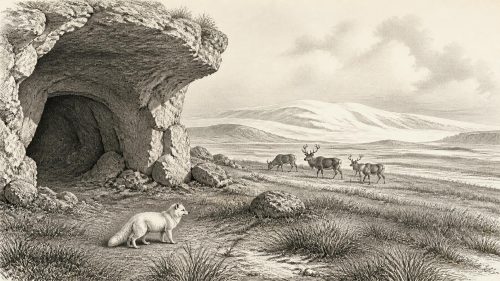
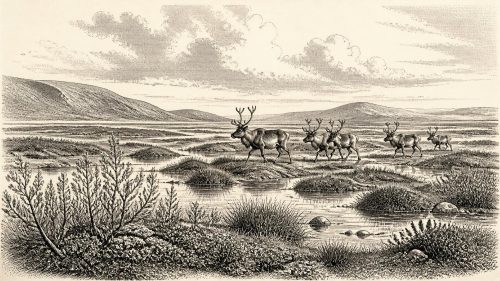
In County Cork, Castlepook Cave near Doneraile has produced a striking, though chronologically mixed, Ice Age fauna. Material associated with the cave includes reindeer, woolly mammoth, giant deer, spotted hyaena, wolf, arctic fox, hare and lemming. These remains were accumulated over long periods and in different chambers, and many were recovered during early twentieth-century excavations whose recording standards cannot match modern practice. They should not be treated as a single herd seen together in one season. Nonetheless, they demonstrate that Ireland was part of the broader north-west European cold-stage world in which large grazing animals, scavengers and predators used open landscapes and caves.
Reindeer are particularly evocative because they could exploit sparse, seasonal vegetation and move widely. Their presence does not establish a regular migration path across the whole island, but it makes a mobile, open country more plausible than a densely wooded one. Mammoth and giant deer remains point to a varied mosaic of grassland, herb-rich ground, wet places and sheltering terrain at different times. Caves were not automatically human homes: carnivores denning, animals dying naturally, water sorting bones and later disturbance all helped form such assemblages. The cave evidence is therefore strongest for fauna, weaker for exact local habitat, and weaker still for human behaviour.
The Human Question at Castlepook
The most consequential possible human evidence is a reindeer femur from Castlepook that has been publicised as roughly 33,000 years old and as bearing a mark interpreted as fresh-bone cutting with a sharp stone tool. If that interpretation is confirmed, it would show that people reached Ireland and processed a reindeer during the Upper Palaeolithic, far earlier than the long-established record of sustained post-glacial settlement. It is a genuinely important claim, but its limits are equally important. The specimen derives from an older collection rather than a securely excavated occupation floor associated with hearths, tools and living surfaces.
One modified bone cannot demonstrate a permanent population, a named cultural group, language, ancestry, family line or political territory. It does not prove that people were present precisely in 30,561 BCE. Nor should it be used to populate the island with imagined tribes. The cautious interpretation is narrower: at some point in the broad pre-Last Glacial Maximum interval represented by the bone, one person or a small party may have reached this part of Ireland and handled a reindeer carcass. Whether they hunted it, scavenged it, briefly sheltered in the cave or travelled onward remains unknown. Ongoing work at Castlepook seeks stratified deposits, securely dated bones and unequivocal artefacts that could test these possibilities.
Life Without States or Borders
There is no evidence for political affairs, diplomacy, warfare, chiefs, formal territories or institutions in Ireland at this date. Those are not missing chapters awaiting a name; they are questions for which the surviving record is silent. If visitors were present, their social organisation is best approached only by comparison with Upper Palaeolithic hunter-gatherers elsewhere in north-west Europe: small, mobile groups dependent on knowledge of animals, weather, stone, fuel and safe routes. Such comparison can suggest possibilities, but it cannot supply facts about Ireland that archaeology has not yet produced.
Everyday survival would have depended on mobility and timing. A party able to reach exposed Ireland needed clothing, fire-making knowledge, cutting implements and dependable social connections beyond the immediate camp. Animal carcasses could provide meat, fat, hide, sinew, bone and antler; wetland plants and small animals may have supplemented resources, though direct evidence for human use of either in Ireland is absent. Stone raw materials and finished tools have not yet been found in a securely associated Irish assemblage of this age. Consequently, trade, exchange routes and technology cannot be described beyond the general observation that any human visit would have required practical equipment and learned skills.
Culture, Belief and the Limits of Inference
There are no known Irish burials, artworks, ornaments, structures, hearths or inscriptions securely dating to this broad period. Nothing permits a responsible account of religious practice, ritual or learning in Ireland around 30,561 BCE. Continental Upper Palaeolithic societies made sophisticated tools and, in some regions, ornaments and cave art; that wider context shows what Homo sapiens communities were capable of. It does not license the transfer of those practices to Ireland. The absence of such finds may reflect sparse visitation, later ice erosion, deeply buried archaeology and the limited investigation of caves and drowned landscapes, but it remains absence.
The chief historical development, then, was environmental rather than political. Ireland was a changeable cold-stage landscape at the Atlantic edge of Europe: not simply frozen, not securely settled, and not yet divided into the human regions familiar from later history. At Derryvree, freshwater plants and tundra vegetation endured between episodes of glaciation. At Castlepook, large mammals and carnivores entered caves or left remains later gathered there. A possible cut on a reindeer bone raises the prospect of a fleeting human encounter. That small and contested trace is valuable precisely because it is so slight: it reminds us that Ireland’s deepest past is reconstructed from sediments, fossils and probabilities, not from a calendar of events.
Primary Sources
- A Middle Midlandian Freshwater Series at Derryvree, Maguiresbridge, County Fermanagh, Northern Ireland
- IQUA Guide 16 (Derryvree and Maguiresbridge glacial deposits)
- Figure 6.— The Subdivision of the Quaternary Period in Ireland
- BSBI: Menyanthes trifoliata
- BSBI: Salix herbacea
- BSBI: Dryas octopetala
- BSBI: Myriophyllum alterniflorum
- BSBI: Selaginella selaginoides
- Archaeological Heritage of County Cork 2020
- County Cork Heritage Grant Scheme 2023: The Castlepook Cave Project
- The Irish Quaternary Fauna Project
- Ireland's Palaeolithic Archaeology – Fleeting Footprints in a Frozen Land
- New Insights on the Fauna of Ireland's Younger Dryas and Early Holocene from Alice & Gwendoline Cave
- Deglaciation Chronology of the Donegal Ice Centre, North-west Ireland
- Early Deglaciation of the British-Irish Ice Sheet on the Atlantic Shelf Northwest of Ireland Driven by Glacioisostatic Depression and High Relative Sea Level
- Growth and Retreat of the Last British–Irish Ice Sheet, 31,000 to 15,000 Years Ago: the BRITICE-CHRONO Reconstruction
- The Timing and Magnitude of the British–Irish Ice Sheet Between Marine Isotope Stages 5d and 2
- The IntCal20 Northern Hemisphere Radiocarbon Age Calibration Curve (0–55 cal kBP)
- The Mesolithic in Ireland: When Was It?
- Reindeer Bone Found in Cork Cave Shows Human Activity in Ireland 33,000 Years Ago