Derryvree’s Calcareous Pools30493 BCE
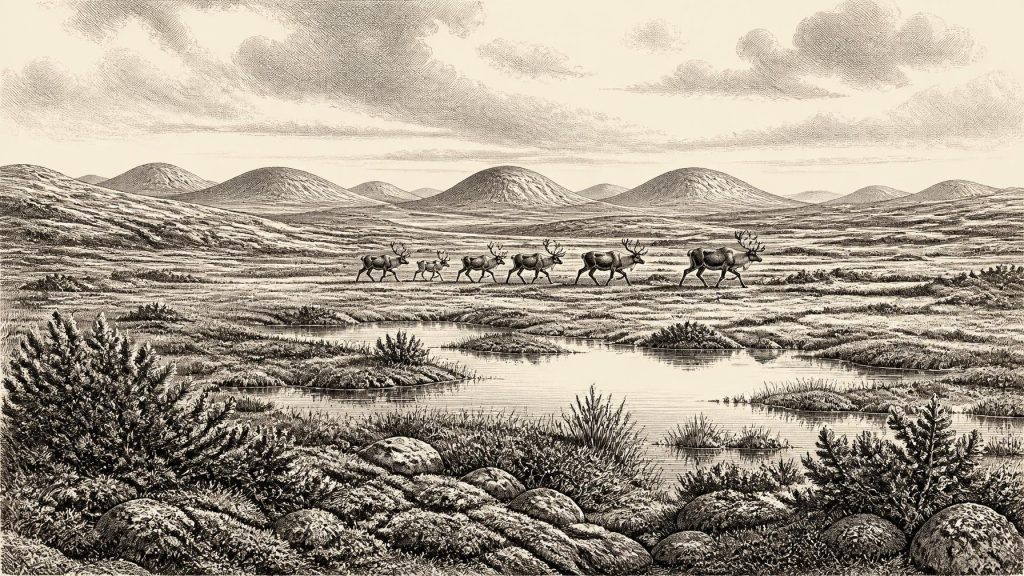
At the date of 30,493 BCE, Ireland’s evidence records environments rather than events. Derryvree, County Fermanagh, preserves freshwater deposits between tills, showing an interval of cold, treeless wet tundra between glacial episodes. Radiocarbon dating places it broadly within Marine Isotope Stage 3, not at a precise calendar year. Pools, sedges, mosses, herbs and insects indicate active periglacial wetlands. Castlepook Cave, County Cork, preserves diverse Ice Age fauna, including mammoth, reindeer, giant deer, bear and hyaena, accumulated over time. A cut-marked reindeer bone suggests possible human carcass processing, but proves neither settlement nor population. Growing ice transformed and obscured these landscapes.
Dateline
Modern calendar-year precision is not available for Ireland in 30,493 BCE. This date is a convenient point on a modern timeline, equivalent to roughly 32,442 years before AD 1950, rather than a year for which archaeology can identify an event, a settlement, a ruler or an individual. The responsible evidence comes from wide radiocarbon ranges, glacial layers, plant and insect remains, and cave fauna. It illuminates changing environments and possible human activity during the Late Pleistocene, not a historical chronicle.
The closest securely relevant Irish environmental record is at Derryvree near Maguiresbridge, County Fermanagh. There, a road cutting through a drumlin exposed freshwater silts, fine sands and organic material lying between two separate sheets of till: sediments deposited by glacier ice. The sequence establishes a simple but important order. Ice had affected the locality; later, water and vegetation accumulated in a basin; subsequently, ice or ice-related sediment sealed that environment beneath another till. It is evidence that the district was not continuously covered by ice throughout the last cold stage.
A Date Within Deep Time
Organic material from the Derryvree freshwater deposits produced the conventional radiocarbon determination BIRM-166: 30,500 radiocarbon years before present, with an uncertainty of +1,170 and −1,030 years. Radiocarbon years are not calendar years. Calibration against records of past atmospheric carbon-14 converts that measurement into a broad calendar range commonly expressed as about 36,900–31,700 calibrated years before present. In approximate BCE terms, this spans c. 34,950–29,750 BCE. The modern label 30,493 BCE therefore falls within the wide interval represented by the deposits, but cannot be assigned to a particular sediment layer, pool, plant, animal or season.
This was Marine Isotope Stage 3, a long, unstable part of the last glacial cycle. North Atlantic climate swung repeatedly between relatively milder and markedly colder phases. Irish deposits of this age are scarce, discontinuous and often altered by later ice. The Derryvree material has consequently been described as a cold phase rather than confidently as a warm interstadial. That terminology matters: the fossil assemblage does not support a picture of a wooded, benign Ireland. It records a severe but living landscape during an interval between glacial episodes.
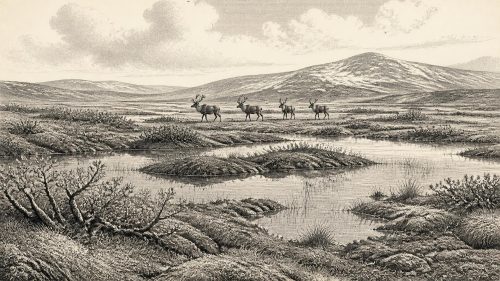
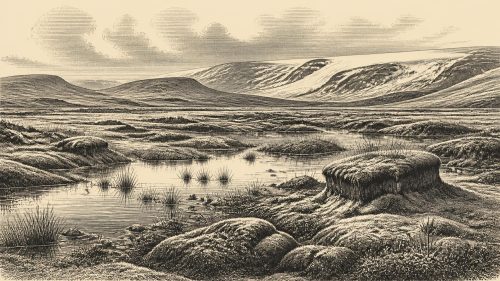
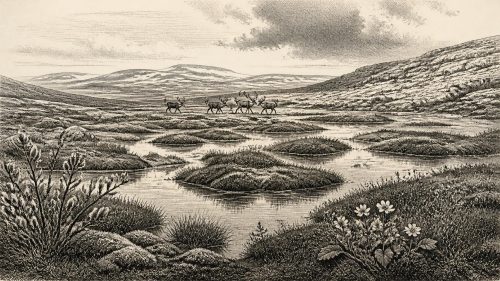
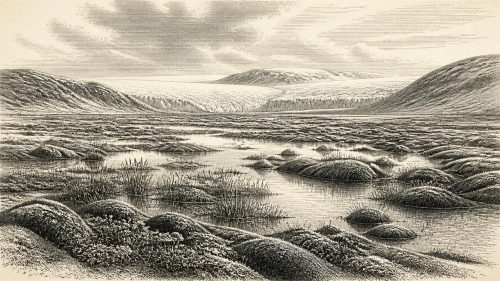
Derryvree’s Wet Tundra
The Derryvree evidence points to open, treeless country. Grasses and sedges were prominent, accompanied by juniper and herbs, while mosses, aquatic plants and insect remains came from a wet, organic-rich setting. Fossil remains of plants including bogbean and mountain avens are especially evocative. Bogbean indicates fresh water and marshy margins; mountain avens is associated with cold, open, often calcareous ground. Together with the insect evidence, these finds support the reconstruction of a tundra-like muskeg: a mosaic of shallow pools, wet sedge ground, mossy patches and sparsely vegetated mineral soils.
That reconstruction is an interpretation built from direct observations. The direct evidence is the presence of particular pollen grains, seeds, moss fragments and insect remains within a local deposit. The broader conclusion—that the surrounding region was cold, largely treeless and periglacial—becomes persuasive because several kinds of evidence agree. Yet Derryvree was a low, wet basin. It should not be treated as a perfect miniature of every coast, limestone upland or valley across Ireland. Nor can it tell us whether an individual summer was mild, a winter unusually severe, or precisely how far seasonal frost extended.
Even so, the deposit overturns any image of a lifeless island. Fresh water accumulated, plants flowered and set seed, insects completed their life cycles, and sufficient organic material built up to be preserved. Summers may have allowed a burst of biological activity around pools and sedge margins; winters were likely long, cold and restrictive. Frozen or seasonally frozen ground would have influenced drainage, leaving water perched near the surface in thawed months. In such conditions, productive wetland strips could stand beside exposed, wind-scoured ground.
Ice Growing Around an Island
Ireland was moving towards the much more extensive glaciation conventionally associated with the Last Glacial Maximum. Modern reconstructions of the British–Irish Ice Sheet show major ice growth after about 31,000 years ago, followed by large advances over the surrounding continental shelves. The exact geometry of ice around Ireland before and during that build-up remains debated, particularly for earlier parts of Marine Isotope Stage 3. It would be unsafe to draw a single ice margin for 30,493 BCE or to claim that the whole island was simultaneously free of ice, or wholly buried beneath it.
The stratigraphy at Derryvree supplies a more modest certainty. Its lower till proves earlier glaciation in that locality; its upper till proves later ice-related deposition. Between them lay a freshwater environment. Elsewhere, ice, snowfields, bare ground, river systems and animal habitats may have formed a shifting regional patchwork. The eventual advance of ice did more than change the scenery. Glaciers eroded older land surfaces, rearranged sediments and destroyed or concealed many traces of the landscapes that preceded them. This helps explain why evidence for Ireland’s deepest human past is so sparse.
Sea level was lower than today because enormous quantities of water were locked in northern ice sheets, but the precise coastal geography and practical routes between Ireland, Britain and continental Europe are matters for reconstruction rather than simple certainty. Any people or animals reaching Ireland had to negotiate an environment whose coastlines, ice margins and waterways differed radically from modern ones. Mobility was possible in principle, but neither a route nor a regular connection can be demonstrated for this particular point in time.
Castlepook’s Animal World
County Cork provides the other major archive relevant to this date. Castlepook Cave, near Doneraile and sometimes called Mammoth Cave, has produced more than 2,000 bones and is Ireland’s richest known record of vertebrate life before the Last Glacial Maximum. Its collections include woolly mammoth, reindeer, giant deer, brown bear and spotted hyaena, with later Ice Age finds including Arctic fox, wolf and lemmings. Improved radiocarbon dating has shown that some of the cave’s older fauna belongs in Marine Isotope Stage 3, substantially earlier than several original determinations implied.
The cave must not be mistaken for a snapshot of animals living together at one instant. Bones accumulated over a very long period, and the deposit was affected by carnivores, water movement and excavations undertaken in the early twentieth century. Hyaenas appear to have used parts of the cave, and carnivore transport offers a credible explanation for some remains. Castlepook therefore demonstrates that cold-stage Ireland supported a remarkably varied large-mammal and predator community across successive episodes; it cannot supply a census for 30,493 BCE.
Nevertheless, the fauna makes ecological sense alongside the Fermanagh wetland record. Reindeer could exploit open country rich in grasses, sedges and herbs. Mammoth and giant deer signal a substantially different animal world from modern Ireland, while hyaena, wolf and bear remind us that large herbivores faced formidable predators and scavengers. Their presence does not prove that all species shared one habitat or occurred in every Irish region. It does show that portions of the island, at various points before the great ice advance, could sustain complex food webs.
The Mark on a Reindeer Bone
One Castlepook object gives this remote date its strongest possible human connection: a reindeer femur bearing a deep linear mark interpreted by palaeozoologist Ruth Carden as damage made by a sharp stone tool during carcass processing. County Cork heritage material assigns the bone broadly to about 31,000 BCE. If the interpretation is upheld, it may be Ireland’s earliest known indication that people handled an animal, and it sits close in time to the broad period considered here.
The finding is important precisely because it is limited. A marked limb bone is not a settlement. No securely associated hearth, stone-tool assemblage, dwelling surface, burial, human skeleton, food store or stratified butchery area of comparable age has yet been published from Castlepook. The cave’s old and disturbed collections also make contextual questions difficult. The mark cannot establish whether people hunted the reindeer, found a carcass, removed meat, hide or sinew, stayed for an afternoon, travelled in a small party, or returned again.
The cautious interpretation is therefore an episode of possible animal processing, not proof of a resident population. If people were present, they were likely highly mobile hunter-gatherers able to use a sharp stone edge and exploit a large animal in an exposed northern landscape. That is an inference from the bone and from wider Upper Palaeolithic practice elsewhere in Europe, not direct evidence for a camp at Doneraile. The National Museum of Ireland’s broader assessment remains appropriately conservative: clear, securely contextual evidence for a Palaeolithic human presence on the island has yet to emerge.
No Polities, No Proven Beliefs
There is no evidence from Ireland around this date for political communities, leaders, warfare, diplomacy, territorial institutions or organised trade. Nor can archaeology identify a language, named people, religious system, artistic tradition or body of learning. It would be misleading to fill those silences with later Irish myths, Celtic identities or imagined Ice Age tribes. Agriculture, pottery, metalworking and permanent villages lay far in the future. The relevant economy, where the reindeer femur’s interpretation is accepted, was immediate and mobile: obtaining and processing animal resources within a demanding seasonal environment.
The principal development around 30,493 BCE was environmental. Ireland contained local refuges of wetland life and open tundra during a volatile cold stage, while the British–Irish Ice Sheet was becoming an increasingly dominant force. Derryvree preserves the plants and waters of that precarious interval; Castlepook preserves its large animals and a tantalising possible sign of people. Neither archive yields a year-by-year history. Together, they provide something more durable: a disciplined picture of an Ireland that was cold, biologically active, climatically unstable and on the threshold of profound glacial transformation.
Primary Sources
- A Middle Midlandian Freshwater Series at Derryvree, Maguiresbridge, County Fermanagh, Northern Ireland
- A reconsideration of the radiocarbon dating of the Marine Isotope Stage 3 fauna from southern Ireland
- The Irish Quaternary Fauna Project
- Cork County Geological Site: Castlepook Cave
- Heritage Artefacts of County Cork
- Archaeology Research Excavation Grant 2022
- Prehistoric Details
- The Quaternary of the North of Ireland: Field Guide
- Landscapes and Environments of the Last Glacial-Interglacial Transition: A Time of Amazingly Rapid Change in Ireland
- Pleistocene Glaciations in Ireland
- Quaternary Deposits and Glacial Stratigraphy in Ireland
- Growth and Retreat of the Last British-Irish Ice Sheet, 31,000 to 15,000 Years Ago: The BRITICE-CHRONO Reconstruction
- The Timing and Magnitude of the British-Irish Ice Sheet Between Marine Isotope Stages 5d and 2
- Growth, Dynamics and Deglaciation of the Last British-Irish Ice Sheet: The Deep-Sea Ice-Rafted Detritus Record
- Maximum Extent and Readvance Dynamics of the Irish Sea Ice Stream and Irish Sea Glacier Since the Last Glacial Maximum
- Extent and Timing of the Last Glacial Maximum in Britain and Ireland: A Review
- Radiocarbon Constraints on the Age of the Maximum Advance of the British-Irish Ice Sheet in the Celtic Sea
- Trimlines, Blockfields and the Vertical Extent of the Last Ice Sheet in Southern Ireland
- The IntCal20 Northern Hemisphere Radiocarbon Age Calibration Curve (0–55 cal kBP)
- IntCal Data
- New Insights on the Fauna of Ireland’s Younger Dryas and Early Holocene