Castlepook Before Maximum30442 BCE
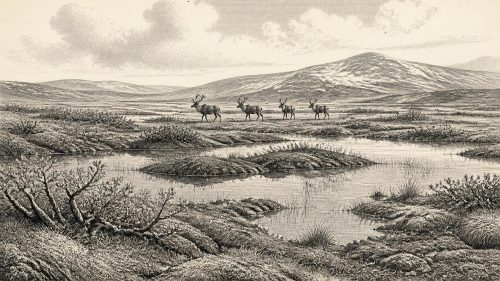
Around 30,442 BCE, Ireland lay in the later Middle Pleniglacial, approaching the Last Glacial Maximum. This calendar label cannot identify events within a single year, as evidence carries broad dating uncertainties. A growing British–Irish Ice Sheet created fluctuating, regionally varied conditions. Derryvree sediments indicate cold freshwater tundra, with wetlands, mosses, sedges and arctic-alpine plants, later buried by advancing ice. Castlepook Cave preserves a complex, time-averaged assemblage including mammoth, reindeer, giant deer, bears, wolves, foxes, lemmings and hyaenas. No secure evidence confirms human occupation; a possibly cut-marked reindeer bone remains inconclusive. Ireland was an environmentally fragmented, intermittently habitable ecological northern margin.

Dateline
30,442 BCE is not a date that can be treated as a year in the ordinary historical sense. It is a modern calendar label, equivalent to roughly 32,391 years before AD 1950, the reference point used for “BP” dating. No excavation, fossil deposit or climatic record can identify events in Ireland within a single calendar year so deep in time. Even the best radiocarbon determinations have uncertainties measured in centuries or millennia, and must be calibrated against changing atmospheric carbon. What can responsibly be said is that this point falls in the later Middle Pleniglacial of the last Ice Age: a period of severe climatic fluctuation before the Last Glacial Maximum transformed much of Ireland beneath expanding ice.
A Landscape Nearing Glaciation
Ireland at this time was not a familiar island of woods, farms and coasts. Sea level was far lower than today because immense quantities of water were locked in continental ice sheets. The Irish Sea and adjacent shelves were correspondingly altered landscapes, while routes between Ireland, Britain and mainland Europe changed repeatedly as water, ice and exposed ground shifted. It would be unsafe to imagine a single permanent land bridge, or a straightforward route that people and animals could use at will. The physical geography of the north-west European margin was dynamic, and local access could be obstructed by sea ice, glacier margins, rivers, wetlands and barren terrain.
The British–Irish Ice Sheet was growing towards its maximum extent. Its detailed early history remains debated: evidence is stronger for the peak and later retreat than for every advance before them. Large modern reconstructions place major growth and decay between about 31,000 and 15,000 years ago, while other work stresses that parts of the wider ice-sheet system had more complicated, earlier histories. Around 30,442 BCE, therefore, Ireland should not be pictured either as uniformly ice-covered or securely ice-free. Conditions differed sharply by region and could change on timescales far shorter than an archaeological period. The most reliable general conclusion is one of mounting glacial pressure on a cold, exposed and environmentally fragmented country.
Derryvree’s Earlier Cold Wetland
The clearest Irish environmental archive relevant to this broad era lies at Derryvree near Maguiresbridge, County Fermanagh. Roadworks there exposed organic silts and fine sands sealed between two thick tills within a drumlin. The deposit produced the radiocarbon determination BIRM-166, 30,500 radiocarbon years BP, with a substantial error range. That is not the same as 30,442 BCE: when calibrated, it represents a considerably earlier and broad calendar interval, rather than a single point in time. Nevertheless, it is crucial evidence for the sort of interlude that could occur in Ice Age Ireland before renewed glaciation buried the landscape.
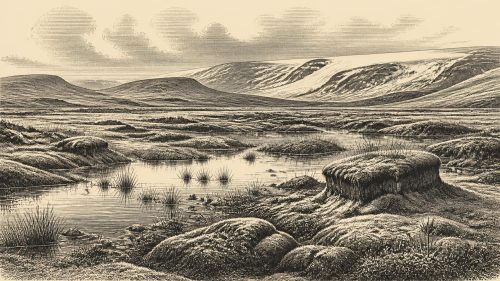
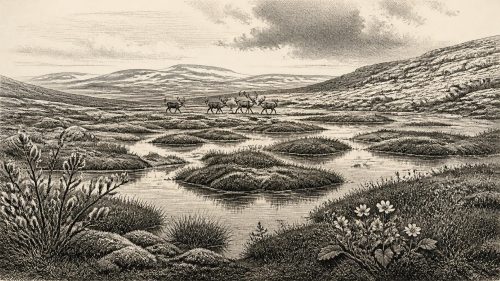
The Derryvree sediments recorded freshwater conditions amid an open, full-glacial tundra. Their plant and animal remains include mosses, sedges and other cold-adapted species, with aquatic and wetland plants such as bogbean and water-milfoil. Dwarf willow, mountain avens and arctic-alpine herbs point to low vegetation rather than woodland. This was not a lifeless snowfield. In the brief growing season, shallow water, muddy margins, mossy ground and herb-rich patches could sustain a varied ecological mosaic. Yet the botanical evidence also indicates a periglacial regime: prolonged cold, frost action, sparse tree cover and a climate in which the ground itself was shaped by freezing and thawing.
Derryvree cannot be projected mechanically across all of Ireland or assigned exactly to this nominal year. It is a local deposit, sampled from a particular basin and preserved by exceptional geological circumstances. Its significance is instead methodological and historical. It demonstrates that, between phases of ice advance, parts of Ireland could contain freshwater wetlands and tundra vegetation capable of supporting animal life. The later till above it records the vulnerability of that world: glacial expansion eventually overran and sealed it.
Castlepook’s Animal Evidence
For the living creatures of southern Ireland in the wider pre-maximum interval, Castlepook Cave near Doneraile in north County Cork is indispensable. Early twentieth-century investigations recovered more than two thousand bones from its passages and chambers, and recent work has returned to the cave in search of undisturbed deposits. The archive is complex. Bones were accumulated through more than one process and at more than one time: carnivores brought prey into the cave, animals died naturally, water redistributed material, and older excavations did not meet modern standards of recovery or recording. The cave is therefore an assemblage to be disentangled, not a photograph of one day’s fauna.
Even with that caution, the fauna establishes an Ice Age Irish environment far richer in large mammals than the later historical island. Castlepook has yielded mammoth, reindeer, giant deer, brown bear, wolf, fox, Arctic fox, hare, both collared and Norwegian lemmings, and the spotted hyaena. A mammoth bone once returned a radiocarbon age of 33,400 ± 1,200 BP, while later direct dating shows that the cave contains material spanning a long portion of the Late Pleistocene. These results support the broad proposition that cold-adapted mammals reached and occupied parts of Ireland during favourable episodes before the glacial maximum. They do not establish that every listed species stood together outside the cave in 30,442 BCE.
The spotted hyaena is particularly revealing. Its presence signals a predator capable of moving, breaking and accumulating bones; some cave remains may represent a den or scavenging site rather than prey taken by people. Mammoth and giant deer likewise evoke an open landscape with adequate forage, but neither proves the precise character of the surrounding vegetation in a particular season. Reindeer are especially compatible with a cold, open setting and mobile herd behaviour. The proper historical picture is not of a stable “Ice Age zoo”, but of animal populations entering, leaving and re-entering a marginal territory as climate, terrain and access changed.
The Human Question
There is no securely dated settlement, hearth, stone-tool assemblage, dwelling, grave or human bone from Ireland that can be assigned to around 30,442 BCE. The National Museum of Ireland accordingly continues to state that clear evidence for Palaeolithic human presence in Ireland has not emerged. This is an important restraint. Hunter-gatherers were present elsewhere in north-west Europe during the Upper Palaeolithic, but their known existence in Britain or continental Europe cannot be converted into a settled Irish population.
A reindeer femur from Castlepook has, however, been reported as bearing a mark interpreted as a cut made with a sharp stone tool. If that reading is confirmed by further microscopic and contextual research, it would be evidence that a person processed an animal carcass in Ireland during the Upper Palaeolithic. It would still not demonstrate a village, repeated occupation, a named group or a year-specific hunt. A mark on a bone records a possible action; the bone’s radiocarbon age dates the animal, not necessarily the moment of cutting. Castlepook’s mixed depositional history makes this distinction especially necessary.
The better-established evidence for humans in Ireland is much later. A butchered brown-bear patella from Alice and Gwendoline Cave, County Clare, has been directly dated to about 12,810–12,590 calibrated BP, during the Younger Dryas. Recent reassessment of that cave also shows how cautious archaeologists must be with old collections: some bones were washed or moved into the cave from above, and a bone-bearing deposit need not be the place where people acted. That lesson applies with greater force to a period almost twenty millennia earlier.
No Polities, But Possible Encounters
There is no evidence from which to reconstruct political affairs, leaders, territories, alliances, warfare or diplomacy in Ireland at this date. Nor are there grounds for describing Irish religion, language, art, education, trade networks or domestic life. Those absences are not minor gaps in a written record; they are the expected condition of an archaeological landscape repeatedly altered by ice, meltwater, erosion and rising post-glacial seas.
If people did reach Ireland intermittently, they would have belonged to highly mobile Upper Palaeolithic hunter-gatherer worlds rather than to states or farming communities. Elsewhere, such people used stone, bone and antler equipment, made decisions about seasonal movement, and relied on detailed environmental knowledge. But that is comparative context, not direct evidence for Ireland. No securely provenanced Irish artefact allows us to identify a camp, a technology or a cultural tradition here around 30,442 BCE.
A Precarious Northern Margin
The economy visible in the evidence is therefore ecological rather than human. Wetland plants drew on brief summer light; herbivores moved through open ground; predators followed prey or used caves as refuges; freshwater pools and stream margins formed local concentrations of life. This was a northern margin in which survival depended on mobility and climatic opportunity. The next major development was not political change but environmental compression, as the expanding ice sheet reorganised drainage, landforms and habitats on a continental scale.
For Ireland, 30,442 BCE is best understood as an approximate waypoint, not an anniversary. Derryvree preserves evidence of a cold freshwater tundra from an earlier dated interval; Castlepook preserves a time-averaged record of Pleistocene animals and an intriguing but unconfirmed possibility of human butchery. Together they illuminate a country on the threshold of severe glaciation: intermittently habitable for specialised plants and animals, perhaps occasionally visited by people, but far beyond the reach of calendar-year political or social history.
Primary Sources
- Middle Midlandian Freshwater Series at Derryvree, Maguiresbridge, County Fermanagh, Northern Ireland
- Palaeoecology
- Castlepook Cave County Geological Site Report
- 2022:564 – Castlepook Cave, Castlepook South, Cork
- Archaeology Research Excavation Grant 2022: Final Report
- Occurrence of Mammalia Relicts at Site Castlepook Cave
- Pleistocene Vertebrates in the British Isles
- Growth and Retreat of the Last British–Irish Ice Sheet, 31,000 to 15,000 Years Ago: the BRITICE-CHRONO Reconstruction
- Pattern and Timing of Retreat of the Last British-Irish Ice Sheet
- Deglaciation Chronology of the Donegal Ice Centre, North-West Ireland
- Radiocarbon Constraints on the Age of the Maximum Advance of the British-Irish Ice Sheet in the Celtic Sea
- Sedimentology and Chronology of the Advance and Retreat of the Last British-Irish Ice Sheet on the Continental Shelf West of Ireland
- Maximum Extent and Dynamic Behaviour of the Last British–Irish Ice Sheet West of Ireland
- The Timing and Magnitude of the British–Irish Ice Sheet Between Marine Isotope Stages 5d and 2
- First Evidence of a Late Upper Palaeolithic Human Presence in Ireland
- New Insights on the Fauna of Ireland’s Younger Dryas and Early Holocene from Alice & Gwendoline Cave
- Prehistoric Details: Mell Flint Flake
- The IntCal20 Northern Hemisphere Radiocarbon Age Calibration Curve (0–55 cal kBP)
- Radiocarbon Dating and Chronological Modelling: Radiocarbon Dating
- Anthropogenic Changes to the Holocene Nitrogen Cycle in Ireland
- The Mesolithic in Ireland: When Was It?