
Derryvree’s Tundra Interval
Approximately 31,733 BCE, Ireland lay within the unstable Late Pleistocene climate of Marine Isotope Stage 3, not a precisely datable historical year. Derryvree, County Fermanagh, preserves freshwater sediments between tills, indicating a cold tundra wetland interval before renewed glaciation. Mosses and sedges suggest open, treeless terrain, while Crag Cave records milder episodes permitting water flow. Castlepook Cave’s mixed fauna, including mammoth, reindeer and hyaena, demonstrates diverse Ice Age habitats but not contemporaneous populations. A cut-marked reindeer femur may indicate brief human activity, although evidence remains insecure. Overall, geological archives reveal changing ice margins, habitats and uncertainty rather than conventional history.
View Record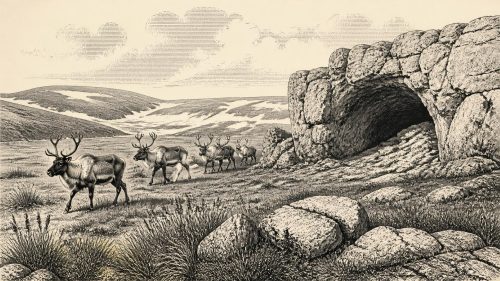
The Awbeg Reindeer Mark
Circa 31,734 BCE, Ireland lay within the climatically unstable Late Pleistocene, not a precisely datable historical year. Ice, changing sea levels and open, locally variable landscapes shaped habitats for reindeer, giant deer, mammoth and spotted hyaena. Castlepook Cave in north Cork preserves important but disturbed animal remains from this period. A radiocarbon-dated reindeer femur bears a linear mark possibly made by a stone tool during butchery, potentially indicating Ireland’s earliest human visit. However, lacking associated tools, hearths or settlements, it cannot demonstrate permanent occupation. The evidence supports a harsh, productive landscape intermittently used by animals and perhaps mobile hunting parties.
View Record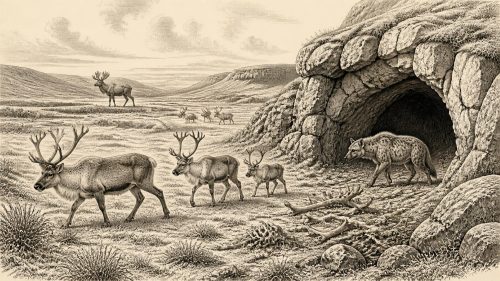
Hyenahall’s Carnivore Archive
About 33,700 calibrated years before 1950, Ireland lay in a cold, unstable MIS 3 landscape preceding maximum glaciation, with some ice-free ground, periglacial conditions and lower sea levels. Derryvree deposits in Fermanagh preserve tundra-like wetland vegetation, demonstrating locally habitable terrain. Castlepook Cave, Cork, contains Ireland’s richest pre-glacial vertebrate archive, including mammoth, reindeer, giant deer, hyaena, wolf and bear, though its time-mixed, carnivore-modified deposits demand caution. A possibly tool-marked reindeer bone suggests, but cannot prove, brief human presence. No political, cultural or settled community is recoverable; fauna instead reveal changing ecological links with north-west Europe during favourable intervals before extensive ice.
View Record
Castlepook’s Faunal Mosaic
Labelled 31,736 BCE, this period cannot be dated in Ireland more closely than later Marine Isotope Stage 3, a climatically volatile phase preceding the Last Glacial Maximum. Evidence from Derryvree and Aghnadarragh indicates shifting environments, including open wetlands, cool-temperate episodes, periglacial ground and changing ice margins. Castlepook Cave preserves a time-depth assemblage of reindeer, mammoth, giant deer, bears, wolves, Arctic foxes, lemmings and hyaenas, demonstrating varied animal communities but not a single contemporaneous fauna. A possibly butchered reindeer bone suggests an Upper Palaeolithic visit, yet no settlement is proven. The record illuminates ecology and glaciation, while precluding year-specific human history.
View Record
Maguirebridge’s Inter-Till Waters
31,737 BCE is a modern label for a Late Pleistocene, MIS 3 interval, not a documented Irish year. Inter-till freshwater sediments at Derryvree, County Fermanagh, reveal an ice-free phase with cold, periglacial wetlands, plants and insects between glacial advances. Southern caves, especially Castlepook in County Cork, preserve evidence of mammoth, reindeer, giant deer, predators and other cold-stage fauna, though deposits span multiple periods. A marked reindeer bone may indicate early human butchery, yet lacks secure context or associated artefacts. Lower sea levels altered routes, while advancing ice created a volatile ecological frontier. Permanent occupation, polities and Irish identities remain unproven.
View Record
Derryvree and Castlepook
About 31,738 BCE, Ireland was a climatically unstable Late Pleistocene landmass, not a modern island with documented annual history. Derryvree, County Fermanagh, preserves freshwater sediments between glacial tills, showing an ice-free, cold wetland interval with open, treeless vegetation. Crag Cave, Kerry, records milder episodes through stalagmite growth. Castlepook Cave, Cork, contains a long, disturbed faunal archive including mammoth, giant deer, reindeer, bear, wolf, Arctic fox, lemmings and hyaena. A cut-marked reindeer femur may indicate early human carcass processing, but lacks secure context. Evidence demonstrates changing environments and animals, not settled communities, politics or culture at that precise nominal date, however.
View Record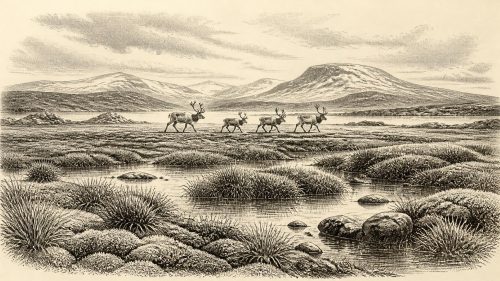
Fermanagh’s Buried Bogbean
Around 31,739 BCE, Ireland lay within the climatically unstable Late Pleistocene MIS 3, before the Last Glacial Maximum. Derryvree, County Fermanagh, preserves freshwater sediments between glacial tills, indicating cold, open wetland landscapes with sedges, mosses, bogbean and Arctic-alpine plants during an interglacial interval. Southern caves, notably Castlepook and Shandon, contain remains of mammoth, reindeer, giant deer, predators and other Ice-Age fauna, although their deposits span millennia. A cut-marked Castlepook reindeer femur may indicate brief human handling of carcasses, but no securely associated tools, hearths or settlements exist. Ireland’s evidence therefore documents dynamic environments and animals, while human occupation remains unproven.
View Record
Doneraile’s Reindeer Incision
At approximately 31,740 BCE, Ireland lay within the fluctuating cold conditions of Marine Isotope Stage 3, before the last British–Irish Ice Sheet reached its greatest extent. Castlepook Cave near Doneraile preserves remains of mammoth, reindeer, giant deer, hyaena, lemmings and other fauna, indicating open, largely treeless habitats. An incised reindeer femur may record processing with a stone tool and therefore a Upper Palaeolithic human visit. However, old excavation context and absence of associated tools or settlement prevent certainty. The evidence neither proves permanent occupation nor later ancestry. Ice and seas obscured traces; later human activity is confirmed in County Clare.
View Record
Castlepook’s Stone-Edge Question
31,741 BCE is a modern label for an uncertain Late Pleistocene interval, not a recordable Irish year. Castlepook Cave, County Cork, produced a reindeer femur dated broadly around 33,000 years ago, whose deep fresh-bone incision may represent stone-tool butchery. If confirmed, it would be Ireland’s earliest evidence of human contact, though excavation methods, mixed cave deposits and carnivore activity prevent stronger conclusions. Fauna indicate a cold, varied landscape of tundra, herbivores and predators. Derryvree sediments document ice-free periglacial wetlands during the wider period. Approaching ice-sheet expansion constrained possible mobile visitors; no settlement, society, route or repeated occupation is securely demonstrated.
View Record
Castlepook’s Deep Incision
31,742 BCE is a modern label, not a precise Irish date; the relevant setting is later Marine Isotope Stage 3, before glaciation. Ireland was a cold, unstable, open landscape with changing ice margins, lower seas and Pleistocene fauna. Castlepook Cave, County Cork, preserves reindeer, mammoth, giant deer, hyaena and remains, although antiquarian excavation and disturbed deposits limit interpretation. A reindeer femur, roughly 33,000 years old, bears a mark possibly made by a stone tool during butchery. If confirmed, it may be Ireland's earliest human trace, indicating brief activity rather than settlement. Further stratified excavation, dating and taphonomic study are required.
View Record