
Derryvree’s Pre-Ice Wetlands31318 BCE
31,318 BCE is a modern label within an uncertain MIS 3 interval, not a recoverable Irish historical year. At Derryvree, County Fermanagh, freshwater organic sediments between glacial tills record an ice-free phase, broadly 36,900–31,700 calibrated years BP. Fossils indicate cold, treeless, wet tundra-like ground, while successive ice advances and retreats made conditions regionally variable. Southern cave deposits show that diverse Ice Age mammals reached Ireland over MIS 3. A cut-marked Castlepook reindeer bone may indicate brief human activity, but proves neither settlement nor continuous occupation. Lower seas changed coastlines, yet travel routes remain uncertain. Later glaciation destroyed or buried evidence.
Dateline
31,318 BCE is a modern calendar label, not a year that can be recovered from Ireland’s Late Pleistocene evidence. There were no written records, named polities, calendars or securely dated annual archaeological layers from which an event in that particular year could be identified. In archaeological usage, the equivalent point lies roughly 33,268 years before AD 1950, within Marine Isotope Stage 3 (MIS 3), a climatically unstable stretch of the last Ice Age. That calculation must not be mistaken for precision: radiocarbon measurements from this depth of time require calibration, and their resulting calendar ranges commonly extend across centuries or millennia.
The responsible subject is therefore an interval rather than an anniversary. Around the notional date, the landmass now called Ireland was part of a changing north-west European world of cold climates, moving ice margins, lower global sea levels and open habitats. Its modern coastlines, political geography and familiar wooded appearance did not exist. The evidence is sparse, local and unevenly preserved, but it is sufficient to rule out two misleading extremes: Ireland was neither a green, settled country nor a permanently uniform sheet of ice throughout this phase of the last glacial cycle.
A Date Within a Range
The best Irish environmental evidence close to this horizon comes from Derryvree townland, near Maguiresbridge in County Fermanagh. Road works in 1969 cut through a drumlin and revealed an exceptional sequence: freshwater silts and fine sands, including organic material, caught between two thick layers of till. Till is the unsorted sediment deposited directly by glacier ice. The order of the deposits is decisive. An earlier glacial episode formed the lower till; water, sediment and living things then accumulated during an ice-free interval; a later advance buried the evidence under fresh glacial debris. The later ice both remodelled the landscape and, paradoxically, helped preserve this small window into an earlier one.
The Derryvree organic material produced the radiocarbon determination Birm-166: 30,500 radiocarbon years BP, with a substantial laboratory uncertainty of +1,170 and −1,030 years. The original investigators described a freshwater series whose flora and fauna indicated open tundra vegetation and a periglacial climatic regime. Subsequent discussion has placed the material broadly within about 36,900–31,700 calibrated years BP. The nominal date of 31,318 BCE falls within that broad environmental range, but no part of the deposit can be assigned to that individual year. It dates a natural archive accumulated over time, not a recorded episode in human history.
Wet Ground in a Cold Country
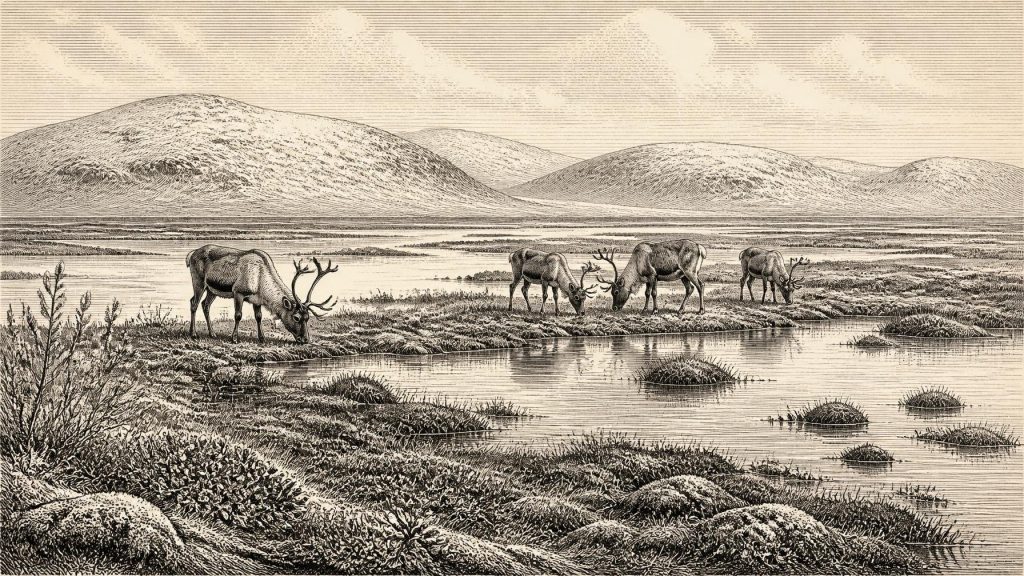
Derryvree gives the clearest picture of conditions in one locality, not a complete map of the island. Its plant fossils, pollen and associated remains indicate a largely treeless, open landscape shaped by severe cold, frost action and short growing seasons. The old term muskeg is useful if handled carefully: it evokes wet, mossy and sedge-rich ground with shallow water, organic mud and pools, rather than a featureless plain of snow. Plants represented in the deposit include bogbean, dwarf willow, lesser clubmoss and mountain avens, species well suited to cold, open or wet conditions. Their presence shows that life persisted in the Fermanagh locality; it does not mean that every Irish valley bore the same vegetation at the same moment.
Such ground could have been seasonally productive. During the brief warmer part of the year, wetland margins may have supported aquatic plants, insects and grazing animals, while exposed mineral soils and low vegetation occupied drier patches. In winter, frozen ground, snow cover and sharp winds would have imposed severe constraints. There is no evidence here for the oak, hazel, elm or ash woods of much later prehistory. Sparse tree pollen in a sediment sequence cannot, by itself, demonstrate local woodland, since pollen may travel far on the wind or be redeposited. The sound conclusion is a cold, open and locally wet landscape, not a detailed reconstruction of each season’s weather.
Ice, Water and an Unsettled Landscape
The setting was dynamic. Derryvree’s two tills prove glacial activity before and after the freshwater interval, while wider Irish and British–Irish research shows that ice-sheet growth and retreat were not simple, one-way processes. The conventional Last Glacial Maximum, when the final ice sheet reached its greatest extent, came later, broadly around 27,000–23,000 calibrated years BP in Ireland and its offshore shelf. Yet the precise history before that maximum remains debated. Recent work argues that substantial British–Irish ice may have developed earlier in the last cold stage, with advances and retreats during MIS 3; other reconstructions emphasise the much better-dated large expansion during MIS 2.
For 31,318 BCE, this means that no single statement about ice cover across all Ireland is secure. Derryvree demonstrates ice-free ground in its own dated interval, whereas the enclosing tills record the capacity of later or earlier ice to cross the district. Raised beaches and glacial sediments on southern coasts, offshore records and landforms elsewhere add evidence, but their dating is uneven. The island’s physical history should be understood as regional and changing: inland basins, uplands, coastal margins and the continental shelf did not necessarily experience identical conditions.
Animals at Ireland’s Edge
Cave deposits, especially in southern Ireland, add a second line of evidence. The Irish Quaternary Fauna Project showed that a varied mammal fauna reached Ireland between at least about 45,000 and 20,000 years ago. Castlepook Cave, near Doneraile in north County Cork, is particularly important because it has yielded remains attributed to reindeer, woolly mammoth, giant deer, brown bear, wolf, Arctic fox, mountain hare, lemmings and spotted hyaena. The National Museum of Ireland’s collections include a Castlepook spotted-hyaena skull, a tangible reminder that carnivores as well as herbivores occupied parts of this cold-stage world.
These animals must not be assembled into an imaginary herd roaming together in 31,318 BCE. Castle deposits often combine bones accumulated over very long periods. Predators drag prey into caves; scavenging, gnawing, water movement, sediment disturbance and early excavation can mix material. Direct redating has also shown that several older Irish cave determinations required revision, pushing some Castlepook fauna thousands of radiocarbon years further back than formerly believed. The firm point is that Ireland supported, at different times during MIS 3, an Ice Age fauna far richer than the later post-glacial island. The precise composition of an animal community in any one year remains unknown.
The Reindeer Bone Question
Castlepook has a possible human significance as well. A reindeer femur from the cave bears a deep incision interpreted by zooarchaeologist Ruth Carden as a cut made with a sharp stone tool during carcass processing. County Cork heritage material has presented the object as evidence of Palaeolithic activity at about 31,000 BC. If that interpretation is upheld, it would indicate that people reached Ireland far earlier than the formerly accepted post-glacial settlement record. It would fit a broader European picture in which mobile Upper Palaeolithic hunter-gatherers followed opportunities created by animal movements and changing climates.
However, the evidence must be described at its proper scale. The dated bone is not a settlement, a camp, a household or a population census. No securely associated hearth, stone-tool assemblage, dwelling surface, burial, food store or repeated butchery area has been identified at Castlepook for this period. Nor can the age of the animal bone establish the exact day or even generation in which the cut was made. The cave’s complex antiquarian excavation history adds further caution. The most that can responsibly be proposed is a possible brief human visit or visits, perhaps connected with reindeer processing, within a broad late MIS 3 horizon.
No Polities, No Proven Diplomacy
There is no evidence for political affairs, diplomacy, warfare, religion, formal learning, trade institutions or permanent settlements in Ireland at this date. It would be anachronistic to supply them with invented tribes, chiefs, rituals or territorial boundaries. If people did enter the island, they would have been small, highly mobile hunter-gatherer groups rather than farmers or inhabitants of villages. Their economy would have depended on knowledge of animals, weather, fuel, shelter and routes through a hazardous environment. Reindeer, if available, offered potential meat, marrow, hide, sinew, antler and bone; but Castlepook does not reveal which resources were taken from the individual represented by the femur.
Lower global sea levels altered the shape of the surrounding coasts, but this did not necessarily create a simple, permanent land bridge between Ireland and Britain. The Irish Sea basin, local ice, changing relative sea level and poorly known palaeoshorelines make routes difficult to reconstruct. Animals and perhaps people nevertheless reached the landmass at different points in the Pleistocene. Whether passage occurred across exposed coastal plains, shortened sea crossings, seasonal ice or a combination of routes cannot presently be decided from the Irish evidence.
A Fragile Record
The most important development around 31,318 BCE was environmental, not political: Ireland occupied a precarious place near the western edge of habitable Ice Age Europe. Derryvree records cold freshwater wetlands and tundra-like vegetation during an ice-free interval in Fermanagh. Castlepook and other caves demonstrate that large mammals had reached Ireland over the wider MIS 3 period. A single marked reindeer bone raises the possibility of an exceptionally early human presence, but cannot prove continuous occupation or a settled society.
Later glaciation probably removed, buried or reworked much of the evidence that might have clarified the picture, especially camps on low ground and former coasts. That taphonomic loss explains why the record is slight, but it cannot justify filling the silence with stories. Ireland at this remote point is known through strata, fossils, radiocarbon determinations and one debated trace of butchery. Their message is modest but compelling: a cold, open, wet and changeable landscape sustained life at the margin of the ice, long before the island’s enduring human settlement, agriculture, monuments or written history.
Primary Sources
- A Middle Midlandian Freshwater Series at Derryvree, Maguiresbridge, County Fermanagh, Northern Ireland
- A reconsideration of the radiocarbon dating of the Marine Isotope Stage 3 fauna from southern Ireland
- The Irish Quaternary Fauna Project
- New insights on the fauna of Ireland's Younger Dryas and Early Holocene from Alice & Gwendoline Cave
- First evidence of a Late Upper Palaeolithic human presence in Ireland
- Growth and retreat of the last British–Irish Ice Sheet, 31,000 to 15,000 years ago: the BRITICE-CHRONO reconstruction
- Timing, pace and controls on ice sheet retreat: an introduction to the BRITICE-CHRONO transect reconstructions of the British–Irish Ice Sheet
- The timing and magnitude of the British–Irish Ice Sheet between Marine Isotope Stages 5d and 2
- Late Pleistocene chronostratigraphy and ice sheet limits, southern Ireland
- Radiocarbon constraints on the age of the maximum advance of the British-Irish Ice Sheet in the Celtic Sea
- Trimlines, blockfields and the vertical extent of the last ice sheet in southern Ireland
- Ireland: Submerged Prehistoric Sites and Landscapes
- The Quaternary of South Fermanagh
- The Quaternary of County Limerick and the Shannon Estuary
- Quaternary Geological Map of Ireland
- Quaternary
- Spotted Hyena Skull
- BSBI: Menyanthes trifoliata
- BSBI: Salix herbacea
- BSBI: Selaginella selaginoides
- BSBI: Dryas octopetala
- The Mesolithic in Ireland: when was it?
- Could brown bears (Ursus arctos) have survived in Ireland during the Last Glacial Maximum?
- The colonization of Ireland: A human ecology perspective