Cork’s Pre-LGM Reindeer31317 BCE
About 33,300 years ago, Ireland was in Marine Isotope Stage 3, shortly before Last Glacial Maximum ice cover reshaped the island. Southern caves, especially Castlepook in north Cork, preserve remains of reindeer, mammoth, giant deer, hyaena and fauna, indicating cool, open habitats. Lower sea levels altered coastlines and may have facilitated animal and human movement. A cut-marked reindeer femur may represent Ireland’s earliest evidence of human carcass processing, but it proves neither settlement nor hunting. Dating remain uncertain. Later glaciation and rising seas destroyed or submerged evidence, leaving a record of a fauna-bearing landscape and possible human visits to Ireland.
Dateline
What is called 31,317 BCE cannot be treated as a historical year in the usual sense. Nobody in Ireland recorded a calendar, named a ruler or dated an event then. The label is a modern, proleptic conversion: it corresponds broadly to c. 33,266 years before the conventional radiocarbon reference year of AD 1950, or c. 33.3 thousand calendar years before present. That arithmetic is useful for locating the period, but it does not give modern calendar-year precision. Evidence from this depth of time is dated in calibrated ranges, often with margins of centuries or millennia, and must be read as evidence for changing environments and occasional animal or human activity rather than an annal for one year.
Before the Ice Sheet’s Maximum
At this approximate point Ireland lay within the Late Pleistocene, specifically Marine Isotope Stage 3, during the last glacial cycle. It was not yet in the fullest phase of the Last Glacial Maximum. A widely used synthesis places the build-up of the British–Irish Ice Sheet after roughly 35–32 ka, with maximum extent later, around 27–21 ka. Other studies likewise place the island’s most extensive Late Glacial ice cover substantially after the period represented by this article. The important conclusion is chronological rather than dramatic: c. 33.3 ka was a threshold before the later advance transformed Ireland’s landscapes under ice.
That does not mean a mild or stable country. Marine Isotope Stage 3 included marked climatic oscillations across the North Atlantic world. Ireland’s weather, vegetation and coastlines cannot be reconstructed season by season, or even securely for every region at precisely this moment. Yet geological and palaeontological evidence indicates that parts of the island could support large mammals during warmer intervals before the maximum glaciation. A modern study of Ireland’s environmental history summarises the broad pattern by placing the island’s final ice-free conditions until about 32,000 calibrated years before present, before comprehensive glaciation during the Last Glacial Maximum. The proximity of c. 33.3 ka to that transition is precisely why local variation and chronological caution matter.
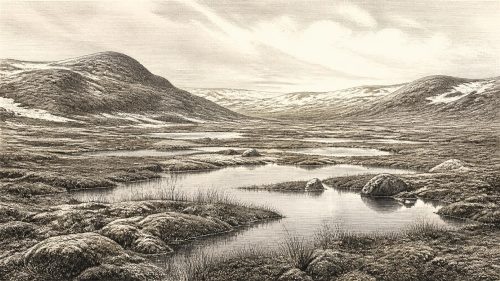
An Open, Mobile Landscape
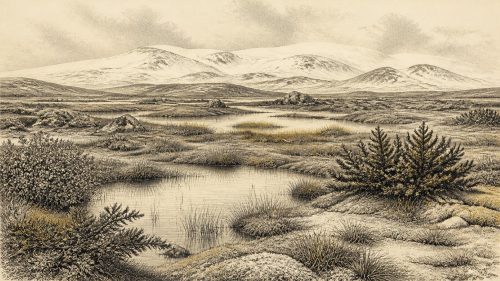
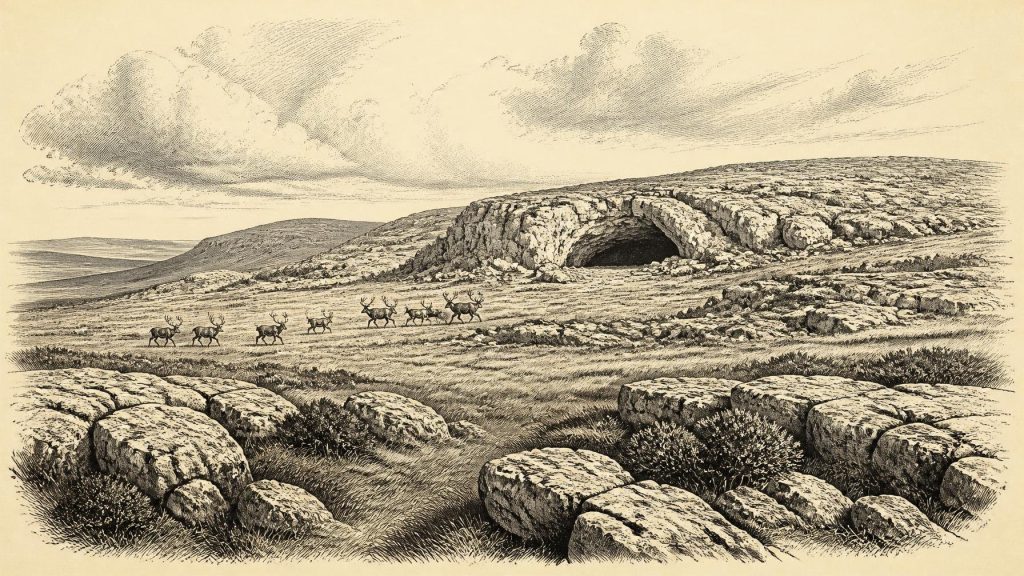
The country would not have resembled modern green Ireland. The best direct clues come from fossil animals, sediments and later glacial landforms, rather than from surviving settlements. The southern limestone caves of Cork and Waterford have yielded evidence for a Pleistocene fauna including reindeer, woolly mammoth, giant deer, brown bear, wolf, fox, Arctic fox, hare, lemmings and spotted hyaena. These animals did not necessarily all live together at Castlepook at one instant: cave deposits accumulated over long periods, were disturbed by animals and water, and were excavated in the early twentieth century before modern stratigraphic standards. They nevertheless demonstrate that Ice Age Ireland at different times supported a far richer large-mammal community than the island does now.
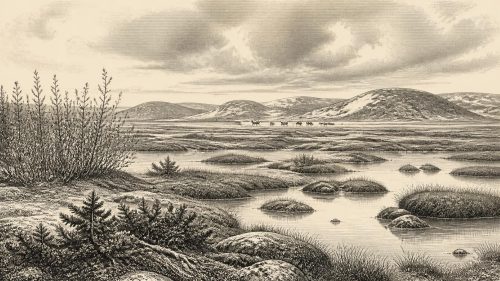
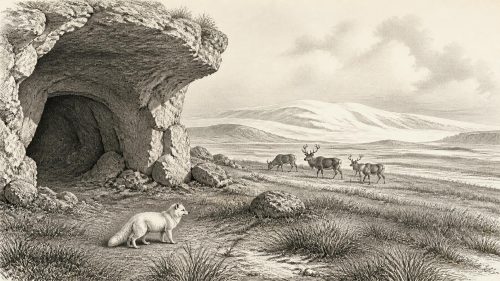
Reindeer are particularly evocative, but they should not be imagined as proof of a uniform, treeless tundra from coast to coast. Their presence supports an interpretation of cool, open or broken terrain with seasonal forage and room for mobile herds. Mammoth, giant deer and predators point towards extensive habitats rather than dense closed woodland. Caves offered shelter to carnivores and traps for bones; they were not necessarily places where the animals died or where people lived. At Castlepook, near Doneraile in north Cork, hyaena remains and other fossils make the cave an archive of animal movement, scavenging and den use as much as of the surrounding landscape. The National Museum of Ireland regards it as the country’s most important site for mammal remains from the last cold stage.
Sea level was lower than today because enormous volumes of water were stored in ice sheets. Ireland’s coastal outline was therefore different, with land now submerged forming part of the wider western European landscape. Lower sea level made movement between Ireland, Britain and continental Europe more feasible at some stages, but the exact routes available at c. 33.3 ka remain uncertain. One should not picture a known road-like land bridge or assume regular crossings. The responsible conclusion is more limited: animal populations reached Ireland during the Pleistocene, and any human visitors would have travelled through a changing landscape whose present shorelines are misleading guides.
The Castlepook Question
The strongest reason to discuss human history at all for this period is a reindeer femur from Castlepook Cave, also known as Mammoth Cave. County Cork heritage material describes the bone as c. 31,000 BC and identifies a deep incision as a mark made by a sharp stone tool during butchery. If that assessment is correct, it is potentially Ireland’s earliest evidence that people handled an animal carcass. It would push the island’s human story far beyond the long-established evidence for post-glacial settlement.
Its importance requires equal care. The age commonly attached to the specimen is an approximate age for the bone, not a date for the cutting action to a particular calendar year. Nor does a single marked limb bone prove that people occupied the cave, founded a camp, hunted the reindeer themselves, or remained in Ireland. The animal may have been processed elsewhere; carnivores could have carried or disturbed remains; and the cave’s earlier excavations created complex, incompletely documented collections. There is no securely associated hearth, stone-tool assemblage, dwelling floor, burial, human bone or occupation surface that can demonstrate a settled Upper Palaeolithic community at Castlepook.
The caution is not merely theoretical. Re-dating research has shown that older Irish cave radiocarbon results can change substantially when improved pretreatment methods are used. At Castlepook, revised results for some samples were 5,000 to 12,000 radiocarbon years older than earlier determinations. Recent fieldwork has therefore sought surviving Pleistocene deposits in both the upper and lower cave systems, rather than relying wholly on antiquarian finds. The 2022 excavation located sediments with further potential, but it did not convert the cave into a proven settlement site.
People, If Present
The most defensible interpretation is modest. If the incision is anthropogenic and broadly contemporary with the animal, a small, mobile group used a sharp stone edge in connection with a reindeer carcass. Such a group could have removed meat, hide, sinew or marrow, but the bone alone cannot reveal which materials were taken, whether the reindeer was hunted, or how many people were involved. Their stay may have been brief. They cannot responsibly be assigned an Irish ethnic identity, a language, a named archaeological culture or a line of descent to later inhabitants.
Context from north-west Europe makes a human visit plausible but does not supply missing Irish evidence. Homo sapiens were established elsewhere in Europe by this broad period, and Upper Palaeolithic hunter-gatherers elsewhere made sophisticated stone and organic tools, travelled widely and used animal resources intensively. None of that establishes comparable camps, art, clothing styles or technologies in Ireland. The National Museum of Ireland’s general prehistoric overview still stresses that no clear Palaeolithic human presence has emerged from the Irish archaeological record; the Castlepook bone should therefore be understood as an important claim under investigation, not as a licence to fill the island with imagined hunters.
No Politics to Recover
There is no evidence from Ireland around this date for political institutions, chiefs, kingdoms, diplomacy, law or organised warfare. There is likewise no direct evidence for farming, permanent villages, trade goods, ritual monuments, formal religion, writing, teaching or artistic production. These absences are not signs that people lacked social lives or beliefs; they reflect the severe limits of the evidence. If visitors were present, they almost certainly depended on co-operation, shared knowledge of animals and terrain, and practical skill. But the scale, organisation and cultural meanings of those activities cannot be recovered from one possible cut mark and a scattered cave fauna.
Economically, the visible world is principally an animal economy rather than an agricultural one. Reindeer were valuable potential sources of food and raw materials; large herbivores also shaped the movements of predators and scavengers. Ecologically, the Castlepook assemblage hints at a connected community of grazers, browsers and carnivores operating in southern Ireland before the later ice advance. It does not supply evidence for exchange networks or seasonal territories. The cave provides snapshots of biological presence, not a map of ownership or a record of commerce.
A Landscape Later Erased
The later British–Irish Ice Sheet is central to why this period is so difficult to see. Subsequent ice advance eroded, transported and buried deposits, while later sea-level rise drowned large areas of former lowland. The eskers, drumlins, U-shaped valleys and other glacial features visible in Ireland today chiefly record the power of those later ice movements, not the precise landscape of c. 33.3 ka. Even so, they establish the scale of environmental change that followed: a habitable, fauna-bearing landscape in at least some areas gave way to conditions in which extensive ice ultimately dominated the island.
For this approximate year, then, Ireland’s history is not the history of an event but of a precarious window before the Last Glacial Maximum. The evidence securely illuminates an Ice Age environment in southern Ireland, a varied fauna and the possibility that people briefly processed reindeer there. It does not justify a year-specific narrative of settlement or society. Castlepook’s marked bone remains valuable precisely because it makes that distinction sharper: it may be the faintest human trace, preserved in a cave, on the edge of a landscape soon to be remade by ice.
Primary Sources
- A reconsideration of the radiocarbon dating of the Marine Isotope Stage 3 fauna from southern Ireland
- The Irish Quaternary Fauna Project
- The Exploration of Castlepook Cave, Co. Cork
- Occurrence of mammalia relicts at site Castlepook Cave
- 2022:564 – Castlepook Cave, Castlepook South, Cork
- Heritage Artefacts of County Cork
- Spotted Hyena Skull
- Ice Age Ireland
- Prehistoric Details
- Extent and timing of the Last Glacial Maximum (LGM) in Britain and Ireland: a review
- Pattern and timing of retreat of the last British-Irish Ice Sheet
- Timing and pace of ice-sheet withdrawal across the marine-terrestrial transition west of Ireland during the last glaciation
- Late Pleistocene chronostratigraphy and ice sheet limits, southern Ireland
- Early deglaciation of the British-Irish Ice Sheet on the Atlantic shelf northwest of Ireland driven by glacioisostatic depression and high relative sea level
- New data for the Last Glacial Maximum in Great Britain and Ireland
- Stratigraphic and palaeo-geomorphological evidence for the glacial-deglacial history of the last British-Irish Ice Sheet in the north-western Irish Sea
- Anthropogenic changes to the Holocene nitrogen cycle in Ireland
- Stoats (Mustela erminea) provide evidence of natural overland colonization of Ireland
- Ireland through geological time
- Quaternary
- New insights on the fauna of Ireland’s Younger Dryas and Early Holocene from Alice & Gwendoline Cave