

The Doneraile Reindeer Mark31322 BCE
31,322 BCE is a modern label for a Late Pleistocene interval, best understood through uncertain dated ranges rather than year-specific history. Derryvree silts in Fermanagh indicate cold, treeless tundra-like wetlands, while Castlepook Cave, County Cork, preserves fauna including reindeer, mammoth, giant deer and predators. A reindeer femur bears a possible fresh-bone stone-tool incision, potentially indicating Upper Palaeolithic human activity. However, disturbed cave contexts and absent associated hearths, tools or settlements prevent stronger conclusions. Ireland was varied as ice expanded, with traces often erased by glaciation. No community, polity, culture or occupation is proven; humans remain a plausible but unconfirmed presence.
Dateline
31,322 BCE is a modern chronological label, not a year that anyone in Ireland could have named, recorded or experienced through a fixed calendar. At this depth of time, archaeology cannot identify a particular event, person, season or generation. The date falls broadly around 33,270 calendar years before AD 1950, within the Late Pleistocene and Marine Isotope Stage 3 (MIS 3), a climatically unstable part of the last Ice Age. The responsible way to approach Ireland at this point is therefore through dated ranges, deposits and probabilities rather than a year-specific narrative.
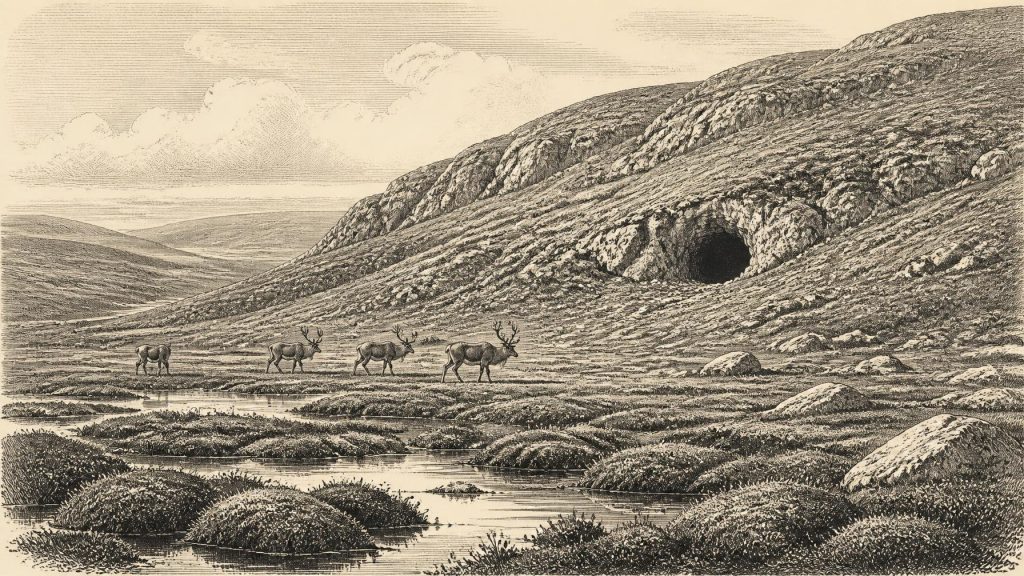
The most relevant evidence comes from two very different Irish archives. In north County Cork, Castlepook Cave near Doneraile has produced a remarkable collection of Ice Age animal bones, including reindeer, woolly mammoth, giant deer, brown bear, wolf, Arctic fox, lemmings and spotted hyaena. In County Fermanagh, organic silts preserved beneath a drumlin at Derryvree retain pollen, plant remains and insects from a cold, open landscape. Together they show that parts of Ireland could support life before the major expansion of the last British–Irish Ice Sheet. They do not, however, provide a history of an Irish people, polity or settlement in 31,322 BCE.
A Date Measured in Ranges
Modern BCE arithmetic should not be confused with a radiocarbon measurement. Radiocarbon ages are expressed in years before present, where “present” conventionally means AD 1950, and must be calibrated against curves that account for past changes in atmospheric carbon. At around 33,000 calendar years ago, the relationship between a laboratory radiocarbon age and a calendar age is neither simple nor precise to a single year. Even an excellent bone date normally yields a probability range, while deposits may contain material accumulated over centuries or millennia.
The Derryvree freshwater sediments are particularly useful for setting a securely discussed Irish range. Their radiocarbon result of 30,500 ± 1,200 radiocarbon years BP has been calibrated to approximately 36,900–31,700 calendar years BP. The notional date of 31,322 BCE lies near the younger end of that broad interval. This does not mean that Derryvree was a lakeshore visited on that particular year, nor that every animal from Castlepook was alive at the same time. It means that the environmental evidence is relevant to the world in which this nominal date belongs.
The Cave and Its Reindeer
Castlepook Cave, sometimes called Mammoth Cave, is the principal southern Irish archive for the fauna of this part of the Ice Age. Its importance rests partly on the great age of some individual bones and partly on the mixture of species carried into, preserved within, or exposed by the cave. Earlier investigations were undertaken before the stratigraphic standards expected today. Bones were removed from chambers, sands and rubble with limited contextual recording; cave deposits could also have been disturbed by water, frost, collapse, burrowing animals and carnivores. A cave is not automatically a human dwelling. It may be a den, scavenging site, trap, shelter, sediment store and natural bone archive in successive periods.
One reindeer femur from the old Castlepook collection has become exceptionally important. Zooarchaeologist Ruth Carden has interpreted a deep mark on it as an incision or chopping trace made with a sharp stone implement while the bone was fresh. Public heritage material places the bone broadly at about 31,000 BC, and its reported age has made it a possible indication of Upper Palaeolithic human activity in Ireland. If the interpretation is sustained, it would show that a person used a stone edge on a reindeer carcass in Ireland tens of millennia before the securely established post-glacial settlement record.
That is a substantial but deliberately narrow conclusion. The bone’s date is the age of the animal, not necessarily the exact instant at which the mark was made. The mark itself is a specialist taphonomic judgement, separate from radiocarbon dating. Nor is there a securely associated hearth, stone-tool assemblage, dwelling floor, burial, refuse deposit or repeatedly used processing place at Castlepook of comparable age. The femur does not establish whether people killed the reindeer, encountered a carcass, removed meat or hide, extracted marrow, or processed the animal elsewhere before a carnivore carried the bone into the cave.
An Open, Harsh Landscape
The Derryvree deposits provide the best direct picture of northern Irish conditions within the relevant broad interval. Plant macrofossils, pollen, mosses and beetles point to treeless tundra or muskeg: a wet, cold landscape with open pools, sedges, grasses, herbs, mossy ground and very sparse dry-land vegetation. Finds have included plants associated with cold environments, among them bogbean, water-milfoil, mountain avens, willow and juniper. The evidence is not a photograph of the whole island. It represents one basin in Fermanagh, and pollen can travel farther than the plants that produced it. Yet it firmly rules out a familiar modern Irish scene of woodland, enclosed pasture and settled farms.
Conditions fluctuated markedly through MIS 3. Greenland ice cores and North Atlantic records show repeated shifts between colder stadials and relatively milder interstadials. Ireland was affected by this wider North Atlantic system, though local terrain, ice and water made its response uneven. At Derryvree, the freshwater layer was later sealed beneath glacial till, showing that an ice advance followed the interval in which its plants and insects lived. Research on ice-sheet development indicates that north-central Ireland remained ice-free until at least about 34,000 years ago, but ice was building in the wider British–Irish region by the time represented by the early thirty-first millennium BCE.
It would be misleading, therefore, to imagine either a wholly ice-covered Ireland or a uniformly habitable island. Ice fields and glaciers could occupy uplands and northern sectors while lowland basins, coasts and southern limestone country offered very different conditions. Later glacial erosion, deposition and sea-level change have removed or buried many possible traces. The scarcity of archaeological evidence is itself partly a product of this destructive geological history, though erosion cannot turn an absence of camps, tools and human remains into proof that they once existed.
Animals, Food and Risk
The Castlepook fauna demonstrates that sizeable herbivores and formidable predators used Irish landscapes at different points in the later Ice Age. Reindeer are especially important because they prosper in open northern environments and because their meat, hide, sinew, antler and bone were valuable resources to Upper Palaeolithic communities elsewhere in Europe. Woolly mammoth and giant deer indicate that some areas could sustain large grazing animals, while hyaena, wolf and bear reveal a carnivore guild capable of scavenging, competing for carcasses and dragging bones into caves. Arctic fox and lemmings add to the evidence for cold-adapted habitats.
The assemblage must not be read as one simultaneously roaming herd or as an inexhaustible hunting ground. Castlepook’s dated bones span long periods; species survived, arrived, disappeared and returned under changing conditions. A carcass would have been an unpredictable and contested resource. If people did process the marked reindeer femur, they operated in a landscape where cold exposure, limited fuel, shifting routes, carnivores and highly seasonal food supplies imposed severe constraints. The most that can responsibly be inferred is the possibility of a small, mobile party with a cutting tool and knowledge of animal anatomy.
No Polities, No Proven Community
There is no evidence for political affairs, warfare, diplomacy, named territories, leadership, law or collective institutions in Ireland at this date. There are no settlements from which population size, social rank or household organisation can be reconstructed. Neither language, ancestry nor a migration route can be recovered from the Castlepook femur. Even if a person or small group reached the island, their relationship with communities in Britain or continental Europe remains unknown. Lower sea levels altered coastlines and exposed areas now submerged, but the precise practical route of any human journey to Ireland at this time has not been demonstrated archaeologically.
Religion, ritual, art and learning are equally beyond the Irish evidence. Upper Palaeolithic peoples elsewhere in Europe made sophisticated stone and organic tools, ornaments and art, maintained social connections over considerable distances, and in some regions practised elaborate burial rites. Such comparisons establish what contemporary Homo sapiens societies were capable of; they do not demonstrate that those practices occurred at Castlepook. No Irish object, image, burial or ceremonial location can be attributed to 31,322 BCE.
The Meaning of One Mark
The Doneraile reindeer mark matters precisely because it is so slight. A single modified bone, if confirmed, would transform the chronology of possible human activity in Ireland. Yet its value lies in prompting better questions rather than licensing a complete origin story. Was the animal butchered by a brief visiting party? Did people follow reindeer through an open, changing world? Can newly excavated, stratified cave sediments provide a tool, hearth or a second unequivocally modified bone? Ongoing research at Castlepook is directed towards such evidence.
For now, Ireland around this nominal year is best understood as a varied Ice Age landscape rather than an early nation. Its most securely visible inhabitants are plants, insects and animals, preserved in wetland silts and limestone caves. Humans remain a compelling possibility centred on one reindeer femur, not a proven resident population. That distinction is not a weakness in the story. It is the essential discipline required by deep prehistory.
Primary Sources
- A reconsideration of the radiocarbon dating of the Marine Isotope Stage 3 fauna from southern Ireland
- The Irish Quaternary Fauna Project
- Trimlines, blockfields and the vertical extent of the last ice sheet in southern Ireland
- Exploring controls of the early and stepped deglaciation on the western margin of the British Irish Ice Sheet
- Growth and retreat of the last British–Irish Ice Sheet, 31,000 to 15,000 years ago: the BRITICE-CHRONO reconstruction
- Growth and retreat of the last British–Irish Ice Sheet, 31,000 to 15,000 years ago: the BRITICE-CHRONO reconstruction
- Dimensions and chronology of the last ice sheet in Western Ireland
- Pattern and timing of retreat of the last British-Irish Ice Sheet
- Stratigraphic and palaeo-geomorphological evidence for the glacial-deglacial history of the last British-Irish Ice Sheet in the north-western Irish Sea
- Red deer (Cervus elaphus) in Ireland: genetic and osteological evidence of human-mediated translocations
- First evidence of a Late Upper Palaeolithic human presence in Ireland
- New insights on the fauna of Ireland's Younger Dryas and Early Holocene from Alice & Gwendoline Cave
- The IntCal20 Northern Hemisphere Radiocarbon Age Calibration Curve (0–55 cal kBP)
- The IntCal20 approach to radiocarbon calibration curve construction: a new methodology using Bayesian splines and errors-in-variables
- Palaeoecology
- Castlepook Cave: County Geological Site Report
- Archaeological Heritage of County Cork
- Heritage Artefacts of County Cork
- Archaeology Research Excavation Grant 2022: Final Report
- Prehistoric Details
- Homo sapiens reached the higher latitudes of Europe by 45,000 years ago
- Fast and slow components of interstadial warming in the North Atlantic during the last glacial