
The Silent Reindeer Femur
31,822 BCE is a modern chronological approximation, not a recorded Irish year. During late Marine Isotope Stage 3, before maximum glaciation, Ireland was a cold, unstable landscape supporting diverse fauna, including mammoth, reindeer, giant deer, hyaena and lemmings. Castlepook Cave in Cork provides crucial but imperfect evidence, affected by old excavation methods and disturbed deposits. A reindeer femur, dated about 33,000 years ago, bears a mark possibly made by a stone tool, suggesting brief Upper Palaeolithic human visitation. However, no associated tools, hearths or settlement prove occupation. Later ice damaged evidence, leaving human presence in Ireland plausible but still unproven.
View Record
Maguirebridge’s Tundra Mosses
Around 33,800 cal BP, corresponding broadly to 31,823 BCE, Ireland experienced a climatically unstable late Pleistocene environment before the Last Glacial Maximum. Derryvree, near Maguiresbridge, preserves freshwater silts between tills, dated approximately 35,900 cal BP, indicating locally ice-free, open tundra with mosses, sedges, grasses, herbs and juniper. Cave deposits show that reindeer, giant deer and carnivores reached Ireland at various times, but do not form single snapshots. No securely dated human settlements, tools or institutions exist for this period; early human presence remains unproven. Fragmentary geological and biological evidence instead records seasonal habitats later profoundly reshaped by expanding ice sheets.
View Record
Hyaena Hall’s Reindeer
31,824 BCE is not a recoverable historical year but a point within unstable Marine Isotope Stage 3, before the Last Glacial Maximum. Ireland’s ice, coastlines and possible routes from Britain changed regionally, while evidence is fragmentary. Derryvree, County Fermanagh, preserves older deposits showing treeless, wet tundra with sedges, pools and cold-adapted life. Castlepook Cave, County Cork, yielded mammoth, reindeer, giant deer, bear and Ireland’s only spotted hyaena remains, though its bones span different periods. An incised reindeer femur may indicate human butchery, but lacks secure context. No settlements, tools, institutions or beliefs can be identified; research may clarify human presence.
View Record
The Doneraile Limestone Assemblage
31,825 BCE is a reference point, not a recoverable Irish year. During climatically unstable Marine Isotope Stage 3, Ireland contained expanding regional ice, while ice-free areas were open, treeless, cold environments and coastlines differed under lower sea levels. Castlepook Cave, County Cork, preserves a long, disturbed assemblage of mammoth, reindeer, giant deer, hyaena and other fauna, demonstrating intermittent animal occupation rather than a single community. Revised radiocarbon dating places remains earlier in MIS 3. A possibly cut-marked reindeer bone suggests a human visit around 33,000 years ago, but no secure settlement evidence exists. Uncertainty remains central to interpreting this period.
View Record
Maguirebridge’s Sedgewater Fauna
31,826 BCE is a modern point within a broad, uncertain Late Pleistocene radiocarbon range, rather than a datable Irish event. Organic sediments at Derryvree, County Fermanagh, between glacial tills, record an ice-free, cold freshwater tundra with sedges, mosses, insects and sparse vegetation. Comparable sites confirm intermittent non-glacial conditions before expanding ice culminated later in the Last Glacial Maximum. Castlepook Cave, County Cork, preserves remains of mammoth, reindeer, giant deer, carnivores and smaller animals, evidencing productive open-country ecosystems. A possibly cut-marked reindeer bone raises, but cannot prove, early human presence. No secure evidence supports settlement or social organisation; evidence remains fragmentary.
View Record
Derryvree’s Sub-Till Wetland
Labelled 31,827 BCE only for modern chronology, this period belongs broadly to later Marine Isotope Stage 3, when Ireland experienced unstable Ice Age climates before maximum glaciation. At Derryvree, County Fermanagh, freshwater silts between glacial tills, dated approximately 36,900–31,700 calibrated BP, reveal cold, marshy tundra-steppe supporting aquatic plants, insects and local ecological variation. Castlepook Cave, County Cork, preserves MIS 3 fauna including mammoth, giant deer, reindeer, horse, hyaena and Arctic species, demonstrating changing animal habitats. Possible tool damage on a reindeer bone suggests, but cannot establish, human activity. Lower seas aided movement uncertainly; no secure Palaeolithic occupation evidence exists yet.
View Record
Elephant Hall’s Mammoth Rib
Thirty-one thousand, eight hundred and twenty-eight BCE is a modern label approximating early MIS 3, not a precisely datable Irish event. Ireland’s unstable Late Pleistocene environment included intermittently ice-free, cold open habitats. Derryvree sediments in Fermanagh record wet tundra-like vegetation, while Castlepook Cave in Cork preserves diverse fauna, including mammoth, reindeer, giant deer and predators, although cave deposits are chronologically mixed. A cut-marked reindeer femur may indicate Palaeolithic butchery, but remains unconfirmed evidence of human visitation rather than settlement. No contemporary Irish camps, artefacts, institutions or cultural practices are securely known. These records reveal ecological complexity while leaving visitation unresolved.
View Record
Derryvree’s Sedgewater Archive
31,829 BCE is a modern approximation within Marine Isotope Stage 3, not a precisely knowable Irish date. Evidence from Derryvree, County Fermanagh, records freshwater sediments between glacial tills, showing locally ice-free, cold, treeless wetlands before the later ice-sheet maximum. Plants, insects and southern cave deposits indicate fluctuating climates, with water and sparse vegetation persisting during severe conditions. Castlepook Cave preserves mammoth, reindeer, giant deer, predators and lemmings, though its old, disturbed collections require caution. A marked reindeer bone may indicate human activity, but cannot prove settlement. No political or cultural institutions are evidenced; environmental change defines this deep Irish prehistory.
View Record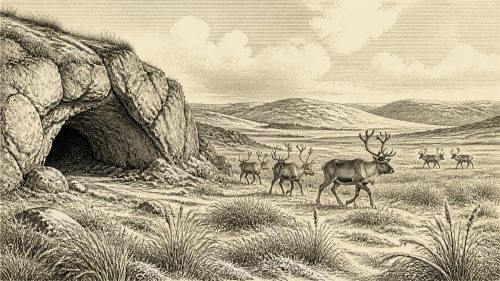
Castlepook’s Lone Incision
31,830 BCE is a modern label for a climatically unstable phase of MIS 3, not a recoverable Irish calendar year. Ireland was cold, largely treeless and open, with changing ice, lowered seas and uncertain access from Britain. Castlepook Cave in County Cork preserves fauna including reindeer, mammoth, giant deer, hyaena, wolves and lemmings, evidencing a wider north-west European cold-stage ecosystem. Cave deposits are complex and bones may reflect predators, water or natural deaths. A deeply incised reindeer femur, reportedly about 33,000 years old, may record stone-tool butchery, but cannot prove settlement. Expanding ice later erased evidence and profoundly transformed Ireland.
View Record
Derryvree’s Tundra Silt
31,831 BCE is a modern label, not a recoverable Irish historical year, and evidence belongs broadly to climatically unstable Marine Isotope Stage 3. At Derryvree, Fermanagh, freshwater silts dated to 30,500 radiocarbon years BP, between glacial tills, preserve signs of cold, open, waterlogged tundra rather than woodland. Cave assemblages show that reindeer, giant deer, horse, mammoth, predators and other mammals occupied Ireland during parts of MIS 3. A marked Castlepook reindeer femur may indicate butchery by humans around 33,000 years ago, but remains unconfirmed. Ice advances, changing coastlines and poor preservation limit secure conclusions about settlement, society, movement and subsistence.
View Record