Castlepook’s Uncertain Hunters31410 BCE
31,410 BCE is a modern label for a broad, uncertain interval in Ireland’s Late Glacial history, not a recoverable annual event. Derryvree, County Fermanagh, preserves freshwater sediments between tills, showing locally ice-free, treeless tundra wetlands with arctic-alpine flora during Marine Isotope Stage 3. Castlepook Cave, County Cork, contains a disturbed but significant fauna including reindeer, mammoth, giant deer, carnivores and lemmings, indicating cold open habitats. A marked reindeer femur may record butchery by people around 33,000 years ago, but cannot prove permanent occupation. As ice-sheet expansion approached, evidence portrays diversity, fragmentary records and possible transient hunters, not settlements or polities.
Dateline
31,410 BCE is a modern chronological label, not a year that can be recovered from Ireland’s archaeological record. No one on the island kept a calendar, named a ruler, built a datable monument or left writing at this depth of time. In the radiocarbon convention, the label corresponds approximately to 33,360 years before AD 1950, during the later part of Marine Isotope Stage 3: a fluctuating cold phase within the Last Glacial Period, before the fullest expansion of the last British–Irish Ice Sheet. The responsible question is therefore not what happened in one notional year, but what the fragmentary environmental and faunal evidence can say about Ireland in the broad interval around it.
A Date Beyond Annual History
Even the best available dates have wide margins. Radiocarbon measures changing atmospheric carbon rather than a calendar directly, and results older than 30,000 years require calibration against independently constructed curves. The important Fermanagh evidence from Derryvree near Maguiresbridge produced the conventional radiocarbon determination BIRM-166, 30,500 +1,170/−1,030 radiocarbon years BP. Calibration places the deposit only within a broad range, often expressed as roughly 36,900–31,700 calibrated years BP, or about 34,950–29,750 BCE. The date under consideration falls within that broad span, but cannot be assigned to an individual layer, season or event.
This uncertainty is not a defect to be concealed; it is central to the history. Deposits may preserve a sequence of deposition over centuries or millennia, while bones recovered from old cave excavations may have been moved by water, carnivores or excavators. Dates establish the likely age of a specimen or sediment, not the precise moment that every animal lived, died or entered a cave. Around 31,410 BCE, Ireland can be described as a cold, environmentally varied north-western peninsula or island landscape with intermittent access for animals and perhaps people. It cannot responsibly be furnished with a settled population, a tribe, a chiefdom or a fixed political map.
Freshwater Beneath a Drumlin
Derryvree is among the most revealing Irish records for this stretch of the Ice Age. Roadworks in 1969 exposed a drumlin containing freshwater silts and fine sands sandwiched between two distinct layers of till, the unsorted debris deposited by glacial ice. The order is clear: an earlier ice advance had laid down the lower till; a non-glacial phase allowed water and organic sediments to accumulate; and later ice buried the deposit beneath a fresh till sheet. That sequence demonstrates local ice-free conditions in the Fermanagh locality during the time represented by the middle beds, though it does not make the whole island ice-free at every moment.
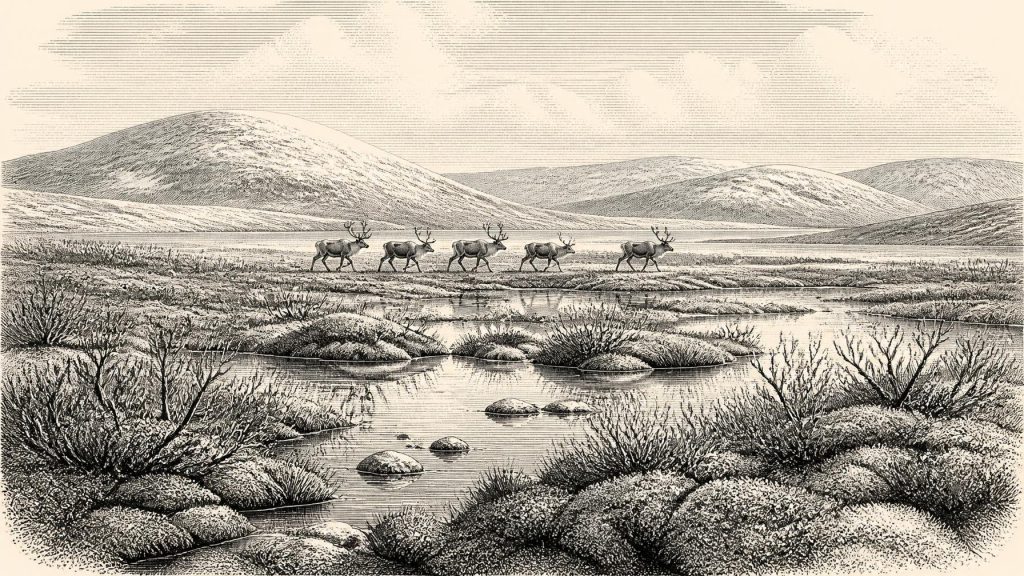
The Derryvree flora and fauna indicate open tundra and periglacial conditions. Mosses, sedges, arctic-alpine plants and aquatic species record damp ground and standing or slow-moving freshwater within a generally treeless landscape. They offer a corrective to the simple image of an entirely lifeless frozen Ireland. There were wet hollows, pools and shallow watercourses capable of sustaining specialised plants and invertebrates, but they existed amid cold conditions, seasonal freezing and exposed terrain. This was not the familiar green, wooded Ireland of later prehistory, nor necessarily a continuous grassland extending unchanged across the island.
Before the Great Expansion
The climate was heading towards a far more severe glacial phase. Modern reconstructions show that the British–Irish Ice Sheet expanded rapidly after about 31,000 calibrated years BP, while its maximum extent varied between regions and was reached later, broadly around 27,000–23,000 calibrated years BP. In BCE terms that major expansion belongs principally to the mid-to-late 20,000s BCE, after this article’s notional date. The distinction matters. At approximately 33,360 cal BP, the evidence does not support imagining Ireland already sealed beneath the maximum ice cover that later reshaped its surface.
Regional differences were probably substantial. Upland snowfields and small ice masses could coexist with exposed lowlands, and conditions shifted as temperature, precipitation, sea level and ice margins changed. Glaciers would later scour away or bury much of the evidence for earlier terrain and activity. The survival of Derryvree’s organic beds between tills is therefore exceptional. Its buried wetland is less a complete portrait of Ireland than a narrow, fortunate window into habitats usually erased by ice.
Castlepook’s Animal World
In north County Cork, Castlepook Cave near Doneraile is the principal Irish cave archive for animals living before the Last Glacial Maximum. Its Pleistocene assemblage includes reindeer, woolly mammoth, giant deer, brown bear, wolf, fox, mountain hare, lemmings and spotted hyaena. Not all remains belong to one date or one undisturbed deposit; the cave was excavated in the early twentieth century, and water disturbance and later contamination complicate its stratigraphy. Yet modern radiocarbon reassessment has confirmed that parts of the fauna belong to Marine Isotope Stage 3, establishing that a far richer cold-stage mammal community reached Ireland than its later historic fauna would suggest.
These animals do not prove that every species shared one valley at exactly 31,410 BCE. They do, however, make an open, cold-adapted mosaic entirely credible for southern Ireland during the relevant broad period. Reindeer and lemmings point towards cool, open habitats; mammoths and giant deer indicate that substantial grazing and browsing animals could enter and survive in the wider region; carnivores show that carcasses, prey and sheltered dens formed part of the ecological system. Caves were not neutral snapshots of a living landscape. Hyenas, wolves, water and gravity could all concentrate bones there, so their contents must be read as accumulated evidence rather than as a census.
The Reindeer Femur Question
Castlepook has also become central to the question of human presence. A reindeer femur from the cave, examined afresh in the twenty-first century, has been dated to around 33,000 years ago and bears a deep surface mark interpreted by zoologist Ruth Carden as a cut or chop made with a sharp stone tool during butchery. If that interpretation is upheld, it is potentially the earliest evidence for people in Ireland, tens of millennia before the well-established Mesolithic settlement of the early Holocene.
The finding is important precisely because it remains limited. No securely associated Palaeolithic stone-tool assemblage, hearth, dwelling floor, burial or settlement has yet been identified in Ireland for this period. The dated femur is evidence for the age of the animal; the identification of the mark as human-made is a separate taphonomic judgement. Nor would one butchered bone demonstrate a permanent population. The most cautious conclusion is that short-lived visits by mobile hunter-gatherers are possible, perhaps even likely if the mark is confirmed, but unproven as an enduring occupation of the island.
People Without Polities
There is no evidence from Ireland around this time for political institutions, diplomacy, warfare, formal religion, language, art, trade networks or organised learning. These absences should not be turned into claims that people, if present, lacked social complexity. They instead reflect the extraordinary thinness of the record. A small travelling party could leave little beyond worked stone, broken bone and a fire trace, all vulnerable to later erosion, glaciation and cave disturbance. At present, even those traces are absent or contested for this early phase.
Likewise, it would be wrong to invent settlements of hide tents beside Castlepook or seasonal camps at Derryvree. Continental north-west Europe certainly contained Upper Palaeolithic hunter-gatherers with sophisticated technologies and social worlds, but direct relevance is not direct proof. Ireland’s evidence can support discussion of a landscape potentially visited by people following animal movements or exploiting carcasses; it cannot identify their route, cultural affiliation, family life, beliefs or relations with other groups. The sea and land connections of the wider region were changing with lowered sea levels, but no excavated Irish site yet documents a crossing or a migration at this date.
Economy as Ecology
For the non-human inhabitants, survival depended on the seasonal distribution of forage, water, shelter and prey. The economy visible in the evidence is therefore ecological rather than human: wetland plants rooted in Fermanagh sediments; herbivores moving through open country; predators and scavengers making use of animal remains; caves acting intermittently as shelters, dens and traps for sediment. If people did enter Ireland, large herbivores such as reindeer would have been a plausible resource, but the Castlepook femur alone cannot reveal hunting methods, food-sharing, clothing production or exchange.
The most significant development around this point in deep Irish history was not a recorded event but a precarious conjunction. Local ice-free freshwater habitats survived in parts of the island; a diverse Pleistocene fauna was present in or reached southern Ireland; and the climate system was moving towards the large-scale glaciation that would transform or destroy many such landscapes. Derryvree and Castlepook preserve different sides of that world: one a wetland sealed between ice advances, the other a cave archive of animals and a tantalising, unresolved possible human intervention. Together they give Ireland at 31,410 BCE a history of evidence, uncertainty and approaching ice—not a history of named actors or annual events.
Primary Sources
- A Middle Midlandian Freshwater Series at Derryvree, Maguiresbridge, County Fermanagh, Northern Ireland
- A Reconsideration of the Radiocarbon Dating of the Marine Isotope Stage 3 Fauna from Southern Ireland
- The Irish Quaternary Fauna Project
- Growth and Retreat of the Last British–Irish Ice Sheet, 31,000 to 15,000 Years Ago: the BRITICE-CHRONO Reconstruction
- The Timing and Magnitude of the British–Irish Ice Sheet Between Marine Isotope Stages 5d and 2: Implications for Glacio-Isostatic Adjustment, High Relative Sea Levels and ‘Giant Erratic’ Emplacement
- Timing and Pace of Ice-Sheet Withdrawal Across the Marine–Terrestrial Transition West of Ireland During the Last Glaciation
- The Deglaciation of the Western Sector of the Irish Ice Sheet from the Inner Continental Shelf to its Terrestrial Margin
- Dimensions and Chronology of the Last Ice Sheet in Western Ireland
- Late Pleistocene Chronostratigraphy and Ice Sheet Limits, Southern Ireland
- New Insights on the Fauna of Ireland’s Younger Dryas and Early Holocene from Alice & Gwendoline Cave
- The IntCal20 Northern Hemisphere Radiocarbon Age Calibration Curve (0–55 cal kBP)
- On the Cave of Castlepook, Near Doneraile, Co. Cork
- Castlepook Cave: County Geological Site Report
- 2022:564 — Castlepook Cave, Castlepook South, Cork
- Heritage Artefacts of County Cork
- Mammoth Cave (Castlepook Cave)
- Occurrence of Mammalia Relicts at Site Castlepook Cave
- The Quaternary of the Irish Midlands
- Ireland’s Palaeolithic Archaeology – Fleeting Footprints in a Frozen Land
- Reindeer Bone Found in Cork Cave Shows Human Activity in Ireland 33,000 Years Ago
- A Middle Midlandian Freshwater Series at Derryvree, Maguiresbridge, County Fermanagh, Northern Ireland
- The BRITICE-CHRONO Reconstruction
- The Deglaciation of the Western Sector of the Irish Ice Sheet from the Inner Continental Shelf to its Terrestrial Margin