Hyaena Hall’s Reindeer World31406 BCE
31,406 BCE is a modern label within Marine Isotope Stage 3, not a precisely recoverable Irish year. Derryvree, County Fermanagh, preserves pre-glacial wetland sediments indicating open, treeless, tundra-like ground with grasses, sedges, mosses, herbs and freshwater habitats. Castlepook Cave, County Cork, contains mixed, long-accumulated faunal remains, including reindeer, mammoth, giant deer, hyaena, wolves, foxes and lemmings, evidencing cold open landscapes. A marked reindeer femur may indicate Upper Palaeolithic butchery, but cannot establish settlement or continuous occupation. No tools, hearths, burials or social institutions are securely known. Later glaciation and mixed deposits limit certainty, revealing active ecosystems rather than historical society.
Dateline
The label 31,406 BCE is a modern chronological convenience, not a recoverable year in Ireland’s deep past. No one in Pleistocene Ireland kept a calendar, and no excavation can identify an event within this single year. In calibrated terms, it corresponds roughly to 33,355 years before 1950. The nearest informative Irish environmental sequence, at Derryvree near Maguiresbridge in County Fermanagh, has been associated with a conventional radiocarbon determination of about 30,500 ± 1,100 radiocarbon years BP. Calibrated estimates place that deposit broadly around 36,900–31,700 cal BP, or approximately 34,950–29,750 BCE. This wide interval includes the nominal year, but it does not prove that every condition recorded at Derryvree existed everywhere in Ireland at precisely that moment.
What can responsibly be said is that Ireland lay within the later part of Marine Isotope Stage 3, a fluctuating cold phase of the last glacial cycle. The Last Glacial Maximum, when the British–Irish Ice Sheet attained its greatest late-Pleistocene expansion, was still to come. Ireland was neither a timeless white wilderness nor a settled country awaiting written history. It was a geographically changing north-western peninsula or near-peninsula of Europe, with ice margins, low sea levels and coastlines unlike those of today. Its habitats altered with climate, ice and drainage; its surviving record is fragmentary because later glaciation eroded, buried and rearranged much of the earlier landscape.
A Cold-Stage Wetland at Derryvree
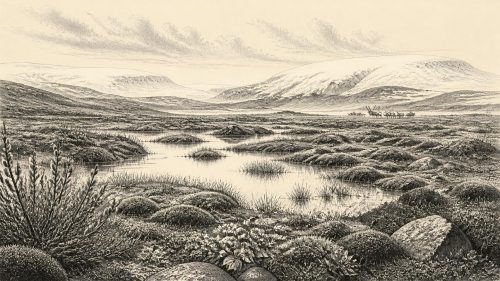
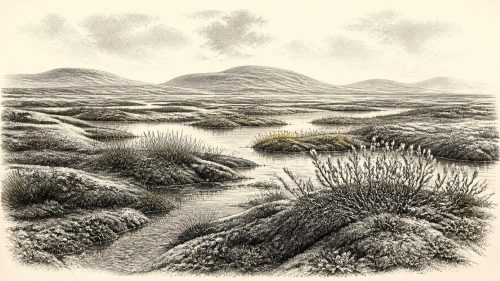
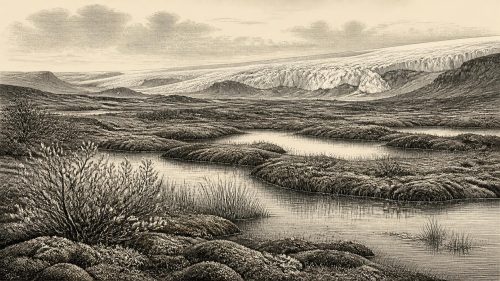
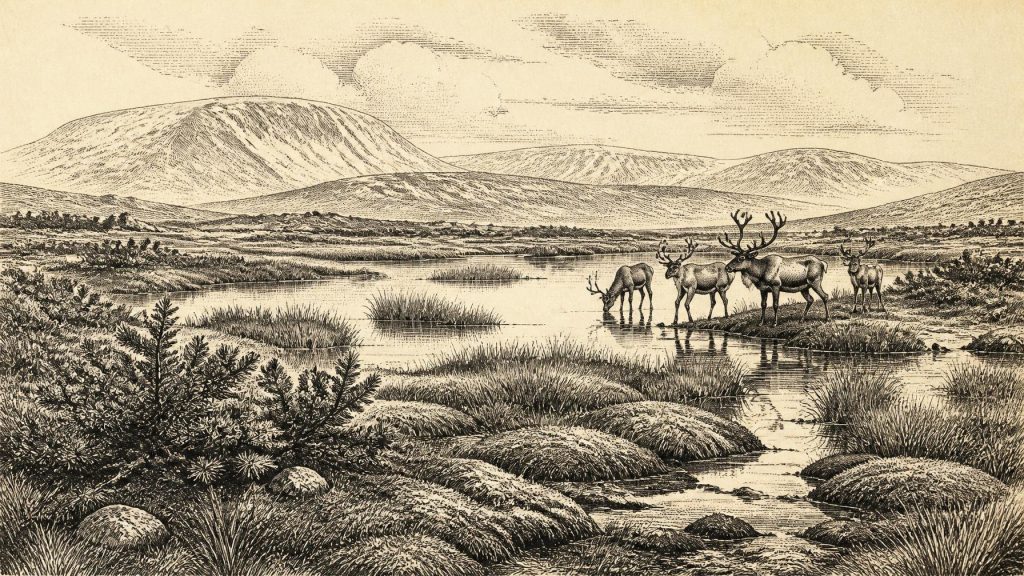
Derryvree is especially important because organic sediments were sealed beneath a drumlin by later glacial deposits. Such a position makes the site an unusually valuable witness to an earlier interval: a body of freshwater and waterlogged ground existed before ice again crossed the district. Plant remains, pollen, mosses and insect evidence point not to woodland but to an open, treeless and periglacial environment. Grasses, sedges, juniper and herbs are recorded, alongside plants associated with cold, wet ground, including mountain clubmoss and bogbean. The evidence has often been described as tundra or tundra-like muskeg: uneven, saturated ground with pools, mosses, sedges and sparse low vegetation.
That reconstruction is evidence-led, but its limits matter. A pollen grain can travel far; a seed or moss fragment represents a particular microhabitat; insects reveal local conditions more closely but not an entire island. Derryvree therefore does not give a photograph of all Ireland in 31,406 BCE. It does demonstrate that at least part of what is now Fermanagh supported freshwater, wetland and open-ground communities during a cold interval. The land was capable of sustaining plant growth, small aquatic habitats and animal life between episodes of more extensive glaciation.
Seasonality would have dominated daily ecological rhythms. Winters were severe, summers short and cool by modern Irish standards, and exposed ground was vulnerable to frost action. Yet “cold” should not be mistaken for lifeless. Pools and margins supported aquatic plants; mosses held moisture; sedges and grasses offered grazing; and patches of willow or juniper may have found shelter in favourable places. The resulting landscape was a mosaic, shaped as much by drainage, relief and proximity to ice as by average temperature.
Castlepook and the Animal Record
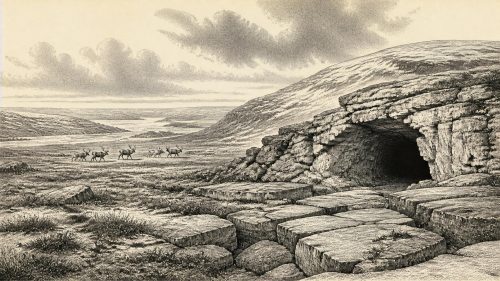
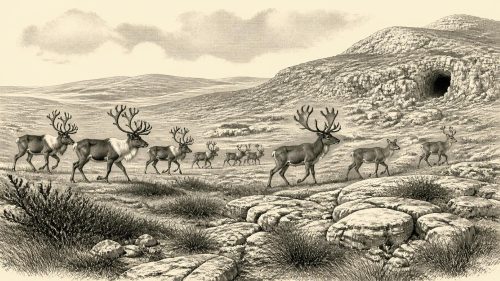
In the south, Castlepook Cave near Doneraile in north County Cork provides the richest Irish archive of pre-Last Glacial Maximum vertebrate remains. The limestone cave system, in the Awbeg valley below the Ballyhoura Hills, was explored in the late nineteenth and early twentieth centuries. Its galleries acquired memorable names, including Hyaena Hall and Elephant Hall. More than two thousand surviving bones and teeth, together with excavation records, make the cave central to any account of Ireland’s Middle and Late Pleistocene fauna.
The important caution is that Castlepook is not a single frozen instant. Its sediments and finds accumulated over a long period, were affected by carnivores and water, and were excavated before modern recovery and recording standards. Later radiocarbon re-dating has shown that several specimens are substantially older than early results suggested. Individual dates and animal remains must therefore be considered specimen by specimen, rather than combined into one imagined herd living on one day.
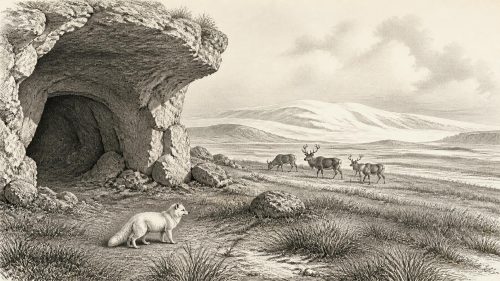
Even so, the broad picture is striking. Castlepook has yielded remains of reindeer, woolly mammoth, giant deer, brown bear, wolf, fox, Arctic fox, mountain hare, collared lemming, Norwegian lemming and spotted hyaena. This fauna supports the interpretation of cold, open country with a varied food web. Reindeer and mammoth imply extensive grazing landscapes; lemmings and Arctic fox point towards severe northern conditions; hyaenas and wolves were competitors and scavengers as well as predators. Caves could serve as dens, traps, shelters or places where bones were carried and accumulated. Hyaena Hall’s name reflects a real palaeontological possibility, not a storybook label.
For the nominal year, the safest conclusion is not that every listed species stood together in the Awbeg valley. Rather, the dated cave fauna and the Derryvree wetland record show that Ireland contained, across this broad climatic phase, habitats suitable for cold-adapted animals and plants. It was an active ecosystem at Europe’s Atlantic edge, not a blank interval between ice advances.
The Reindeer Femur Question
Castlepook also bears on the most difficult historical question: were people in Ireland at this time? A fragment of reindeer femur from the cave has been reported as approximately 33,000 years old and as carrying a deep mark interpreted as having been made on fresh bone by a sharp stone tool. If that assessment is upheld, it would be powerful evidence that one or more Upper Palaeolithic people handled or butchered a reindeer in Ireland broadly near this article’s date.
That is an important possibility, but not a licence to invent a settlement. The date obtained from bone establishes when the animal died within a probability range; it does not identify the exact moment of a surface modification. Identifying a cut or chop mark requires separate taphonomic analysis, since carnivore activity, trampling, breakage, sediment movement and excavation damage can also alter bone. Moreover, a butchered limb would demonstrate an episode of animal processing, not necessarily hunting at the spot, a camp, a resident population, a route regularly used by people, or a family living in the cave.
The distinction is particularly important because Ireland has no securely associated stone-tool assemblage, hearth, dwelling floor, human burial, ornament or art that can be assigned to c. 31,406 BCE. The better-established evidence for Upper Palaeolithic human presence remains much later: cut-marked brown-bear bone from Alice and Gwendoline Cave in County Clare, dated to the opening of the Younger Dryas, about 12,810–12,590 cal BP. Castlepook may push Ireland’s human story much further back, but the reindeer femur should presently be treated as a serious, closely bounded indication rather than proof of continuous occupation.
No Polities, No Proven Diplomacy
There is no evidence for political institutions, leaders, territories, diplomacy or organised warfare in Ireland at this depth of time. It would be misleading to attach later concepts of tribe, nation, kingdom or frontier to a landscape for which even a human presence is uncertain. Nor is there evidence from Ireland for religion, formal learning, artistic traditions or exchange networks around this date. Upper Palaeolithic communities elsewhere in Europe made sophisticated stone tools, garments, ornaments and images, and maintained social connections over long distances. Those comparisons help explain what a visiting foraging group might theoretically have known. They are not evidence that equivalent objects or practices existed in Ireland.
If people did reach the island or its then-connected western approaches, their economy was probably based on highly mobile foraging rather than farming, herding, trade or permanent village life. Reindeer meat, marrow, hides and sinews would have been valuable resources; fire, fitted clothing and co-operation would have been essential in exposed conditions. But these are cautious inferences from wider Upper Palaeolithic lifeways, not discoveries from Castlepook itself. No responsible account can supply names, languages, beliefs or social ranks for them.
An Ireland Before Settlement
The most important development around 31,406 BCE was environmental rather than political: Ireland occupied a precarious interval within a long glacial cycle. At Derryvree, wet tundra-like ground preserves the botanical trace of a cold but living landscape. At Castlepook, cave bones preserve a fauna that included reindeer, mammoth and hyaena. Together they reveal regional diversity: freshwater hollows and mossy sedge ground in Fermanagh; limestone caves and open grazing country in north Cork; ice and changing sea levels framing both.
These archives also explain why certainty is scarce. The later ice sheet destroyed many surface traces, while cave deposits mix events separated by centuries or millennia. The proper history of this year is consequently one of ranges, deposits and probabilities. Ireland was not yet a historical society, and may not have been permanently inhabited at all. Yet it was already a place where cold-stage wetlands nourished plants, large herbivores crossed open ground, carnivores used limestone shelters, and—perhaps—an Upper Palaeolithic visitor cut meat from a reindeer carcass. That limited possibility is historically significant precisely because the evidence remains so slight.
Primary Sources
- A Reconsideration of the Radiocarbon Dating of the Marine Isotope Stage 3 Fauna from Southern Ireland
- Castlepook Cave, County Geological Site Report
- The Exploration of Castlepook Cave, County Cork
- Occurrence of Mammalia Relicts at Site Castlepook Cave
- The Irish Quaternary: A Guide to the Evidence
- Landscapes and Environments of the Last Glacial-Interglacial Transition: A Time of Amazingly Rapid Change in Ireland
- Deglacial Rates and Controls for the Western Margin of the British-Irish Ice Sheet
- The Timing and Magnitude of the British–Irish Ice Sheet Between Marine Isotope Stages 5d and 2
- Pattern, Style and Timing of British–Irish Ice Sheet Advance and Retreat Over the Last 45,000 Years
- Advance and Retreat of the Marine-Terminating Irish Sea Ice Stream into the Celtic Sea During the Last Glacial
- Magnetic Signature of European Margin Sediments: Provenance of Ice-Rafted Debris and the Climatic Response of the British Ice Sheet During Marine Isotope Stages 2 and 3
- First Evidence of a Late Upper Palaeolithic Human Presence in Ireland
- New Insights on the Fauna of Ireland’s Younger Dryas and Early Holocene from Alice & Gwendoline Cave
- The IntCal20 Northern Hemisphere Radiocarbon Age Calibration Curve (0–55 cal kBP)
- Radiocarbon Calibration
- Early Midlandian–Middle Midlandian, Pleistocene, Northern Ireland
- Selaginella selaginoides
- Castlepook Cave, Co. Cork, 2022
- Heritage Artefacts of County Cork
- County Cork Heritage Grant Scheme 2023